
Neighbor Relations: Harm Between Neighbors and How to Resolve It
Based on 73 consultation cases · Updated · Translated from the Korean original.
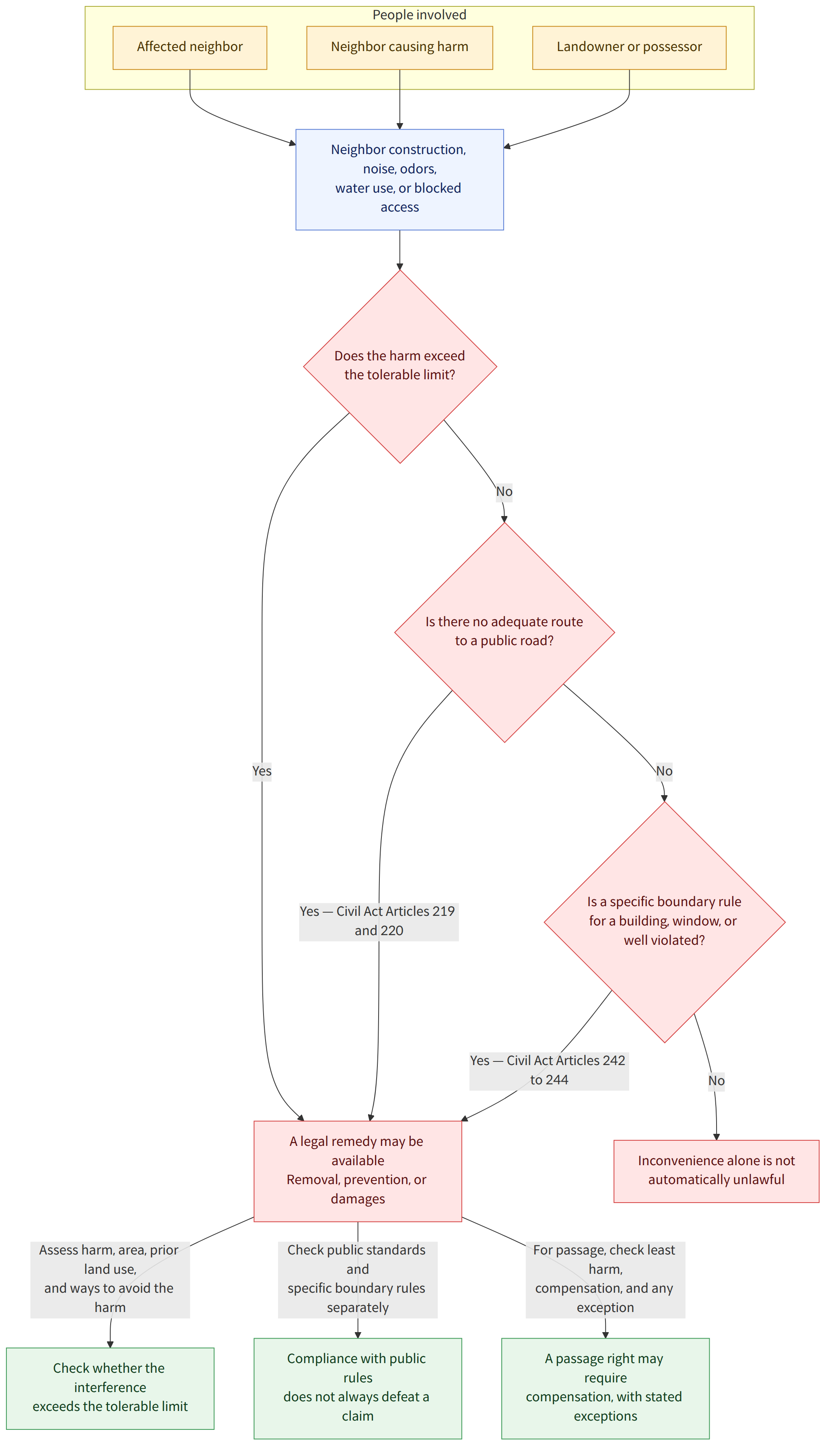
Even when harm results from a neighbor’s construction, noise or odors, use of water, or passage across land, not every inconvenience is automatically unlawful. Whether the harm exceeds the tolerable limit is determined by examining the specific circumstances, including the extent of the harm and the relationship between the uses of the land. Depending on the circumstances, you may seek removal or prevention of the interference, or claim damages.
At a glance
Key points
- Whether interference with an interest in daily life, such as access to sunlight or a view, noise, or odors, exceeds the tolerable limit is determined by considering the extent of the harm, the characteristics of the area, the order in which the land uses arose, and the possibility of avoiding the harm, among other factors (Cases 1, 3, 4, 16, and 17).
- The fact that a person complied with public-law standards, such as those in the Building Act, does not always justify harm under private law (Cases 1, 3, and 17).
- A landowner may seek removal or prevention of interference with ownership, and in certain circumstances a possessor may also seek removal of interference with possession (Civil Act, Articles 214 and 205 (민법 제214조, 제205조); Cases 2, 4, and 12).
- A right of passage over surrounding land may be recognized if there is no route needed to access a public road or an existing route does not function adequately. Normally, the location and manner of passage that cause the least damage must be selected, and the owner of the land crossed must be compensated. However, compensation may not be required for a right of passage arising from a division of land or transfer of part of it (Civil Act, Articles 219 and 220 (민법 제219조·제220조); Cases 6, 15, and 22).
- Separate requirements, such as setback distances or privacy screens, may apply to buildings, windows, and wells near a boundary. You should therefore distinguish between whether a setback requirement has been violated and what remedies are available for the harm (Civil Act, Articles 242, 243, and 244 (민법 제242조·제243조·제244조); Cases 3, 23, and 24).
- A unit owner may take preservation measures concerning a common area of a condominium building. Responsibility for managing and repairing a common area may depend on whether the relevant area is a private or common area (Act on the Ownership and Management of Condominium Buildings, Articles 16 and 17 (집합건물의 소유 및 관리에 관한 법률 제16조·제17조); Cases 2 and 13).
- If noise or vibration from a business premises or similar source causes harm, the precedents cited in the cases hold that the person responsible may be liable for compensation even without fault (Framework Act on Environmental Policy, Article 44(1) (환경정책기본법 제44조 제1항); Case 25).
Frequently asked questions
Q. Can I demand that a neighboring building be demolished or claim damages if it blocks sunlight?
If interference with sunlight exceeds the socially tolerable limit, you may seek an order prohibiting or suspending construction, or claim damages. Whether the limit has been exceeded is determined by considering the extent of the harm, the characteristics of the area, the use of the buildings, which use of the land came first, and the possibility of reducing the harm, among other factors. A claim is not necessarily dismissed merely because the relevant laws and regulations were followed.
Q. Can I directly ask a neighboring factory to reduce its noise or odors?
If harm to the enjoyment of daily life caused by noise or odors exceeds the tolerable limit, an owner or possessor may seek the removal or prevention of the interference. According to the precedent cited in the case, compensation may be awarded for environmental pollution damage caused by a business premises or similar source even if the person responsible was not at fault.
Q. Can I demand demolition if my neighbor builds a building right next to the boundary?
Unless a special custom applies, a building must be set back at least half a meter from the boundary. If this requirement is violated, you may demand that the building be altered or demolished. However, under Article 242 of the Civil Act (민법 제242조), once a year has passed since construction began or the building has been completed, you may claim only damages. You should therefore check when construction began and the building’s current status.
Q. Can I use my neighbor’s land to reach a property that has no access route?
A right of passage over surrounding land may be recognized if there is no necessary access route or an existing route is not adequate for actual use. The location and manner of passage must be chosen to cause the least damage to the neighboring land, and the general right of passage over surrounding land requires compensation for the loss suffered by the owner of the land crossed.
Q. Do I have to pay a passage fee if a road becomes blocked after I buy part of a property?
If a division of land or transfer of part of it has left the land without access to a public road, a gratuitous right of passage over surrounding land may be recognized over the land of the person who divided it or the other party to the partial transfer. However, this right applies between the person who divided the land and the parties to the partial transfer, and its scope is determined by considering both the passage needed and the loss to the other party.
Q. Can I demand a privacy screen if a window in my neighbor’s house looks into my home?
If a window or veranda is installed within two meters of the boundary and allows a view into the interior of a neighboring home, an appropriate privacy screen must be installed. If these requirements apply, you may ask the building owner to install one. You may also consider claiming damages if the owner fails to comply with this obligation.
Q. Who should I ask to make repairs if there is a leak from the apartment above mine?
The person responsible for repairs and the party who bears the cost may differ depending on whether the leak originates in the upstairs unit’s private area or a common area. First, determine which area the pipe belongs to. If the requested repairs are not carried out, you may consider seeking removal of the interference or asking a court to order performance.
Q. Can one unit owner take action if a neighbor exclusively uses a common hallway or machine room?
If a third party unlawfully occupies a common area of a condominium building, an individual unit owner may, based on their co-ownership interest, seek removal of the interference or removal of the facilities, either alone or together with other unit owners. The owners’ association may also take related action, subject to requirements such as appointing a manager.
Relevant laws
- Constitution of the Republic of Korea, Article 35(1) (헌법 제35조 제1항)
- Framework Act on Environmental Policy, Articles 6(1) and 44(1) (환경정책기본법 제6조 제1항, 제44조 제1항)
- Former Framework Act on Environmental Policy, Article 31(1) (구 환경정책기본법 제31조 제1항)
- Civil Act, Articles 205(1) and (2), 214, 217, 219, and 221(1) (민법 제205조 제1항·제2항, 제214조, 제217조, 제219조, 제221조 제1항)
- Civil Act, Articles 231 through 234 and 236 through 239 (민법 제231조부터 제234조까지, 제236조부터 제239조까지)
- Civil Act, Articles 241 through 244, 263, 389, and 750 (민법 제241조부터 제244조까지, 제263조, 제389조, 제750조)
- Act on the Ownership and Management of Condominium Buildings, Articles 2(6), 16, and 17 (집합건물의 소유 및 관리에 관한 법률 제2조 제6호, 제16조, 제17조)
- Civil Execution Act, Article 261(1) (민사집행법 제261조 제1항)
- Building Act, Article 59(1) (건축법 제59조 제1항)
- Enforcement Decree of the Building Act, Articles 55 and 81(1) and (3) (건축법 시행령 제55조, 제81조 제1항·제3항)
- National Health Promotion Act, Articles 9(5) and (7) and 34 (국민건강증진법 제9조 제5항·제7항, 제34조)
- Enforcement Rule of the National Health Promotion Act, Article 6-2 (국민건강증진법 시행규칙 제6조의2)
- Apartment Housing Management Act, Article 18 (공동주택관리법 제18조)
- Groundwater Act, Articles 7(1) and (3)(1) and 10(1)(2) (지하수법 제7조 제1항·제3항 제1호, 제10조 제1항 제2호)
- River Act, Article 50(1) (하천법 제50조 제1항)
Watch out for
- The tolerable limit is not determined merely by the fact that harm has occurred. The specific circumstances, including the extent of the interference and the characteristics of the area, must also be considered.
- A claim to alter or demolish a building because it violates the boundary setback requirement may be restricted once a year has passed since construction began or the building has been completed.
- A general right of passage over surrounding land requires compensation for the loss suffered by the owner of the land crossed. However, a gratuitous right of passage arising from a division of land or transfer of part of it has different requirements and applies to a different set of parties.
- Whether a provisional injunction suspending construction is granted may depend on the stage of construction and the possibility of further harm. It may not be granted if excavation work has already been completed.
Source cases
This guide was compiled by AI from the following Korea Legal Aid Corporation consultation cases (in Korean).
- 이웃건물 등의 일조권 침해에 대한 서로 참아야 할 한도와 구제방법
- 아파트 위층에서 물이 새는 경우 보수청구 등 구제방법
- 이웃에서 법정거리 없이 건물을 신축한 경우 철거청구 가능한지
- 인근 공장의 소음으로 인한 점유자의 피해구제방법
- 일조권침해로 인한 손해배상청구의 경우 그 손해배상의 범위
- 토지매수인이 기존의 유일한 통로를 폐쇄할 경우 주위토지통행권
- 새로운 보(洑) 설치로 기존 공유하천용수권을 침해한 경우 구제방법
- 인근지역의 지하수 개발로 인한 기존 지하수의 피해 구제방법
- 아파트 차량출입통제, 단지상가건물 구분소유자권리를 침해하는지
- 건축법상 방화벽 축조 규정과 민법상 이격거리제한 규정의 관계
- 아파트 공용구역에서의 흡연을 금지시킬 수 있는지
- 고층건물건축을 위한 굴착공사로 인접건물의 균열 등 위험 구제방법
- 집합건물공용부분을 제3자가 불법 점유하는 경우 방해배제청구권자
- 아파트 내에서 대형견 사육을 금지할 수 있는지
- 주위토지통행권 때문에 통로를 내준 경우 보상은 받을 수 있는지
- 조망권이 법적 보호 대상인지
- 이웃에서 나는 악취 및 소음으로 인한 피해의 구제방법
- 저지소유자의 제방설치로 인해 우수(雨水)배수 장애우려가 있는 경우 피해의 구제방법
- 공동으로 쓰는 담의 보수비용을 누가 부담하여야 하는지
- 수인한도를 넘는 해수용수권 침해에 대한 피해의 구제
- 기존건물에 의해 일조방해를 받던 중 신축건물과 결합하여 수인한도를 넘는 일조침해가 발생한 경우 손해액의 산정방법
- 토지의 일부를 양도받은 매수인의 무상 주위토지통행권
- 인접토지의 우물 중 일부만이 2미터 내에 설치된 경우 피해의 구제
- 이웃한 신축 빌라의 창문으로 거실이 훤히 보이는 경우의 대처방법
- 사업장 등에서 발생하는 소음·진동으로 피해가 발생한 경우, 사업자나 원인자가 귀책사유가 없더라도 피해를 배상하여야 하는지 여부...
This guide is general legal information about Korean law, not legal advice for your situation. For a specific case, consult a lawyer or the Korea Legal Aid Corporation (call 132 in Korea).