
Key Principles and Precautions Regarding Other Claims
Based on 9 consultation cases · Updated · Translated from the Korean original.
For other claims, the terms of the contract and the nature of the obligation determine matters such as interest on restitution, damages for delay, several liability, and impossibility of performance. Circumstances affecting the exercise of rights—such as a creditor's delay in accepting performance, failure to file a claim, or a report of loss concerning an instrument—must also be considered.
At a glance
Key points
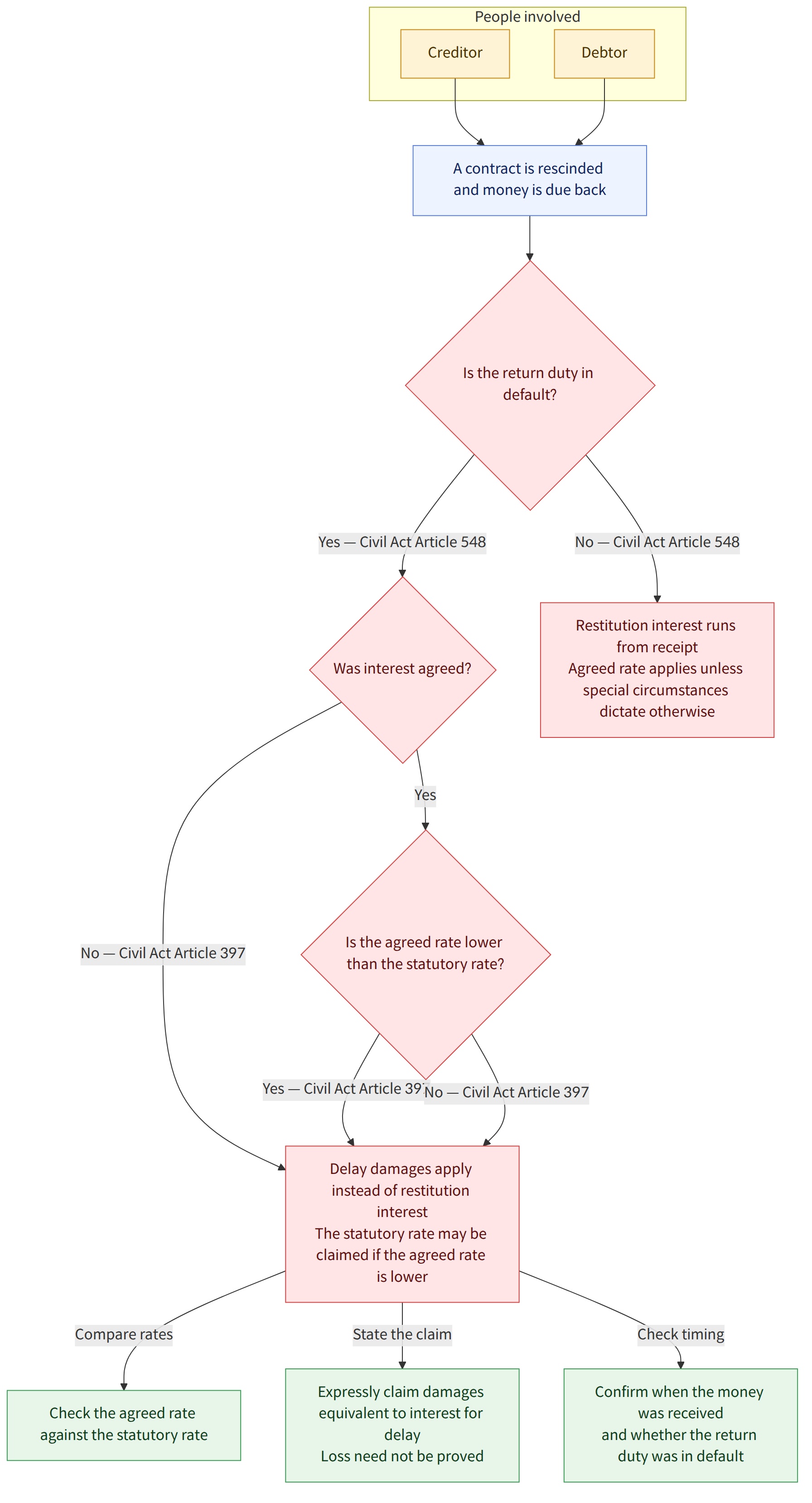
- Interest on money returned following rescission of a contract forms part of restitution. If the parties agreed on interest, the agreed rate applies unless special circumstances dictate otherwise (Civil Act, Article 548 (민법 제548조), Case 1).
- Once the duty to return is in default, damages for delay arise rather than interest as part of restitution. Even if the parties agreed on an interest rate, damages for delay at the statutory rate may be claimed if the agreed rate is lower (Case 1).
- If property is damaged or destroyed while the creditor is in delay in accepting it, the debtor may not be liable for damages resulting from nonperformance if the debtor acted without intent or gross negligence (Civil Act, Article 401 (민법 제401조), Case 2).
- When claiming damages equivalent to interest for delay due to nonperformance of a monetary obligation, the loss need not be proved, but the claim must state that such damages are being sought (Civil Act, Article 397 (민법 제397조), Case 3).
- Even if multiple debtors are involved in a transaction, the general rule is that each bears a divisible obligation corresponding to that person's share, unless there is a special agreement or the nature of the obligation dictates otherwise (Civil Act, Article 408 (민법 제408조), Case 4).
- If the parties agree to transfer a certain area of land but do not specify its location, the right may be treated as an alternative claim under which the location of the land to be transferred is selected and determined (Civil Act, Article 380 (민법 제380조), Case 6).
- If the shares to be returned are subject to a generic obligation, the fact that the holder sold the shares to a third party does not, by itself, make the obligation to return them impossible to perform (Civil Act, Article 375 (민법 제375조), Case 7).
- A claim forfeited because it was not filed during reorganization proceedings may remain a natural obligation, but that claim alone does not entitle the claimant to require consent to payment of the lost-instrument security deposit (Former Company Reorganization Act, Article 241 (구 회사정리법 제241조), Case 8).
Frequently asked questions
Q. If a contract is rescinded, what interest rate applies to the money to be returned?
Money to be returned as restitution following rescission bears interest from the date it was received. If the parties agreed on interest, the agreed rate applies unless special circumstances dictate otherwise. Once the duty to return is in default, damages for delay become relevant. If the agreed rate is lower than the statutory rate, damages for delay at the statutory rate may be claimed.
Q. If property is damaged after someone refuses a request to collect it, can damages be claimed from the custodian?
If the property is damaged or destroyed after the creditor delays accepting it, the custodian may not be liable for damages if the custodian acted without intent or gross negligence. Whether the creditor was in delay in accepting the property, and whether the custodian acted with intent or gross negligence, depend on the specific circumstances.
Q. When claiming interest for delay on a monetary obligation, must I prove that I actually suffered a loss?
There is no need to prove loss equivalent to interest for delay resulting from nonperformance of a monetary obligation. However, a court will not necessarily recognize such loss on its own if no assertion at all has been made that the loss occurred. Accordingly, the claim should state that damages equivalent to interest for delay are being sought.
Q. If several people jointly discounted a promissory note, must they all repay the full amount?
Unless there is a specific indication of intent or circumstances that make the obligation indivisible or joint and several by its nature, the general rule is that each person bears only the portion of the obligation corresponding to that person's share, as a divisible obligation. The fact that a single promissory note was jointly issued or used in a transaction does not, by itself, establish that all parties are liable for the entire amount.
Q. When receiving a pledge over a negotiable certificate of deposit, must I verify it with the issuer?
If there are no special circumstances giving rise to doubt about ownership of or rights to a negotiable certificate of deposit, it is not mandatory to verify those rights with the issuer or a prior holder. However, if such circumstances do exist and the certificate is acquired without a reasonable inquiry, gross negligence may be found.
Q. If an agreement provides for the transfer of a certain area of land but does not specify its location, what right arises?
Unless special circumstances indicate otherwise, the right is treated as one to receive a transfer of a specified area of land at a specified location. If the location has not yet been determined, the right may constitute an alternative claim, under which the land to be transferred is selected and thereby determined.
Q. If a holder sells shares held in trust to a third party, will it become impossible to recover them?
Shares whose individual identity is not important, such as shares of the same class in the same company, may be treated as generic obligations. Therefore, the fact that the holder sold the shares held in the holder's name does not, by itself, make the obligation to return them impossible to perform. What matters is whether there are special circumstances, such as an inability to acquire shares and return them.
Q. If I fail to file a claim for payment under a promissory note during reorganization proceedings, can I claim the lost-instrument security deposit?
According to the case, a claim for payment under a promissory note that was forfeited for failure to file during reorganization may remain a natural obligation against the company in reorganization. However, that fact alone does not establish that the claimant is the rightful holder of the note. Unless there is a separate agreement or the requirements of the applicable rules are met, it is difficult to require the administrator to consent to payment of the lost-instrument security deposit or to seek confirmation of the right to claim that payment.
Q. Must an issuer that receives a report of a lost bearer bond give public notice of it?
Unless a bearer bond is a security eligible for deposit or there is a statutory basis or separate agreement, the issuer has no duty to receive and administer a report of loss or to give public notice of it. However, the result may depend on the issuer's internal rules and the contents of the report if the issuer has adopted such rules and has handled reports of loss accordingly.
Relevant laws
- Civil Act, Article 375 (민법 제375조)
- Civil Act, Article 380 (민법 제380조)
- Civil Act, Article 390 (민법 제390조)
- Civil Act, Article 393 (민법 제393조)
- Civil Act, Article 397 (민법 제397조)
- Civil Act, Article 401 (민법 제401조)
- Civil Act, Article 402 (민법 제402조)
- Civil Act, Article 403 (민법 제403조)
- Civil Act, Article 408 (민법 제408조)
- Civil Act, Article 409 (민법 제409조)
- Civil Act, Article 544 (민법 제544조)
- Civil Act, Article 548 (민법 제548조)
- Former Company Reorganization Act, Article 241 (구 회사정리법 제241조)
Watch out for
- Interest arising from rescission of a contract and damages for delay arising after the duty to return is in default are distinct and should be treated separately.
- To assert that a creditor was in delay in accepting performance, consider the specific circumstances, including how performance was requested or demanded and whether the creditor refused to accept it.
- Whether an obligation is divisible or indivisible, or specific or generic, may depend on the contract's terms and the nature of the obligation.
- Cases concerning the former Company Reorganization Act concern reorganization proceedings to which that Act applied; do not assume that they apply unchanged to current proceedings or other legal relationships.
Source cases
This guide was compiled by AI from the following Korea Legal Aid Corporation consultation cases (in Korean).
- 계약해제 시 반환할 금전에 가산할 이자에 관하여 당사자 사이에 약정이 있는 경우, 이행지체로 인한 지연손해금에 관하여도 그 약...
- 채권자지체 중 물건이 멸실된 경우에도 채무자에게 책임이 있는지
- 금전채무 불이행을 원인으로 한 손해배상청구에 있어 법원이 채권자의 주장도 없이 민법 제397조 소정의 지연이자 상당의 손해를 ...
- 1매의 어음을 각자의 임금액으로 나누어 할인받은 경우 채권관계
- 양도성예금증서를 취득함에 있어 중대한 과실이 있다고 볼 수 있는 경우 및 양도성예금증서의 양수인이 그 발행인이나 전 소지인에게...
- 토지소유자가 1필 또는 수필의 토지 중 일정 면적의 소유권을 상대방에게 양도하기로 하는 계약을 체결하였으나 양도할 토지 위치가...
- 乙 보유 주식이 제3자에게 매도되어 보유하고 있지 않는 경우 乙의 주식반환의무가 이행불능이 되었다고 할 수 있는지 여부
- 정리채권인 약속어음금 채권이 실권되면 그 약속어음금 채권은 자연채무 상태로 남게되는지 여부
- 예탁대상유가증권이 아닌 무기명채권의 발행인이 사고신고를 받은 경우, 이를 접수하여 대외적으로 공시하여야 하는지 여부
This guide is general legal information about Korean law, not legal advice for your situation. For a specific case, consult a lawyer or the Korea Legal Aid Corporation (call 132 in Korea).