
Standards for and Liability in Other Damages Claims
Based on 195 consultation cases · Updated · Translated from the Korean original.
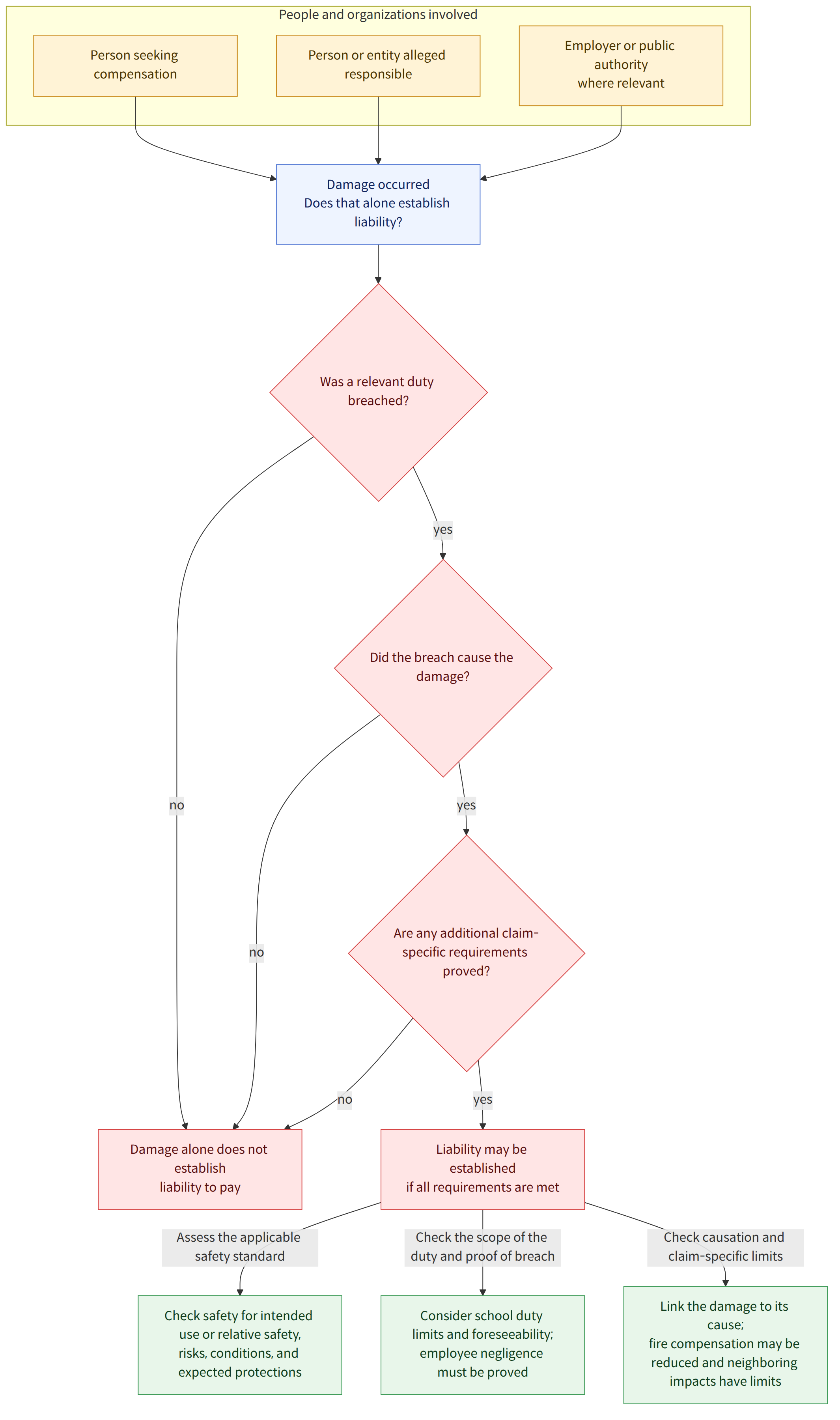
The fact that damage has occurred does not automatically establish the other party’s liability to pay compensation. The cause of the accident, the other party’s breach of duty, and the relationship between that breach and the damage must be examined. The requirements for liability and matters to be proved vary depending on the circumstances, including cases involving structures, roads, schools, and employers.
At a glance
Key points
- A defect in the installation or maintenance of a structure means that it lacks the safety ordinarily required for its intended use. The standard is whether protective measures socially expected in light of the level of risk were taken (Civil Act, Article 758(1) (민법 제758조 제1항); Supreme Court Decision 2009Da101343, April 29, 2010).
- A defect in the management of a road or public facility is assessed by reference not to perfect safety, but to relative safety, assuming that users will use it in a sensible and orderly manner. The type and condition of the road, weather, traffic conditions, and management circumstances are considered together (State Compensation Act, Article 5(1) (국가배상법 제5조 제1항)).
- Even if an employee’s conduct was not part of the work itself, the employer may be held liable if, viewed externally, the conduct was connected with the employer’s business or affairs and was closely related to the work in time and place. However, the connection to the work and the circumstances on the employer’s side must be examined (Civil Act, Article 756(1) (민법 제756조 제1항)).
- A school’s duty to protect and supervise students does not extend to every aspect of their lives; it is limited to educational activities and closely related aspects of their daily lives. Consideration is given to whether the accident could reasonably have been anticipated, as well as the student’s age and capacity for judgment.
- The mere fact that an employee was injured at work does not give rise to the employer’s liability for damages. A breach of the employer’s duty to protect the employee, and negligence, must be established; the employee alleging that negligence must prove it (Supreme Court Decision 99Da60115, March 10, 2000).
- Whether sunlight, views, or privacy have been infringed by a neighboring building cannot be determined solely by whether the construction complied with applicable laws and regulations. Whether the infringement exceeded the limits that must be tolerated is assessed in light of various circumstances, including the extent of the infringement, the character of the area, and the circumstances of the construction (Supreme Court Decision 2000Da72213, December 10, 2002, and others).
- Compensation may be awarded for fire damage that spreads even if the fire was not caused by gross negligence, but the person liable for compensation may ask the court to reduce the amount. Whether to grant a reduction, and to what extent, is determined by considering various circumstances, including the cause of the fire and the extent of the damage (Act on Liability for Fire Caused by Negligence, Articles 2 and 3 (실화책임에 관한 법률 제2조·제3조)).
- In a damages claim, the relationship between the damage and its cause is important in addition to whether the other party meets the requirements for liability. Depending on the circumstances, the method of proof and scope of liability may differ in cases involving products, fires, or facility accidents.
Frequently asked questions
Q. Can I claim compensation from the road authority if an accident is caused by an object lying on the road or by ice?
Whether you can make a claim depends on whether the road had the safety ordinarily required and whether the authority took measures proportionate to the risk. The type and condition of the road, whether the risk could have been anticipated, and the circumstances of its management are considered together. The mere fact that an accident occurred does not establish liability.
Q. If I am injured when a fixture in a building collapses, must the building owner always compensate me?
Not necessarily. The relevant considerations include whether the fixture had the safety required for its intended use, whether the person responsible for its management took the protective measures socially expected, and whether the accident could have been anticipated in the ordinary use of the fixture. Liability may be denied if the accident resulted from unusual conduct.
Q. If an employee assaults a coworker, can I also claim damages from the company?
Even if the assault was not part of the work itself, the company may be held liable as an employer if the act was connected with the performance of work or was so closely related to the company’s business in time and place that it appeared externally to be work-related. The connection between the act and the work must be examined, as must whether the victim knew, or through gross negligence failed to know, that the act fell outside the employee’s authority.
Q. If a student is injured at school, can I seek compensation from the teacher or school?
The school’s duty to protect and supervise students is relevant where the accident could have been anticipated during educational activities or in a closely related aspect of the student’s daily life. Relevant considerations include the student’s age and capacity for judgment, the place and nature of the activity, and the specific risks involved. Depending on the circumstances, the duty may also cover a young student’s journey home.
Q. I was injured at work and received workers’ compensation benefits. Can I also claim additional compensation from my employer?
The fact that you received workers’ compensation benefits does not, by itself, entitle you to claim additional compensation from your employer. The specific circumstances must be examined to determine whether the employer negligently breached its duty to protect you—for example, by failing to take necessary safety measures despite knowing, or being able to know, of the risk.
Q. If I suffered investment losses after entrusting someone with my investments, must the securities firm employee or company compensate me?
The mere fact that you suffered losses does not establish liability for compensation. Relevant considerations include whether, during the investment recommendation process, the employee interfered with your ability to properly understand the risks or recommended risks excessive in light of your circumstances, and whether, in discretionary trading, there was excessive trading that disregarded your interests. The fact that a profit was guaranteed does not, by itself, mean that you are entitled to compensation for the entire loss.
Q. Can I receive compensation if construction of a neighboring building interferes with my view or privacy?
This depends on whether the view is an important living interest deserving legal protection and whether the obstruction of the view or invasion of privacy exceeds what society would consider tolerable. Various circumstances are considered together, including the distance and height of the buildings, the location of windows and living rooms, the conditions in the area, and compliance with public-law regulations.
Q. If a fire accidentally spreads to a neighboring shop, can the amount of damages be reduced?
The Act on Liability for Fire Caused by Negligence may apply to damage resulting from the spread of a fire, and a person who caused the fire without gross negligence may ask the court to reduce the amount of damages. The court considers the cause and scale of the fire, the extent of the damage, efforts to prevent the damage from spreading, and the parties’ financial circumstances, among other factors. A reduction is not automatic.
Relevant laws
- Civil Act, Article 750 (민법 제750조)
- Civil Act, Article 753 (민법 제753조)
- Civil Act, Article 755(1) and (2) (민법 제755조 제1항·제2항)
- Civil Act, Article 756(1) (민법 제756조 제1항)
- Civil Act, Article 758(1) (민법 제758조 제1항)
- Civil Act, Article 760 (민법 제760조)
- Civil Act, Article 765 (민법 제765조)
- Civil Act, Article 680 (민법 제680조)
- Civil Act, Article 681 (민법 제681조)
- Civil Act, Article 391 (민법 제391조)
- State Compensation Act, Article 1 (국가배상법 제1조)
- State Compensation Act, Article 2(1) (국가배상법 제2조 제1항)
- State Compensation Act, Article 5(1) (국가배상법 제5조 제1항)
- Financial Investment Services and Capital Markets Act, Article 55 (자본시장과 금융투자업에 관한 법률 제55조)
- Financial Investment Services and Capital Markets Act, Article 70 (자본시장과 금융투자업에 관한 법률 제70조)
Watch out for
- Whether liability is established cannot be determined solely from the fact that damage occurred. You should secure evidence supporting the cause of the accident, the breach of duty, and the causal connection with the damage.
- If the injured party was also negligent in causing the accident or increasing the damage, that may affect the scope of compensation.
- The requirements and methods of proof differ by type of liability, including liability involving structures, roads, schools, employers, and products. It may therefore be difficult to apply the outcome of a seemingly similar case directly.
- A reduction for fire damage must be requested from the court for consideration, and the amount of damages will not necessarily be reduced.
Related articles
Source cases
This guide was compiled by AI from the following Korea Legal Aid Corporation consultation cases (in Korean).
- 교통사고로 인도에 설치된 전신주가 넘어지면서 화재가 발생한 경우
- 증권사 직원의 투자수익 보장약속과 달리 손해를 본 경우 회사의 책임
- 초등학교 내 집단 따돌림으로 인하여 자살한 경우 학교의 책임
- 신축건물에 의한 일조권, 조망권 침해와 손해배상
- 콘크리트펌프 차량의 정비책임과 손해배상
- 포괄적 일임매매약정에 기한 주식거래가 불법행위가 되는 경우
- 컴퓨터통신 게시물의 삭제에 대한 법적근거 및 판단기준
- 피용자의 폭행행위로 인한 손해에도 민법상 사용자책임이 인정되는지
- 고속도로상 방치된 투하물을 피하려다 난 사고로 차량이 파손된 경우
- 일반 국도상의 적설로 인한 교통사고 발생 시 손해배상청구권
- 도로의 설치·관리상의 하자 유무
- 유치원생이 귀가하던 중 교통사고를 당한 경우 유치원교사 등의 책임
- 물건 운반도중 척추를 다친 피용자의 사용자에 대한 손해배상청구
- 도박중독자가 카지노에서 도박을 하다가 거액을 탕진한 경우 카지노사업자의 도박중독자에 대한 손해배상책임 여부
- 지휘·감독하는 사용자가 다수인 경우 손해배상책임의 부담
- 조망권, 사생활의 비밀 침해로 인한 손해배상 책임이 인정되는지
- 기획여행업자의 보호의무와 손해배상
- 피용자가 사용자 명의로 어음배서를 위조함으로 인하여 손해를 입은 경우 사용자 책임이 인정되는지 여부
- 여관 배수관을 오르던 행인이 그 시설이 무너져 다친 경우 여관주의 책임
- 중학교 학생이 학교에서 불법행위를 한 경우 그에 관하여 손해배상책임이 있는 자들
- 주택소유자의 임차인에 대한 공작물소유자로서의 책임
- 공작물의 설치 또는 보존의 하자에 대한 점유자 및 소유자의 책임
- 임치물에 손해에 대한 공중접객업자의 책임
- 실화로 인한 손해배상책임
- 냉장고 결함에 의해 일어난 화재로 인한 전자제품 제조사의 손해배상 책임
This guide is general legal information about Korean law, not legal advice for your situation. For a specific case, consult a lawyer or the Korea Legal Aid Corporation (call 132 in Korea).