
Guide to Real Right Claims Based on Ownership
Based on 22 consultation cases · Updated · Translated from the Korean original.
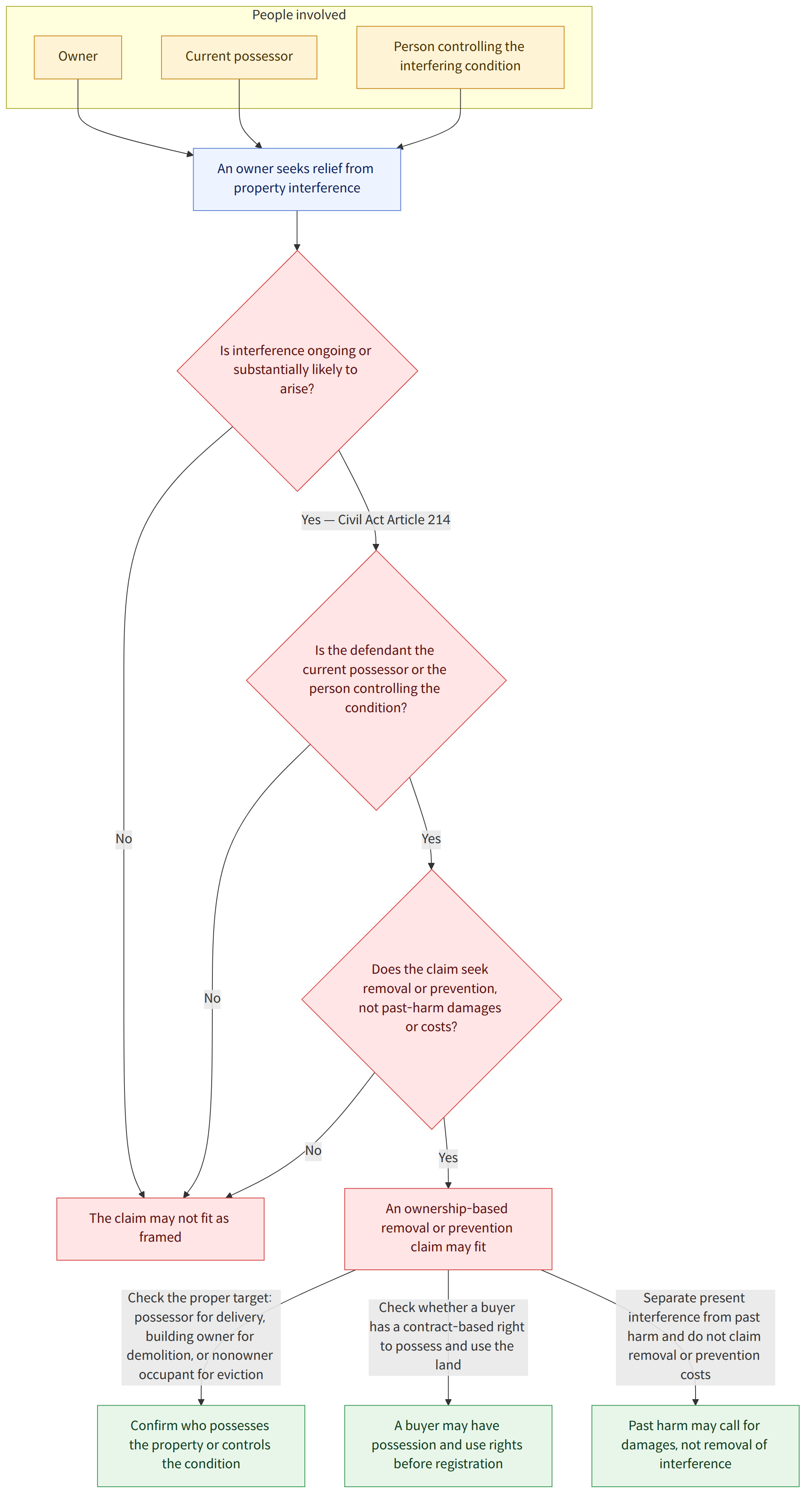
An owner may seek removal of conduct that currently interferes with ownership or, where there is a substantial likelihood that interference will arise, seek to prevent it. Who may be sued and what may be claimed depend on who actually possesses the property, who controls the interfering condition, and whether the claim is intended to compensate for past harm or to remove a present interference.
At a glance
Key points
- A claim for removal of interference seeks to eliminate the source of an ongoing infringement and is distinct from a claim to remove the consequences of an infringement that has already ended or to obtain compensation for them (Case 4, Supreme Court Decision of March 28, 2003, 2003Da5917).
- To establish a likelihood that interference will arise, there must be a substantial likelihood supported by objective grounds, not a vague possibility (Civil Act, Article 214 (민법 제214조), Case 15, Supreme Court Decision of July 14, 1995, 94Da50533).
- A claim for removal or prevention of interference based on ownership cannot be used to recover the costs of removing or preventing the interference (Civil Act, Article 214 (민법 제214조), Case 10, Supreme Court Decision of November 27, 2014, 2014Da52612).
- A claim concerning a building on land may seek demolition from the building owner; if someone other than the owner occupies the building, the claim may seek that occupant’s eviction (Cases 12 and 20).
- One case held that if the occupant of a building is the person obligated to demolish it, the obligation to vacate is included in the obligation to demolish, so a separate judgment ordering eviction is unnecessary (Case 21, Supreme Court Decision of April 28, 2017, 2016Da213916).
- A claim for delivery of a building or land must generally be brought against the person currently possessing it. One case held that if a company employee is merely an assistant in possession, the claim must be brought against the company (Cases 14 and 17).
- A buyer who has received land in performance of a sale contract may have the right to possess and use it under the contract even without completing registration, which may limit the seller’s claim for delivery (Cases 6 and 7).
- One Supreme Court decision held that if ownership is lost and the real right claim can no longer be exercised, damages cannot be claimed on the ground that performance of that claim has become impossible (Case 2, Supreme Court en banc Decision of May 17, 2012, 2010Da28604).
Frequently asked questions
Q. Can I require waste buried on my land to be removed based on my ownership rights?
According to one case, the consequences of past landfilling alone do not amount to a continuing, present interference with ownership, so the owner cannot seek removal of the waste through a claim for removal of interference. The case explains that the matter must instead be addressed through a claim for damages.
Q. If a building tenant has an opposable leasehold right, can they assert a right to occupy the building against the landowner?
One case held that the opposability of a leasehold right in a building concerns the building and does not, by itself, confer a right to use the land. Depending on the circumstances, the landowner may seek to have the building’s occupant vacate the building.
Q. Should I seek to have the owner of an unauthorized building vacate it?
One case held that the proper claim against the owner of a building is for demolition of the building and delivery of the land, not for the owner to vacate the building. A separate claim for eviction may be brought against someone who occupies the building without owning it.
Q. Can I seek demolition from someone who later bought an unregistered building rather than from the person who originally built it?
The person obligated to demolish an unregistered building is not necessarily the person who originally constructed it. The obligation may rest on someone who is legally and factually in a position to dispose of the building; in one case, the court found that a person who had purchased the building was in that position.
Q. If the possessor changes during a lawsuit, against whom should I seek delivery of the property?
One case held that a claim for delivery based on unlawful possession must be brought against the person who actually possesses the property. If the former possessor has transferred possession and no longer possesses the property, the claim must be brought against the current possessor.
Q. Can the seller demand the land back even though the buyer has not registered ownership?
A buyer who has received land in performance of a sale contract may acquire the right to possess and use the land under the contract even before registration. One case explains that, absent grounds such as termination of the contract, the buyer need not comply with the seller’s claim for delivery of the land.
Q. Can I recover construction costs incurred to prevent interference through a claim based on ownership?
One case held that a claim under Article 214 of the Civil Act (민법 제214조) to remove or prevent interference does not include a right to recover the costs of removing or preventing the interference. Accordingly, those costs cannot be claimed under that provision alone.
Q. After losing ownership, can I claim damages from the former owner instead of seeking cancellation of the registration?
The court in the cited case held that when ownership is lost, the basis for a real right claim, such as a claim to cancel a registration, is also lost. Accordingly, damages cannot be claimed on the ground that performance of that claim has become impossible. It is necessary to first confirm whether ownership is still held and what the claim is based on.
Relevant laws
- Civil Act, Article 214 (민법 제214조)
- Civil Act, Article 390 (민법 제390조)
- Building Act, Article 38 (건축법 제38조)
- Building Act, Article 39 (건축법 제39조)
- Enforcement Decree of the Building Act, Article 25 (건축법 시행령 제25조)
- Rules on the Entry and Management of Building Registers, Article 6 (건축물대장의 기재 및 관리 등에 관한 규칙 제6조)
- Rules on the Entry and Management of Building Registers, Article 21 (건축물대장의 기재 및 관리 등에 관한 규칙 제21조)
Watch out for
- A demand to undo the consequences of past harm or infringement must be distinguished from a claim to remove the source of an ongoing interference.
- The proper defendant in a claim for delivery, eviction, or demolition may depend on whether the person is the actual possessor, an assistant in possession, the building owner, or someone able to dispose of the building.
- A claim to prevent interference is not established by a merely theoretical possibility; there must be a substantial likelihood supported by objective grounds.
Source cases
This guide was compiled by AI from the following Korea Legal Aid Corporation consultation cases (in Korean).
- 소유권에 기한 방해제거청구권의 범위
- 물권적 청구권의 이행불능으로 인한 전보배상청구권의 인정가부
- 소유권에 기한 방해제거청구의 상대방
- 방해의 의미
- 소유권에 기한 방해제거청구권의 범위
- 소유물반환 청구권 행사의 상대방
- 소유물반환 청구권 행사의 상대방
- 소유물반환청구권자
- 소유물반환 청구의 가부
- 물권적 청구권의 범위
- 소유권에 기한 방해제거청구 가부
- 소유권에 기한 방해제거청구의 상대방
- 용익물권자가 있는 경우 소유자의 소유물반환 청구 가부
- 소유물반환 청구권 행사의 상대방
- 방해의 염려의 의미
- 미등기 건물의 철거의무자
- 소유물반환 청구권 행사의 상대방
- 물권적 청구권의 상대방
- 소유물반환 청구 상대방 점유의 태양
- 소유권에 기한 퇴거의무자
- 철거 의무의 범위
- 미등기 건물의 철거의무자
This guide is general legal information about Korean law, not legal advice for your situation. For a specific case, consult a lawyer or the Korea Legal Aid Corporation (call 132 in Korea).