
Recognition of Paternity and Related Matters: A Guide to Claims by Children Born Out of Wedlock and Family Relations Registration
Based on 12 consultation cases · Updated · Translated from the Korean original.
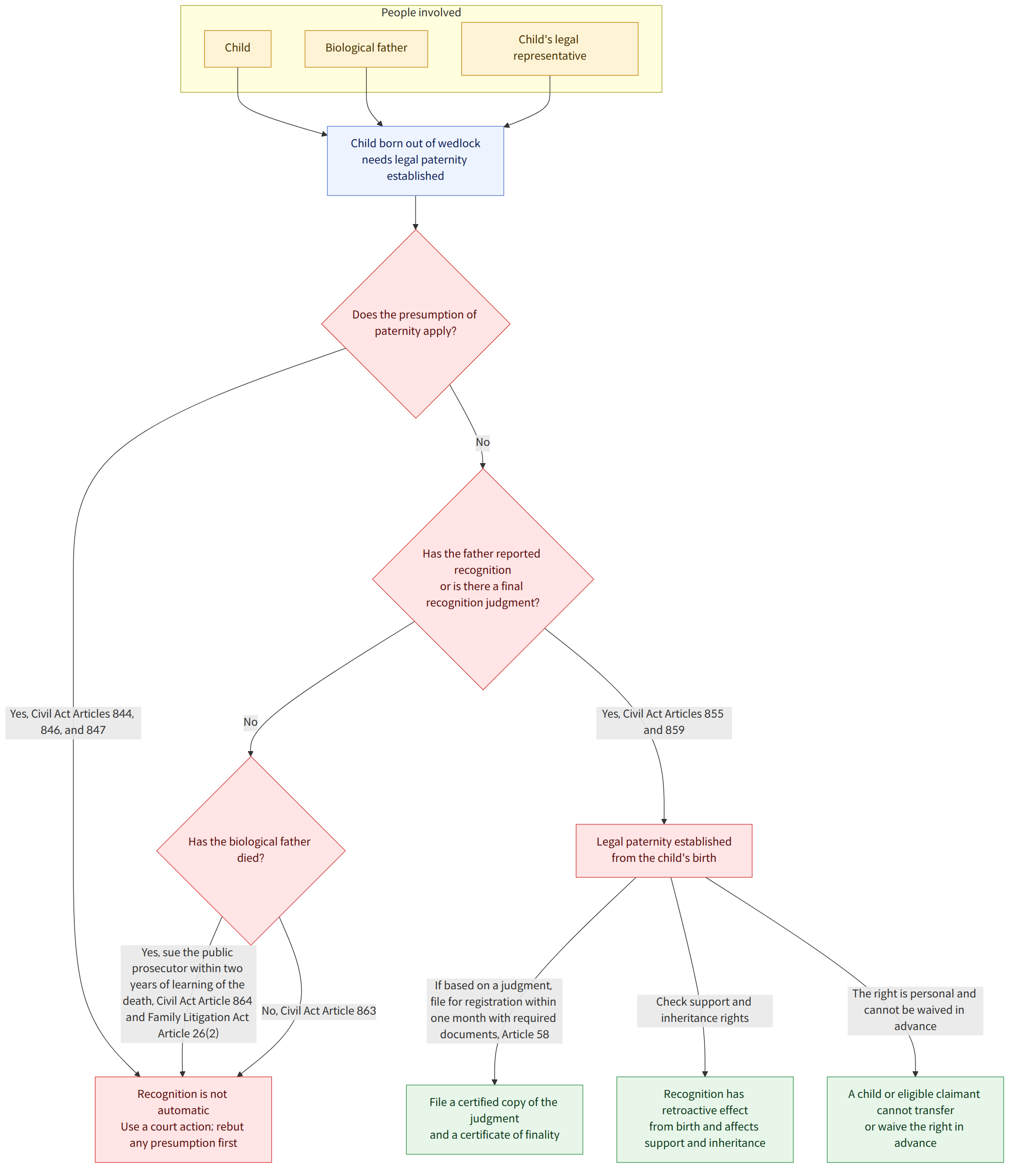
For a child born out of wedlock, a legal parent-child relationship with the biological father does not arise automatically at birth. A report of recognition by the biological father or a final judgment in an action for recognition of paternity is required. Once paternity is recognized, the parent-child relationship retroactively dates from the child's birth; however, if the presumption of paternity applies, it must first be rebutted.
At a glance
Key points
- A legal parent-child relationship between a child born out of wedlock and the birth mother arises through childbirth, but the relationship with the biological father is established by a report of recognition or a final judgment in an action for recognition of paternity (Civil Act, Articles 855 and 859 (민법 제855조, 제859조); Civil Act, Article 863 (민법 제863조)).
- If the biological father does not recognize the child, the child, the child's lineal descendants, or the child's legal representative may bring an action for recognition of paternity (Civil Act, Article 863 (민법 제863조)).
- If the biological father has died, an action for recognition of paternity must be brought against the public prosecutor within two years from the date the claimant learned of the death (Civil Act, Article 864 (민법 제864조); Family Litigation Act, Article 26(2) (가사소송법 제26조 제2항)).
- Recognition of paternity has retroactive effect from the child's birth and affects rights relating to support and inheritance (Civil Act, Articles 860 and 974 (민법 제860조, 제974조); Civil Act, Article 1014 (민법 제1014조)).
- A biological father cannot immediately recognize a child who is covered by the presumption of paternity; the presumption must first be rebutted by a final judgment in an action to deny paternity (Civil Act, Articles 844, 846, and 847 (민법 제844조, 제846조, 제847조)).
- The right to seek recognition of paternity is personal and non-transferable to the child. An agreement by the child or the child's legal representative to waive the right in advance is ineffective (Supreme Court Decision 2001Meu1353, November 27, 2001 (대법원 2001. 11. 27. 선고 2001므1353 판결)).
- Grandparents cannot recognize a child born out of wedlock. Recognition of someone who is not a biological child is ineffective, but it may be treated as an adoption if the requirements are met (Civil Act, Article 855 (민법 제855조); Supreme Court Decision 75Da948, April 13, 1976 (대법원 1976. 4. 13. 선고 75다948 판결); Supreme Court Decision 92Da29399, October 23, 1992 (대법원 1992. 10. 23. 선고 92다29399 판결)).
- Once a judgment recognizing paternity becomes final, a report must be filed within one month from the date it becomes final, with a certified copy of the judgment and a certificate of finality attached, for the recognition to be recorded in the family relations register (Act on Registration of Family Relations, Article 58 (가족관계의 등록 등에 관한 법률 제58조)).
Frequently asked questions
Q. Can an action for recognition of paternity be brought after the biological father has died?
Yes. The child or another eligible person must file an action for recognition of paternity against the public prosecutor in the court with jurisdiction over the deceased biological father's last address at the time of his death, within two years from the date they learned of his death.
Q. Can a mother bring an action for recognition of paternity on behalf of her minor child?
According to the explanation of the case, the child's legal representative may bring an action for recognition of paternity against the biological father on the child's behalf. Once the judgment becomes final, the recognition must be reported within one month from the date it becomes final, with a certified copy of the judgment and a certificate of finality attached.
Q. Once paternity is established, does it affect child support or inheritance?
Recognition of paternity has retroactive effect from the child's birth and therefore affects support obligations and inheritance rights. The child's caregiver may claim both past and future child support. If succession has already commenced, the child may claim from co-heirs of the same rank payment of the monetary value of the child's inheritance share.
Q. Can the biological father immediately recognize a child born to a married couple during their marriage?
If the child is covered by the presumption of paternity, the biological father cannot immediately recognize the child. He may do so only after a final judgment in an action to deny paternity has rebutted the presumption.
Q. Can the biological father immediately recognize a child born within 300 days after a divorce?
The case explains that a child born within 300 days after the end of a marriage may also be presumed to be the former husband's child. In that situation, the biological father may recognize the child only after a final judgment in an action to deny paternity.
Q. If there is an agreement not to seek recognition of paternity, can a claim still be brought later?
An agreement alone cannot extinguish the right to seek recognition of paternity. That right is personal and non-transferable to the child, so an agreement by the child or the child's legal representative to waive it is ineffective.
Q. Can grandparents recognize a grandchild born out of wedlock?
No. Recognition of paternity is an act that must be made by the biological father or mother personally. A grandparent's birth report does not establish recognition of paternity.
Q. Can an action for recognition of paternity be brought even if the sperm provider promised not to take responsibility for raising the child?
According to the reasoning of the judgment in the case, a child conceived through artificial insemination using sperm provided during a de facto marriage may bring an action for recognition of paternity against the sperm provider. A written agreement not to hold the provider responsible for childbirth or child-rearing does not, by itself, bar the claim.
Q. Does a parent-child relationship arise if someone other than the biological father files a report of recognition of paternity?
Recognition of paternity of a person who is not the biological child is ineffective. However, if, when the report was made, both parties clearly intended to adopt and all requirements for adoption were satisfied, it may be recognized as an adoption.
Relevant laws
- Civil Act, Article 781(3) (민법 제781조 제3항)
- Civil Act, Article 781(5) (민법 제781조 제5항)
- Civil Act, Article 781(6) (민법 제781조 제6항)
- Civil Act, Article 844 (민법 제844조)
- Civil Act, Article 844(1) (민법 제844조 제1항)
- Civil Act, Article 844(2) (민법 제844조 제2항)
- Civil Act, Article 846 (민법 제846조)
- Civil Act, Article 847 (민법 제847조)
- Civil Act, Article 855 (민법 제855조)
- Civil Act, Article 859 (민법 제859조)
- Civil Act, Article 860 (민법 제860조)
- Civil Act, Article 863 (민법 제863조)
- Civil Act, Article 864 (민법 제864조)
- Civil Act, Article 864-2 (민법 제864조의2)
- Civil Act, Article 974 (민법 제974조)
Watch out for
- When a claim for recognition of paternity is brought after the biological father's death, the time limit is calculated from the date the claimant learned of the death, not the date of death; the case guidance states that the claim must be brought within two years.
- To have the recognition recorded in the family relations register after the judgment becomes final, a report must be filed within one month from the date it becomes final.
- The mere filing of an action for recognition of paternity does not allow the claimant to exercise inheritance rights as an heir before a final judgment is issued.
- Whether recognition of paternity is possible may depend on whether the presumption of paternity applies. If that presumption is at issue, consider whether an action to deny paternity must be brought before seeking recognition.
Source cases
This guide was compiled by AI from the following Korea Legal Aid Corporation consultation cases (in Korean).
- 부(父)의 사망과 인지(認知)
- 사실혼 부(夫)의 사망시 그 자(子)의 가족관계등록 관계
- 인지제도
- 생부 사망 후 혼인외 출생자의 인지청구 소송 중 상속채무의 변제방법
- 인공수정으로 출산한 자의 정자제공자에 대한 인지청구
- 생부가 친생추정이 미치는 자(子)에 대하여 인지를 할 수 있는지
- 인지의 효과
- 생부모가 가족관계등록부상의 부모와 다른 사실이 객관적으로 명백한 경우 생부모를 상대로 인지를 청구할 수 있는지
- 이혼한지 얼마 되지 않아 출산한 경우 생부가 혼외자를 인지할 수 있는지
- 인지청구권을 포기할 수 있는지
- 조부모가 인지를 할 수 있는지
- 친생자가 아닌 자에 대하여 한 인지가 유효한지
This guide is general legal information about Korean law, not legal advice for your situation. For a specific case, consult a lawyer or the Korea Legal Aid Corporation (call 132 in Korea).