
Guide to Parent-Child Relationships, the Presumption of Paternity, and Legal Actions
Based on 20 consultation cases · Updated · Translated from the Korean original.
A child born during a marriage may be presumed to be the husband's biological child regardless of the actual biological relationship. As a rule, anyone challenging this presumption must file an action to deny paternity. The procedures and filing deadlines for acknowledgment of a child born outside marriage, artificial insemination, posthumous birth, and confirmation of a parent-child relationship vary according to the specific circumstances.
At a glance
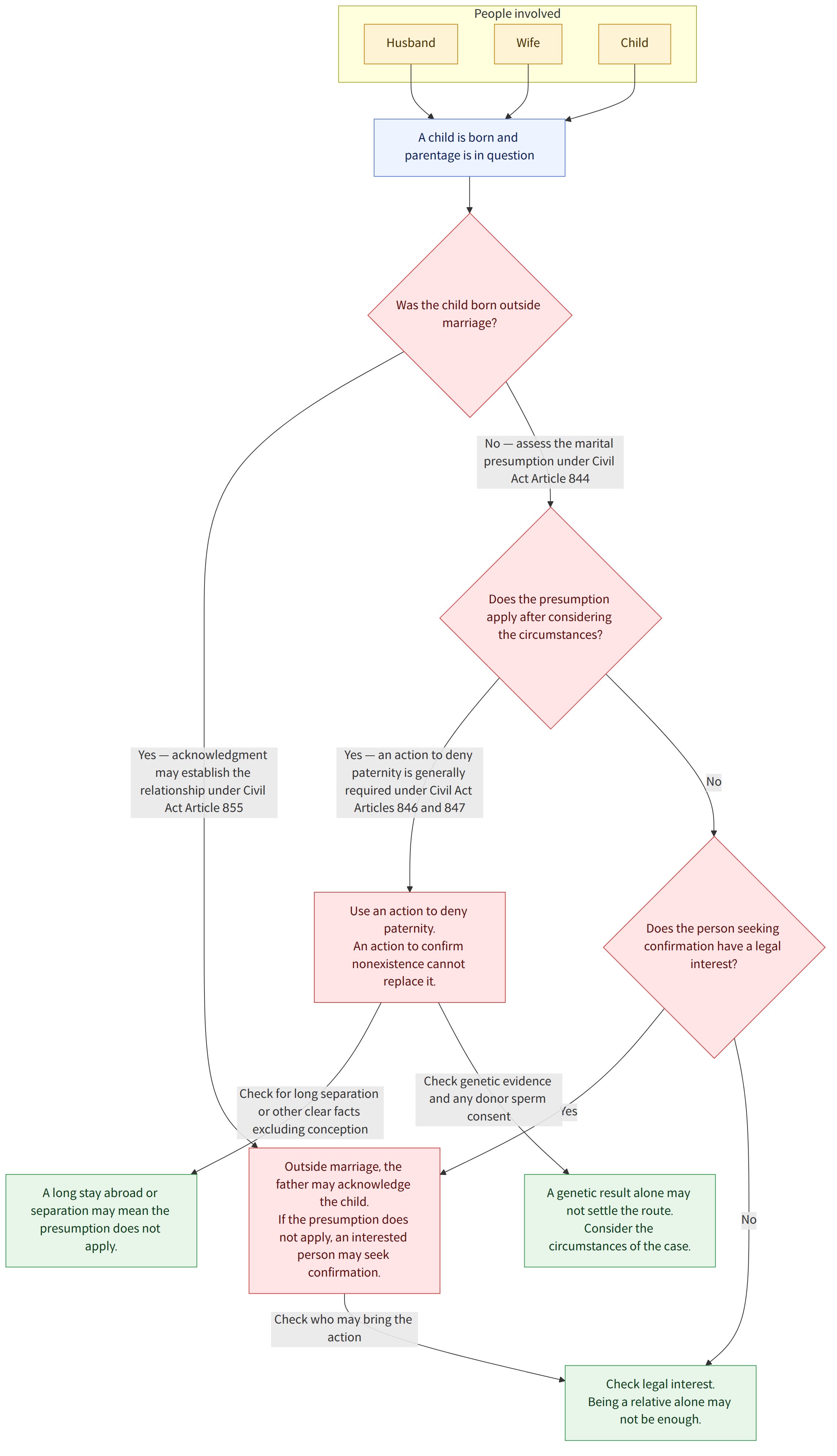
Key points
- As a rule, a child conceived by a married couple during their marriage is presumed to be the husband's biological child (Civil Act, Article 844 (민법 제844조)).
- As a rule, anyone challenging the legal father-child relationship with a child to whom the presumption of paternity applies must file an action to deny paternity; an action for confirmation of the nonexistence of a parent-child relationship cannot be substituted (Civil Act, Articles 846 and 847 (민법 제846조·제847조)).
- The presumption of paternity may not apply where it is clear on the face of the circumstances that the wife could not have conceived the husband's child, such as during a long stay abroad or a separation following a de facto divorce (Supreme Court Decision 96Meu1663, rendered February 25, 1997 (대법원 1997. 2. 25. 선고 96므1663 판결)).
- A lower-court decision discussed in the case materials held that the presumption of paternity did not apply where genetic testing clearly ruled out a father-child relationship. Whether the presumption applies must, however, be considered in each case (Seoul Family Court Decision 2014Deudan310144, rendered July 21, 2015 (서울가정법원 2015. 7. 21. 선고 2014드단310144 판결)).
- If the presumption of paternity does not apply, a person with a legal interest in obtaining confirmation may file an action to confirm whether a parent-child relationship exists. The mere fact of being a relative does not always establish a legal interest in confirmation; the case materials state that relatives within the scope set out in Article 777 of the Civil Act may bring an action as interested parties.
- For a child born outside marriage, a legal parent-child relationship with the father may be established by the father's acknowledgment. If the parents in a de facto marriage marry, the effect of legitimation may arise without separate acknowledgment (Civil Act, Article 855 (민법 제855조)).
- A child born through artificial insemination using the spouse's sperm may benefit from the presumption of paternity in the same way as other children. If sperm from a person other than the spouse is used, the husband's consent affects the child's legal status and any challenge to it.
- The effect of a registration of acknowledgment may be challenged by an action to invalidate acknowledgment or an action to contest acknowledgment if no parent-child relationship exists. However, as a rule, a final judicial acknowledgment cannot be challenged by an action to contest acknowledgment; a retrial may be relevant.
Frequently asked questions
Q. Is a child born during a marriage presumed to be the husband's biological child even if the child is not biologically his?
As a rule, a child conceived by a married couple during their marriage is presumed to be the husband's biological child, regardless of the actual biological relationship. To challenge this presumption, an action to deny paternity must generally be filed.
Q. If a genetic test shows that the child is not biologically his, should an action for confirmation of the nonexistence of a parent-child relationship be filed?
Where the presumption of paternity applies, a genetic test result alone does not allow an action for confirmation of the nonexistence of a parent-child relationship to be filed; as a rule, an action to deny paternity is required. However, a lower-court decision discussed in the case materials held that the presumption of paternity did not apply where the genetic profiles were clearly incompatible, so the specific circumstances must be considered.
Q. Is a child born while the husband is abroad for a long time also presumed to be his biological child?
The presumption of paternity may not apply if it is clear on the face of the circumstances that the couple did not live together, such as during a long stay abroad, and that the husband could not have fathered the child. In such a case, there may be grounds to file an action for confirmation of the nonexistence of a parent-child relationship rather than an action to deny paternity.
Q. What happens if the husband is infertile or artificial insemination is performed using a third party's sperm?
A decision discussed in the case materials states that, as long as the couple live together, the presumption of paternity does not cease merely because the husband is infertile. For artificial insemination using sperm from a donor other than the husband, the husband's consent is also important: if he consented, the child may benefit from the presumption of paternity, and his ability to deny paternity may be limited.
Q. Can a child born after the husband's death using his frozen sperm have the parent-child relationship legally recognized?
The case materials discuss a court case in which a claim for acknowledgment was granted for a child born after the husband's death using sperm he had frozen while alive. They explain that the legal representative of a minor child may file an action for acknowledgment against the prosecutor within two years from the day the representative learns of the father's death.
Q. If a child is born to parents in a de facto marriage, does the father need to acknowledge the child when the parents marry?
A child born while the parents are in a de facto marriage is not presumed at birth to be the legal father's biological child. However, if the parents marry, the child is legitimated by their subsequent marriage and becomes a child born during marriage. According to the case materials, no separate acknowledgment is required in this situation, and the legal effects of the parent-child relationship arise from the time the parents marry.
Q. If a child who is not a biological child was registered as one born in wedlock, should an action to invalidate acknowledgment be filed?
A precedent discussed in the case materials states that, when challenging the appearance of a parent-child relationship created by registering a child as a child born in wedlock, an action for confirmation of the nonexistence of a parent-child relationship must be filed, rather than an acknowledgment-related action. However, if the person named as the other party is fictitious and does not exist, an action cannot be brought against that person; an application to correct the Family Relations Register must instead be made.
Q. Can any relative bring an action to confirm whether a parent-child relationship exists?
To bring an action, the claimant must have a legal interest in having the parent-child relationship in question confirmed. According to the case materials, relatives within the scope set out in Article 777 of the Civil Act may bring an action as interested parties. If all the parties whose relationship is to be confirmed have died, the procedure for bringing an action against the prosecutor and a separate filing deadline may become relevant.
Q. What is the deadline for filing an action to deny paternity, and can family members file one if the husband dies?
As a rule, an action to deny paternity must be filed within two years from the day the claimant learns that the child is not biologically his. The case materials explain that, if the father dies before the child is born or dies within the statutory period, the father's or wife's lineal ascendants or descendants may file the action within two years from the day they learn of the death.
Relevant laws
- Civil Act, Article 777 (민법 제777조)
- Civil Act, Article 844 (민법 제844조)
- Civil Act, Article 845 (민법 제845조)
- Civil Act, Article 846 (민법 제846조)
- Civil Act, Article 847 (민법 제847조)
- Civil Act, Article 850 (민법 제850조)
- Civil Act, Article 851 (민법 제851조)
- Civil Act, Article 852 (민법 제852조)
- Civil Act, Article 854 (민법 제854조)
- Civil Act, Article 855 (민법 제855조)
- Civil Act, Article 862 (민법 제862조)
- Civil Act, Article 863 (민법 제863조)
- Civil Act, Article 864 (민법 제864조)
- Civil Act, Article 865 (민법 제865조)
- Civil Act, Article 1093 et seq. (민법 제1093조 이하)
Watch out for
- The action required depends on whether the presumption of paternity applies. Take care not to confuse an action to deny paternity with an action to confirm whether a parent-child relationship exists.
- Some cases state that an action to deny paternity must be filed within two years from the day the claimant learns that the child is not biologically his. Consider when the genetic test result or other relevant facts became known.
- Different procedures may apply in situations involving a parent's death, judicial acknowledgment, or registration of a birth against a fictitious person. Check the filing deadline and the proper opposing party for each case.
Source cases
This guide was compiled by AI from the following Korea Legal Aid Corporation consultation cases (in Korean).
- 유전자검사결과 친자가 아닌 것으로 판명된 경우 친생추정의 효력이 있는지
- 인공수정으로 출생한 자의 법적 지위
- 친족이기만 하면 친생자관계존부확인의 소를 제기할 수 있는지
- 허무인을 상대로 친생자관계부존재확인의 소를 제기할 수 있는지
- 인공수정으로 출생한 자의 법적 지위
- 친생자가 아닌 자에 대한 친생자출생신고를 다투는 방법
- 재혼한 처가 친생부인의 소를 제기할 수 있는지
- 남편이 장기간 해외에 나가 있던 중 처가 임신한 경우 친생추정이 미치는지
- 남편 사망 이후 냉동해 두었던 남편의 정자를 해동하여 출산한 아이도 사망한 남편의 친생자인지
- 친생추정과 친생자관계부존재확인의 소
- 재판상 인지의 효력을 다투는 방법
- 친생자관계가 부존재하는 경우 인지를 다투는 방법
- 혼인에 의한 준정
- 친생부인의 소
- 부를 정하는 소
- 조부가 친생부인의 소를 제기할 수 있는지
- 혼외자에 대한 친생자출생신고로 인지의 효력이 발생하는지
- 승인으로 인한 친생부인권의 소멸과 그 취소
- 친생추정
- 유언에 의한 친생부인
This guide is general legal information about Korean law, not legal advice for your situation. For a specific case, consult a lawyer or the Korea Legal Aid Corporation (call 132 in Korea).