
A Guide to Exercising and Changing Parental Authority and Managing a Child’s Property
Based on 28 consultation cases · Updated · Translated from the Korean original.
Parental authority is both a right and a duty to protect and raise a child and manage the child’s property, and it must be exercised with the child’s welfare as the guiding consideration. Disagreements between parents, or acts involving conflicting interests between a holder of parental authority and a child, may require a decision by the Family Court or the appointment of a special representative.
At a glance
Key points
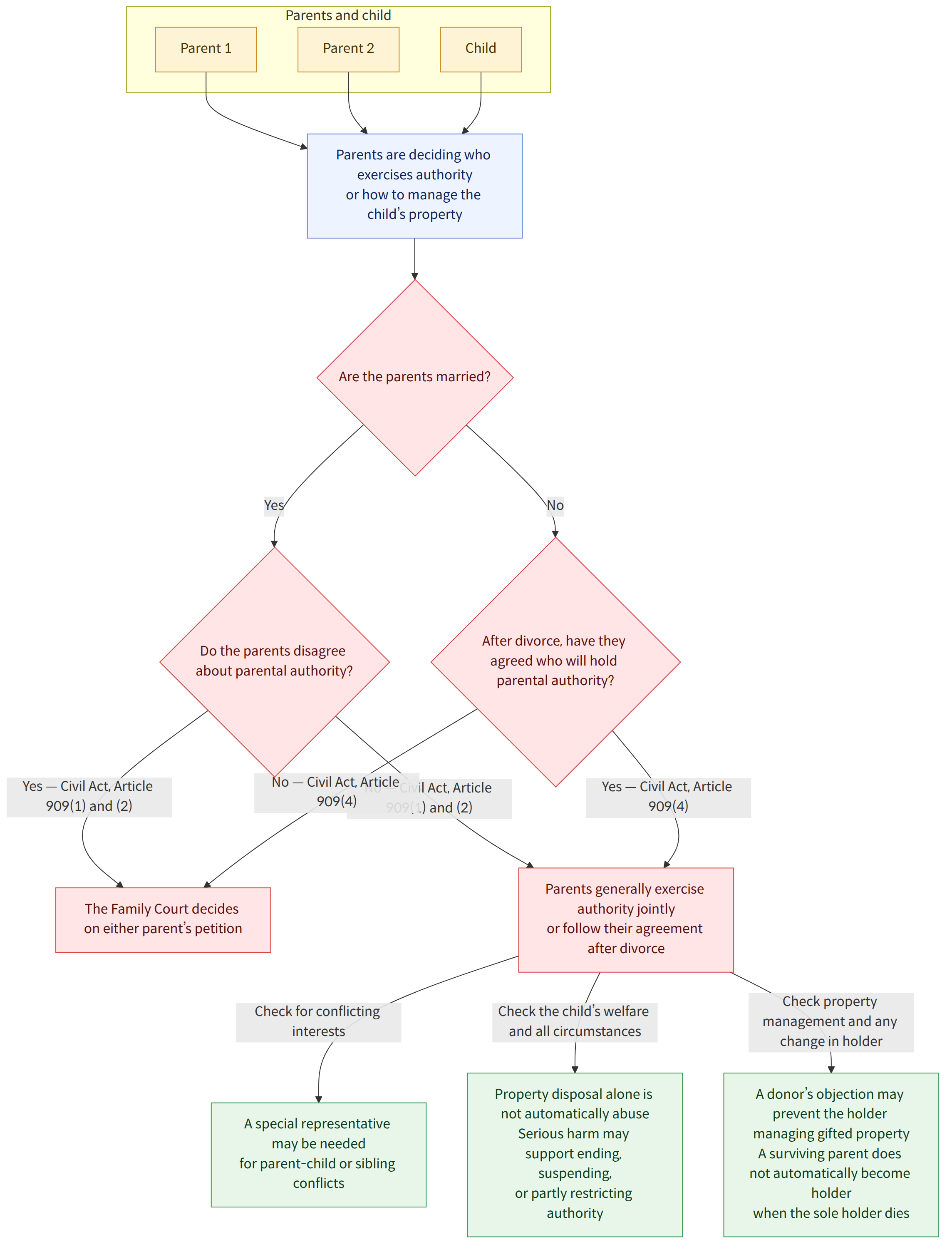
- While the parents are married, they generally exercise parental authority jointly. If they disagree, the Family Court decides upon the petition of either parent (Civil Act, Article 909(1) and (2) (민법 제909조 제1항·제2항)).
- When parents divorce, they designate the holder of parental authority; if they cannot reach agreement, the Family Court may designate one (Civil Act, Article 909(4) (민법 제909조 제4항)).
- A special representative is required for an act where there is an objective possibility of conflicting interests between a holder of parental authority and a child, or among multiple children subject to that parental authority. In dividing jointly inherited property, it may be necessary to appoint a special representative for each minor child (Civil Act, Article 921 (민법 제921조); Supreme Court Decision 92Da54524, April 13, 1993).
- An act disposing of a child’s property does not automatically constitute an abuse of parental authority. The matter is determined by considering the specific circumstances as a whole, including whether the child’s interests were disregarded and the act was intended solely to benefit the holder of parental authority or a third party (Supreme Court Decision 2008Da73731, January 30, 2009).
- If a holder of parental authority significantly harms, or is likely to harm, the child’s welfare, termination or temporary suspension of parental authority, or partial restriction of parental authority with respect to specific matters, may be considered (Civil Act, Articles 924 and 924-2 (민법 제924조·제924조의2)).
- If a person who gives property to a child without consideration objects to its management by the holder of parental authority, the holder cannot manage that property and may designate an administrator or ask the court to appoint one (Civil Act, Article 918 (민법 제918조)).
- If a parent designated as the sole holder of parental authority dies, do not assume that the surviving parent automatically becomes the holder of parental authority; check the procedure for petitioning the Family Court to designate a holder (Civil Act, Article 909-2 (민법 제909조의2)).
Frequently asked questions
Q. If a divorced parent who holds parental authority dies, does the other parent, who has remarried, immediately become the holder of parental authority?
The mere fact that the surviving parent has remarried does not necessarily mean that the parent cannot become the holder of parental authority. However, where a parent designated as the sole holder of parental authority dies, a procedure is provided under which the surviving parent or another person may petition the Family Court to designate a holder of parental authority. Do not assume that parental authority automatically reverts to the surviving parent; check the applicable court procedure.
Q. If I want to transfer inherited property that I share with my child into my name, is it enough to obtain my child’s consent?
Where the holder of parental authority and a minor child are co-heirs, an agreement to divide inherited property may constitute an act involving conflicting interests. If there are multiple children, it may be necessary to appoint a special representative for each minor child to participate in the agreement (Civil Act, Article 921 (민법 제921조)).
Q. Can I use my minor child’s real property as security to repay my own debt?
Creating a security interest over real property owned by a child to secure the holder of parental authority’s own debt may constitute an act involving conflicting interests, requiring the appointment of a special representative. Unless there are exceptional circumstances, the validity of a representative act performed without a special representative may be called into question.
Q. Does providing a child’s property to secure a relative’s debt also constitute an act involving conflicting interests?
The court decision discussed in the example did not consider the creation of a mortgage over a child’s real property to secure a debt owed by the holder of parental authority’s sibling to a third party to be an act involving conflicting interests. However, that fact alone does not make the act an abuse of parental authority; the specific circumstances must be considered.
Q. If parents exercise parental authority jointly but disagree about their child’s schooling or studying abroad, what can they do?
If the parents disagree, either parent may petition the Family Court, which will decide in accordance with the child’s welfare. For parents who are living apart but are not divorced, it is necessary to distinguish between designating one parent to exercise parental authority and determining how parental authority is to be exercised.
Q. Can parental authority be terminated solely because of a parent’s wrongdoing or past misconduct?
Parental authority is not automatically terminated merely because of a parent’s misconduct. The decision takes into account the specific circumstances, including the child’s age and health and the child’s care arrangements, and considers whether terminating parental authority would better serve the child’s welfare. There is also a court decision holding that parental authority cannot be terminated solely on the basis of past circumstances if the grounds for concern have disappeared and the parent is currently caring for the child properly.
Q. What happens if a child’s only asset is given to someone else without consideration?
In a case where the holder of parental authority gave away the child’s only asset without consideration, and the other party knew this, the court held that the act was an abuse of parental authority and its effect did not extend to the child. However, not every disposition of a child’s property constitutes an abuse of parental authority; the specific circumstances must be considered.
Q. Can a holder of parental authority enter into an employment contract on behalf of a minor child?
According to the example, a holder of parental authority cannot enter into an employment contract on behalf of a child; the minor must enter into the contract personally (Labor Standards Act, Article 67(1) (근로기준법 제67조 제1항)).
Relevant laws
- Civil Act, Article 777 (민법 제777조)
- Civil Act, Article 869(2) (민법 제869조 제2항)
- Civil Act, Article 909(1), (2), and (4) (민법 제909조 제1항·제2항·제4항)
- Civil Act, Article 909-2(1) and (3) (민법 제909조의2 제1항·제3항)
- Civil Act, Article 910 (민법 제910조)
- Civil Act, Article 911 (민법 제911조)
- Civil Act, Article 913 (민법 제913조)
- Civil Act, Article 915 (민법 제915조)
- Civil Act, Article 918(1), (2), and (3) (민법 제918조 제1항·제2항·제3항)
- Civil Act, Article 920 (민법 제920조)
- Civil Act, Article 921(1) and (2) (민법 제921조 제1항·제2항)
- Civil Act, Article 923(1) and (2) (민법 제923조 제1항·제2항)
- Civil Act, Article 924(1) (민법 제924조 제1항)
- Civil Act, Article 924-2 (민법 제924조의2)
- Civil Act, Article 925 (민법 제925조)
Watch out for
- The example states that, if a parent designated as the sole holder of parental authority dies, a petition to designate a holder of parental authority may be filed within one month after learning of the death and within six months after the date of death. Make sure to check these deadlines so that they are not missed.
- Where the interests of a holder of parental authority conflict with those of multiple minor children in dividing jointly inherited property, it may be necessary to appoint a special representative for each child.
- Whether an act involves conflicting interests, constitutes an abuse of parental authority, or provides grounds to restrict parental authority are separate questions, and each must be assessed in light of the specific circumstances.
- If the holder of parental authority is changed by agreement or court proceedings, check the notification deadline stated in the example. It states that a change by agreement must be reported within one month, and a change by court proceedings within one month from the date the decision becomes final.
Source cases
This guide was compiled by AI from the following Korea Legal Aid Corporation consultation cases (in Korean).
- 재혼한 어머니가 친권자가 될 수 있는지
- 미성년의 자와 함께 상속받은 재산을 모(母) 명의로 할 수 있는지
- 친권자인 부(父) 사망 시 재혼한 모(母)가 친권자로 되는지
- 인공수정에 의해 태어난 자의 법적지위
- 친권자가 자녀명의 부동산을 담보로 제공할 경우 그 효력
- 친권자로서 적정하게 친권을 행사하리라 기대할 수 없다고 인정한 사례
- 친권자가 자를 감화기관, 교정기관에 위탁하기 위하기 위한 요건
- 친권자의 일시적 양육 불가능 상태가 친권변경 사유인지
- 부부가 별거하고 있으나 이혼하지 않은 경우, 부모 일방을 친권행사자로 지정할 수 있는지
- 자의 재산관리에 관한 포괄적 위임을 받은 부가 자신의 채무지급을 위하여 자와 공동으로 발행한 어음의 효력
- 친권자가 자녀에게 긴급하고 필수적인 진료행위를 거부하는 것도 가능한지 여부
- 친권상실선고에 있어 고려하여야 할 요소
- 수인의 자간의 이해상반행위
- 제3자가 무상으로 子에게 수여한 재산의 관리
- 친권자의 자 소유 재산처분 행위가 대리권 남용에 해당하기 위한 요건
- 과거의 사정을 이유로 친권을 상실시킬 수 있는지
- 미성년자가 낳은 자에 대한 친권자는 누가 되는지
- 친권자가 자녀의 유일한 재산을 증여한 경우
- 친권자가 타인의 채무를 담보하기 위해 자의 부동산에 담보권 설정한 경우
- 사실혼을 해소하면서 인지되지 않은 자에 대해 친권자지정청구가 가능한지
- 양모와 양자 간 등기이전청구의 이해상반행위 여부
- 증여재산에서 수취한 과실을 양육비와 상계할 수 있는지
- 친권자가 자녀의 근로계약을 대리하여 체결할 수 있는지
- 친권자 변경신고 방법
- 공동으로 친권을 행사하는 부모의 의견이 불일치하는 경우
This guide is general legal information about Korean law, not legal advice for your situation. For a specific case, consult a lawyer or the Korea Legal Aid Corporation (call 132 in Korea).