
Partnerships and Gye: Liability and Settlement in Business Partnerships and Gye Arrangements
Based on 44 consultation cases · Updated · Translated from the Korean original.
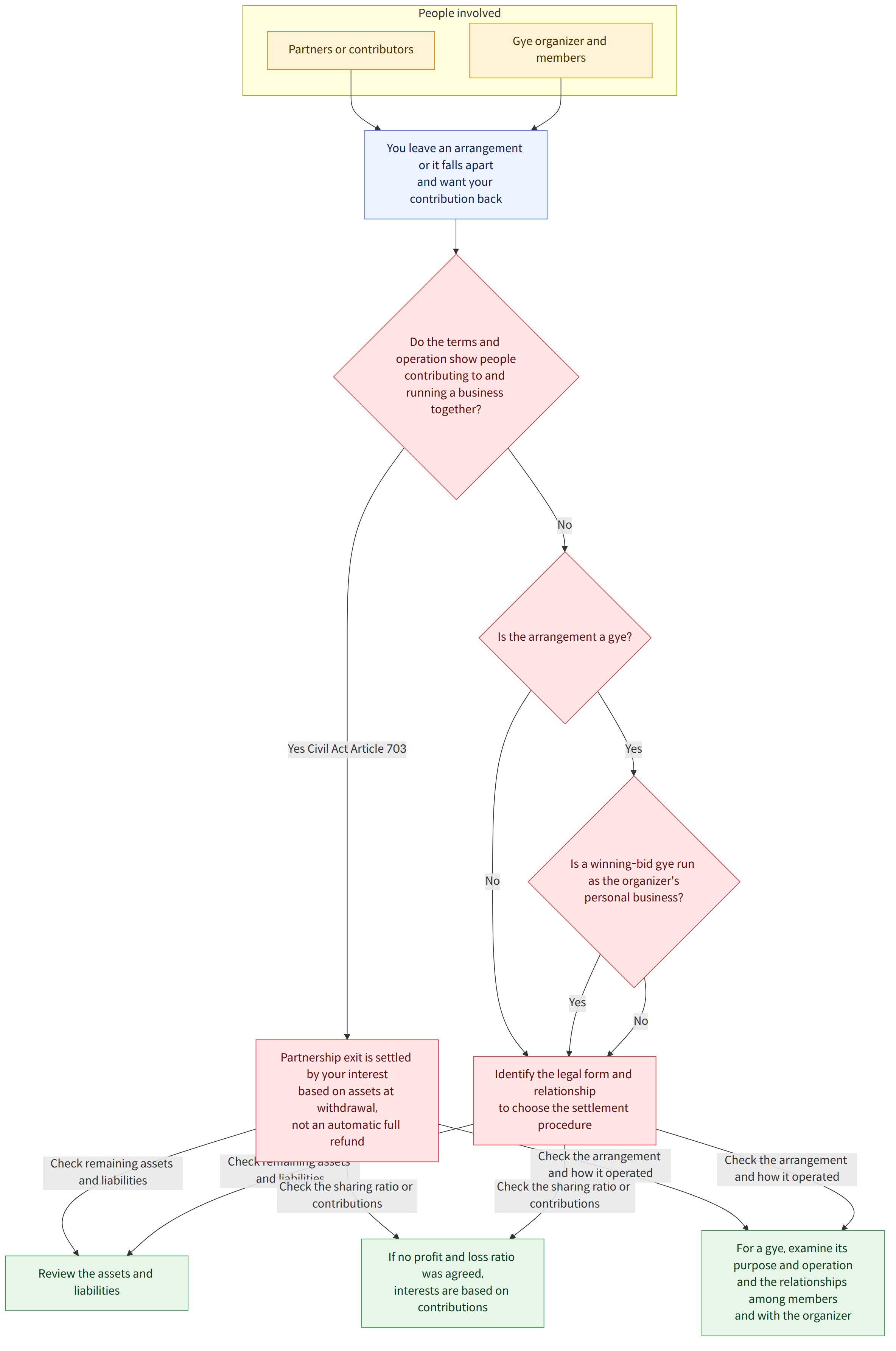
Depending on the terms of the agreement and how the arrangement is operated, a business partnership may be treated as a partnership under the Civil Act. The legal nature of a gye and the resulting liabilities also depend on how it is operated and on the relationships between its members and organizer. Leaving a partnership or a gye falling apart does not mean that the full amount contributed is immediately returned. The partnership’s assets and liabilities should be reviewed, and the applicable settlement procedure should be determined based on the nature of the relationship.
At a glance
Key points
- A business partnership agreement may establish a partnership under the Civil Act, in which several people contribute and operate a business together. Depending on the contractual structure, such as the relationship between an investor and the person running the business, it may instead be treated as an anonymous partnership, a limited partnership, or a company (Cases 4 and 11; Civil Act, Article 703 (민법 제703조)).
- A partnership agreement is difficult to end by rescission and a claim for restoration to the original position, as with an ordinary contract. The issue is generally dealt with through the return of an interest following dissolution, withdrawal, expulsion, or liquidation of the partnership (Cases 2, 12, 14, and 24).
- As a general rule, a withdrawing partner’s interest is calculated based on the state of the partnership’s assets at the time of withdrawal. If no profit-and-loss sharing ratio has been agreed, the interest is determined in proportion to the amounts contributed (Cases 2 and 18; Civil Act, Articles 711 and 719 (민법 제711조, 제719조)).
- When one of two partners withdraws, the partnership is not dissolved absent special circumstances, and the remaining partner may continue the business. As a general rule, the withdrawing partner may claim an interest calculated based on the partnership’s assets at the time of withdrawal, not a refund of the full amount contributed (Cases 2, 12, and 18; Civil Act, Article 719 (민법 제719조)).
- If a person managing the partnership’s affairs acquires a right in their own name through those affairs, they may have to transfer it to the partnership unless otherwise agreed. Disposing of or changing partnership property may constitute a special matter, and if there is no appointed manager, the matter is generally decided by a majority of the partners (Cases 8 and 13; Civil Act, Articles 684, 706, 707, and 709 (민법 제684조, 제706조, 제707조, 제709조)).
- The legal nature of a gye cannot be determined by its name alone. Its purpose and operation, and the relationships between the organizer and members and among the members, must be considered to determine whether it is a partnership agreement, a loan agreement, or an atypical contract, among other possibilities. The party responsible for settlement and the method of settlement may vary accordingly (Cases 3, 5, 7, and 10).
- If a winning-bid gye is operated as the organizer’s personal business, the relationship may be treated as an individual accounting relationship between the organizer and each member, and may therefore be handled differently from the dissolution and liquidation of a partnership (Cases 10, 16, and 17).
- A cooperative must complete the establishment procedures, and, as a general rule, each member must contribute at least one share in accordance with the articles of association. The establishment process includes recruiting promoters, preparing the articles of association, recruiting persons who consent to the establishment, holding an inaugural general meeting, filing an establishment notification, and registering the cooperative (Cases 1 and 20).
Frequently asked questions
Q. If I leave a partnership, can I get back the full amount I initially contributed?
As a general rule, you cannot immediately recover the full amount of your contribution. The amount is settled based on the state of the partnership’s assets and your interest at the time you withdraw, and the amount returned may vary depending on the assets and liabilities remaining in the partnership.
Q. Can I rescind a partnership agreement and claim restoration to the original position?
A partnership agreement, unlike an ordinary contract, cannot be terminated by rescission and a demand that the other party restore the parties to their original positions. The relationship must be ended through dissolution or withdrawal from the partnership, for example, and the resulting settlement or return of your interest must then be sought.
Q. If one of two business partners leaves, is the business immediately liquidated?
When one of the two partners withdraws, the partnership relationship ends, but, absent special circumstances, the partnership is not dissolved or liquidated. The remaining partner may continue the business, and the withdrawing and remaining partners settle the accounts arising from the withdrawal.
Q. As of what date is a withdrawing partner’s interest calculated?
As a general rule, the interest is calculated based on the state of the partnership’s assets at the time of withdrawal. If a profit-and-loss sharing ratio has been agreed, that ratio is used; if none has been agreed, the interest may be determined in proportion to the amounts contributed.
Q. If a gye falls apart, can I claim the full amount of my contributions from the organizer?
This depends on the legal nature of the gye, the parties’ agreement, and how it was operated. If the gye is in the nature of a partnership, liquidation procedures and a settlement based on the liquidation outcome may be necessary. If it is instead viewed as a series of individual contractual relationships between the gye organizer and each member, the member may in some cases claim repayment of contributions from the organizer.
Q. Can I claim the gye payout from one of the joint organizers?
The fact that there are joint gye organizers does not, by itself, establish that each organizer is liable to all members. The specific arrangement must be examined, including who recruited the members and received their contributions, and whether the members had ties to one another or jointly operated the gye.
Q. If my business partner uses the contributed funds as they please, can I personally claim damages?
If contributed partnership funds disappear and a loss results, the injured party may be the partnership rather than an individual partner. In one case, the court held that an individual partner could not claim damages in their personal capacity.
Q. What happens if a partner fails to pay the contribution they promised?
The duty to contribute is an obligation of each partner, and failure to meet that obligation may be a legitimate ground for expelling a partner. In one case, the court held that the partner did not have to be given a further period to make the contribution before expulsion.
Q. Does real estate contributed to a partnership belong to the partnership even before it is registered?
If title to the property has not yet been registered as jointly owned in the partners’ names, there may be no basis to treat the property as jointly owned by the partnership in dealings with third parties who are not partners. However, an obligation to transfer the property to the partnership or make it available for use in the business may remain between the partner and the partnership.
Relevant laws
- Civil Act, Article 103 (민법 제103조)
- Civil Act, Article 684 (민법 제684조)
- Civil Act, Article 703 (민법 제703조)
- Civil Act, Article 706 (민법 제706조)
- Civil Act, Article 707 (민법 제707조)
- Civil Act, Article 709 (민법 제709조)
- Civil Act, Article 711 (민법 제711조)
- Civil Act, Article 712 (민법 제712조)
- Civil Act, Article 713 (민법 제713조)
- Civil Act, Article 718 (민법 제718조)
- Civil Act, Article 719 (민법 제719조)
- Civil Act, Article 746 (민법 제746조)
- Framework Act on Cooperatives (협동조합 기본법)
- Enforcement Rule of the Framework Act on Cooperatives (협동조합 기본법 시행규칙)
- Mutual Savings Banks Act, Article 2 (상호저축은행법 제2조)
Watch out for
- Do not determine the legal nature of a business partnership or gye based on its name alone. Consider the agreement, how it was actually operated, and the relationships between the parties.
- Withdrawal or the breakdown of a gye does not automatically entitle you to a full refund of your contribution. Check the partnership’s assets and liabilities and the applicable date for calculating the settlement.
- Depending on whether property is jointly owned and on the relief sought, all partners may need to bring a lawsuit concerning partnership property together. Check whether you can bring the claim individually.
- The documents and procedures required to file a cooperative establishment notification are described as they appeared in the relevant case. Before establishing a cooperative, confirm the current requirements with the competent authority.
Related articles
Source cases
This guide was compiled by AI from the following Korea Legal Aid Corporation consultation cases (in Korean).
- 협동조합의 설립 절차
- 동업계약 결렬된 후 출자금 반환청구 가능한지
- 중간계주의 책임으로 모집한 계원에 대한 계주의 계금지급의무
- 동업계약 후 일방만 실질적으로 회사를 운영한 경우 다른 동업자의 책임
- 2명의 계주가 있는 계에서 계원들에 대한 각 계주의 책임
- 2인으로 구성된 조합에서 1인이 탈퇴한 경우, 조합채권자가 잔존 조합원에 대하여 조합채무 전부의 이행을 청구할 수 있는지 여부...
- 번호계(또는 순번계)가 파계된 경우 계금 미수령자의 구제방법
- 조합의 업무집행자가 업무처리 중 자기의 이름으로 취득한 부동산에 관하여 조합원 중 1인이 조합원들 명의의 합유등기청구를 할 수...
- 조합계약에서 개괄적으로 조합원 지분의 양도를 인정하고 있는 경우, 그 지분 일부의 양도도 허용되는지 여부
- 낙찰계가 파계된 경우 계원의 불입금에 대한 계주의 책임
- 동업계약의 유형
- 두 사람으로 된 동업관계가 곧바로 결렬되는 경우의 동업관계
- 업무집행자가 없는 조합의 업무집행의 방법 및 조합재산의 처분·변경이 특별사무에 관한 업무집행인지 여부
- 조합계약 당사자 사이에 조합계약을 해제하고, 그로 인한 원상회복을 주장할 수 있는지 여부
- 동업약정에 따라 토지를 공동매수한 경우, 공동매수인이 각자 자기 지분에 관한 소유권이전등기청구를 할 수 있는지 여부
- 낙찰계가 파계된 후 기존계를 유지하기로 하는 합의의 효력
- 계주의 남편이 실질적인 공동운영자라고 볼 수 있는 경우 남편에 대한 책임 여부
- 2인 조합에서 1인이 탈퇴한 경우, 조합재산에 대한 법률관계 및 지분계산을 위한 자산평가의 기준 시기
- 불법적인 사업의 동업관계
- 조합원의 출자의무
- 동업자로 인하여 재산상 손해가 발생한 경우 손해를 입은 주체
- 동업계약체결 전 중요한 내용을 설명 받지 못한 경우 동업탈퇴 가능 여부
- 출자의무를 지체한 조합원에게 이행최고를 하여야 하는지 여부
- 동업체 해제 후 원상회복의무 부담여부
- 출자한 부동산에 대하여 아직 조합의 재산으로 등기절차를 완료하지 않은 경우 제3자에 대한 소유권 행사 가능 여부
This guide is general legal information about Korean law, not legal advice for your situation. For a specific case, consult a lawyer or the Korea Legal Aid Corporation (call 132 in Korea).