
Key Guide to Know Before Applying for Personal Bankruptcy and Discharge
Based on 88 consultation cases · Updated · Translated from the Korean original.
Personal bankruptcy is a proceeding to determine whether a person is insolvent, while discharge is a separate proceeding to decide whether liability for repayment of bankruptcy claims should be released. You should accurately disclose your assets and creditors and check whether grounds exist to deny discharge or whether any claims are nondischargeable.
At a glance
Key points
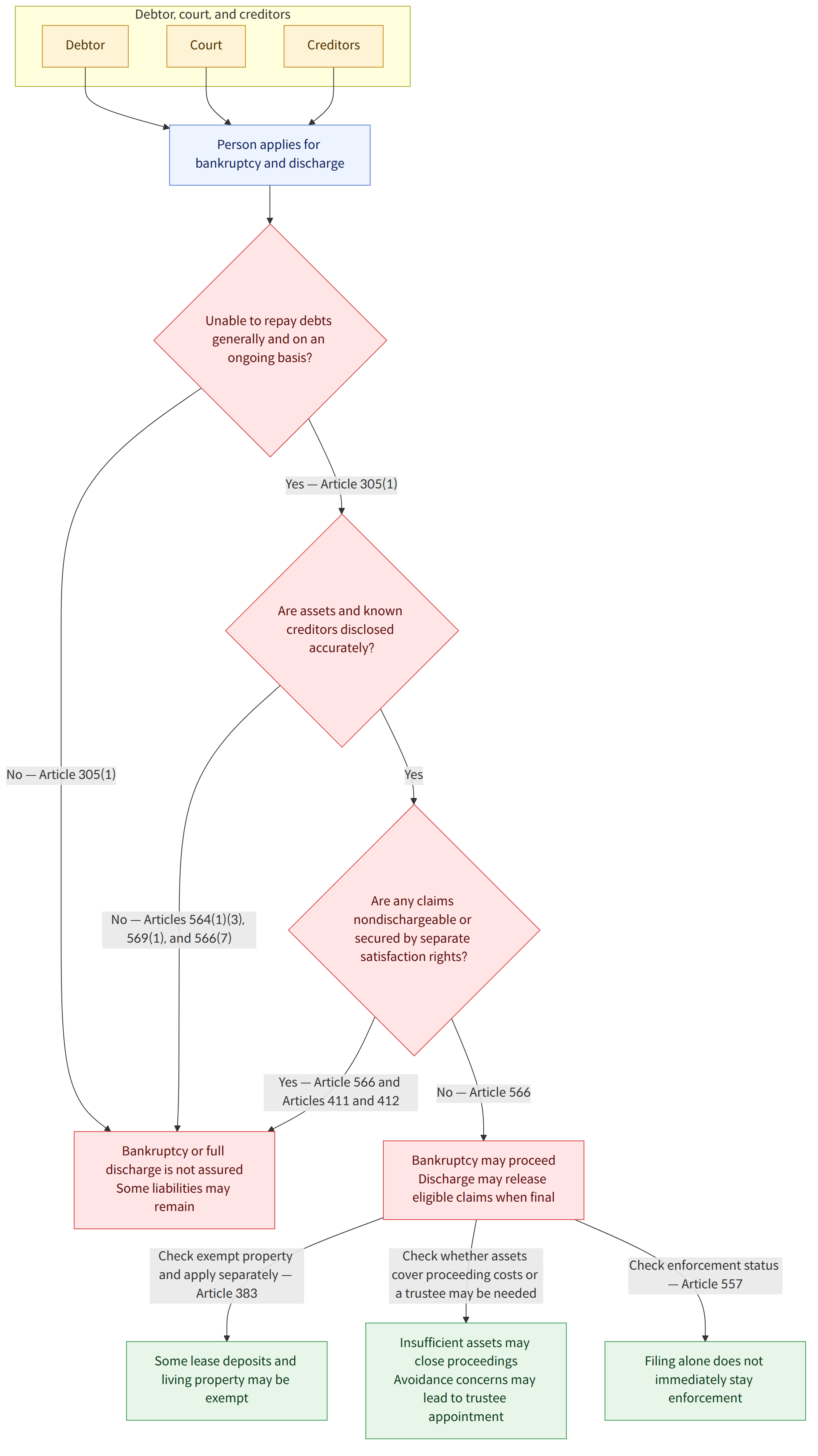
- Bankruptcy is not granted merely because a person has substantial debts. The court determines whether the person is insolvent and unable to repay debts generally and on an ongoing basis, taking into account assets, income, credit, ability to work, age, family relationships, and other factors (Debtor Rehabilitation and Bankruptcy Act, Article 305(1) (채무자 회생 및 파산에 관한 법률 제305조 제1항)).
- Bankruptcy proceedings are intended to liquidate assets and distribute the proceeds to creditors, while discharge proceedings examine grounds for denying discharge and determine whether liability for repayment should be released.
- The schedules of assets and creditors must be prepared accurately. False statements about assets may result in denial or revocation of discharge, and a claim may generally remain nondischargeable if a creditor was knowingly omitted (Debtor Rehabilitation and Bankruptcy Act, Article 564(1)(3), Article 569(1), and Article 566(7) (채무자 회생 및 파산에 관한 법률 제564조 제1항 제3호, 제569조 제1항, 제566조 제7호)).
- If the assets are insufficient to cover the costs of the proceedings, the proceedings may be closed at the same time as the bankruptcy adjudication. However, if the debtor has assets or transactions potentially subject to avoidance are suspected, a bankruptcy trustee may be appointed to administer and liquidate the assets.
- Once a discharge order becomes final, liability for repayment of bankruptcy claims is generally released. However, claims designated by law as nondischargeable and the enforcement of security rights by creditors with rights of separate satisfaction are not eliminated by the discharge alone (Debtor Rehabilitation and Bankruptcy Act, Article 566 and Articles 411 and 412 (채무자 회생 및 파산에 관한 법률 제566조, 제411조·제412조)).
- Some residential lease deposits and property needed for living expenses may be recognized as exempt property, but a separate application must be filed with the court (Debtor Rehabilitation and Bankruptcy Act, Article 383 (채무자 회생 및 파산에 관한 법률 제383조)).
- Filing for bankruptcy does not immediately stay enforcement proceedings. Whether enforcement is stayed or loses effect may depend on whether an order closing the proceedings at the same time as the bankruptcy adjudication has become final, whether a discharge application has been filed, and the progress of the proceedings (Debtor Rehabilitation and Bankruptcy Act, Article 557 (채무자 회생 및 파산에 관한 법률 제557조)).
Frequently asked questions
Q. Can anyone who has difficulty repaying debts file for bankruptcy and obtain a discharge?
Not necessarily. Bankruptcy is determined by whether a person is unable to repay debts generally and on an ongoing basis, taking into account their assets, income, credit, ability to work, and other factors. Separately from the bankruptcy adjudication, the court examines whether grounds exist to deny discharge, and some claims may not be discharged.
Q. What happens if I leave out assets or creditors from my bankruptcy petition?
The schedule of assets should be prepared based on the assets held at the time bankruptcy is adjudicated, and the list of creditors should accurately include every creditor known to you. Intentionally concealing assets or making false statements may lead to denial or revocation of discharge. If you omit a creditor despite knowing that the debt exists, the claim may not be discharged.
Q. If I list only the principal and not the interest on the list of creditors, will the interest also remain nondischargeable?
Under the reasoning of the precedent cited in the example, if the creditor and principal claim are listed so that the creditor has the opportunity to participate in the discharge proceedings, the claim does not become nondischargeable merely because ancillary claims such as interest were not listed separately. This should be distinguished from omitting a creditor whom you knew about.
Q. Do I have to list insurance policies or lease deposits held in a family member’s name as assets?
As a general rule, the surrender value of an insurance policy belongs to the policyholder, so you should list it if you are the policyholder. If a family member is the tenant under a lease, the claim to the return of the security deposit is generally not yours. However, it is advisable to explain the circumstances if the family member’s name was used to conceal your assets or if the property may be considered jointly accumulated marital property.
Q. Do I have to answer if the bankruptcy trustee asks about my family’s assets or the source of funds?
Explanations required in bankruptcy may concern matters necessary to the trustee’s duties, including the bankruptcy estate or the actual ownership of assets. Refusing to explain without a valid reason or providing a false explanation may result in criminal penalties and denial of discharge. Even if you believe a request is improper, rather than simply failing to respond, you should clarify what information is required and why.
Q. Does filing for bankruptcy immediately stop a creditor’s attachment or public auction?
Filing for bankruptcy does not automatically stay enforcement or provisional remedies. If an order closing the bankruptcy proceedings at the same time as the bankruptcy adjudication becomes final and a discharge application has been filed, certain enforcement proceedings may be stayed or may later lose effect when the discharge order becomes final. The applications and documents required depend on the type of enforcement and the stage it has reached.
Q. Are residential lease deposits and property needed for living expenses included in the bankruptcy estate?
The law designates as exempt property part of the right to claim the return of a lease deposit used for the residence of the debtor or a dependent, as well as property needed for living expenses. To have such property recognized as exempt, you must apply to the court with a list of exempt property and supporting evidence. The example states that the application must be filed within 14 days after the bankruptcy adjudication.
Q. If I receive a discharge, are security rights eliminated and all secured debts discharged?
Even after a discharge becomes final, a secured creditor with a right of separate satisfaction, such as a mortgagee, may enforce its security against the collateral. However, any remaining claim after enforcement of the security may be a bankruptcy claim to which the discharge applies.
Relevant laws
- Debtor Rehabilitation and Bankruptcy Act, Article 3 (채무자 회생 및 파산에 관한 법률 제3조)
- Debtor Rehabilitation and Bankruptcy Act, Article 8 (채무자 회생 및 파산에 관한 법률 제8조)
- Debtor Rehabilitation and Bankruptcy Act, Article 32-2 (채무자 회생 및 파산에 관한 법률 제32조의2)
- Debtor Rehabilitation and Bankruptcy Act, Article 305(1) (채무자 회생 및 파산에 관한 법률 제305조 제1항)
- Debtor Rehabilitation and Bankruptcy Act, Article 317 (채무자 회생 및 파산에 관한 법률 제317조)
- Debtor Rehabilitation and Bankruptcy Act, Article 321 (채무자 회생 및 파산에 관한 법률 제321조)
- Debtor Rehabilitation and Bankruptcy Act, Article 348(1) (채무자 회생 및 파산에 관한 법률 제348조 제1항)
- Debtor Rehabilitation and Bankruptcy Act, Article 383 (채무자 회생 및 파산에 관한 법률 제383조)
- Debtor Rehabilitation and Bankruptcy Act, Article 391 (채무자 회생 및 파산에 관한 법률 제391조)
- Debtor Rehabilitation and Bankruptcy Act, Article 396 (채무자 회생 및 파산에 관한 법률 제396조)
- Debtor Rehabilitation and Bankruptcy Act, Article 405 (채무자 회생 및 파산에 관한 법률 제405조)
- Debtor Rehabilitation and Bankruptcy Act, Articles 411 and 412 (채무자 회생 및 파산에 관한 법률 제411조·제412조)
- Debtor Rehabilitation and Bankruptcy Act, Articles 449, 451, 460, 461, and 462 (채무자 회생 및 파산에 관한 법률 제449조·제451조·제460조·제461조·제462조)
- Debtor Rehabilitation and Bankruptcy Act, Article 473(10) and Article 475 (채무자 회생 및 파산에 관한 법률 제473조 제10호·제475조)
- Debtor Rehabilitation and Bankruptcy Act, Articles 556, 557, 558, and 562 (채무자 회생 및 파산에 관한 법률 제556조·제557조·제558조·제562조)
Watch out for
- If you omit a creditor from the list of creditors despite knowing that the debt exists, the claim may not be discharged even if the omission was accidental. You should also check whether the claim has been assigned and identify the current creditor.
- Exempt property is not protected automatically; you must submit an application and supporting evidence. The example advises applying within 14 days after the bankruptcy adjudication.
- Do not assume that filing for bankruptcy will automatically stay an attachment or enforcement proceeding. The applicable measures depend on the bankruptcy adjudication, whether an order closing the proceedings at the same time has become final, whether a discharge application has been filed, and the stage of enforcement.
- Enforcement of security rights or liability for claims that are nondischargeable by law may remain even after bankruptcy is adjudicated. A discharge order should not be understood to eliminate all debts and rights.
Source cases
This guide was compiled by AI from the following Korea Legal Aid Corporation consultation cases (in Korean).
- 파산신청서의 재산목록 작성 방법
- 낭비로 인한 파산의 경우 면책불허가 사유인지
- 파산신청서의 채권자목록 및 채권자주소록 작성 방법
- 채권자를 누락하거나 오기한 경우 면책의 효력
- 파산관재인의 설명요구에 불응시 면책이 불허가 되는지
- 면책과 형사처벌
- 재도의 파산신청이 허용되는지 여부
- 파산선고를 받을 경우 어떤 불이익이 있는지
- 부인권(否認權) 대상행위
- 면책과 강제집행의 관계
- 재산이 있는 경우의 파산절차
- 주민등록상 등록된 주소와 거소가 상이한 경우 파산 관할법원
- 면책채권에 대한 지급약정의 효력
- 면제재산제도
- 파산채권자로서 다른 채권자의 채권에 이의가 있는 경우 불복방법이 있는지
- 이혼에 따른 재산분할이 면책불허가 사유에 해당하는지 여부
- 파산과 강제집행의 관계
- 파산선고로 인하여 근무관계가 종료되는지
- 17.채권자목록에 원본 채권만 기재하고 부수채권을 따로 기재하지 않은 경우의 효력
- 개인파산, 개인회생, 개인워크아웃 제도의 비교
- 파산의 의의와 절차
- 파산원인에 대한 판단기준
- 면책 후 별제권 행사 가능 여부 및 별제권 행사 후 잔여채무에 대한 면책 여부
- 개인 채무자가 파산원인인 지급불능상태에 있는지 여부의 판단 방법
- 재단채권이란 무엇이며 재단채권에 대하여 어떻게 변제받을 수 있는지
This guide is general legal information about Korean law, not legal advice for your situation. For a specific case, consult a lawyer or the Korea Legal Aid Corporation (call 132 in Korea).