
Guide to Individual Rehabilitation Eligibility and Repayment Methods
Based on 90 consultation cases · Updated · Translated from the Korean original.
Individual rehabilitation is a procedure under which you make payments under a repayment plan using income that you can earn regularly or continuously/repeatedly, and may obtain a discharge of the remaining debt after completing the approved plan. In preparing a repayment plan, you should consider not only eligibility but also living expenses, assets, claims entitled to priority payment, security interests, and whether any seizure is in place.
At a glance
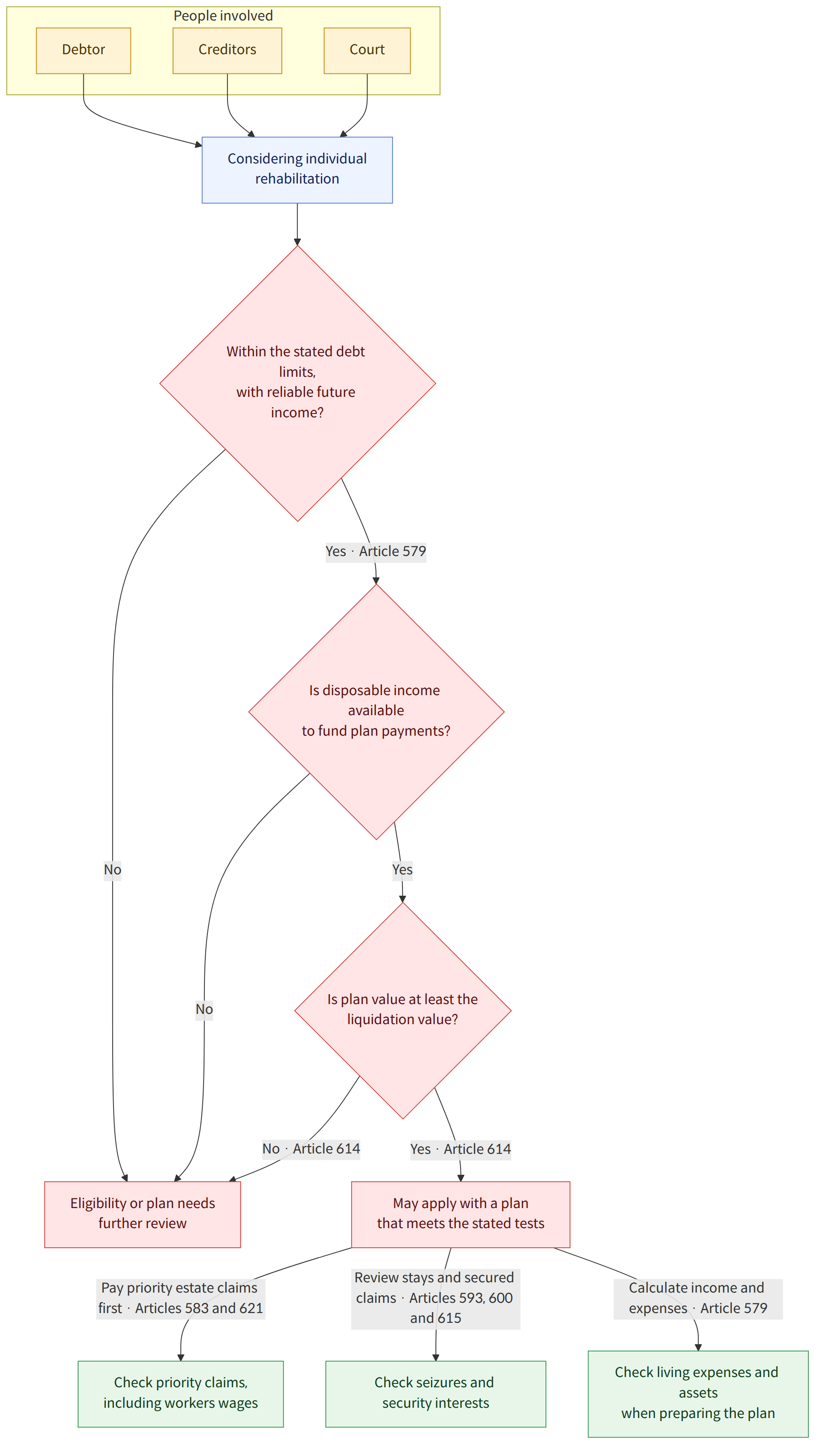
Key points
- An individual who is insolvent or at risk of insolvency and is likely to earn income regularly or continuously may apply. The debt limits stated in the examples are no more than KRW 1 billion in secured claims and KRW 500 million in unsecured claims (Debtor Rehabilitation and Bankruptcy Act, Article 579 (채무자 회생 및 파산에 관한 법률 제579조); Example 13).
- Disposable income is the amount remaining from average monthly income after deducting taxes and social insurance contributions, living expenses for the debtor and dependents, and expenses necessary for operating a business. It is used to fund repayment (Debtor Rehabilitation and Bankruptcy Act, Article 579, subparagraph 4 (채무자 회생 및 파산에 관한 법률 제579조 제4호); Examples 4–6).
- The present value of the repayment plan must be at least equal to the liquidation value—the amount that would be distributed to creditors in bankruptcy. To meet this requirement, a plan may adjust living expenses or include proceeds from asset dispositions in the repayment amount (Debtor Rehabilitation and Bankruptcy Act, Article 614 (채무자 회생 및 파산에 관한 법률 제614조); Examples 3, 9, and 25).
- Claims against the individual rehabilitation estate, including workers’ wage claims, must be paid before individual rehabilitation claims and separately from the proceedings. Failure to do so may result in compulsory execution or termination of the proceedings (Debtor Rehabilitation and Bankruptcy Act, Articles 583 and 621 (채무자 회생 및 파산에 관한 법률 제583조, 제621조); Examples 1 and 17).
- At the application stage, you may apply to stay or prohibit compulsory execution and similar proceedings. Upon a commencement decision, proceedings within the scope prescribed by law are stayed or prohibited. However, in some cases a secured creditor may enforce its security interest after approval of the plan (Debtor Rehabilitation and Bankruptcy Act, Articles 593, 600, and 615 (채무자 회생 및 파산에 관한 법률 제593조, 제600조, 제615조); Examples 7, 10, and 22).
- If circumstances change unexpectedly—for example, through unemployment, reduced income, or an increase in the number of dependents—you may apply to modify the repayment plan. Even if you have not completed repayment, the court may grant a discretionary discharge if certain requirements are met (Debtor Rehabilitation and Bankruptcy Act, Article 619 and Article 624, paragraph 2 (채무자 회생 및 파산에 관한 법률 제619조, 제624조 제2항); Examples 12 and 15).
- Concealing assets or income, or damaging or improperly disposing of assets, may give rise to criminal liability. However, a precedent cited here held that merely failing to properly disclose information in an asset list through passive omission does not, by itself, constitute concealment of assets for the purpose of fraud in rehabilitation proceedings (Debtor Rehabilitation and Bankruptcy Act, Article 643, paragraph 3 (채무자 회생 및 파산에 관한 법률 제643조 제3항); Supreme Court Decision 2008Do6950, rendered January 30, 2009 (대법원 2009. 1. 30. 선고 2008도6950 판결); Example 20).
Frequently asked questions
Q. Can I apply for individual rehabilitation if I work part-time or as a day laborer?
Eligibility is not determined solely by employment type or whether income is reported. What matters is whether you are likely to earn regular and reliable income, or to earn income continuously or repeatedly in the future. The debt limits stated in the examples are no more than KRW 1 billion in secured claims and KRW 500 million in unsecured claims.
Q. How are individual rehabilitation repayment payments calculated?
Disposable income is the amount remaining from average monthly income after deducting taxes and social insurance contributions, living expenses for the debtor and dependents, and expenses necessary for operating a business. It may vary from person to person, taking into account factors such as the number and ages of dependents, their income, and whether they are actually supported by the debtor.
Q. Can I apply for individual rehabilitation if I own assets such as a home or a rental deposit?
Having assets does not by itself make you ineligible to apply. However, the present value of payments under the repayment plan must be at least equal to the liquidation value. Accordingly, if you wish to retain your assets, you may need to increase your disposable income or reflect the proceeds from disposing of assets in the repayment plan.
Q. Can I pay only part of unpaid wages or taxes through individual rehabilitation and have the rest discharged?
The examples explain that a worker’s wage claims and similar claims are claims against the individual rehabilitation estate. Such claims must be paid before individual rehabilitation claims, and the repayment plan must provide for their payment in full. Taxes may also receive priority payment or separate treatment in the proceedings, depending on their type and nature, so you should review your tax arrears when preparing a plan.
Q. If I apply for individual rehabilitation, will wage garnishment or an ongoing auction stop immediately?
Filing an application does not automatically stop all enforcement. At the application stage, you may apply to the court for a stay or prohibition. After the commencement decision, enforcement and other proceedings that meet the statutory requirements may be stayed or prohibited, but enforcement of security interests may resume after approval of the repayment plan.
Q. Can I apply if a home is subject to a mortgage or I have to return a tenant’s deposit?
You may apply, but a secured creditor may enforce its security interest separately from the individual rehabilitation proceedings, and only the amount not recoverable through the security may be treated as an individual rehabilitation claim. A tenant’s deposit, where the tenant has a preferential right to repayment, must also be reflected in the list of creditors and related documents. You should therefore carefully verify the details of the security and lease.
Q. If I cannot make the repayment payments, will I be unable to obtain a discharge?
If it has become difficult to comply with the plan because of circumstances such as unemployment or a decrease in income, you may apply to modify the repayment plan before completing the payments. Even if you have not completed repayment, the court may grant a discharge if all statutory requirements—including circumstances for which you are not responsible—are met. However, meeting the requirements does not guarantee that a discharge will be granted.
Q. If I go through individual rehabilitation, will my guarantor also be free from having to repay the debt?
Individual rehabilitation is a proceeding for the debtor personally, so creditors may still pursue the guarantor separately. In the principal debtor’s proceedings, the law prescribes how matters are handled, including listing prospective persons entitled to reimbursement in the list of creditors. If a creditor exercises its rights for the full amount of the claim, the guarantor’s ability to exercise procedural rights may be limited.
Q. If I leave out assets or income from my application, could that constitute fraud in rehabilitation proceedings?
Conduct such as concealing or damaging assets, or disposing of them to the detriment of creditors, may raise the issue of fraud in rehabilitation proceedings. However, a precedent cited in the examples held that merely failing to properly disclose asset or income circumstances in an asset list or similar document, through passive omission, did not constitute concealment of assets for the purpose of that offense. Even so, you must accurately and fully disclose your assets and income.
Relevant laws
- Debtor Rehabilitation and Bankruptcy Act, Article 579 (채무자 회생 및 파산에 관한 법률 제579조)
- Debtor Rehabilitation and Bankruptcy Act, Article 580 (채무자 회생 및 파산에 관한 법률 제580조)
- Debtor Rehabilitation and Bankruptcy Act, Article 581 (채무자 회생 및 파산에 관한 법률 제581조)
- Debtor Rehabilitation and Bankruptcy Act, Article 583 (채무자 회생 및 파산에 관한 법률 제583조)
- Debtor Rehabilitation and Bankruptcy Act, Article 593 (채무자 회생 및 파산에 관한 법률 제593조)
- Debtor Rehabilitation and Bankruptcy Act, Article 600 (채무자 회생 및 파산에 관한 법률 제600조)
- Debtor Rehabilitation and Bankruptcy Act, Article 611 (채무자 회생 및 파산에 관한 법률 제611조)
- Debtor Rehabilitation and Bankruptcy Act, Article 614 (채무자 회생 및 파산에 관한 법률 제614조)
- Debtor Rehabilitation and Bankruptcy Act, Article 615 (채무자 회생 및 파산에 관한 법률 제615조)
- Debtor Rehabilitation and Bankruptcy Act, Article 619 (채무자 회생 및 파산에 관한 법률 제619조)
- Debtor Rehabilitation and Bankruptcy Act, Article 621 (채무자 회생 및 파산에 관한 법률 제621조)
- Debtor Rehabilitation and Bankruptcy Act, Article 624 (채무자 회생 및 파산에 관한 법률 제624조)
- Debtor Rehabilitation and Bankruptcy Act, Article 643 (채무자 회생 및 파산에 관한 법률 제643조)
- Housing Lease Protection Act, Article 3 (주택임대차보호법 제3조)
- Housing Lease Protection Act, Article 3-2 (주택임대차보호법 제3조의2)
Watch out for
- Filing an application does not stop all seizures or auctions. If necessary, you must apply to the court for a stay or prohibition.
- Even if enforcement of a security interest is temporarily stayed after commencement of the individual rehabilitation proceedings, it may resume after approval of the plan. Consider whether a separate agreement with the secured creditor is necessary.
- Claims against the individual rehabilitation estate, including wages, must be paid in priority and separately from payments on ordinary claims under the repayment plan.
- If it has become difficult to comply with the repayment plan, consider whether it can be modified before missed payments accumulate. A modification proposal may be submitted before repayment is completed, but it must also meet the requirements for approval.
Related articles
Source cases
This guide was compiled by AI from the following Korea Legal Aid Corporation consultation cases (in Korean).
- 개인회생신청 시 미지급 임금이나 조세는 어떻게 되는지
- 개인회생신청 시 급여에 대한 압류 해제가 가능한지
- 청산가치보장의 원칙과 면제재산의 범위
- 가용소득과 관련한 생계비의 산정은 어떻게 하는지
- 가용소득과 관련한 월평균 소득의 산정은 어떻게 하는지
- 가용소득과 관련하여 생계비 산정 방법
- 개인회생신청 시 강제집행 및 담보권실행을 막을 수 있는지
- 개인회생신청 시 주택임차보증금채무는 어떻게 되는지
- 개인회생신청 시 재산처분을 통한 변제도 해야 하는지
- 개인회생절차에서 별제권이란 무엇인지
- 개인회생신청 시 보증인은 어떻게 되는지
- 개인회생절차 종료 후 면책 가능여부
- 개인회생제도에 이용자격 제한이 있는지
- 변제계획인가 후 개인회생절차폐지
- 변제계획의 변경 또는 면책이 가능한지
- 신청불성실을 이유로 한 개인회생절차개시 기각
- 개인회생재단채권과 개인회생절차상 처리
- 급여채권에 압류 및 전부명령이 확정된 경우 개인회생신청 가능 여부
- 개인회생절차는 어떻게 진행되는지
- 사기회생죄 성립 여부
- 편파변제 등과 관련한 개인회생절차개시신청 기각사유
- 개인회생절차개시결정과 강제집행의 중지·금지
- 상속포기와 부인권 행사
- 개인회생절차에서 장래의 구상권자에 대한 처리
- 청산가치와 가용소득의 현가와의 비교 방법
This guide is general legal information about Korean law, not legal advice for your situation. For a specific case, consult a lawyer or the Korea Legal Aid Corporation (call 132 in Korea).