
A Guide to the Meaning of Possession and Claims for Its Protection
Based on 19 consultation cases · Updated · Translated from the Korean original.
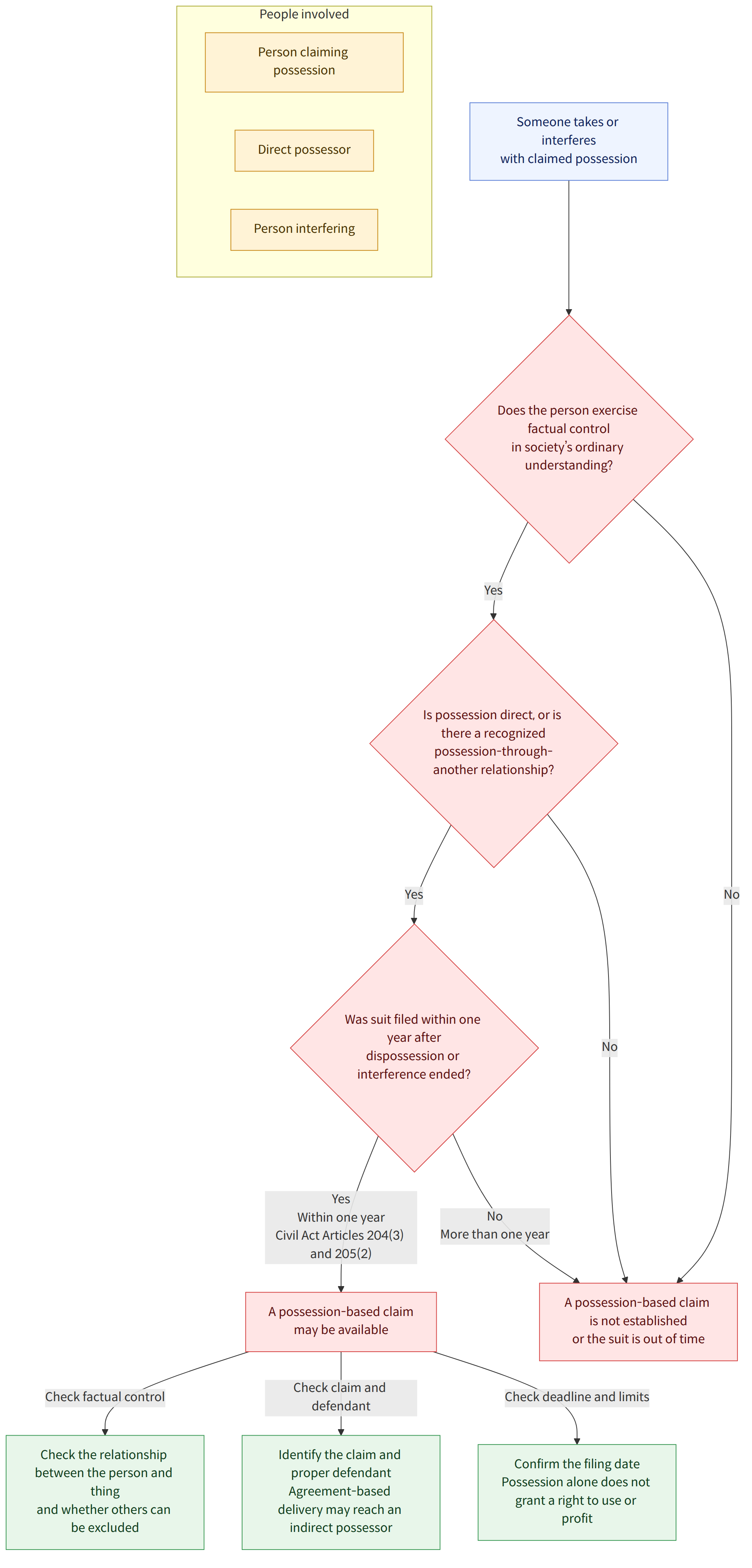
Possession is not recognized only when someone physically holds a thing. Rather, whether a person exercises factual control in the ordinary understanding of society is determined by considering the relationship between the thing and the person, among other factors. If possession is taken or interfered with, a claim based on the right of possession may be available, but the type of claim, the proper defendant, and the time limit for filing suit must be considered.
At a glance
Key points
- Possession means objective factual control over a thing and is not determined solely by physical, actual control.
- An action to recover possession may concern indirect possession as well as direct possession. For indirect possession, however, there must be a relationship of possession through another in which the direct possessor possesses the thing in recognition of the indirect possessor’s right to demand its return.
- An action to recover possession, remove interference, or otherwise protect possession must be filed within one year from the date the dispossession or interference ended (Civil Act, Article 204(3), Article 205(2) (민법 제204조 제3항, 제205조 제2항)).
- A claim to remove interference based on the right of possession may be established when possession is interfered with even without a legal basis justifying that possession.
- The right of possession does not mean a right to use or derive benefits from another person’s property, and it does not include such powers in claims to remove or prevent interference.
- A claim for delivery of real property under an agreement may also be brought against an indirect possessor, but the outcome may differ if the indirect possessor’s duty cannot reasonably be expected to be performed because of another person’s direct possession.
- A possessor in good faith acquires the fruits of the thing possessed for as long as the possessor remains in good faith. The judgment in the case discussed held that there was no duty to return those fruits even if they were obtained without legal grounds (Civil Act, Article 201(1) (민법 제201조 제1항)).
- When a possessor is asked by the person entitled to recovery to return the thing possessed, the possessor may exercise a claim for reimbursement of necessary and useful expenses, and the reimbursement obligation is then due (Civil Act, Article 203(1), Article 203(2) (민법 제203조 제1항, 제203조 제2항)).
Frequently asked questions
Q. Is possession recognized only when someone physically holds or uses a thing?
Not necessarily. Whether there is factual control in the ordinary understanding of society is determined by considering the temporal and spatial relationship between the person and the thing, the legal relationship, and whether the control of others can be excluded.
Q. Can an indirect possessor bring an action to recover possession of a building occupied by a tenant?
Indirect possession may also be the subject of an action to recover possession, but there must be a relationship of possession through another between the indirect possessor and the direct possessor. In the case discussed, it was considered difficult to find such a relationship between the tenant and a third party who was not the landlord entitled to demand the property’s return from the tenant.
Q. Can an action to recover possession be brought more than one year after dispossession?
According to the case discussed, the action must be filed within one year from the date of dispossession. This is not a period that can be met merely by making a demand outside court; it is interpreted as a period for filing suit.
Q. Can I claim removal of interference even if I have no contract or right justifying my possession?
The judgment in the case discussed held that a claim to remove interference based on the right of possession does not require a legal basis justifying the possession. However, the right of possession alone does not entitle someone to use or derive benefits from another person’s property.
Q. Can a claim for delivery of real property under an agreement also be brought against an indirect possessor?
Unlike a claim for delivery based on unlawful possession, a claim for delivery under an agreement may also be brought against an indirect possessor. An exception may apply, however, where another person’s direct possession prevents the indirect possessor from performing the duty to deliver and performance cannot reasonably be expected.
Q. Do I have to return profits generated by property I possessed in good faith?
The judgment in the case discussed held that a possessor in good faith acquires the fruits of the thing possessed for as long as the possessor remains in good faith. It ruled that the possessor is not obliged to return those fruits even if they were acquired without legal grounds and another person suffered a loss as a result.
Q. Can I claim reimbursement for necessary or useful expenses when asked to return the thing I possess?
A possessor may claim reimbursement for necessary and useful expenses incurred to preserve or improve the thing when returning it. The judgment in the case discussed held that the claim for reimbursement may be exercised when the person entitled to recovery demands return of the thing, and that the reimbursement obligation is then due.
Q. Can I bring an action simply to have my right of possession confirmed?
The judgment in the case discussed held that there is no interest in bringing an action to confirm a right of possession if the state of possession can change easily and confirmation alone cannot effectively resolve legal uncertainty. The matter may be viewed differently, however, where there are special circumstances requiring an immediate legal determination.
Relevant laws
- Civil Act, Article 204(1) (민법 제204조 제1항)
- Civil Act, Article 204(3) (민법 제204조 제3항)
- Civil Act, Article 205(2) (민법 제205조 제2항)
- Civil Act, Article 201(1) (민법 제201조 제1항)
- Civil Act, Article 203(1) (민법 제203조 제1항)
- Civil Act, Article 203(2) (민법 제203조 제2항)
- Local Tax Act, Article 104(4) (지방세법 제104조 제4호)
- Local Tax Act, Article 104(8) (지방세법 제104조 제8호)
Watch out for
- The one-year period for claims to protect possession is a period for filing suit. The fact that a demand was made outside court does not, by itself, mean that the time limit was met.
- A case held that changing an action based on an underlying right into an action to recover possession is treated as equivalent to filing the latter action at the time of the change. Accordingly, check whether one year has passed since the dispossession.
- The proper defendant for a claim to recover possession, and whether indirect possession is recognized, may depend on the actual state of possession and the relationship of possession through another.
- A claim to remove interference based on the right of possession protects factual control; it does not recognize a right to use or derive benefits from another person’s property.
Source cases
This guide was compiled by AI from the following Korea Legal Aid Corporation consultation cases (in Korean).
- 점유회수의 소에서 말하는 ‘점유’의 의미 및 간접점유의 ‘점유매개관계’를 인정하기 위한 요건
- 건물에 대한 점유 유지 판단기준
- 물건에 대한 점유의 의미
- 본권에 기한 청구를 점유권에 기한 청구로 교환적 변경하는 경우 제소기간
- 점유보호청구권의 제척기간의 성질
- 선박의 소유권이전등록을 하지는 않았으나 어구를 포함한 선박을 인도받아 점유·사용하고 있는 경우 점유권 침해로 볼 수 있는지 여...
- 약정에 의하여 부동산 인도를 청구하는 경우, 간접점유자를 상대로 청구할 수 있는지 여부
- 상호 점유 침탈
- 민법 제201조 제1항에서 선의의 점유자에게 과실취득권을 인정한 취지
- 점유권의 확인을 구하는 소의 이익
- 점유자가 회복자에게서 점유물 반환을 청구받은 경우, 필요비나 유익비 상환청구권의 이행기 도래 여부
- 간접점유권의 양도
- 하천복개부지 점유권매매에 대하여 취득세를 부과할 수 있는지 여부
- 직접점유자와 간접점유자의 부당이득반환 의무 사이의 관계
- 점유권에 의한 방해배제청구권이나 방해예방청구권에 타인이 소유하는 물건을 사용·수익할 권능이 포함되는지 여부
- 점유를 정당화할 권원과 점유권에 의한 방해배제청구권의 관계
- 점유권에 기한 방해배제청구권의 성립요건
- 무효인 임대차계약에 의한 점유에 기하여 그 점유방해배제를 청구할 수 있는지 여부
- 위법한 강제집행에 의하여 유체동산의 인도를 받은 경우 점유권 침탈로 볼 수 있는지 여부
This guide is general legal information about Korean law, not legal advice for your situation. For a specific case, consult a lawyer or the Korea Legal Aid Corporation (call 132 in Korea).