
Guide to Rights Under Bills and Checks and Claims for Payment
Based on 257 consultation cases · Updated · Translated from the Korean original.
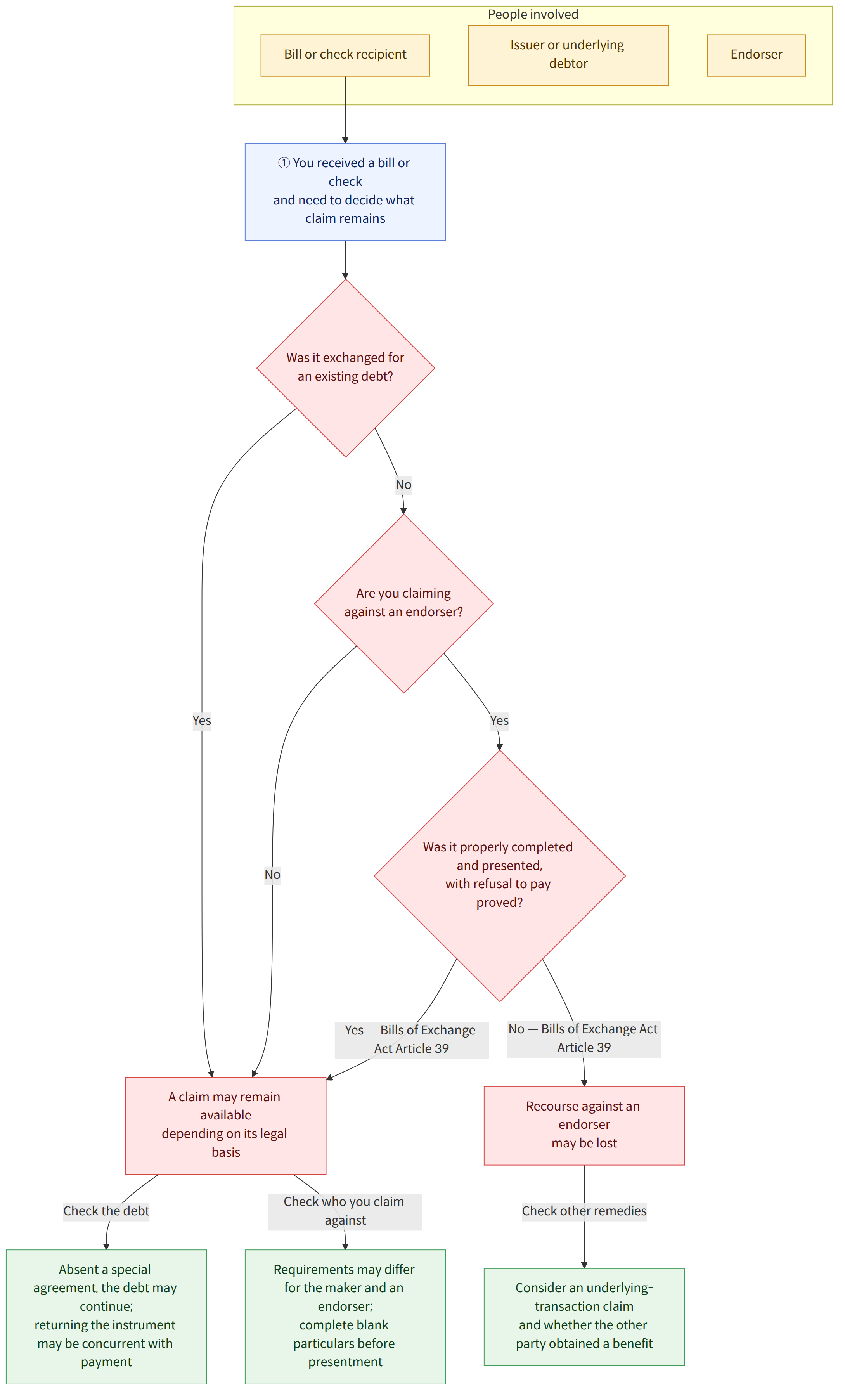
Even if you receive a bill or check, you may lose your rights against endorsers and others if you miss the procedures for presentment for payment or recourse. If you received a bill as payment of an existing debt, you should also check whether the underlying claim continues to exist and how returning the bill relates to performance of the debt.
At a glance
Key points
- If a bill or check is exchanged to perform an existing debt, then, absent a special agreement, the existing debt generally continues to exist alongside the obligation under the instrument. If the issuer is a third party other than the debtor of the underlying obligation, delivery is presumed to have been made “for payment” (Supreme Court Decision of November 9, 1993, 93Da11203, 11210; Supreme Court Decision of November 8, 1996, 95Da25060).
- Where the underlying claim and the claim under the bill or check coexist, returning the instrument may be concurrent with performance of the debt when the underlying claim is asserted (Supreme Court Decision of November 9, 1993, 93Da11203, 11210).
- A right of recourse against an endorser or others requires compliance with conditions such as proper presentment for payment and proof of refusal to pay. The requirements for a claim against the maker of a promissory note may differ from those for recourse against an endorser (Bills of Exchange Act, Article 39 (어음법 제39조); Cases 1, 3, 6, and 10).
- If a blank bill is presented for payment without completing the required particulars, you may lose the right of recourse against an endorser. However, for a blank bill on which the maturity date is stated, the limitation period for a claim under the bill may begin to run from the maturity date even before the blank portion is completed (Bills of Exchange Act, Articles 70(1) and 77(1)(8) (어음법 제70조 제1항, 제77조 제1항 제8호); Cases 3 and 18).
- For a bill with a blank maturity date given as security for continuing transactions, absent special circumstances, the limitation period for the right to complete the blank begins to run when the transactions end and the right under the bill becomes exercisable (Supreme Court Decision of May 28, 1997, 96Da25050; Case 15).
- The fact that a person endorsed a promissory note as a guarantor does not, by itself, establish that the person also guaranteed the underlying debt. An intention to guarantee the underlying debt must be established based on the specific circumstances before and after the endorsement (Supreme Court Decision of December 2, 1994, 93Da59922; Case 9).
- The expiration of rights under a bill or check due to a limitation period or procedural defect does not always give rise to a claim for reimbursement of benefits. It is necessary to consider whether other remedies, such as a claim based on the underlying transaction, are available and whether the other party actually obtained a financial benefit (Bills of Exchange Act, Article 79 (어음법 제79조); Check Act, Article 63 (수표법 제63조); Cases 7 and 19).
- In cases involving forged bills or endorsements, liability under the instrument and an employer’s liability under the Civil Act may be considered separately. Damages based on an employer’s liability are not determined solely by whether the right of recourse under the bill was preserved (Civil Act, Article 756 (민법 제756조); Cases 12 and 20).
Frequently asked questions
Q. I failed to present a bill on time. Can I claim against both the maker and the endorser?
It may depend on whom you are claiming against. The cases explain that a claim against the maker, who is the principal debtor on a promissory note, is not barred merely because the period for presentment for payment has expired. However, the right of recourse against an endorser may not be preserved if proper presentment for payment was not made.
Q. I received a bill issued by a third party instead of payment for existing goods. If the bill is dishonored, can I claim the price of the goods again?
Absent a special agreement, the existing debt may be presumed to continue alongside the obligation under the bill. However, when asserting the underlying claim, returning the bill may be concurrent with performance of the debt. You should therefore also consider returning the bill or requiring payment in exchange for its return.
Q. Can I present a blank bill for payment as it is, with the issue date or payee left blank?
To seek recourse against an endorser, you must complete the necessary blank portions and then properly present the bill for payment. Presentment without completing statutory particulars, such as the issue date, is not proper presentment and may result in the loss of the right of recourse.
Q. Can I still complete a blank bill with no maturity date that I received a long time ago as security for ongoing transactions?
For a bill issued with the maturity date left blank to secure payment of debts arising from continuing transactions in goods, absent special circumstances, the limitation period for the right to complete the blank begins to run when the transactions end and the right under the bill becomes exercisable. Therefore, the fact that a long time has passed since you received the bill does not, by itself, mean that it can no longer be completed.
Q. If I endorse a promissory note, does that mean I have guaranteed the original debt as well?
Generally, an endorser is liable under the bill by virtue of the endorsement, but does not thereby guarantee the underlying debt. Whether the endorser intended to guarantee the underlying debt is determined based on the parties’ specific agreement and the circumstances at the time of the transaction.
Q. If the rights under a check have expired because I did not present it, is there no way to recover the money?
Even if the rights under a check have expired due to a limitation period or procedural defect, you may consider whether a claim based on the underlying relationship or a claim for reimbursement of benefits is available. However, a claim for reimbursement of benefits requires that the other party actually obtained a financial benefit, among other conditions, and may not be recognized if another remedy remains available.
Q. If a claim is assigned to someone else after a check is exchanged, does the debt remain even if the check is later paid?
If a check was delivered to pay an existing debt, it may be understood that the parties intended the underlying debt to be extinguished upon payment of the check. If that circumstance already existed before notice of the assignment was given, the debtor may argue to the assignee that the underlying debt was extinguished even if the check is paid after notice.
Q. An endorsement on a bill was forged, but I missed the deadline for presentment. Can I claim damages from the company?
If an employee’s forgery was related to the performance of the employee’s duties and the employer’s liability is established, that liability is a civil-law obligation to pay damages, separate from liability under the bill. The cases explain that, to claim employer liability, it is not necessarily required that a right of recourse under the bill exist or that proper presentment for payment have been made.
Relevant laws
- Bills of Exchange Act, Article 10 (어음법 제10조)
- Bills of Exchange Act, Article 13(2) (어음법 제13조 제2항)
- Bills of Exchange Act, Article 16(1) (어음법 제16조 제1항)
- Bills of Exchange Act, Article 20(1) (어음법 제20조 제1항)
- Bills of Exchange Act, Article 69 (어음법 제69조)
- Bills of Exchange Act, Article 70(1) (어음법 제70조 제1항)
- Bills of Exchange Act, Article 75 (어음법 제75조)
- Bills of Exchange Act, Article 76 (어음법 제76조)
- Bills of Exchange Act, Article 77(1)(1) (어음법 제77조 제1항 제1호)
- Bills of Exchange Act, Article 77(1)(8) (어음법 제77조 제1항 제8호)
- Bills of Exchange Act, Article 78(1) (어음법 제78조 제1항)
- Bills of Exchange Act, Article 79 (어음법 제79조)
- Check Act, Article 1 (수표법 제1조)
- Check Act, Article 12 (수표법 제12조)
- Check Act, Article 29 (수표법 제29조)
Watch out for
- To seek recourse against an endorser or others, do not miss the presentment period or the requirements for proof of refusal to pay. The cases explain that a proper presentment for payment within 10 days of the issue date is required to seek recourse against the drawer of a check (Check Act, Article 29 (수표법 제29조); Case 6).
- The right of recourse exercised by the holder of a check or another person may become time-barred if it is not exercised within six months after the presentment period expires (Check Act, Article 51 (수표법 제51조); Case 17).
- A claim under a promissory note against its maker may become time-barred if it is not exercised within three years from maturity (Bills of Exchange Act, Articles 70(1) and 77(1)(8) (어음법 제70조 제1항, 제77조 제1항 제8호); Cases 7 and 18).
- Whether the underlying claim continues to exist may depend on whether the bill or check was delivered in substitution for payment of the existing debt, for the purpose of payment, or as security. You should therefore check the parties’ agreement and the circumstances in which it was delivered.
Related articles
Source cases
This guide was compiled by AI from the following Korea Legal Aid Corporation consultation cases (in Korean).
- 악의의 항변과 원인채권의 행사
- 원인채무 이행과 어음반환이 동시이행 관계인 경우 이행지체책임
- 발행일란의 보충 없이 약속어음을 지급제시한 경우 상환청구권 행사 가능한지
- 사고신고담보금을 수동채권으로 한 지급은행의 상계가 권리남용인지
- 국내에서 발행된 어음에 발행지의 기재가 없는 경우 그 효력
- 수표에 대한 지급금지가처분결정이 있더라도 제3취득자가 수표발행인인 제3채무자를 상대로 그 이행을 청구할 수 있는지 여부
- 어음채권과 그 원인채권 모두 시효 소멸한 경우 이득상환청구권
- 회생채권 미신고로 실권된 약속어음 소지인의 사고신고담보금지급청구권
- 약속어음에 보증취지로 배서한 자가 어음의 원인채무 보증까지 부담하는지
- 채권자가 적법한 수표금 지급제시를 하지 않은 경우 채무자의 손해
- 융통어음과 어음할인에서의 인적항변의 단절
- 어음배서가 위조된 경우 사용자책임을 묻기 위한 요건
- 융통어음의 항변이 제3자인 소지인에 대하여도 가능한지
- 어음 배서의 연속의 판단
- 계속적거래 채무 지급으로 만기 백지인 약속어음 발행 시 백지보충권 소멸시효
- 사고신고담보금 지급 후 제권판결이 취소된 경우 은행의 면책요건
- 할인해 준 당좌수표가 부도되고 소멸시효 지난 경우 수표할인의 성질
- 만기가 기재된 백지어음의 지급제시와 소멸시효 중단
- 이득상환청구권은 어떤 경우에 인정되는지
- 위조어음에 통상적인 꼭지 간인이 없었던 경우 표현대리 성립 여부
- 기한 후 백지식 배서의 효력
- 상환청구권 보전의무를 이행하지 아니한 어음소지인의 책임
- 원인채권 양도 이전에 교부된 수표가 채권양도 이후에 지급된 경우, 원인채무 소멸의 효과를 채권양수인에게 주장할 수 있는지 여부...
- 통정허위표시로 발행한 약속어음의 효력
- 약속어음에 있어서 만기 전의 소구가 인정되는 경우
This guide is general legal information about Korean law, not legal advice for your situation. For a specific case, consult a lawyer or the Korea Legal Aid Corporation (call 132 in Korea).