
Recovering and Exercising Ownership: Key Rules to Know
Based on 122 consultation cases · Updated · Translated from the Korean original.
It is difficult to determine ownership and the possibility of recovering it based on registration alone; the type of title trust, the parties to the sale contract, and whether a third party acquired rights must also be considered. Land boundaries, unregistered real estate, and common areas in multi-unit buildings are likewise assessed under different rules.
At a glance
Key points
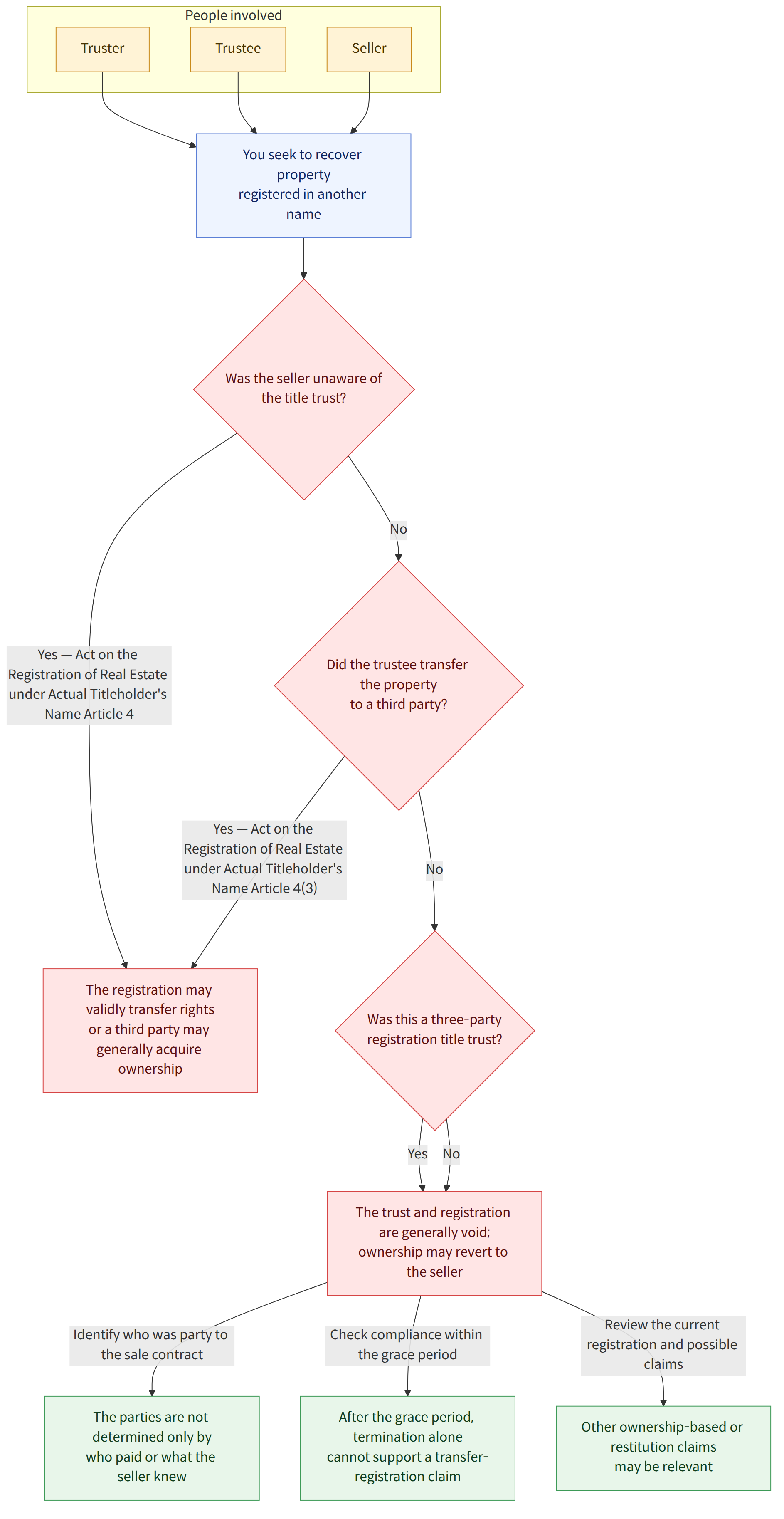
- Under the Act on the Registration of Real Estate under Actual Titleholder's Name, a title-trust agreement and the registration made pursuant to it are generally void. However, if the other party to the sale contract did not know about the title trust, the change in real rights resulting from the registration may be valid (Act on the Registration of Real Estate under Actual Titleholder's Name, Article 4 (부동산 실권리자명의등기에관한법률 제4조)).
- Even a title trust made before the Act on the Registration of Real Estate under Actual Titleholder's Name took effect cannot support a claim for registration of a transfer of ownership based on termination of the title trust after the grace period has expired, if the property was not registered in the titleholder’s real name or otherwise brought into compliance within the grace period (Cases 5 and 9).
- In a three-party registration title trust, if the agreement and registration are void, ownership may revert to the seller. In that situation, it must be considered whether the truster can exercise rights based on a claim for registration of a transfer of ownership against the seller (Cases 2 and 3).
- If the trustee transfers the real estate to a third party, the third party can generally acquire ownership regardless of whether they knew the title trust was invalid (Act on the Registration of Real Estate under Actual Titleholder's Name, Article 4(3) (부동산 실권리자명의등기에관한법률 제4조 제3항), Cases 13 and 14).
- Whether an arrangement is a contract-name title trust is determined by identifying the parties to the sale contract. The parties are not determined solely by who paid the purchase price or whether the seller knew about the title trust (Cases 11 and 16).
- Absent special circumstances, the extent of land ownership is determined by the boundaries and area shown in the cadastral records, not by the location of an actual fence or the boundary of actual use (Case 15).
- Whether part of a multi-unit building is a common area or a unit for exclusive use is generally determined by its objective structure and use when separate ownership was established. The later use of a common area for residential purposes does not convert it into a unit for exclusive use (Cases 20 and 24).
- A person who finds lost property must return it promptly or hand it in to a police station or other appropriate place. If the owner appears, the finder may claim compensation within the statutory limits; if no one asserts rights within the prescribed period, the finder may acquire ownership (Lost Articles Act, Articles 1, 4, 6, 9, and 14 (유실물법 제1조·제4조·제6조·제9조·제14조); Civil Act, Article 253 (민법 제253조)).
Frequently asked questions
Q. Can I recover real estate registered in someone else’s name a long time ago by terminating the title trust?
After the grace period under the Act on the Registration of Real Estate under Actual Titleholder's Name has expired, the title-trust agreement and the registration made pursuant to it are void. Accordingly, you cannot seek registration of a transfer of ownership on the basis of termination of the title trust. Depending on the type of title trust and the current registration status, however, other options—such as a claim to cancel the registration based on ownership or a claim for restitution of unjust enrichment—may be relevant.
Q. If the trustee sells title-trust property to a third party, can I get the ownership back?
As a general rule, a third party who acquires real estate from the trustee can acquire ownership that cannot be defeated by asserting that the title trust was void. However, the circumstances must be considered individually, including whether there was a separate ground for invalidating the third party’s acquisition or any special circumstances, such as the third party’s active participation.
Q. If I paid the purchase price when buying title-trust property, does that make me the purchaser?
The purchaser is determined by identifying the parties to the sale contract. The fact that you paid the purchase price or that the seller knew about the title trust does not, by itself, make the title truster a party to the contract. Special circumstances must also be considered, including who the parties intended to bear the legal effects of the contract.
Q. If the boundary of registered land differs from the actual location of a fence, which one controls?
Absent special circumstances, the location, lot number, land category, area, and boundaries of land are determined according to the cadastral records. It must be separately determined whether special circumstances exist, such as the parties’ agreement at the time of sale to transact by reference to the boundaries on the ground, or a technical error in preparing the cadastral map.
Q. If the land register has no owner address or shows a different name, can I immediately register the initial ownership?
If the owner cannot be identified from the land register, it is difficult to register the initial ownership based on that record alone. You should consider correcting the owner information through an investigation and decision by the agency that maintains the cadastral records, or, depending on the circumstances, obtaining a final judgment proving ownership.
Q. If a basement shelter in a multi-unit residential building has been used as a room for a long time, can it become my property?
If an area was created as a common area when separate ownership was established, it does not become a separately owned unit even if it is later converted into a room or used as a residence. Whether a basement is a common area or a separate unit for exclusive use is determined by considering the building’s structure and objective use, the circumstances at the time of sale, and other relevant factors.
Q. If compensation paid to a fishing village fraternity seems to have been distributed unfairly, can I claim my share directly?
Compensation for the extinguishment of a fishing right is collectively owned by the fishing village fraternity, so any distribution under its rules or a general meeting resolution must be considered first. Rather than immediately claiming an individual share, a member should consider challenging the resolution as nonexistent or invalid if there was a defect in the general meeting’s decision-making process or its terms were manifestly unfair.
Q. I found a wallet on a bus. Can I keep it if the owner does not appear?
A wallet should be returned to its owner promptly or handed in to a police station or other appropriate place. If it is handed in and notice is given in accordance with the statutory procedure, and the owner does not assert their rights within the prescribed period, the finder may acquire ownership. Even then, the finder must collect the item within the prescribed period after acquiring ownership.
Q. If I bought real estate a long time ago but never registered it, can I still claim ownership today?
Where, as in the example, the sale took place before the Civil Act came into force, a purchaser may lose ownership for failing to register within the period prescribed from the Act’s commencement. However, separate consideration must be given to whether the right to seek registration of a transfer of ownership under the sale contract remains, whether the purchaser took possession of and continuously occupied the property, and whether a subsequent purchaser actively participated in a double sale.
Relevant laws
- Act on the Registration of Real Estate under Actual Titleholder's Name, Article 3 (부동산 실권리자명의 등기에 관한 법률 제3조)
- Act on the Registration of Real Estate under Actual Titleholder's Name, Article 4 (부동산 실권리자명의 등기에 관한 법률 제4조)
- Act on the Registration of Real Estate under Actual Titleholder's Name, Article 6 (부동산 실권리자명의 등기에 관한 법률 제6조)
- Act on the Registration of Real Estate under Actual Titleholder's Name, Article 8 (부동산 실권리자명의 등기에 관한 법률 제8조)
- Act on the Registration of Real Estate under Actual Titleholder's Name, Article 11 (부동산 실권리자명의 등기에 관한 법률 제11조)
- Act on the Registration of Real Estate under Actual Titleholder's Name, Article 12 (부동산 실권리자명의 등기에 관한 법률 제12조)
- Civil Act, Article 2 (민법 제2조)
- Civil Act, Article 162 (민법 제162조)
- Civil Act, Article 188 (민법 제188조)
- Civil Act, Article 189 (민법 제189조)
- Civil Act, Article 215 (민법 제215조)
- Civil Act, Article 249 (민법 제249조)
- Civil Act, Article 252 (민법 제252조)
- Civil Act, Article 253 (민법 제253조)
- Civil Act, Article 275 (민법 제275조)
Watch out for
- Title-trust matters must be analyzed by distinguishing between a two-party registration title trust, a three-party registration title trust, and a contract-name title trust. The identity of the parties to the sale contract and the seller’s knowledge may affect the outcome.
- In the example, the right to seek registration of a transfer of ownership based on a claim for restitution of unjust enrichment was subject to a 10-year limitation period. The fact that a person possessed or used the real estate does not, by itself, mean that the limitation period for that right did not run.
- Where the boundary in the cadastral records differs from the boundary on the ground, or the owner shown in the land register is difficult to identify, do not assume that ownership or the boundary can be established solely from the property’s actual use or a privately prepared confirmation document.
- A claim for compensation for lost property must be made within one month after the property is returned. There is also a separate deadline for collecting property after acquiring ownership of it.
Source cases
This guide was compiled by AI from the following Korea Legal Aid Corporation consultation cases (in Korean).
- 수탁자명의로 부동산매매·소유권이전등기 한 경우 명의신탁자소유권회복
- 명의신탁 부동산을 수탁자가 임의 처분한 경우 명의신탁자의 보호
- 매수부동산을 타인명의로 등기명의신탁 한 경우 명의신탁자 소유권회복방법
- 양도담보로 제공된 동산의 선의취득 가능 여부
- 명의신탁자가 제3자에게 진정등기명의회복청구 가능한지
- 토지대장상 소유자의 주소를 모르는 미등기토지의 등기절차
- 상속인 중 1인이 피상속인 소유 부동산 전부를 그 명의로 등기한 후, 다른 상속인의 지분에 대해서는 대외로만 보유하겠다는 약정...
- 구민법 당시 부동산을 매수하고 이전등기하지 않은 자의 지위
- 유예기간 경과 후 등기명의신탁 해지를 원인으로 소유권이전등기신청이 가능한지
- 부동산소유자 행방불명 시 국유재산법상 공고만으로 국유화 가능한지
- 타인을 통해 부동산을 매수하면서 매수인 및 소유권이전등기 명의를 타인으로 하기로 한 경우, 그 타인이 매매당사자인지 여부
- 주택재건축정비사업조합이 현금청산대상자에게 매도청구 가능한지
- 부동산 명의신탁이 무효인 경우 제3자에 대한 대외적 효력
- 이른바 제3자간 명의신탁의 경우, 매도인이 대금을 모두 수령한 상태에서 수탁자가 자신의 명의로 등기한 부동산을 제3자에게 처분...
- 토지경계가 공부상과 일치하지 않을 경우 그 소유권의 범위
- 타인을 통해 부동산을 매수하면서 매수인 및 소유권이전등기 명의를 타인으로 하기로 하였으나, 매도인이 명의신탁관계를 알고 있었을...
- 명의수탁자로부터 신탁된 토지를 취득한 제3자의 부당이득반환청구
- 아파트 소유권이 분양회사인 경우 재건축조합의 매도청구 상대방
- 어촌계원이 바로 어업권상실 손실보상금지분 재분배청구 가능한지
- 공동주택의 공용부분을 주거로 사용할 때 전유부분으로 변경가능한지
- 명의신탁자가 명의신탁 부동산을 계속 점유·사용하여 온 경우에 명의수탁자에 대한 부당이득반환청구권에 기한 등기청구권의 소멸시효가...
- 지갑을 습득한 자의 유실물 소유자에 대한 보상청구권
- 학교법인이 명의수탁자인 경우 허가권을 가지는 관할청의 지위
- 아파트 지하층의 소유권은 입주자와 건축주 중 누구에게 귀속되는지
- 사실혼 배우자에게도 부동산 명의신탁이 허용되는지
This guide is general legal information about Korean law, not legal advice for your situation. For a specific case, consult a lawyer or the Korea Legal Aid Corporation (call 132 in Korea).