
Key Guide to Applying for, Enforcing, and Canceling Provisional Dispositions
Based on 52 consultation cases · Updated · Translated from the Korean original.
A provisional disposition is an interim measure intended to preserve rights or prevent risks arising from a disputed legal relationship until judgment is issued in the action on the merits. However, its effect on third parties, whether enforcement can be stayed, and the grounds for cancellation vary depending on the type of provisional disposition and how it is enforced.
At a glance
Key points
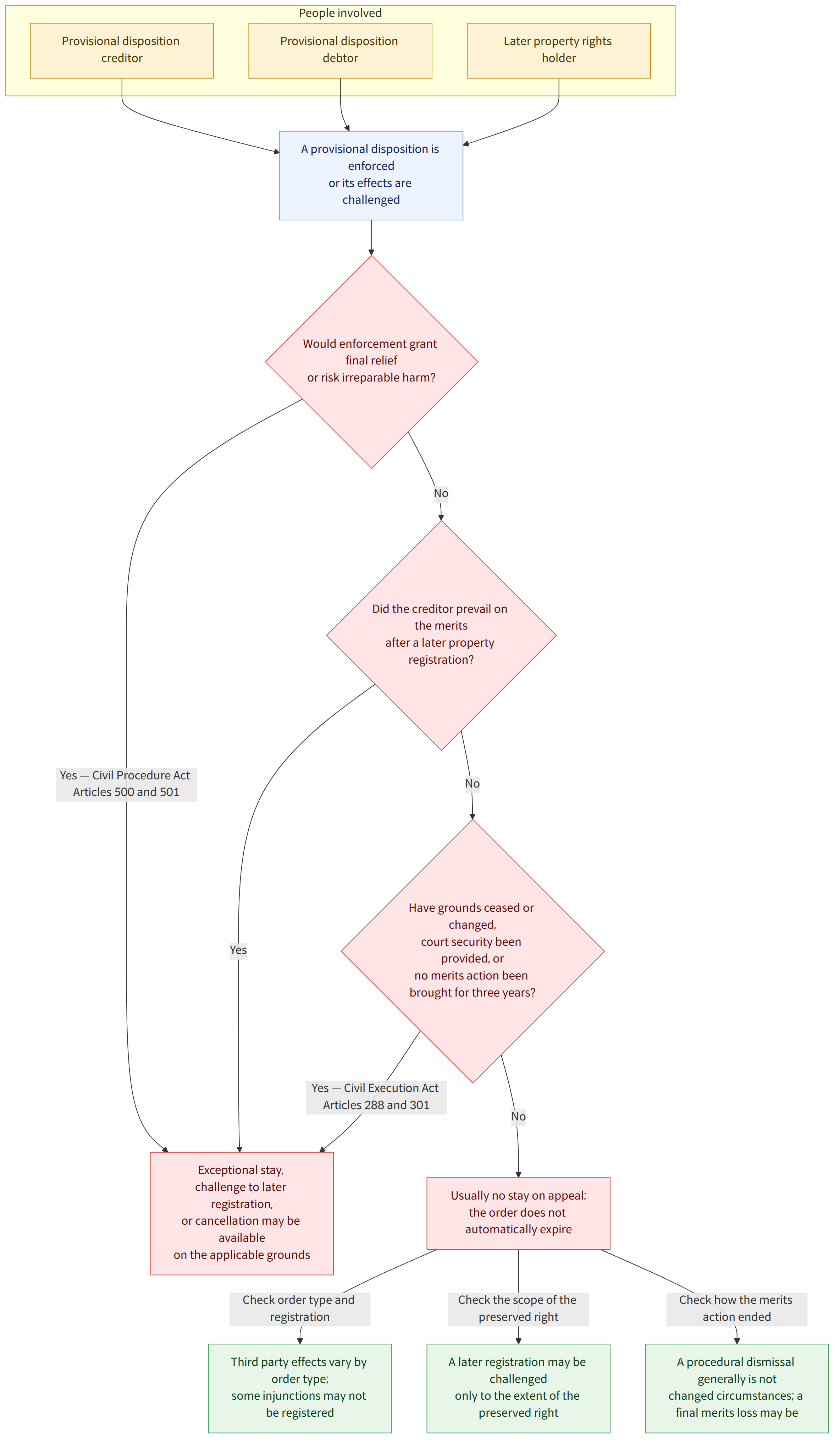
- A provisional disposition is, as a rule, an interim measure to preserve rights, so enforcement cannot be stayed merely by filing an appeal. However, a stay of enforcement may exceptionally be sought if enforcement would grant final relief or risk causing irreparable harm, as with an injunction requiring demolition (Civil Procedure Act, Articles 500 and 501 (민사소송법 제500조·제501조); Supreme Court Order No. 95그2, dated March 6, 1995).
- An injunction prohibiting disposition of real property may affect dispositions made after the injunction is enforced by registration. If the provisional-disposition creditor prevails in the action on the merits, the creditor may assert the injunction against subsequent registrations, or seek their cancellation, to the extent of the right to be preserved.
- Not every provisional disposition has an in rem effect against third parties. If an injunction prohibiting a change of the name of the building owner is not recorded in the register, it may be difficult to challenge the validity of a third party's acquisition where that party actually acquires the right and registers it.
- An application may be made to cancel a provisional disposition if the grounds for it have ceased to exist or circumstances have changed, if security set by the court has been provided, or if no action on the merits has been brought for three years after enforcement, among other grounds (Civil Execution Act, Articles 288 and 301 (민사집행법 제288조·제301조)).
- A provisional disposition does not automatically cease to have effect because three years have passed since enforcement. Even if an action on the merits is brought after the requirements for applying for cancellation have been met, this may not prevent cancellation (Supreme Court Judgment No. 99다37887, dated October 26, 1999).
- A final loss on the merits may constitute grounds for cancellation due to a change in circumstances, but a dismissal on procedural grounds is generally not treated as a change in circumstances (Supreme Court Judgment No. 94다42211, dated August 25, 1995).
- The scope of the right to be preserved by the provisional disposition is important. For example, an injunction to preserve a claim for registration of a mortgage may not cancel a subsequent registration itself; instead, it may prevent the holder from asserting the right or restriction on disposition, to the extent it conflicts with acquisition of the mortgage (Supreme Court Judgment No. 2015다202360, dated July 9, 2015).
Frequently asked questions
Q. Does appealing a ruling on a provisional disposition also stay its enforcement?
As a rule, enforcement is not stayed. However, in exceptional cases, a stay of enforcement may be sought if enforcement would effectively grant final relief or risk causing irreparable harm to the debtor, as with an injunction requiring demolition.
Q. What happens if real property is registered in another person's name after an injunction prohibiting its disposition?
A disposition made after the provisional-disposition registration has been completed may not be assertable against the provisional-disposition creditor, to the extent of the right to be preserved, if that creditor prevails in the action on the merits. Whether a subsequent registration can be canceled, and the procedure for doing so, depends on the type of registration and the terms of the provisional disposition.
Q. Does a provisional disposition automatically lose effect three years after it is enforced?
No. If no action on the merits has been brought for three years after enforcement, that may be grounds to apply for cancellation; the provisional disposition does not automatically expire merely because that period has passed. Even if an action on the merits is brought after the requirements for seeking cancellation have been met, this may not prevent cancellation.
Q. Is a provisional disposition canceled if the action on the merits is dismissed?
If the action is dismissed on procedural grounds, this generally does not constitute grounds for cancellation due to a change in circumstances. By contrast, if a final judgment on the merits rejects the existence of the right to be preserved, that may constitute grounds for cancellation.
Q. Can a provisional disposition be canceled if the debtor withdraws the action after losing on the merits?
If, after losing at first instance, the provisional-disposition debtor withdraws the action on appeal and is consequently barred from bringing the same claim again under the rule against refiling, the need for preservation may be regarded as having ceased. This may constitute grounds for canceling the provisional disposition.
Q. Can a third-party debtor under a provisional disposition also apply for an order to bring an action on the merits?
In a provisional disposition prohibiting disposition of a claim for registration of transfer of ownership, the third-party debtor has no right to apply for an order to bring an action on the merits. Any such application may be dismissed as procedurally improper.
Q. Can a provisional disposition stop a compulsory auction proceeding?
A general provisional disposition cannot be used to stay compulsory execution or a voluntary auction proceeding. To challenge an auction proceeding, the objection or stay procedure prescribed by the laws governing that proceeding must be used.
Q. Can relief be obtained if a registration was canceled based on a forged application to release a provisional disposition?
The provisional-disposition creditor may seek restoration of the canceled registration by filing an objection to execution with the enforcement court. If a third party has a registered interest, that party's consent or a certified copy of a judgment that can be asserted against that party may be required.
Relevant laws
- Civil Execution Act, Article 15 (민사집행법 제15조)
- Civil Execution Act, Article 16 (민사집행법 제16조)
- Civil Execution Act, Article 17 (민사집행법 제17조)
- Civil Execution Act, Article 19(3) (민사집행법 제19조 제3항)
- Civil Execution Act, Article 23(1) (민사집행법 제23조 제1항)
- Civil Execution Act, Article 287 (민사집행법 제287조)
- Civil Execution Act, Article 288(1) (민사집행법 제288조 제1항)
- Civil Execution Act, Article 301 (민사집행법 제301조)
- Civil Procedure Act, Article 123 (민사소송법 제123조)
- Civil Procedure Act, Article 173 (민사소송법 제173조)
- Civil Procedure Act, Article 219 (민사소송법 제219조)
- Civil Procedure Act, Article 252(1) (민사소송법 제252조 제1항)
- Civil Procedure Act, Article 267 (민사소송법 제267조)
- Civil Procedure Act, Article 449 (민사소송법 제449조)
- Civil Procedure Act, Article 473 (민사소송법 제473조)
Watch out for
- Do not assume that a provisional disposition takes effect merely because a court has issued an order. Check whether it has actually been enforced, for example by registration, and review its specific terms.
- A provisional disposition does not automatically expire three years after enforcement. If you wish to have it canceled, you must apply to the court for cancellation.
- The effect of a provisional disposition depends on the outcome of the action on the merits and the scope of the right to be preserved. Distinguish dismissal on procedural grounds from a loss on the merits, and also consider the type of any subsequent registration.
Source cases
This guide was compiled by AI from the following Korea Legal Aid Corporation consultation cases (in Korean).
- 가처분집행에 대하여 집행정지가 가능한지
- 선순위 저당권이 실제상 소멸 시 후순위 처분금지가처분등기 말소회복 여부
- 소유권이전등기청구권 가처분 후 가압류된 경우 가처분이 우선하는지
- 가처분의 본안소송에서 받은 각하판결이 가처분 취소사유인지
- 부동산에 대한 처분금지가처분 집행 후 3년이 지난 후에 가처분채권자가 본안소송을 제기하여 승소판결을 받은 경우, 가처분 집행 ...
- 가처분등기 후 소유권이전등기 및 가등기가 된 경우 가처분권자의 권리
- 가등기가처분에도 시효중단의 효력이 인정되는지?
- 가처분채권자의 파산과 가처분채무자의 공탁금회수청구권
- 가처분신청 절차에서 이루어진 선정행위의 효력이 미치는 범위
- 가처분피보전채권에 대한 압류 및 추심판결확정이 가처분 취소사유인지
- 가처분결정의 본안소송에서 패소판결 선고 후 소취하 시 가처분 취소사유인지
- 저당권설정등기청구권을 보전하기 위한 처분금지가처분
- 일조권·조망권 침해를 이유로 한 공사금지가처분
- 패소판결 확정 후 재심 제기시에도 가처분취소신청을 할 수 있는지
- 임금지급가처분
- 피보전권리가 없는 자의 신청에 의하여 처분금지가처분 결정이 내려지고 그에 기한 가처분등기가 이루어진 경우, 그 가처분등기 후 ...
- 건축주명의변경금지 가처분 후 보존등기한 제3자의 소유권 취득 여부
- 경업금지가처분
- 임시지위를 정하기 위한 가처분으로 강제집행절차, 비송사건절차, 체납처분 등의 절차를 정지시킬 수 있는지
- 부동산처분금지가처분 후 3년이 지나면 가처분을 취소할 수 있는지
- 가처분집행해제신청불수리에 대한 이의신청에 대한 재판에 불복하는 방법
- 소유권이전등기청구권 가처분의 제3채무자가 본안제소신청 가능한지
- 위조된 가처분해제신청서를 사용하여 가처분이 해제된 경우 구제방법
- 가처분 판결에 의한 집행이 집행정지 대상이 될 수 있는지
- 가등기에 터잡은 본등기 금지의 가처분이 허용되는지 여부
This guide is general legal information about Korean law, not legal advice for your situation. For a specific case, consult a lawyer or the Korea Legal Aid Corporation (call 132 in Korea).