
Guide to the Elements and Key Issues of Offenses Involving Obstruction of Official Duties
Based on 44 consultation cases · Updated · Translated from the Korean original.
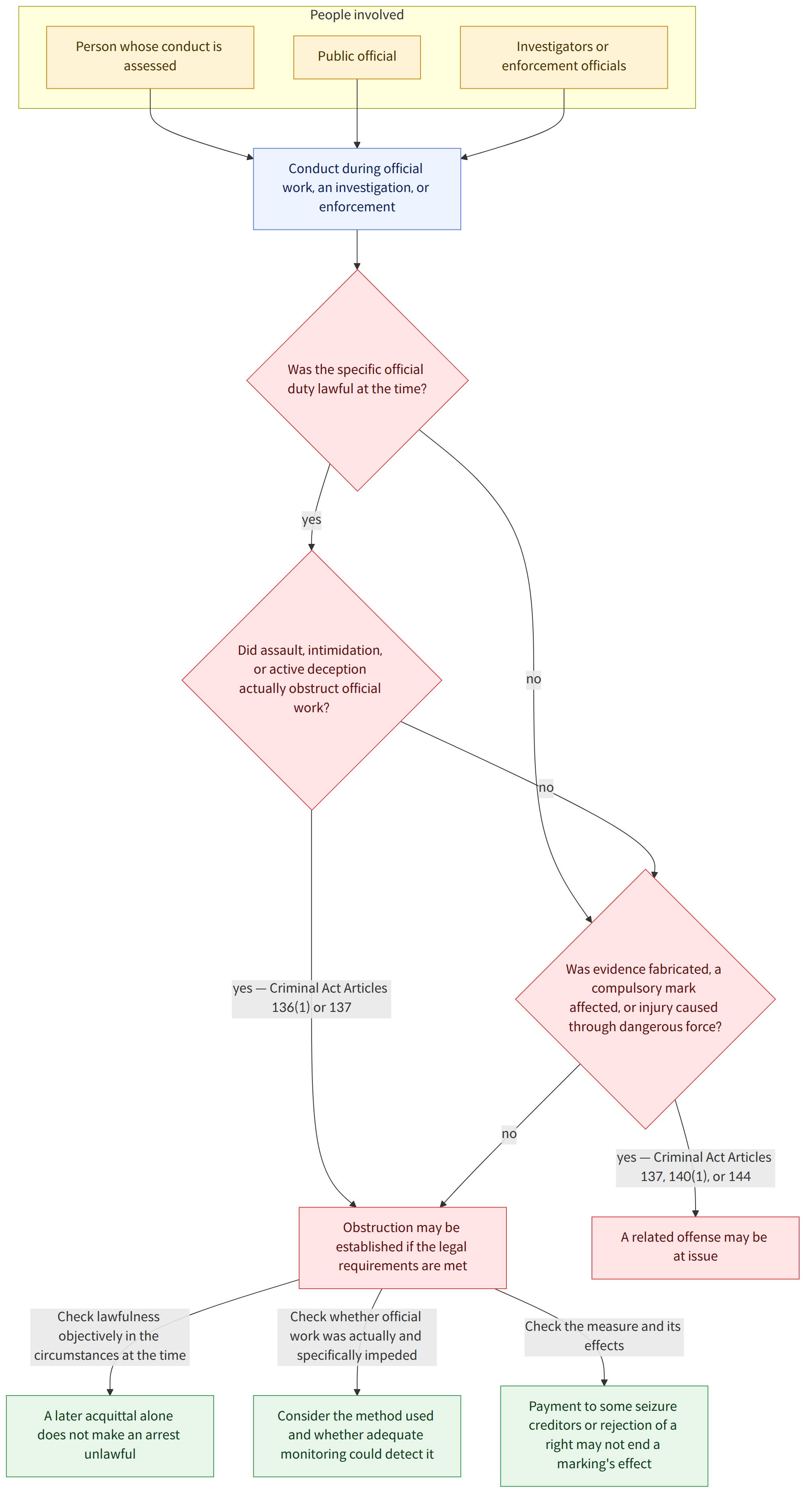
Obstruction of the performance of official duties may be established when a public official is assaulted or intimidated while lawfully performing official duties. Whether obstruction of official duties by fraudulent means or the offense of invalidating official marks has been committed depends on the specific circumstances, including whether the conduct actually impeded the official's work or the effect of a compulsory measure.
At a glance
Key points
- Obstruction of the performance of official duties may be established only if not just the public official's general authority but also the specific performance of official duties was lawful (Criminal Act, Article 136(1) (형법 제136조 제1항)).
- The lawfulness of the performance of official duties is assessed objectively and reasonably based on the specific circumstances at the time of the conduct. The fact that a person was later acquitted of a related offense does not, by itself, make the arrest unlawful (Case 11).
- Assault against a public official may include both direct and indirect use of physical force. Noise during a protest, however, is assessed by considering the circumstances in which it was produced, its intensity, and other factors (Cases 7 and 13).
- Obstruction of official duties by fraudulent means requires causing a public official to be mistaken or deceived in a way that obstructs the actual and specific performance of official duties. It may be established where evidence is actively fabricated to mislead investigators (Criminal Act, Article 137 (형법 제137조); Cases 4, 10, and 15).
- Merely engaging in prohibited conduct or evading monitoring or enforcement may not constitute obstruction of official duties by fraudulent means. It is important whether the person actively impeded official work by using a method that would be difficult to detect even with adequate monitoring and enforcement (Cases 9 and 12).
- Moving the official marking of a compulsory measure, such as a seizure or injunction, or effectively nullifying the measure may raise the issue of the offense of invalidating official marks. The effect of the marking does not automatically cease merely because payment was made to only some seizure creditors or a right was rejected in the underlying case (Criminal Act, Article 140(1) (형법 제140조 제1항); Cases 3, 5, 14, and 17).
- If a public official is injured through obstruction of official duties involving a dangerous object, the offense of special obstruction of the performance of official duties resulting in injury may be at issue. However, an obstacle set up in advance may not be considered assault depending on the specific circumstances, including when and with what intent it was placed (Criminal Act, Article 144 (형법 제144조); Case 18).
Frequently asked questions
Q. Can I be charged with obstruction of the performance of official duties if I refuse or protest a police request to accompany them voluntarily?
You may refuse to accompany the police voluntarily. For the accompaniment to be lawful, it must be objectively clear that you agreed to go voluntarily. Whether the police acted unlawfully, or whether there was assault or intimidation during any protest, must be assessed based on the specific circumstances.
Q. If the police block my way to conduct a stop and question, can I be charged with obstruction of the performance of official duties if I push them?
The police may stop someone using reasonable methods and only to the extent necessary, taking into account factors such as the person concerned, the seriousness of the suspected offense, and the need to ask questions. Assaulting or intimidating an officer in response to a lawful stop and questioning may constitute obstruction of the performance of official duties.
Q. If I am later acquitted of the related charge, does that mean I cannot be punished for obstructing my arrest?
Not necessarily. The lawfulness of an arrest is assessed based on the specific circumstances at the time of the arrest. If there was sufficient reason at that time to believe that the person had been caught in the act, obstruction of the performance of official duties may be established even if the person is later acquitted of the related charge.
Q. Can submitting false documents or another person's blood or urine constitute obstruction of official duties by fraudulent means?
Submitting false information does not invariably constitute an offense by itself. However, an offense may be established if someone actively fabricates evidence by submitting another person's blood or urine as their own, and thereby leads investigators to an incorrect conclusion in circumstances where even a diligent investigation would not have revealed the falsity.
Q. If I spray a reflective product on my license plate to evade speed enforcement, is that obstruction of official duties by fraudulent means?
The court decision discussed in the example found that the conduct alone did not amount to obstructing enforcement through fraudulent means that would be difficult to detect even if police officers carried out their ordinary duties diligently. Merely engaging in prohibited conduct or evading enforcement does not establish obstruction of official duties by fraudulent means.
Q. Can playing loud music through speakers at a protest constitute obstruction of the performance of official duties?
The temporary production of considerable noise during a demonstration or protest does not, by itself, amount to assault by means of sound. Whether sound was used with the intent to cause suffering to a public official, beyond the reasonable scope of communicating a message, is assessed by considering factors such as volume, duration, distance, and the surrounding circumstances.
Q. What offenses could be at issue if I move or dispose of seized property?
Moving seized property a considerable distance without notifying the enforcement officer or obtaining approval, thereby substantially impeding enforcement, may raise the issue of the offense of invalidating official marks. Where there are competing seizures, the effect of a seizure does not automatically cease merely because payment was made to only some creditors or the parties reached an agreement.
Q. Can a family member or third party who is not subject to an injunction be punished for entering a prohibited place?
Whether an injunction or other compulsory measure applies to a person depends on the measure's terms and the persons or property it covers. In the example, the court found that an injunction prohibiting entry, issued against a husband as debtor, did not apply to his wife. It also found that, in the case of an injunction halting construction, changing only the name on the project and continuing the work did not, by itself, impair the effectiveness of the official marking.
Q. If a public official is injured, can lubricant or metal plates laid out in advance be treated as assault?
The court decision discussed in the example found that merely having lubricant spread in advance while no one was present, in preparation for public officials entering, did not amount to physical force against those officials—that is, assault. The outcome may differ, however, if there are special circumstances, such as placing it in the officials' presence with the intent to obstruct their duties.
Relevant laws
- Criminal Act, Article 20 (형법 제20조)
- Criminal Act, Article 21 (형법 제21조)
- Criminal Act, Article 136(1) (형법 제136조 제1항)
- Criminal Act, Article 137 (형법 제137조)
- Criminal Act, Article 140(1) (형법 제140조 제1항)
- Criminal Act, Article 142 (형법 제142조)
- Criminal Act, Article 144(1) and (2) (형법 제144조 제1항·제2항)
- Act on the Performance of Duties by Police Officers, Article 3 (경찰관직무집행법 제3조)
- Act on the Performance of Duties by Police Officers, Article 6(1) (경찰관직무집행법 제6조 제1항)
- Criminal Procedure Act, Article 85(1) and (3) (형사소송법 제85조 제1항·제3항)
- Criminal Procedure Act, Article 199(1) (형사소송법 제199조 제1항)
- Criminal Procedure Act, Article 200-5 (형사소송법 제200조의5)
- Criminal Procedure Act, Article 213-2 (형사소송법 제213조의2)
- Civil Execution Act, Article 189(1) (민사집행법 제189조 제1항)
- Immigration Act, Article 81(1) (출입국관리법 제81조 제1항)
Watch out for
- Whether a public official's demand or arrest was lawful must be assessed in light of the type of duty involved and the specific circumstances at the time. Merely protesting to a public official does not, by itself, constitute obstruction of the performance of official duties.
- When arresting someone caught in the act, officers must inform the person of the gist of the suspected offense and the reason for the arrest. One court decision also indicates that where the use of force must come first, the person must be informed without delay after being restrained.
- A seizure or injunction may remain in effect despite an agreement or partial repayment. Before disposing of or moving property, confirm whether the compulsory measure has been revoked and whether it remains in effect.
- This guide summarizes issues raised in the consultation examples provided. The outcome of an individual case may vary depending on the legal basis and procedure for the official action and the circumstances at the time of the conduct.
Source cases
This guide was compiled by AI from the following Korea Legal Aid Corporation consultation cases (in Korean).
- 임의동행요구에 불응한 경우 공무집행방해죄를 구성하는지
- 공장 밖 노조원들에 대한 ‘고착관리’와 현행범체포 후 40분이 지나 체포이유 등을 고지 한 것이 적법한 직무집행인지
- 압류물을 다른 장소로 이동시킨 경우 처벌 여부
- 허위의 소명자료를 제출하여 등기를 마친 경우 위계에 의한 공무집행방해죄 성립 여부
- 압류경합 시 일부채권자에게만 변제 후 압류물 처분한 경우
- 현장에서 대기 중이었던 공무원을 ‘직무를 집행하는 공무원’이라고 볼 수 있는지
- 맹견으로 집행관의 강제집행을 방해하면 처벌되는지
- 불심검문에 불응하여 경찰관들의 멱살을 잡아 밀친 행위가 공무집행방해죄가 성립하는지
- 차량 번호판에 ‘파워매직세이퍼’를 뿌려 차량을 운행한 행위에 위계에 의한 공무집행방해죄가 성립하는지
- 음주측정을 위한 혈액을 바꿔치기하여 제출한 경우 위계에 의한 공무집행방해죄 성립여부
- 공무집행방해죄에서 공무집행의 적법성을 판단하는 기준 시점은 언제인지
- 재소자가 교도관과 공모하여 담배를 받은 행위가 위계에 의한 공무집행방해죄를 구성하는지
- 음향이 공무집행방해죄에서의 폭행에 해당하는지
- 건물점유이전금지가처분 집행 후 일부 점유이전 한 경우
- 약물검사에 소변을 바꿔치기하여 제출한 경우 위계에 의한 공무집행방해죄 성립 여부
- 관리자의 사전 동의 없이 불법체류자 단속 중인 공무원에게 상해를 가한 경우 처벌되는지
- 특허권 침해로 인하여 가처분집행이 행하여 졌으나 본안에서 특허권 무효판결이 난 경우 공무상표시무효죄 성립 여부
- 미리 뿌려놓은 윤활유나 철판조각에 공무수행중인 공무원이 다친 경우 특수공무집행방해치상죄가 성립하는지 여부
- 벌금미납으로 지명수배된 자가 임의동행을 거부하는 경우 공무집행방해죄를 구성하는지
- 가압류결정 송달받고 채무자에게 가압류된 돈을 지급한 경우
- 공무원이 결재권자에 대하여 허위내용의 결재를 받은 경우 처벌되는지
- 공사중지가처분 집행 후 건축허가명의 변경하여 공사한 경우
- 즉결심판청구를 하지 않고 계속하여 운전면허증의 제시를 요구한 것이 적법한 직무행위인지
- 도로의 보도에서 천막설치를 제지하는 공무원에게 가한 폭행이 공무집행방해에 해당하는지
- 출입금지가처분명령에 위반한 경우의 형사책임
This guide is general legal information about Korean law, not legal advice for your situation. For a specific case, consult a lawyer or the Korea Legal Aid Corporation (call 132 in Korea).