
How far does criminal liability extend for offenses related to public officials’ duties?
Based on 12 consultation cases · Updated · Translated from the Korean original.
A public official’s duties are not limited to the tasks currently assigned to them, and benefits—whether pecuniary or non-pecuniary—received in connection with those duties may constitute bribes. However, dereliction of duty, abuse of authority, and unlawful disclosure of official secrets each have different elements, so the purpose and circumstances of the conduct, as well as the official’s actual authority and role, must be considered.
At a glance
Key points
- The duties referred to in bribery offenses may include not only duties prescribed by law but also acts closely connected to those duties and tasks within an official’s general authority (Supreme Court Decision 2003Do1060, June 13, 2003).
- A bribe may include not only money or goods but also financial benefits from an interest-free loan, entertainment, and other tangible or intangible benefits that satisfy a person’s desires (Supreme Court Decision 2002Do3539, November 26, 2002).
- At the time of an agreement to accept a bribe, the benefit need not actually exist or have a determined value. A benefit that can be anticipated in the future may also be the object of a bribe (Supreme Court Decision 2000Do5438, September 18, 2001).
- Even if a person did not use a bribe personally or returned it later, that may not affect whether the bribery offense was committed if the person accepted it with the intent to appropriate it (Supreme Court Decision 83Do2050, May 14, 1985).
- If a public official has a person who owes them a debt make a payment instead of receiving money directly, the offense of receiving a bribe may still be established if, in light of social norms, the relationship makes this equivalent to the official receiving the money directly (Supreme Court Decision 2001Do7056, April 9, 2002).
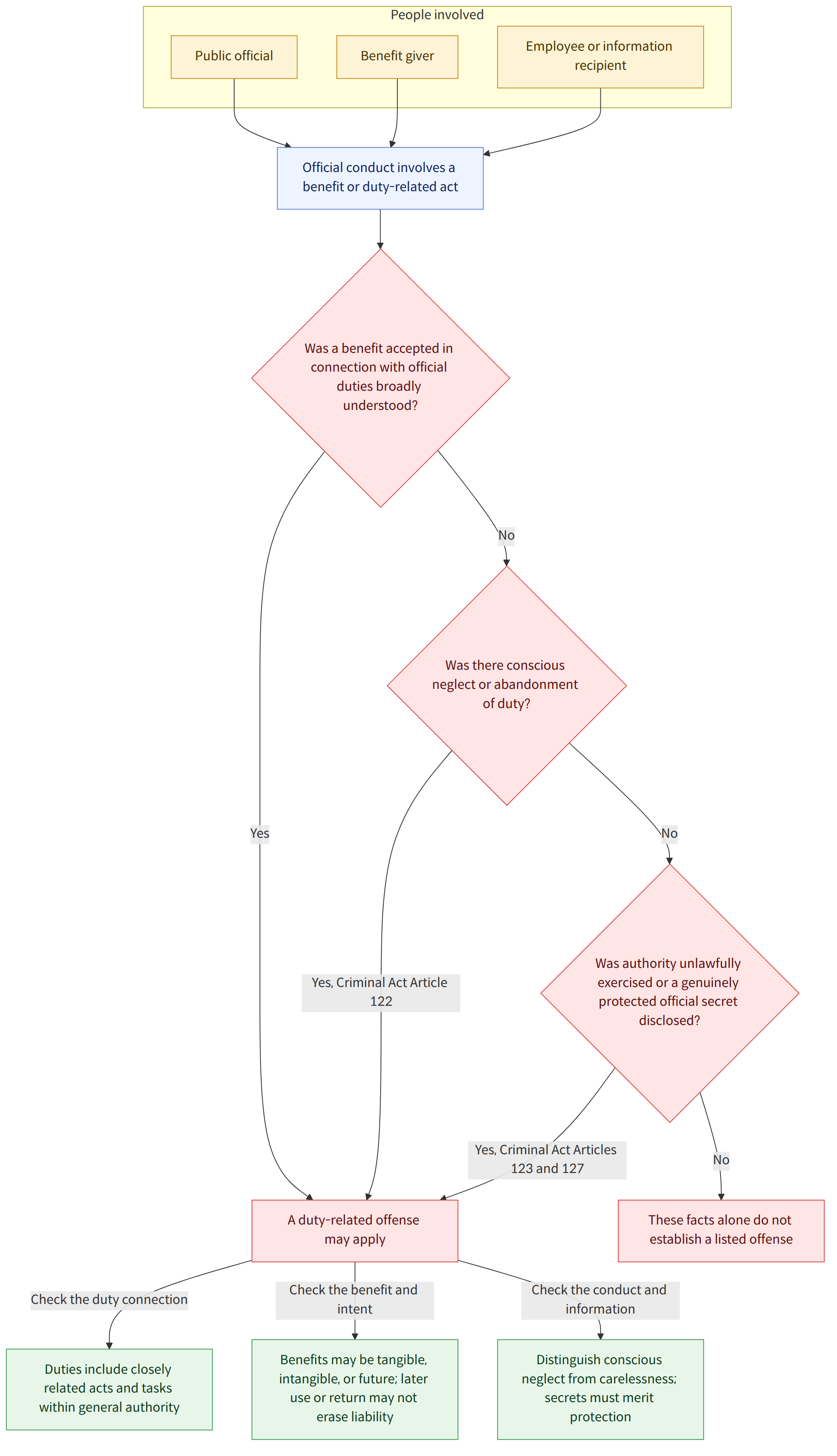
- The offense of dereliction of duty is not established by mere carelessness or improper handling of official duties. The key question is whether the conduct amounted to conscious neglect or abandonment of those duties (Criminal Act, Article 122 (형법 제122조); Supreme Court Decision 2013Do229, April 10, 2014).
- Abuse of authority means the unlawful exercise of general official authority. Where an employee responsible for carrying out work has independent authority and responsibility regarding the applicable criteria and procedures, directing that employee to violate those criteria may raise the question of whether the official caused the employee to perform an act they were not obligated to perform (Criminal Act, Article 123 (형법 제123조); Supreme Court Decision 2010Do13766, February 10, 2011).
- An official secret is not limited to information expressly designated as secret, but it must be genuinely worthy of protection. An estimated price may constitute an official secret, whereas information about a vehicle’s owner alone may not be worthy of protection as a secret (Criminal Act, Article 127 (형법 제127조); Supreme Court Decision 2010Do14734, March 15, 2012).
Frequently asked questions
Q. Can I commit a bribery offense by turning a blind eye to a crime that is not part of my assigned duties?
The duties referred to in bribery offenses are not limited to the tasks an official is actually assigned under the current division of duties. Since enforcing criminal laws may fall within a police officer’s basic duties, a traffic police officer who turns a blind eye to a crime in exchange for a payment may commit a bribery offense related to official duties.
Q. Can agreeing to exchange land that may increase in value in the future constitute an agreement to accept a bribe?
A benefit that is the object of a bribery agreement need not exist at the time of the agreement; it may also include a future benefit that could be anticipated at that time. The fact that its value has not been determined does not, by itself, prevent the offense of agreeing to accept a bribe from being established.
Q. Can an interest-free loan with no fixed repayment term constitute a bribe?
Bribes are not limited to cash or goods. The financial benefit obtained by borrowing money interest-free and for an indefinite term may also constitute a bribe.
Q. Will a bribery offense disappear if I spend the money I received on construction costs or return it?
The fact that the recipient did not use the benefit personally or returned part of it does not, by itself, eliminate a bribery offense. If the recipient accepted the money or other benefit with the intent to appropriate it, its later use or return may not affect whether the offense was committed.
Q. Can I commit the offense of receiving a bribe by having someone pay off my debt instead of accepting the bribe directly?
Even if a public official does not receive money directly, the offense of receiving a bribe may be established if the official has another person pay it and the relationship is such that this is equivalent to the official receiving it directly—for example, where that person owes the official a debt or covers the official’s living expenses.
Q. Can offering a bribe be an offense even if the money never actually reaches the public official I approached?
Whether the public official actually received the money or other benefit is not the sole factor in determining whether the offense of offering a bribe was committed. If someone entrusts money or another benefit to an intermediary for delivery to a public official, the offense may be established even if the official never receives it.
Q. Does disclosing an estimated contract price to a business constitute unlawful disclosure of an official secret?
The estimated price for a matter to be awarded by private contract may be information that must not be disclosed under the law and may constitute an official secret. Disclosing the estimated price to a preselected business may be punishable as unlawful disclosure of an official secret.
Q. Does disclosing information about a vehicle used in a police undercover investigation always constitute unlawful disclosure of an official secret?
An official secret must be information that has an interest in remaining undisclosed to the public and is genuinely worthy of protection. In the case discussed, the court found that the fact that a vehicle was used in an undercover investigation did not, by itself, make information about the vehicle’s owner a secret worthy of protection.
Q. Does postponing enforcement of a disciplinary decision constitute dereliction of duty?
The mere fact that an official received a disciplinary decision and deferred its enforcement does not establish the offense of dereliction of duty. The key question is whether the deferral amounted to a conscious neglect or abandonment of official duties. In the case discussed, deferral based on ongoing criminal proceedings and controversy over the legitimacy of the decision was not considered dereliction of duty.
Q. Can a public official be punished for violating promotion criteria or preparing a report on an inspection trip afterward?
Directing an employee responsible for carrying out promotions to promote someone who is not eligible may constitute the offense of abuse of authority obstructing the exercise of rights. By contrast, in a case where an official had conducted an actual inspection trip beforehand and later prepared a report, entering its date while confident that the inspection’s findings had not changed, the court found it difficult to establish intent to prepare a false official document.
Relevant laws
- Criminal Act, Article 122 (형법 제122조)
- Criminal Act, Article 123 (형법 제123조)
- Criminal Act, Article 127 (형법 제127조)
- Criminal Act, Article 129 (형법 제129조)
- Criminal Act, Article 131 (형법 제131조)
- Criminal Act, Article 227 (형법 제227조)
- Former Local Finance Act (구 지방재정법)
- Act on Contracts to Which the State Is a Party, Article 7 (국가를 당사자로 하는 계약에 관한 법률 제7조)
- Enforcement Decree of the Act on Contracts to Which the State Is a Party, Article 7-2(1) (국가를 당사자로 하는 계약에 관한 법률 시행령 제7조의2 제1항)
- Enforcement Decree of the Act on Contracts to Which the State Is a Party, Article 30(1) (국가를 당사자로 하는 계약에 관한 법률 시행령 제30조 제1항)
- Improper Solicitation and Graft Act, Article 8 (부정청탁 및 금품등 수수의 금지에 관한 법률 제8조)
- Improper Solicitation and Graft Act, Article 22 (부정청탁 및 금품등 수수의 금지에 관한 법률 제22조)
Watch out for
- Whether a benefit constitutes a bribe may depend on the specific circumstances, including the nature of the official’s duties, the relationship with the person providing the benefit, and the circumstances and timing of its receipt.
- Neglecting official duties does not, by itself, constitute dereliction of duty; it is necessary to consider whether the conduct amounted to conscious neglect or abandonment.
- Not all information that has not been disclosed to the public constitutes an official secret; it must be assessed whether the information is genuinely worthy of protection.
Source cases
This guide was compiled by AI from the following Korea Legal Aid Corporation consultation cases (in Korean).
- 뇌물약속죄에서 약속 당시 이익이 현존 또는 확정되어야 하는지
- 교육기관 등의 장이 징계의결서를 통보받고 집행을 유보하는 행위가 직무유기에 해당하는지
- 승진대상자가 아닌 교원들을 승진임용한 교육감의 행위가 직권남용에 해당하는지
- 공무원이 수해 복구 공사계약을 수의계약 방식으로 체결하면서, 미리 선정된 공사업체에게 공사예정가격을 알려준 행위가 공무상 비밀...
- 공무상비밀누설죄에서 ‘법령에 의한 직무상 비밀’의 의미
- 교통계에 근무하는 경찰관이 사례금을 받고 도박범행을 묵인한 경우 뇌물죄성립 여부
- 공무원이 사후에 출장복명서를 작성한 경우 처벌 여부
- 금품수수 후 일부는 홍보비 등으로 사용하고 일부는 돌려준 경우 뇌물성 인정 여부
- 부정한 청탁을 받고 현금이 아닌 은행 대출금을 무이자로 받는 혜택을 받은 경우에도 뇌물죄에서 말하는 뇌물에 해당하는지 여부
- 공무원이 타인으로부터 부정한 청탁을 받고 뇌물을 받으면서 타인에게 뇌물을 지급하게 한 경우 뇌물수수죄가 성립되는지 여부
- 청탁대상인 공무원에게 돈이 실제 전달되지 않은 경우에도 뇌물공여죄로 처벌되는지 여부
- 공무원이 부정행위를 하고 사후에 전별금 명목으로 금원을 받은 경우 사후수뢰죄가 성립되는지 여부
This guide is general legal information about Korean law, not legal advice for your situation. For a specific case, consult a lawyer or the Korea Legal Aid Corporation (call 132 in Korea).