
Guide to Real Estate Administration and Public Works Compensation
Based on 121 consultation cases · Updated · Translated from the Korean original.
If your land or building is included in a public works project, or you are subject to an administrative disposition relating to development or construction, you should separately check who is entitled to compensation, what items are compensable, what may be challenged, and which procedures apply. Eligibility for compensation and the amount may vary depending on whether the land was actually farmed, occupied, or used for business, the relevant rights and interests, the timing of the project, and the history of the land's use.
At a glance
Key points
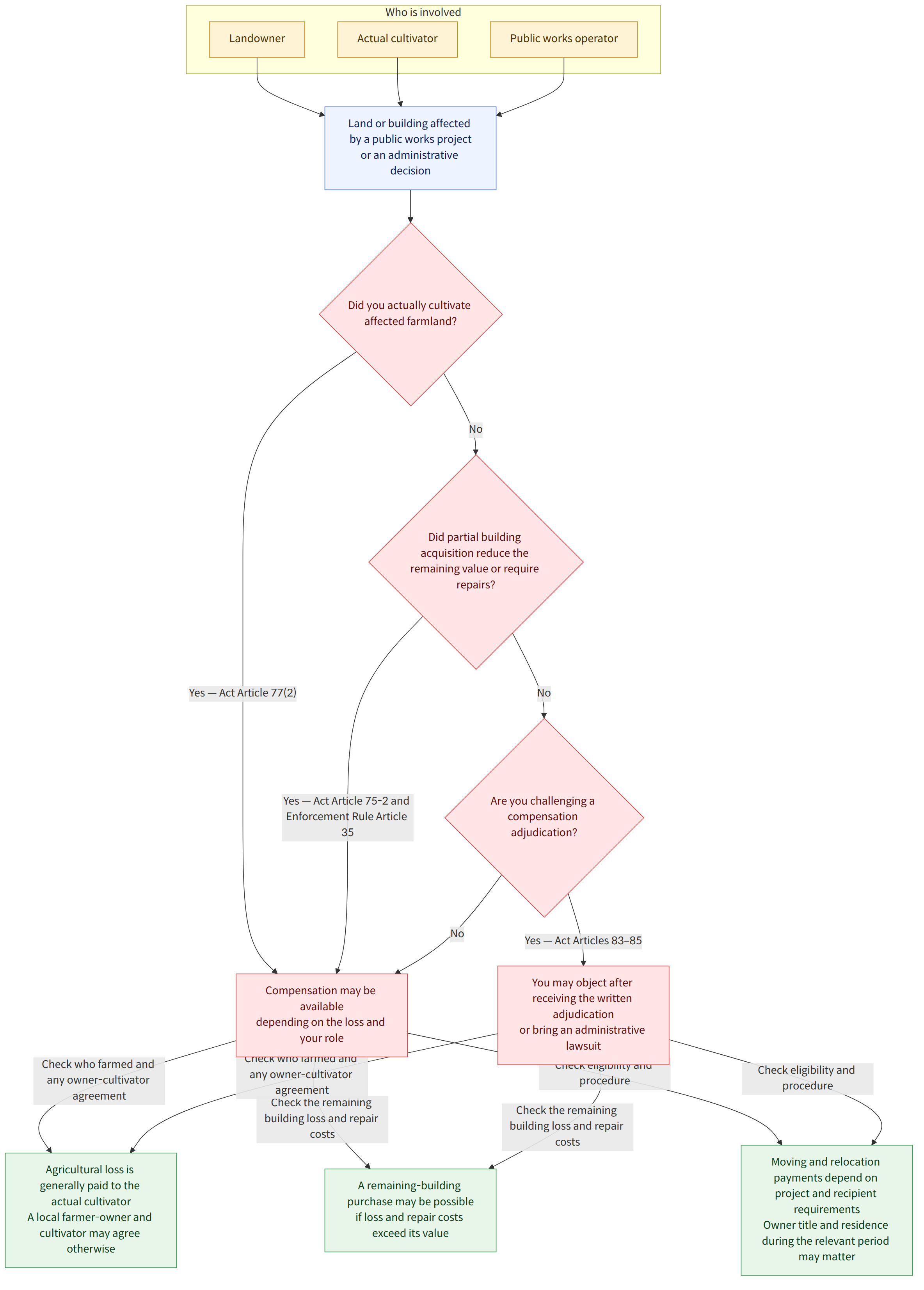
- Compensation for agricultural losses is generally paid to the person who actually cultivated the land. If the farmland owner is a farmer who resides in the area, payment may instead be made in accordance with an agreement between the owner and the cultivator (Act on Acquisition of and Compensation for Land, etc. for Public Works Projects, Article 77(2) (공익사업을 위한 토지 등의 취득 및 보상에 관한 법률 제77조 제2항)).
- If part of a building is expropriated, causing the value of the remaining building to decrease or making repairs necessary, those losses may also be compensable. In some cases, the remaining building may be subject to a purchase claim (Act on Acquisition of and Compensation for Land, etc. for Public Works Projects, Article 75-2 (공익사업을 위한 토지 등의 취득 및 보상에 관한 법률 제75조의2); Enforcement Rule of the Act on Acquisition of and Compensation for Land, etc. for Public Works Projects, Article 35 (공익사업을 위한 토지 등의 취득 및 보상에 관한 법률 시행규칙 제35조)).
- If you object to the compensation amount for land expropriation, you may file an objection with the Central Land Tribunal after receiving the written adjudication, or bring an administrative lawsuit. In a lawsuit seeking an increase or decrease in compensation, the opposing party may be designated as the project operator or the landowner or other interested person (Act on Acquisition of and Compensation for Land, etc. for Public Works Projects, Articles 83–85 (공익사업을 위한 토지 등의 취득 및 보상에 관한 법률 제83조~제85조)).
- When assessing compensation for land subject to expropriation, nearby transaction examples and precedents of compensation do not always have to be taken into account. However, they may be considered if they are materials that affect the assessment as examples of normal prices (Supreme Court decisions cited in the case).
- Eligibility for relocation expenses and moving expenses depends on the type of project and the requirements for the recipient. In certain circumstances, a person entitled to cash settlement in a housing redevelopment project may also qualify for payment. For an owner, whether the owner held title and resided at the property from the date the redevelopment plan was made available for public inspection and announced until the time of compensation may be relevant (Cases 21 and 24).
- A construction permit or amended permit that is deemed to include development permission may be refused if it does not meet the development permission criteria. However, a refusal based only on a vague difficulty in preparing a comprehensive plan may be unlawful (Case 23).
- Administrative plans and the designation of land transaction permit zones may be subject to administrative litigation depending on whether they directly affect rights and obligations. Even where urban planning decisions involve discretion, the balancing of interests and the principle of proportionality must be observed (Cases 7 and 14).
- Losses caused by using land without authority before the expropriation takes effect may be distinct from compensation for losses in the expropriation adjudication process and may instead be addressed as a matter of civil damages or restitution for unjust enrichment (Case 20).
Frequently asked questions
Q. I rented farmland and farmed it myself. Who receives the farming compensation?
As a rule, compensation for agricultural losses is paid to the person who actually cultivated the land. However, if the farmland owner is a farmer who resides in the area, the owner and the actual cultivator may agree on who will receive the compensation. Compensation for the land itself should be distinguished from compensation for agricultural and crop losses.
Q. Can I receive compensation if the value of the remaining building falls after part of the building is expropriated?
If part of a group of buildings owned by the same person is acquired or used, and the value of the remaining building decreases or it otherwise sustains a loss, that loss may be compensated. The cost of repairing the remaining part may also be relevant. If the combined amount of the loss and repair costs exceeds the value of the remaining building, it may be possible to have the remaining building purchased.
Q. What procedures can I use to challenge a land expropriation compensation amount that I consider too low?
If you object to an adjudication, you may file an objection with the Central Land Tribunal within 30 days from the date you receive an authenticated copy of the written adjudication. You may also bring an administrative lawsuit without first filing an objection. The period for filing a lawsuit after receiving the written adjudication varies under the provisions of the Public Works Compensation Act cited in the case, so you should check the applicable deadline.
Q. Can I receive compensation if an unauthorized building is included in a public works project?
The case explains that a building cannot automatically be excluded from compensation for losses solely because it was built without a construction permit. However, the outcome may depend on the specific circumstances, including the building's legality, when and how it was built, and how it is used.
Q. Can a person entitled to cash settlement in a redevelopment project receive relocation expenses and moving expenses?
The case explains that a person entitled to cash settlement who owns a residential building in a housing redevelopment project may receive relocation expenses and moving expenses if ownership was transferred through a cash-settlement agreement or if the building was expropriated because no agreement was reached. Separately, an owner's eligibility for relocation expenses may depend on whether the owner continuously owned and occupied the building from the date the redevelopment plan was made available for public inspection and announced until the building was compensated for.
Q. Can my permit to extend a building be refused because of an undertaking I submitted when I obtained the construction permit?
If a condition is attached without a statutory basis to a construction permit or an approval for use, both of which are bound administrative acts, the condition may not be legally valid. Accordingly, it may be unlawful to refuse an application solely because of an undertaking that was improperly prepared. The matter may be decided differently, however, if there is a separate, compelling public interest that warrants the condition.
Q. Can the designation of a land transaction permit zone or an urban planning decision also be challenged in an administrative lawsuit?
The case explains that designating an area as a land transaction permit zone may be challenged through an appeal-type administrative lawsuit because it directly imposes legal restrictions on land transactions and use. An urban planning decision may also specifically restrict the exercise of rights. However, because planning decisions involve discretion, it is necessary to consider whether there are grounds for illegality, such as a failure to balance interests or a lack of objectivity or legitimacy.
Q. If the project operator carried out construction on land before an expropriation adjudication, can I claim compensation in the adjudication?
The case explains that losses caused by using land without authority before the expropriation takes effect cannot be claimed as compensation for losses in the expropriation adjudication process. In that situation, you should separately consider whether you can claim civil damages or restitution for unjust enrichment.
Q. Is compensation for land used as a road always lower when it is expropriated?
No. The lower valuation standard may apply if the land qualifies as a de facto private road and, in light of various circumstances such as how it was created and how it has been used, there is an objective reason to value it below neighboring land. The value is not automatically reduced merely because the land was used for passage.
Relevant laws
- Act on Acquisition of and Compensation for Land, etc. for Public Works Projects, Article 2(5) (공익사업을 위한 토지 등의 취득 및 보상에 관한 법률 제2조 제5호)
- Act on Acquisition of and Compensation for Land, etc. for Public Works Projects, Article 25 (공익사업을 위한 토지 등의 취득 및 보상에 관한 법률 제25조)
- Act on Acquisition of and Compensation for Land, etc. for Public Works Projects, Article 34 (공익사업을 위한 토지 등의 취득 및 보상에 관한 법률 제34조)
- Act on Acquisition of and Compensation for Land, etc. for Public Works Projects, Article 40 (공익사업을 위한 토지 등의 취득 및 보상에 관한 법률 제40조)
- Act on Acquisition of and Compensation for Land, etc. for Public Works Projects, Article 45 (공익사업을 위한 토지 등의 취득 및 보상에 관한 법률 제45조)
- Act on Acquisition of and Compensation for Land, etc. for Public Works Projects, Articles 50 and 51 (공익사업을 위한 토지 등의 취득 및 보상에 관한 법률 제50조, 제51조)
- Act on Acquisition of and Compensation for Land, etc. for Public Works Projects, Articles 61, 64, and 68 (공익사업을 위한 토지 등의 취득 및 보상에 관한 법률 제61조, 제64조, 제68조)
- Act on Acquisition of and Compensation for Land, etc. for Public Works Projects, Articles 73, 75, and 75-2 (공익사업을 위한 토지 등의 취득 및 보상에 관한 법률 제73조, 제75조, 제75조의2)
- Act on Acquisition of and Compensation for Land, etc. for Public Works Projects, Articles 76, 77, and 78 (공익사업을 위한 토지 등의 취득 및 보상에 관한 법률 제76조, 제77조, 제78조)
- Act on Acquisition of and Compensation for Land, etc. for Public Works Projects, Articles 81–85 and 89 (공익사업을 위한 토지 등의 취득 및 보상에 관한 법률 제81조~제85조, 제89조)
- Enforcement Rule of the Act on Acquisition of and Compensation for Land, etc. for Public Works Projects, Articles 26, 33, and 35 (공익사업을 위한 토지 등의 취득 및 보상에 관한 법률 시행규칙 제26조, 제33조, 제35조)
- Enforcement Rule of the Act on Acquisition of and Compensation for Land, etc. for Public Works Projects, Articles 37–41, 44–48, 54, and 55 (공익사업을 위한 토지 등의 취득 및 보상에 관한 법률 시행규칙 제37조~제41조, 제44조~제48조, 제54조, 제55조)
- Development Gains Restitution Act, Article 5(3), and Enforcement Decree of the same Act, Article 4(1) (개발이익환수에 관한 법률 제5조 제3항, 같은 법 시행령 제4조 제1항)
- National Land Planning and Utilization Act, Articles 56–58, 64, 117, and 118 (국토의 계획 및 이용에 관한 법률 제56조~제58조, 제64조, 제117조, 제118조)
- Administrative Litigation Act, Articles 2, 3, and 19 (행정소송법 제2조, 제3조, 제19조)
Watch out for
- There are deadlines for challenging an adjudication and objecting to an officially assessed individual land price, among other procedures. First check the date you received the written adjudication or the relevant decision or public notice.
- Compensation for losses and damages for unlawful acts may have different legal grounds and procedures. You should distinguish whether losses caused by use of the land or construction before expropriation can be claimed in the expropriation adjudication process.
- Eligibility for compensation may vary depending on whether the land was actually farmed, occupied, or used for business; when permits or notifications were issued; when the project was announced; and the history of the land's use.
- The cases cite court decisions issued under repealed legislation as well as statutory provisions from different periods. For an actual matter, check the legislation in effect at the relevant time and the procedures currently in force.
Source cases
This guide was compiled by AI from the following Korea Legal Aid Corporation consultation cases (in Korean).
- 농지 수용 시 영농보상금은 소유자와 임차인 중 누가 받는지
- 건물의 일부만 수용 시 잔여건물에 대한 감가보상 인정되는지
- 개발부담금부과처분과 관련하여 동일한 사업의 분할개발인지 여부
- 행정청의 개별공시지가결정에 대한 불복절차
- 무허가건물도 손실보상의 대상인지
- 공법상 의무의 이행을 민사소송의 방법으로 구할 수 있는지
- 부당한 도시계획결정에 대한 행정소송 가능한지
- 지목이 유지(溜池)인 밭의 지목변경신청반려처분 취소방법
- 신축건물사용승인을 받을 당시 작성하였던 공증각서의 내용에 반하여 후에 제출한
- 측량을 위한 출입사실을 통지하지 않고 한 도로구역결정의 효력
- 아파트 명칭변경의 요건과 절차
- ‘가설건축물’ 수용 시 임차인의 영업손실을 보상하여야 하는지
- 영업손실보상에 있어서 영업의 폐지 또는 휴업 여부의 구별기준
- 토지거래허가구역의 지정이 항고소송의 대상인 ‘처분’이 되는지
- 어업권자의 손실보상청구권 행사 방법
- 무허가건물 양수인에 대한 변상금부과 가능한지
- 지방토지수용위원회의 보상금 증액 재결에 대한 불복절차
- 위법한 토지수용 재결에 대하여 불복 시 취소소송의 대상
- 수용토지의 정당한 보상액 산정 시 보상선례를 참작할 수 있는지
- 수용효력발생 전 사업시행자가 수용대상토지를 사용한 경우
- 공익사업의 시행에 의거 주거용 건축물 소유자에 대한 주거이전비 보상은 정비계획에 관한 공람ㆍ공고일부터 해당 건축물에 대한 보상...
- 도로로 사용되던 토지의 수용 시 다른 토지보다 보상액이 적은지
- 개발행위허가의 변경이 의제되는 건축허가사항의 변경허가
- 현금청산대상자에 대한 주거이전비 및 이사비의 지급여부
- 토지손실보상금에 대한 압류 및 전부명령 시 공탁사유인지
This guide is general legal information about Korean law, not legal advice for your situation. For a specific case, consult a lawyer or the Korea Legal Aid Corporation (call 132 in Korea).