
Real Estate Brokerage Guide: Brokers’ Duties and Fees
Based on 50 consultation cases · Updated · Translated from the Korean original.
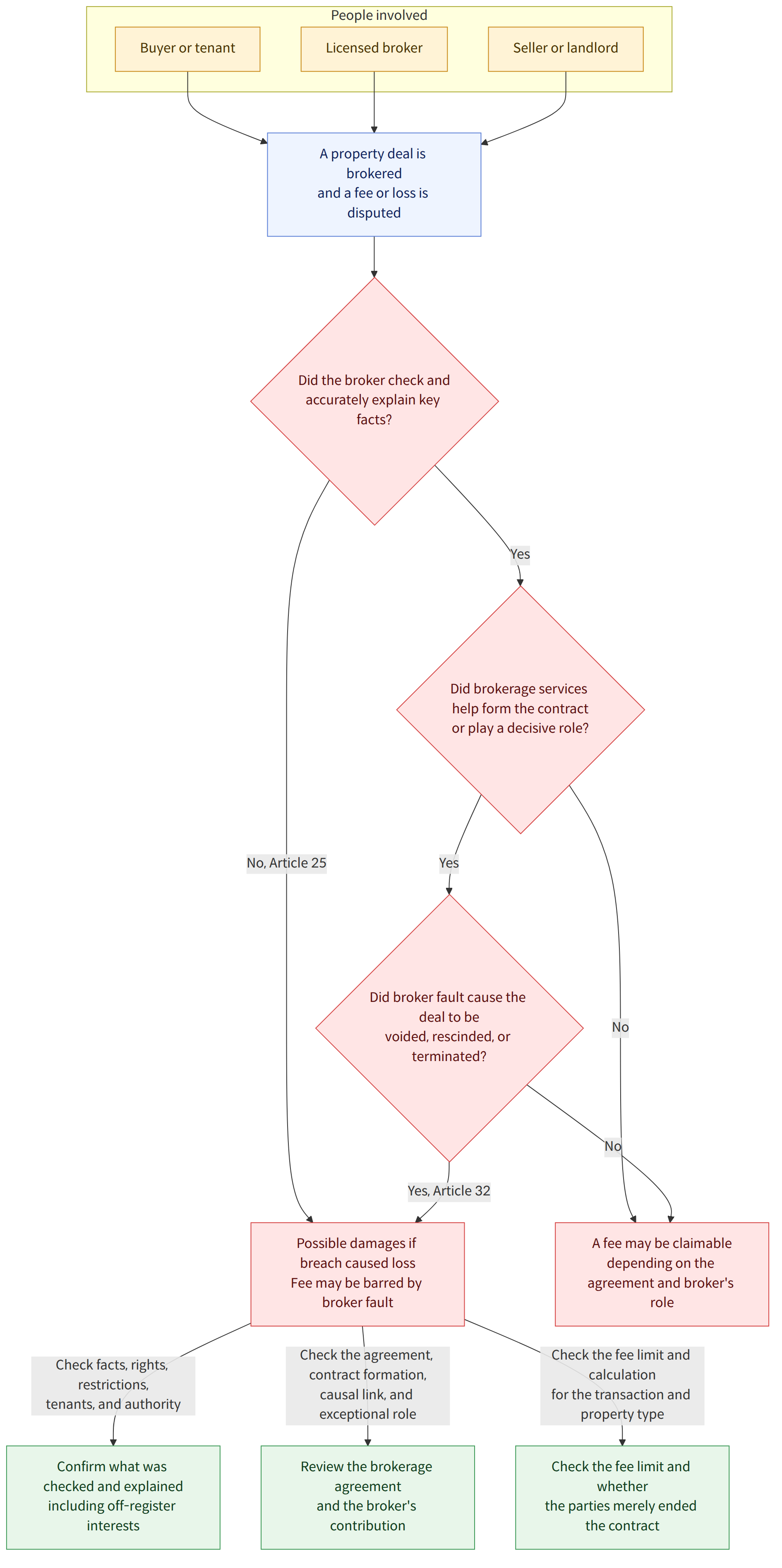
A licensed real estate agent operating a brokerage business must check and accurately explain important matters, including the property’s legal rights and any restrictions on transactions or use. The agent may be liable for damages if a failure to do so causes loss. Brokerage fees should be assessed by considering whether a contract was formed, the broker’s contribution to the transaction, and the statutory limits.
At a glance
Key points
- A licensed real estate agent operating a brokerage business must handle entrusted brokerage work with the care of a good manager and perform the work in good faith (Civil Act, Article 681 (민법 제681조); Licensed Real Estate Agents Act, Article 29(1) (공인중개사법 제29조 제1항)).
- The agent must check and accurately explain the property’s condition, location, and legal rights, as well as statutory restrictions on transactions or use, and present supporting materials (Licensed Real Estate Agents Act, Article 25 (공인중개사법 제25조); Cases 1, 5, and 17).
- Legal rights or interests that do not appear in the land or building register may also need to be checked and explained if they are important to the transaction. A case involving checks of existing tenants’ deposits and lease periods in a multi-unit house is one example (Cases 6 and 19).
- If an agent enters into a contract on someone else’s behalf, the broker must check that the agent has authority. If a loss results from a brokerage assistant’s work-related conduct, both the assistant and the licensed real estate agent who employs them may be liable (Cases 18 and 23).
- A claim for a brokerage fee generally depends on the brokerage agreement, formation of the contract being brokered, and a causal link between the brokerage services and formation of the contract. However, case law recognizes that in an exceptional case where the broker played a decisive role but, for reasons not attributable to the broker, could not participate in completing the transaction, the broker may claim a fee commensurate with the brokerage services already performed (Cases 4 and 22).
- The fact that the parties terminate a contract between themselves after it has been formed does not automatically extinguish the brokerage fee. However, the broker may not be entitled to a fee if the transaction is rendered void, rescinded, or terminated due to the intentional misconduct or negligence of the licensed real estate agent operating the brokerage business (Licensed Real Estate Agents Act, Article 32 (공인중개사법 제32조); Case 24).
- Brokerage fees must be set within the statutory limit, taking into account the method for calculating the transaction amount and the type of property. A fee agreed upon by an unregistered, unqualified person engaged in brokerage may be unenforceable (Cases 3, 10, 11, and 16).
- The duty to confirm and explain does not automatically disappear just because no brokerage fee was received. However, it may be difficult to claim compensation under a mutual aid scheme if conduct by a person who entered into a contract as an actual party to the transaction does not objectively constitute brokerage (Cases 9 and 14).
Frequently asked questions
Q. Can I claim damages if the broker gave me incorrect information about the area or orientation?
Area and orientation are basic information about a property being brokered and must be checked accurately and explained. If a loss results from an incorrect explanation or an error in the confirmation and explanation form, the broker may be held liable for damages. However, the amount of damages may be reduced if a party to the transaction is also found to have been negligent in causing or increasing the loss.
Q. When renting a multi-unit house, can I ask the broker to check information about existing tenants?
In the case described, the broker was found to have a duty to request and check information from the landlord about existing tenants’ deposits, the start and end dates of their leases, and related matters, and to explain and present that information to the prospective tenant. It also explains that if the broker does not receive the information, that fact must be stated in the confirmation and explanation form.
Q. Can I claim damages from the broker even if I did not pay a brokerage fee?
The fact that no brokerage fee was paid does not automatically eliminate the broker’s duty to confirm and explain, or liability for damages resulting from a breach of that duty. The case explains that the duty may also apply to brokerage provided free of charge.
Q. If I entered into a contract with someone claiming to be the landlord’s agent, but they had no actual authority, is the broker also liable?
The broker must check whether a purported agent is genuinely acting as an agent and has authority to enter into the contract. If the broker fails to do so and the tenant suffers a loss, the broker may be held liable for damages.
Q. If a sale contract is later terminated, can I get the brokerage fee back?
If a contract is validly formed and later terminated by agreement between the parties or on another basis, the brokerage fee may still be payable. However, the broker may not be entitled to a fee if the transaction is rendered void, rescinded, or terminated due to the intentional misconduct or negligence of the licensed real estate agent operating the brokerage business.
Q. If I agreed to pay a brokerage fee above the statutory limit, do I have to pay the full amount?
The case explains that an agreement to pay a fee exceeding the statutory limit may be unenforceable to the extent of the excess. The applicable limit and calculation of the transaction amount must be checked in light of the type of property being brokered and the rules that apply.
Q. The deal fell through just before the contract was written, but the parties later made a contract between themselves. Do I have to pay a brokerage fee?
As a rule, a contract must be formed before a brokerage fee can be claimed. However, case law recognizes that, in exceptional circumstances where the broker played a decisive role in forming the contract but, for reasons not attributable to the broker, could not participate in preparing the final written contract, the broker may claim a fee commensurate with the brokerage services already performed.
Q. The broker entered into a contract directly as the landlord. Can I claim compensation from the Korea Association of Realtors?
One case held that when the operator of a brokerage office personally contracts as a party to the transaction, that conduct does not become brokerage merely because the brokerage office’s name appears on the contract or a confirmation and explanation form was prepared. The key question is whether, viewed objectively, the conduct involved arranging or brokering the transaction.
Q. Can a brokerage operator be punished for unregistered brokerage even if they did not receive a brokerage fee?
The case cited explains that a person cannot be punished under the relevant provision penalizing unregistered brokerage merely for promising or requesting a brokerage fee without actually receiving it. This is the case’s conclusion concerning criminal punishment; it does not mean that there can be no other legal liability.
Relevant laws
- Civil Act, Article 681 (민법 제681조)
- Civil Act, Article 686(3) (민법 제686조 제3항)
- Licensed Real Estate Agents Act, Article 2(1) (공인중개사법 제2조 제1호)
- Licensed Real Estate Agents Act, Article 9 (공인중개사법 제9조)
- Licensed Real Estate Agents Act, Article 15(2) (공인중개사법 제15조 제2항)
- Licensed Real Estate Agents Act, Article 25 (공인중개사법 제25조)
- Licensed Real Estate Agents Act, Article 26 (공인중개사법 제26조)
- Licensed Real Estate Agents Act, Article 29(1) (공인중개사법 제29조 제1항)
- Licensed Real Estate Agents Act, Article 30 (공인중개사법 제30조)
- Licensed Real Estate Agents Act, Article 32 (공인중개사법 제32조)
- Licensed Real Estate Agents Act, Article 33 (공인중개사법 제33조)
- Licensed Real Estate Agents Act, Article 48 (공인중개사법 제48조)
- Enforcement Decree of the Licensed Real Estate Agents Act, Article 21 (공인중개사법 시행령 제21조)
- Enforcement Decree of the Licensed Real Estate Agents Act, Article 26 (공인중개사법 시행령 제26조)
- Enforcement Rule of the Licensed Real Estate Agents Act, Article 20 (공인중개사법 시행규칙 제20조)
Watch out for
- The cases include past legislation and brokerage rates and transaction examples from particular regions at the time. Check separately the brokerage fee limits and laws that apply today.
- Before signing a contract, it is advisable to check that the unit number, area, and orientation in the contract match the official records, and that the legal rights and any agent’s authority have been verified.
- Whether damages are payable and in what amount may depend not only on whether the broker breached a duty, but also on the causal link to the loss and any negligence by the client.
- The limitation period for claims under guarantee insurance or a mutual aid scheme may vary depending on when the contract was made and which laws apply. Do not apply the period stated in a case to a current matter without checking.
Source cases
This guide was compiled by AI from the following Korea Legal Aid Corporation consultation cases (in Korean).
- 개업공인중개사가 부동산중개 할 경우 주의의무
- 부동산중개인이 체결한 보증보험계약상 보험금청구권의 소멸시효 기간
- 부동산 중개보수의 산정방법
- 개업공인중개사의 보수청구권의 발생요건
- 중개업자가 아파트면적을 잘못 알려준 경우의 책임
- 다가구주택의 경우 중개업자의 확인·설명의무
- 현관문호실과 등기부호실이 달라 보증금을 떼인 경우 중개업자의 책임
- 임차인 계약갱신요구권 설명과 중개업자의 책임
- 무상의 부동산중개행위에도 개업공인중개사의 손해배상책임 있는지
- 중개사무소 개설등록 않은 자와의 중개수수료지급약정의 효력
- 부동산중개업자에게 법정수수료 초과 약정수수료를 지급의무가 있는지
- 부동산중개업자에게 법정수수료 초과 약정수수료 지급의무가 있는지
- 개업공인중개사가 중개하지 않고 거래계약서 등 작성·교부한 책임
- 중개사명의대여 받은 자를 직접 당사자로 한 계약행위가 중개행위인지
- 부동산중개업자가 부동산 관련 세금을 잘못 설명한 경우
- 공인중개사 자격이 없는 자가 부동산중개업을 하면서 체 결한 중개수수료 지급약정의 효력
- 부동산중개업자가 아파트 방향을 잘못 설명한 경우
- 대리인을 통한 임대차계약 체결시 중개업자의 주의의무
- 중개업자의 설명의무의 범위
- 부동산 중개업자의 금지행위
- 부동산 중개업자에 대한 공제금 지급계약 및 면책약관의 효력
- 부동산 중개업자가 최종적 계약서 작성에 관여하지 못하고도 중개수수료를 청구할 권한이 있는지 여부
- 중개보조원의 행위에 대한 중개업자의 책임
- 부동산매매계약이 해제된 경우에도 중개보수 지급해야 하는지
- 중개사무소 개설등록을 하지 아니하고 부동산 거래를 중개하는 행위의 형사 책임
This guide is general legal information about Korean law, not legal advice for your situation. For a specific case, consult a lawyer or the Korea Legal Aid Corporation (call 132 in Korea).