
Acquisitive Prescription of Real Estate: A Key Guide to 20 Years of Possession and Registration
Based on 108 consultation cases · Updated · Translated from the Korean original.
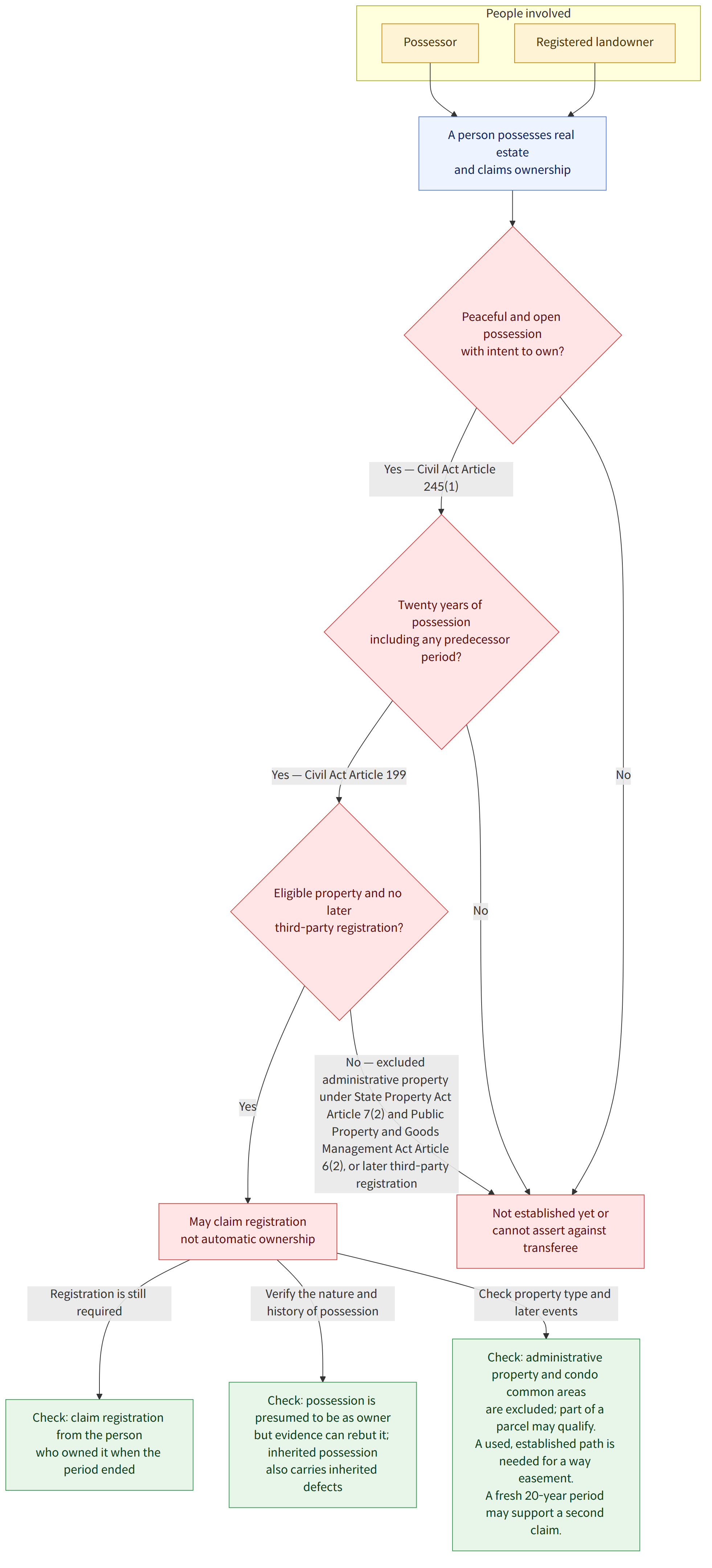
A person who possesses real estate peacefully and openly, with the intention of owning it, for 20 years may claim acquisitive prescription by possession. However, the passage of the possession period does not itself immediately confer ownership; as a rule, registration is required. The outcome may depend on the nature of the possession, succession to possession and the timing of changes in ownership, whether the property is State property, and whether a third party registered ownership after the prescriptive period was completed.
At a glance
Key points
- Under the acquisitive prescription rules for real estate, a person acquires ownership by possessing the property peacefully and openly, with the intention of owning it, for 20 years and registering the ownership (Civil Act, Article 245(1) (민법 제245조 제1항)).
- A possessor is generally presumed to possess with the intention of owning the property. However, that presumption may be rebutted by evidence that the possessor knew the possession was unauthorized, or by evidence of the basis for possession and surrounding circumstances showing that the possessor did not intend to exclude another person’s ownership (Civil Act, Article 197(1) (민법 제197조 제1항)).
- A successor in possession may rely solely on their own possession or may also rely on the possession of a predecessor. If the predecessor’s possession is added to the period, any defect in that possession is also inherited (Civil Act, Article 199 (민법 제199조)).
- A change in the owner during the possession period does not, by itself, interrupt the running of the period. However, if a third party completes registration of a transfer of ownership after the period is completed but before registration, the possessor generally cannot assert completion of the prescriptive period against that third party.
- Even when acquisitive prescription by possession is completed, ownership is not transferred immediately before registration. As a rule, the possessor must claim registration of the transfer from the person who owned the property when the prescriptive period was completed.
- Even if ownership is transferred to a third party after the prescriptive period is completed, making it impossible to assert the claim against that party, a person who continues possession may claim a second acquisitive prescription by using the date of the change in ownership as the new starting point and possessing the property for another 20 years.
- Administrative property among State property is not subject to acquisitive prescription, while general property may be subject to it if the requirements are met. Administrative property owned by a local government also cannot be acquired by prescription (State Property Act, Article 7(2) (국유재산법 제7조 제2항); Public Property and Goods Management Act, Article 6(2) (공유재산 및 물품 관리법 제6조 제2항)).
- Acquisitive prescription may apply to part of a parcel of land, but a common area in a condominium building cannot be acquired as property through acquisitive prescription. An easement of way may be acquired by prescription only if an objective state of affairs in which a path has been established and used has continued (Civil Act, Article 294 (민법 제294조)).
Frequently asked questions
Q. If I possess property for more than 20 years, do I become its owner immediately without registration?
No. Even if the period and requirements for acquisitive prescription by possession are met, possession alone does not confer ownership; as a rule, registration is required. The basic approach is to claim registration of the transfer from the person who owned the property when the prescriptive period was completed.
Q. Can I add the previous possessor’s period of possession to reach 20 years?
Yes. A successor in possession may rely solely on their own possession or may also rely on the possession of a predecessor. However, if the predecessor’s possession is added to the period, any defect in that possession is also inherited. If possession has passed through several people, it may also be disputed how far back the periods can be added.
Q. If the landowner changes while I am in possession, does the acquisitive prescription period start over?
A change in the registered owner before the prescriptive period is completed does not, by itself, interrupt the existing possession or stop the period from running. However, if a third party completes registration of a transfer of ownership after the period is completed but before you register your right, as a rule it is difficult to assert the already-completed prescription against that third party.
Q. Can I claim acquisitive prescription again even if ownership was registered in a third party’s name after the period was completed?
Even if a third party registers ownership after the prescriptive period is completed, making it impossible to assert the first period of prescription against that party, you may claim a second acquisitive prescription if you continue possession and 20 years pass from the date ownership was transferred to the third party. The key is to use the date of the change in ownership as the new starting point.
Q. Can land owned by the State or a local government be acquired by prescription?
State property must be classified as administrative property or general property. Administrative property is not subject to acquisitive prescription, but general property may be subject to it if the requirements are met. The fact that administrative property is not actually being used does not, by itself, make it general property.
Q. Can I acquire property by prescription if I bought and possessed it without knowing it belonged to someone else?
The fact that possession began with a purchase does not automatically rebut the presumption that the possession was as an owner. However, the outcome may differ if the possessor knew when taking possession that the seller had no authority to dispose of the property, or if other objective circumstances show that the possession cannot be regarded as intended to exclude the owner’s rights.
Q. Can I claim acquisitive prescription over part of a parcel or part of co-owned land?
Acquisitive prescription by possession may apply even to part of a parcel of land. If someone possesses a specific part of land held in a form of co-ownership in which each co-owner has a separately owned portion, the other co-owners may also be required to register the transfer of their shares in that part. In some cases, a claim must therefore be brought against all relevant co-owners.
Q. Can I acquire a common area in a condominium building by prescription if I have used it for a long time?
A common area in a condominium building cannot be acquired as separate property through acquisitive prescription. It cannot be owned as though it were a unit or disposed of separately from a unit merely because it has been used for a certain period.
Relevant laws
- Civil Act, Article 186 (민법 제186조)
- Civil Act, Article 187 (민법 제187조)
- Civil Act, Article 197(1) (민법 제197조 제1항)
- Civil Act, Article 199 (민법 제199조)
- Civil Act, Article 245(1) and (2) (민법 제245조 제1항·제2항)
- Civil Act, Article 247(1) (민법 제247조 제1항)
- Civil Act, Article 252(2) (민법 제252조 제2항)
- Civil Act, Article 291 (민법 제291조)
- Civil Act, Article 294 (민법 제294조)
- Civil Act, Articles 1053 through 1058 (민법 제1053조부터 제1058조까지)
- Real Estate Registration Act, Article 65 (부동산등기법 제65조)
- State Property Act, Article 6 (국유재산법 제6조)
- State Property Act, Article 7(2) (국유재산법 제7조 제2항)
- State Property Act, Article 12(1) and (2) (국유재산법 제12조 제1항·제2항)
- Public Property and Goods Management Act, Article 6(2) (공유재산 및 물품 관리법 제6조 제2항)
Watch out for
- Do not assume that 20 years of possession automatically confers ownership. The nature and duration of the possession must be checked, and any necessary claim for registration should be considered.
- The legal effect differs depending on whether ownership changes before the prescriptive period is completed or ownership is transferred to a third party after completion but before registration.
- When adding a predecessor’s period of possession, any defect in that possession may also be inherited. The determination of the starting point may also depend on when the possessor or registered owner changed.
- The outcome for land owned by the State or a local government may depend on the type of property and the circumstances of possession. It is necessary to consider both whether the property is administrative or general property and whether possession was as an owner.
Related articles
Source cases
This guide was compiled by AI from the following Korea Legal Aid Corporation consultation cases (in Korean).
- 각 공유자에 대한 점유취득시효 기산점을 달리하여 주장할 수 있는지
- 취득시효 완성 후 토지가 수용될 경우 시효취득자의 소유권 주장방법
- 부동산의 일부에 대하여도 점유취득시효가 인정될 수 있는지
- 점유자가 수탁자에 대하여 취득시효 완성을 주장할 수 있는지 여부
- 점유취득시효 완성 후 상속등기에 이의하지 않은 경우 타주점유인지
- 자기 소유의 부동산에 대하여 시효취득이 가능한지
- 취득시효 완성 후 등기한 제3자에 대한 점유취득시효 주장 가능한지
- 미등기·미등록 토지 점유시효취득자의 권리행사 방법
- 국유재산도 점유취득시효의 대상이 될 수 있는지
- 타인 소유 토지를 매수한 경우 자주점유의 추정이 번복되는지
- 20년 이상 경작한 토지에 대한 점유취득시효 완성 여부
- 부동산소유권이전등기 후 일정기간 점유할 때 등기부취득시효
- 취득시효 완성된 명의신탁 부동산이 새로운 명의수탁자로 변경된 경우
- 구분소유적 공유관계에 있는 토지에 대하여 시효취득이 가능한지
- 타인 토지 위의 무단건축물 양수 후 점유취득시효주장이 가능한지
- 이주대책으로 점유한 토지에 대한 점유취득시효 주장이 가능한지
- 부동산의 취득시효 기간 중 원소유자가 설정한 근저당권의 효력
- 등기부취득시효 완성 후 그 등기명의가 불법 말소된 경우 소유권 상실 여부
- 취득시효 완성된 토지 상속인이 제3자를 거쳐 이전등기 한 경우의 효력
- 토지에 대한 점유취득시효 완성 전 상속인명의로 등기 된 때 시효취득 여부
- 점유취득시효완성 후 소유자 변동된 경우 2차 점유취득시효 기산점
- 국가가 토지를 20년간 점유하여 취득시효가 완성된 경우, 국가 소유로 등기가 이루어지기 전에 토지 소유자가 하천편입토지 보상 ...
- 새마을운동의 일환으로 개설된 도로를 폐쇄할 경우 대응방법
- 국가나 지방자치단체가 토지의 취득절차에 관한 자료를 제출하지 못하는 경우, 자주점유 추정이 번복되는지 여부
- 집합건물의 공용부분이 취득시효에 의한 소유권 취득의 대상이 되는지 여부
This guide is general legal information about Korean law, not legal advice for your situation. For a specific case, consult a lawyer or the Korea Legal Aid Corporation (call 132 in Korea).