
Guide to the Maintenance and Repair of Rented Housing
Based on 18 consultation cases · Updated · Translated from the Korean original.
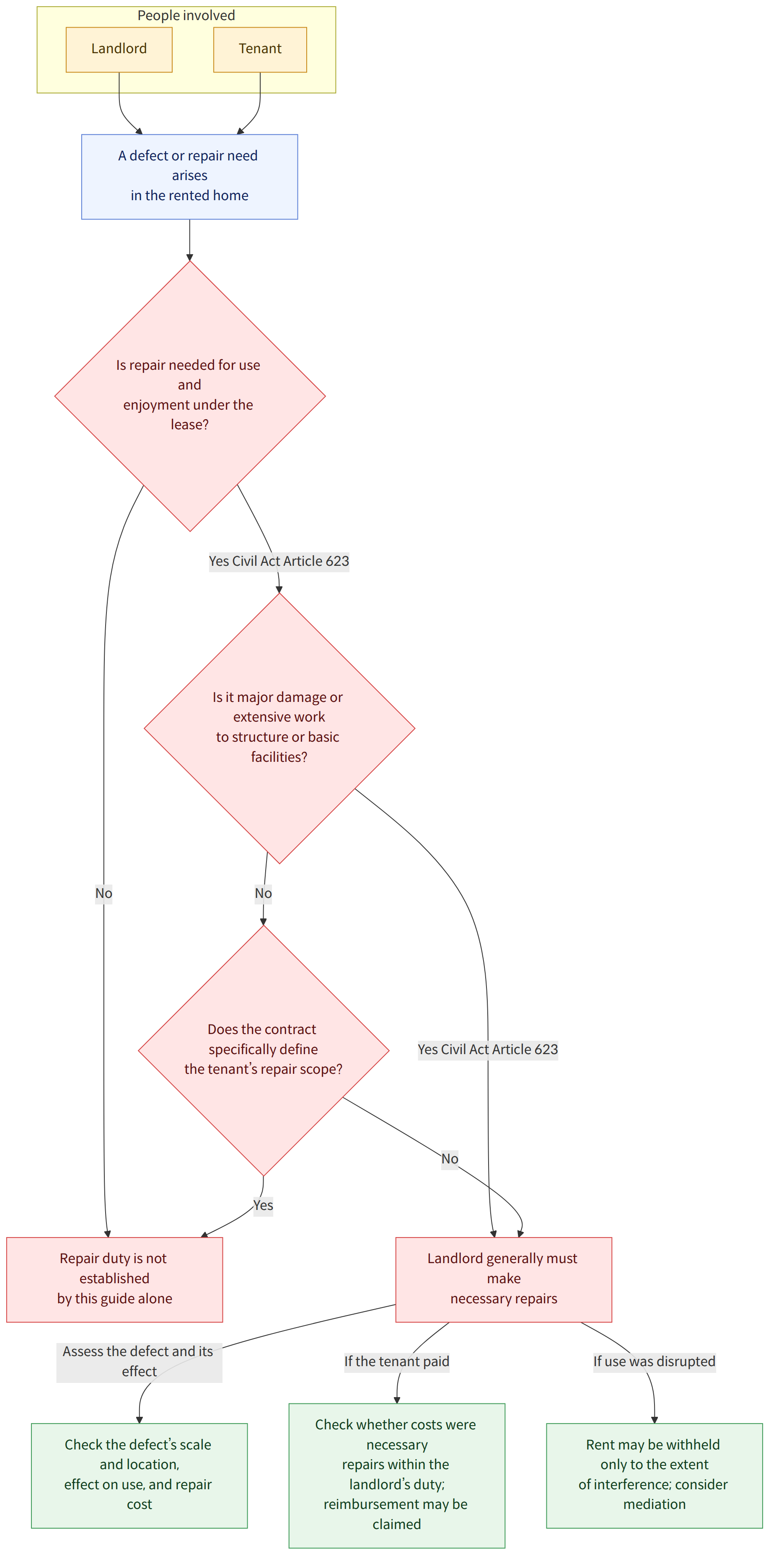
As a general rule, the landlord must keep the home in a condition that allows the tenant to use and enjoy it for the purpose of the lease, and must make the repairs necessary to do so. The scope of repairs and responsibility for their costs depend on factors such as the extent and cause of the defect, the terms of the contract, and the effect on the tenant’s use of the home. In some cases, a tenant who makes repairs directly may claim reimbursement for the costs.
At a glance
Key points
- The landlord’s duty to make repairs is recognized to the extent necessary for the tenant to use and enjoy the home in accordance with the purpose and intended use of the lease. Various circumstances are considered, including the scale and location of the defect, its effect on use, and the cost of repairs (Civil Act, Article 623 (민법 제623조); Supreme Court Decision 2011Da107405, rendered March 29, 2012 (대법원 2012. 3. 29. 선고 2011다107405 판결)).
- Even if the contract states that the tenant is to make repairs, the provision may be interpreted as limited to ordinary minor repairs unless there are special circumstances in which the scope has been specifically defined. Major damage and extensive repairs to principal structural components or basic facilities may remain the landlord’s responsibility (Supreme Court Decision 94Da34692, rendered December 9, 1994 (대법원 1994. 12. 9. 선고 94다34692 판결); Supreme Court Decision 2007Da91336, rendered March 27, 2008 (대법원 2008. 3. 27. 선고 2007다91336 판결)).
- Defects that emerge during the lease term may include defects that existed when the contract was made but were discovered later. If condensation results from a structural defect, measures may be necessary to investigate and eliminate its cause (Civil Act, Article 623 (민법 제623조); Supreme Court Decision 2010Da89876, rendered June 14, 2012 (대법원 2012. 6. 14. 선고 2010다89876 판결)).
- If the tenant pays expenses that fall within the landlord’s duty to make repairs, the tenant may claim reimbursement for necessary expenses as soon as they are incurred and may claim the full amount spent, regardless of whether the benefit of those expenses remains (Civil Act, Article 626(1) (민법 제626조 제1항)).
- If the landlord fails to make repairs and this interferes with the tenant’s use and enjoyment, or if such interference occurs during repairs, the tenant may refuse to pay rent to the extent of the interference. The tenant may also assert that reimbursement for necessary expenses and payment of rent must be performed concurrently, or consider set-off or exercising a right of retention if the requirements are met (Civil Act, Article 626(1) (민법 제626조 제1항)).
- The landlord may be held liable if a fire results from a defect in an area under the landlord’s control and management, or from the negligence of a contractor engaged by the landlord to carry out repairs. Conversely, the tenant may need to prove that the cause was not attributable to them or that they exercised the care of a prudent manager, among other matters (Civil Act, Articles 374, 390, 391, 615, and 654 (민법 제374조, 제390조, 제391조, 제615조, 제654조)).
- A dispute over the duty to make repairs or responsibility for repair costs may be addressed by applying for mediation to a Housing Lease Dispute Mediation Committee (Housing Lease Protection Act, Article 14(2)(4) (주택임대차보호법 제14조 제2항 제4호)).
Frequently asked questions
Q. If my landlord refuses to make repairs, can I fix the problem myself and claim the cost?
If the defect falls within the landlord’s duty to make repairs, the tenant may make the repairs and then claim reimbursement for necessary expenses. The tenant may claim the expenses as soon as they are incurred and may claim the full amount spent, regardless of whether the benefit of those expenses remains (Civil Act, Article 626(1) (민법 제626조 제1항)).
Q. If the contract says that I am responsible for building repairs, do I have to pay for major repairs too?
Unless there are special circumstances in which the scope of repairs has been specifically defined, the tenant’s responsibility may be limited to minor repairs for damage that can ordinarily be expected. Major damage, extensive repairs to principal structural components, and replacement of basic facilities may remain the landlord’s responsibility (Supreme Court Decision 94Da34692, rendered December 9, 1994 (대법원 1994. 12. 9. 선고 94다34692 판결)).
Q. I could not properly use my home while repairs were being made. Do I still have to pay rent?
If the premises cannot be used or enjoyed, the tenant may refuse to pay rent to the extent of that interference. The same principle applies to interference with use arising while the landlord is carrying out the duty to make repairs (Supreme Court Decision 96Da44778, rendered April 25, 1997 (대법원 1997. 4. 25. 선고 96다44778 판결); Supreme Court Decision 2014Da65724, rendered February 26, 2015 (대법원 2015. 2. 26. 선고 2014다65724 판결)).
Q. If condensation occurs, can I ask the landlord to fix it?
If condensation results from a defect such as inadequate insulation or moisture-proofing due to the building’s structure, the landlord may be required to investigate and eliminate the cause. Depending on the circumstances, the tenant may request necessary measures such as installing a dehumidifier or ventilation system, or carrying out floor work (Supreme Court Decision 2010Da89876, rendered June 14, 2012 (대법원 2012. 6. 14. 선고 2010다89876 판결)).
Q. If the landlord changes before I claim repair costs, whom should I claim them from?
If the tenant’s leasehold right is enforceable against third parties and the leased property is sold, the new owner succeeds to the landlord’s position, so the tenant may claim reimbursement from the new owner. If the leasehold right is not enforceable against third parties, the tenant must, in principle, claim reimbursement from the former owner. A court decision has explained that, under Article 203 of the Civil Act, the tenant cannot claim the expenses from the new owner (Housing Lease Protection Act, Article 3(4) (주택임대차보호법 제3조 제4항); Supreme Court Decision 2001Da64751, rendered July 25, 2003 (대법원 2003. 7. 25. 선고 2001다64751 판결)).
Q. If water leaks from the upstairs balcony, should I claim against the upstairs neighbor or the building management body?
If the leak originates in a common area, a claim for damages should be made against the building management body; if it originates in an exclusive-use area, the claim should, in principle, be made against the upstairs owner. Whether a balcony is an exclusive-use area or a common area must be determined on a case-by-case basis by considering the building’s structure and objective use, so no general conclusion can be reached.
Q. When can a tenant avoid liability for damages if a fire occurs in the rented home?
The tenant has a duty to preserve the leased property and return it in its original condition at the end of the lease. Therefore, the tenant may be liable for damages unless they prove, for example, that the damage occurred for reasons for which they were not responsible. However, the landlord may be held liable if the fire resulted from a defect in an area under the landlord’s control and management, or from the negligence of a repair contractor engaged by the landlord (Civil Act, Articles 374, 390, 391, 615, and 654 (민법 제374조, 제390조, 제391조, 제615조, 제654조)).
Q. What happens if I discover a defect but tell my landlord late?
If the landlord did not know about the defect and the tenant also failed to report it without delay, the landlord’s liability for damages may be limited to the extent that the landlord was unable to make repairs because they had not received notice. It is important to notify the landlord without delay after discovering a defect.
Q. I’m in a dispute over repairs. Is there an option other than going to court?
A landlord or tenant may apply for mediation to a Housing Lease Dispute Mediation Committee. Disputes concerning the maintenance and repair of rented housing are also subject to mediation (Housing Lease Protection Act, Article 14(2)(4) (주택임대차보호법 제14조 제2항 제4호)).
Relevant laws
- Civil Act, Article 203 (민법 제203조)
- Civil Act, Article 374 (민법 제374조)
- Civil Act, Article 390 (민법 제390조)
- Civil Act, Article 391 (민법 제391조)
- Civil Act, Article 575(1) (민법 제575조 제1항)
- Civil Act, Article 580(1) (민법 제580조 제1항)
- Civil Act, Article 615 (민법 제615조)
- Civil Act, Article 623 (민법 제623조)
- Civil Act, Article 626(1) (민법 제626조 제1항)
- Civil Act, Article 630(1) (민법 제630조 제1항)
- Civil Act, Article 652 (민법 제652조)
- Civil Act, Article 654 (민법 제654조)
- Housing Lease Protection Act, Article 3(4) (주택임대차보호법 제3조 제4항)
- Housing Lease Protection Act, Article 14(2)(4) (주택임대차보호법 제14조 제2항 제4호)
Watch out for
- Whether the landlord or the tenant is responsible for repairs cannot be determined based on the contract wording alone. Any special provision defining the scope of repairs, the scale and cause of the defect, and its effect on the use of the home should all be considered.
- Before making repairs directly, the tenant should keep records showing the defect and the need for repairs, what was communicated to the landlord, and the expenses incurred.
- The tenant must notify the landlord without delay after discovering a defect. The landlord’s liability may be limited to the extent that delayed notice prevented the landlord from making repairs.
- The mere fact that external conditions or nearby hazards may damage the tenant’s other property does not establish a duty on the landlord to take protective measures. It is necessary to consider whether there are special circumstances that interfere with the use and enjoyment of the home for the purpose of the lease.
Source cases
This guide was compiled by AI from the following Korea Legal Aid Corporation consultation cases (in Korean).
- 임대인의 수선의무의 한계 범위
- 윗층 베란다 누수로 인한 손해의 배상의무자
- 화재로 인한 주택 훼손시 임차인이 책임을 면하는 경우
- 주택 인도 당시 이미 존재하고 있던 하자에 대한 수선의무
- 필요비상환청구권의 포기특약
- 임차건물의 내부공사를 용인하는 묵시적 약정의 인정가능성
- 전기배선의 하자로 인한 화재
- 임대물 수선 공사 중 수급인 과실로 인해 발생한 화재에 대한 책임
- 임대인의 수리 중 집에 불이 난 경우
- 임대인의 수선의무를 특약으로 면제한 경우
- 임차목적물 매매시 비용상환청구의 상대방
- 필요비상환청구권의 이행 확보 방안
- 건물 바닥의 결로현상이 발생할 경우
- 임차인이 하자 통지의무를 지체하였을 때, 임대인의 손해배상 범위
- 임차주택의 수선 중 차임지급 의무
- 임차인의 임차주택 수선
- 전대차 관계에서 전차인의 비용상환청구권의 상대방
- 주택임대차분쟁조정위원회를 통한 문제해결
This guide is general legal information about Korean law, not legal advice for your situation. For a specific case, consult a lawyer or the Korea Legal Aid Corporation (call 132 in Korea).