
Offenses under the Road Traffic Act: Alcohol, Unlicensed Driving, and Post-Accident Duties
Based on 40 consultation cases · Updated · Translated from the Korean original.
Whether a violation of the Road Traffic Act has occurred depends on factors such as the circumstances of an alcohol test, the situation at the time of driving, measures taken after an accident, and the driver’s license status. In particular, whether refusing an alcohol test or driving in a parking lot constitutes an offense depends on the specific legal requirements, so both the conduct and the legality of the evidence must be considered.
At a glance
Key points
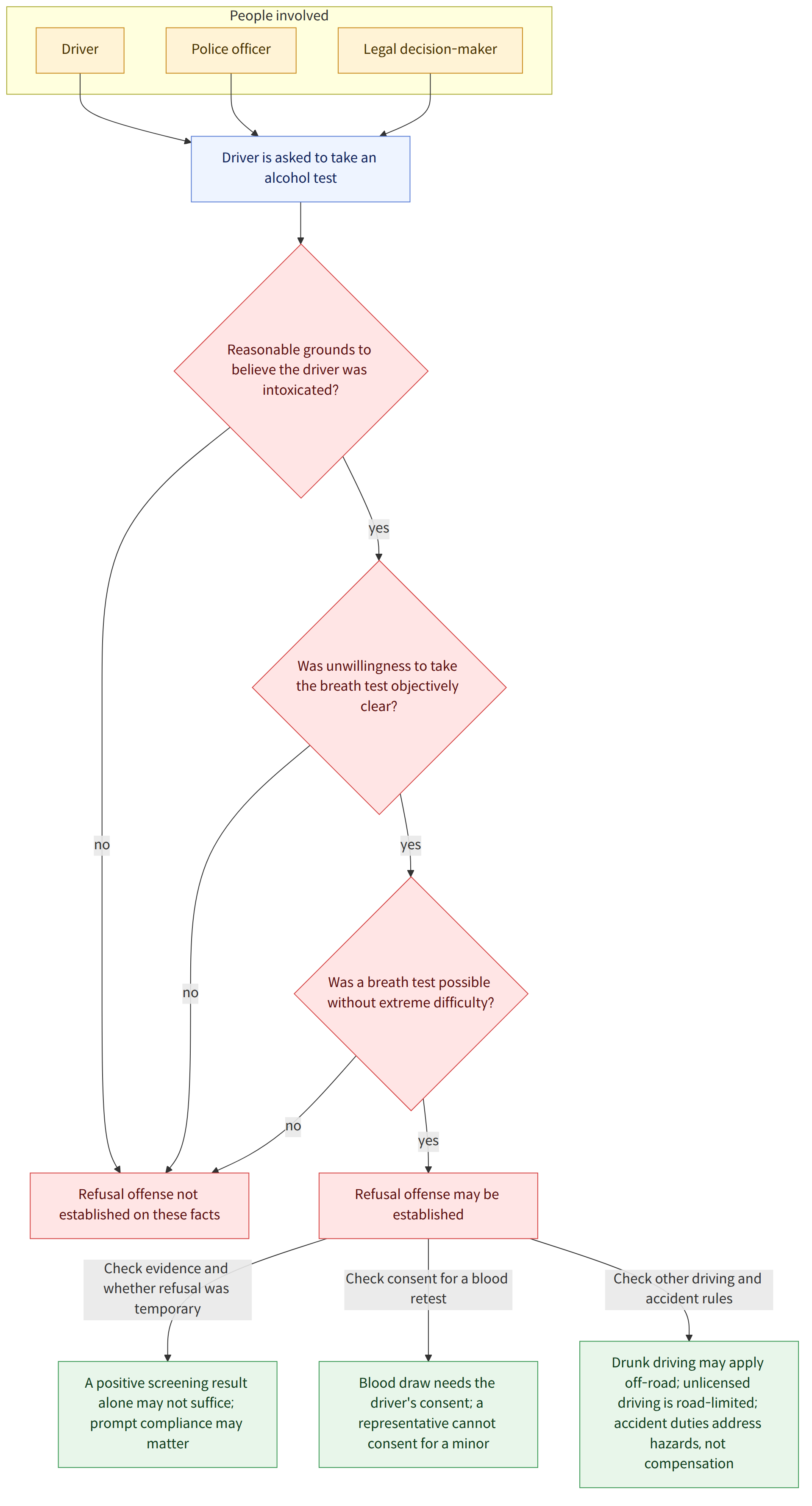
- The offense of refusing a breath-alcohol test is established when there are reasonable grounds to believe that the driver is intoxicated and it is objectively clear that the driver is unwilling to take the test. A positive result from an alcohol-screening device alone may not be enough (Cases 2, 4, 13).
- A driver’s consent is required to have blood drawn after disputing a breath-test result, and a legal representative cannot consent on behalf of a minor even if the minor lacks the capacity to make decisions (Cases 1, 3).
- If a breath test is impossible or extremely difficult because of a physical condition, refusing a blood test alone does not establish the offense of refusing a breath-alcohol test (Case 5).
- Drunk driving may be punished even in places other than roads, but there is no exception extending the offense of driving without a license to driving in places other than roads, so the nature of the location may lead to different results (Road Traffic Act, Article 2(26) (도로교통법 제2조 제26호); Cases 12, 20).
- The duty to take measures after an accident is a duty to prevent or remove traffic hazards and obstructions, not a duty to compensate for the damage. However, if a vehicle moves independently of the driver’s will, it may be difficult to treat that movement as “driving a vehicle or other traffic” under the relevant provision (Road Traffic Act, Article 54(1) (도로교통법 제54조 제1항); Cases 11, 14).
- Where continued drunk driving is recognized as a single comprehensive crime and some of the conduct was included in a final judgment, that conduct may not be tried again. By contrast, drunk driving and refusing a breath-alcohol test may be separate, cumulative offenses (Cases 7, 8).
- If a driver did not know that their license had been revoked, the intent required for the offense of driving without a license may not be established. If an administrative revocation of a license is overturned through administrative litigation, the revocation may lose effect retroactively from the date it was issued (Cases 21, 23).
Frequently asked questions
Q. If I dispute the result of a breath test, can I request a blood test?
According to the case, a driver who disputes the result of a breath test may, with consent, be tested again by having blood drawn or by another method. However, consent to a blood draw must be valid, and a legal representative cannot consent on behalf of a minor solely on the ground that the minor lacks the capacity to make decisions.
Q. Does refusing an alcohol-screening device test immediately constitute the offense of refusing a breath-alcohol test?
Refusing an alcohol-screening device test does not automatically constitute an offense in every case. It must be considered whether the driver knew that a breath-alcohol test was to follow and, by refusing the screening test, objectively showed an unwillingness to take that test, and whether there were reasonable grounds to believe that the driver was intoxicated.
Q. Can I be punished if I refuse a breath-alcohol test once but then promptly agree to take it?
Even if a driver refuses once, the offense of refusing a breath-alcohol test may not be established if the driver then promptly complies with a renewed request and the refusal was only temporary. The overall circumstances matter, including whether it was objectively clear that the driver was unwilling to take the test.
Q. If I cannot take a breath test and refuse a blood draw, have I committed the offense of refusing a breath-alcohol test?
If a breath test was impossible or extremely difficult because of a physical condition or another reason, the driver cannot be considered to have refused the breath test merely because it could not be properly completed. The case law discussed in the example explains that refusing a request to have blood drawn does not, by itself, establish the offense of refusing a breath-alcohol test.
Q. Is it drunk driving if I drink alcohol and move my car in an apartment basement parking lot?
According to the case, drunk driving may be punished even when the vehicle is driven somewhere other than a road. Thus, drunk driving may be established regardless of whether a parking lot qualifies as a road. By contrast, there is no exception that extends the offense of driving without a license to places other than roads, so whether the same conduct in a parking lot constitutes unlicensed driving depends on whether the lot qualifies as a road.
Q. Can I simply leave after an accident if there is no debris and the damage is minor?
The fact that the damage was minor or that no debris was scattered on the road does not, by itself, establish that the driver fulfilled the duty to take measures after an accident. Whether the necessary measures were taken depends on the circumstances of the accident, the extent of the damage, and the possibility of further danger, among other factors.
Q. Is only one of drunk driving and refusing a breath-alcohol test punishable?
The case law discussed in the example held that the offense of driving while intoxicated and the offense of refusing a breath-alcohol test are separate, cumulative offenses. Accordingly, both offenses may be at issue if the elements of each are met.
Q. Is it driving without a license if I drove without knowing that my license had been revoked?
The offense of driving without a license may be established when a person drives knowing that they do not have a valid driver’s license. The fact that notice of license revocation was given or published does not, by itself, establish that the driver knew of the revocation; the specific circumstances must be considered.
Q. If I did not receive notice of the aptitude test, is it okay to miss the testing deadline?
The case law discussed in the example held that a separate notice of the aptitude test is not required, and that a person generally cannot avoid responsibility for missing the deadline merely by claiming not to have received a notice. It is important to check the aptitude-test period shown on the driver’s license.
Relevant laws
- Road Traffic Act, Article 2(1) (도로교통법 제2조 제1호)
- Road Traffic Act, Article 2(26) (도로교통법 제2조 제26호)
- Road Traffic Act, Article 39(4) (도로교통법 제39조 제4항)
- Road Traffic Act, Article 44(1) through (4) (도로교통법 제44조 제1항부터 제4항까지)
- Road Traffic Act, Article 45 (도로교통법 제45조)
- Road Traffic Act, Article 48(1) (도로교통법 제48조 제1항)
- Road Traffic Act, Article 54(1) (도로교통법 제54조 제1항)
- Road Traffic Act, Article 68(2) (도로교통법 제68조 제2항)
- Road Traffic Act, Article 80(1) (도로교통법 제80조 제1항)
- Road Traffic Act, Article 96(1) (도로교통법 제96조 제1항)
- Road Traffic Act, Article 148 (도로교통법 제148조)
- Road Traffic Act, Article 148-2(1)(1) and (2), and (3) (도로교통법 제148조의2 제1항 제1호·제2호 및 제3항)
- Road Traffic Act, Articles 149 through 157 (도로교통법 제149조부터 제157조까지)
- Road Traffic Act, Article 159 (도로교통법 제159조)
- Road Traffic Act, Article 160(2)(7) (도로교통법 제160조 제2항 제7호)
Watch out for
- The examples refer to provisions and standards under both former and amended laws, so the law applicable at the time of the incident must be checked.
- The offense of refusing a breath-alcohol test is assessed by considering the overall circumstances, including the reason and manner in which the test was requested, the driver’s conduct, and the circumstances of the refusal—not just the act of refusing.
- Whether the driver knew that their license had been revoked and whether they took the necessary measures after an accident may depend on the circumstances of each case.
Source cases
This guide was compiled by AI from the following Korea Legal Aid Corporation consultation cases (in Korean).
- 호흡측정을 한 후 혈액채취에 의한 음주측정이 허용되는지
- 음주감지기에 의한 시험 요구 불응시 음주측정불응죄 성립 여부
- 법정대리인이 미성년자를 대리하여 혈액채취에 동의할 수 있는지
- 음주측정불응죄의 성립요건 중 '술에 취한 상태에 있다고 인정할 만한 상당한 이유'의 판단기준
- 호흡측정에 응할 수 없는 운전자가 혈액채취에 의한 측정을 거부했을 때 음주측정불응죄가 성립하는지
- 음주운전을 일시 중단한 운전자에게 음주측정불응죄가 성립할 수 있는지
- 음주운전으로 인한 도로교통법 위반죄의 죄수
- 주취운전과 음주측정거부의 각 도로교통법위반죄의 죄수관계
- 도로교통법 제44조 제1항을 2회 이상 위반한 전과에 실효되거나 사면된 전과가 포함되는지
- 도로교통법 제148조의2 제3항 위반의 죄가 약물 등의 영향으로 현실적으로 ‘정상적으로 운전하지 못할 상태’에 이르러야 성립...
- 도로교통법 제54조 제1항의 취지 및 사고운전자가 취하여야 할 조치의 정도
- 주차장에서의 음주운전도 도로교통법상 음주운전인지
- 음주측정거부가 일시적인 경우 음주측정불응죄 성립 여부
- 도로교통법 제54조 제1항의 ‘차의 운전 등 교통’의 의미
- 위법한 체포 상태에서 음주측정 요구에 불응한 경우
- 도로교통법 제44조 제1항을 2회 이상 위반한 전과에 개정법 시행 이전의 전과가 포함되는지
- 비보호 좌회전을 하다 충돌한 경우 안전운전의무 위반인지 여부
- 종업원이 고정조치의무를 위반하여 화물을 적재한 경우 그를 고용한 법인의 책임
- 호흡측정기에 의한 음주 측정시 입안을 헹굴 기회를 달라는 요구를 무시당한 경우
- 주차장에서의 무면허운전도 도로교통법위반죄가 되는지
- 적성검사 기간 경과로 면허가 취소된 상태에서 운전한 경우 무면허운전인지 여부
- 국제협약의 양식에 맞지 않는 국제운전면허증의 효력
- 운전면허가 취소된 후 자동차를 운전하였으나 운전면허취소처분이 행정쟁송절차에 의하여 취소된 경우, 무면허운전의 성립 여부
- 도로에 방치된 교통에 방해가 될 만한 물건을 단순히 사용한 경우 도로교통법 위반인지
- 운전면허 적성검사 기간에 관한 안내가 없었던 경우에도 그 기간을 경과하면 처벌되는지 여부
This guide is general legal information about Korean law, not legal advice for your situation. For a specific case, consult a lawyer or the Korea Legal Aid Corporation (call 132 in Korea).