
Guide to Defects, Rescission, and Damages in Sales Contracts
Based on 68 consultation cases · Updated · Translated from the Korean original.
If the subject of a sale has a defect, you may be able to rescind the contract or claim damages, but the available remedies depend on the nature of the defect, the contract’s purpose, and whether the buyer knew of the defect. Failure to comply with procedures such as the time limits for notifying the seller or exercising rights, or the requirement to tender performance, may make it difficult to exercise your rights.
At a glance
Key points
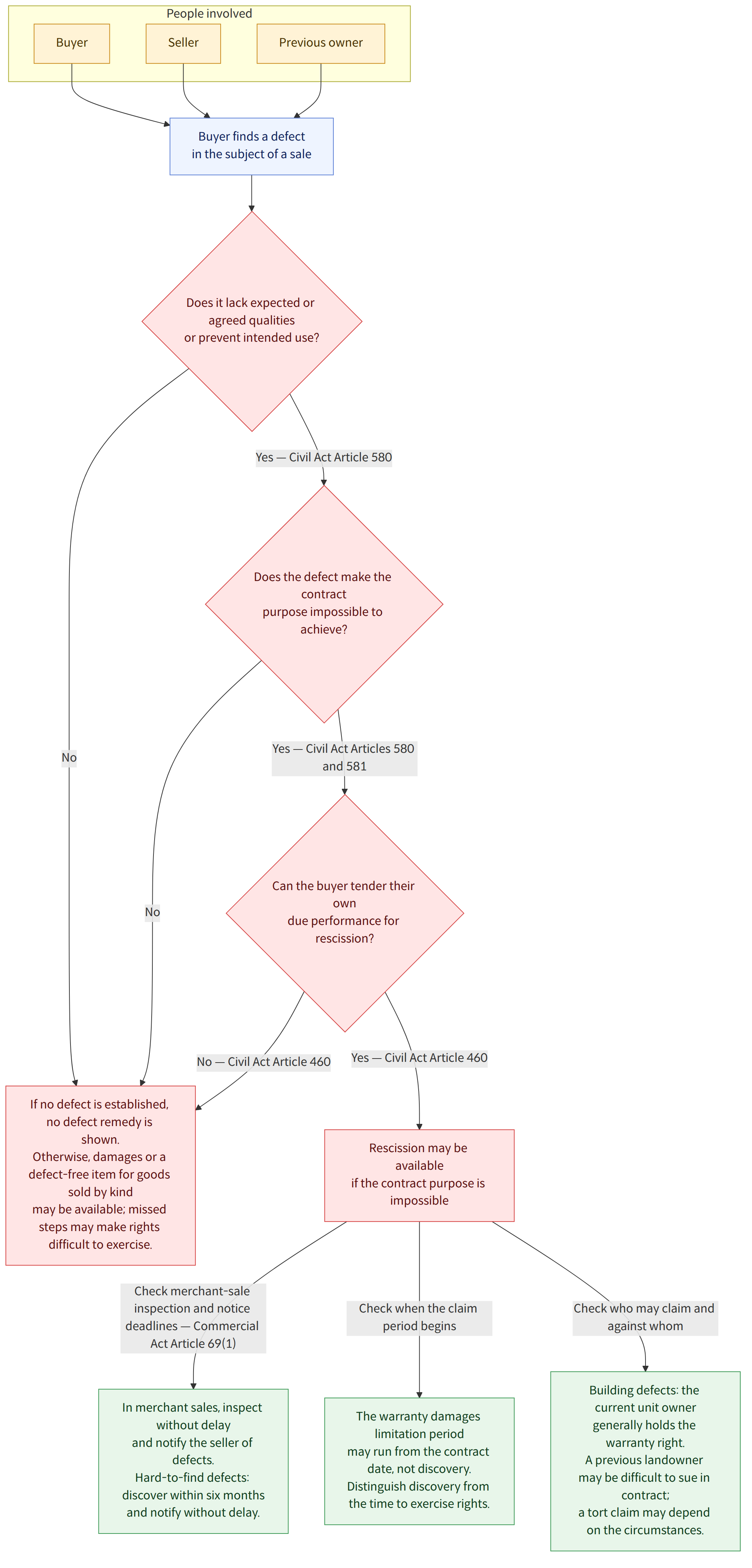
- A defect may exist if the subject of a sale lacks the qualities or performance reasonably expected in light of ordinary commercial practice, or qualities that the parties contemplated or warranted. A legal restriction that prevents the subject from being used for its intended purpose may also constitute a defect (Civil Act, Article 580; Supreme Court Decision 98Da18506, January 18, 2000).
- If a defect makes it impossible to achieve the contract’s purpose, the buyer may rescind the contract; in other cases, the buyer may claim damages. In a sale of goods specified by kind, the buyer may also demand a defect-free item (Civil Act, Articles 580 and 581).
- A seller’s liability under the warranty against defects and liability for nonperformance may both arise. However, liability under the warranty against defects may be limited if the buyer knew of the defect or did not know of it due to the buyer’s negligence (Civil Act, Articles 390 and 580; Case 6).
- As a general rule, the right to pursue a warranty claim for defects in a building under the Act on Ownership and Management of Aggregate Buildings belongs to the current unit owner. Thus, a current owner who did not contract directly with the builder may also exercise the right directly (Act on Ownership and Management of Aggregate Buildings, Article 9; Supreme Court Decision 2001Da24891, January 27, 2004).
- In a sale between merchants, the buyer must inspect the subject matter without delay after receiving it and notify the seller of any defects. A defect that is difficult to discover immediately must be discovered within six months, and the seller must be notified without delay, for the buyer to claim liability under the warranty (Commercial Act, Article 69, Paragraph 1).
- Even if the buyer was unaware of the defect, the limitation period for a damages claim based on liability under the warranty against defects may begin to run when the contract is made. The date the defect was discovered must therefore be distinguished from the period for exercising the right (Civil Act, Articles 162, Paragraph 1, and 582; Case 11).
- A person who purchased land through one or more intermediate buyers may find it difficult to hold a previous seller liable under the contract or for nonperformance. However, depending on the circumstances, such as the illegal burial of waste, that person may claim that the previous owner is liable in tort (Civil Act, Article 750; Supreme Court en banc Decision 2009Da66549, May 19, 2016).
- To rescind a contract where the parties’ obligations are concurrently due, a party must, as a general rule, tender performance of their own obligation so that they are ready to perform it. Merely showing a copy of a bankbook containing the balance may not constitute a proper tender of performance (Civil Act, Article 460; Supreme Court Decision 2004Da49525, December 9, 2004).
Frequently asked questions
Q. If waste is buried in land I purchased, from whom can I claim compensation?
You may claim damages for breach of the warranty against defects or for nonperformance from the person who sold the land to you directly. If you did not contract directly with a previous owner, it is difficult to hold that owner contractually liable. However, depending on the circumstances of the transaction involving land contaminated after illegal waste burial, you may claim damages in tort.
Q. Can I rescind a contract if land I bought for construction is subject to building restrictions or has a steep slope?
A defect may be established if the land cannot be used for the intended construction purpose as of the time of contracting, or if using it for that purpose would require substantial time and expense. If the contract’s purpose cannot be achieved, you may consider rescission. The contract’s purpose, the seriousness of the defect, and other circumstances are considered together.
Q. If a newly purchased car has a defect, can I demand a new car in exchange?
In a sale of goods specified by kind, if the particular item delivered has a defect, the buyer may demand a defect-free item instead of rescission or damages. Whether a deficiency constitutes a defect and how it affects the contract’s purpose are determined by considering the specific circumstances, including the nature of the deficiency and when it arose.
Q. Can I no longer exercise my rights once six months have passed since I discovered a defect in the subject of a sale?
Under the Civil Act, rights based on the warranty against defects must be exercised within six months from the day the buyer becomes aware of the defect. However, the limitation period for a damages claim may begin to run from the date the contract was made. The six-month period for exercising rights must therefore be distinguished from the limitation period.
Q. If businesses buy and sell goods and the buyer discovers a defect late, can the buyer refuse to pay the price?
In a sale between merchants, the buyer must inspect the goods without delay after receiving them and immediately notify the seller upon discovering a defect. A defect that could not be discovered immediately must also be discovered within six months, and the seller must be notified without delay thereafter. Failure to meet these requirements may make it difficult to assert liability under the warranty against defects.
Q. Can I ask the construction company directly to repair defects in a condominium apartment I purchased?
As a general rule, the right to pursue a warranty claim for defects in a building under the Act on Ownership and Management of Aggregate Buildings belongs to the current unit owner. Accordingly, a current owner who did not contract directly with the construction company may also demand that defects be repaired. However, the warranty period and the period for exercising the right must be checked separately.
Q. Can I rescind the contract immediately if the seller says they will not perform it?
If the other party has clearly stated that they will not perform, rescission may be possible without tendering performance of your own obligation. If the other party’s intention is not clear, you must properly tender your own obligation that is concurrently due. Merely showing a copy of a bankbook containing the balance may not be sufficient.
Q. Can I claim the deposit or a penalty if the contract does not include a penalty clause?
The fact that a deposit changed hands does not, by itself, mean that the amount was agreed as a penalty or as liquidated damages. If the contract contains no special provision treating it as a penalty, it may be difficult to claim a penalty separately from the return of the deposit.
Relevant laws
- Civil Act, Article 104 (민법 제104조)
- Civil Act, Article 109, Paragraph 1 (민법 제109조 제1항)
- Civil Act, Article 138 (민법 제138조)
- Civil Act, Article 162, Paragraph 1 (민법 제162조 제1항)
- Civil Act, Article 390 (민법 제390조)
- Civil Act, Article 396 (민법 제396조)
- Civil Act, Article 398, Paragraphs 2 and 4 (민법 제398조 제2항·제4항)
- Civil Act, Article 460 (민법 제460조)
- Civil Act, Article 569 (민법 제569조)
- Civil Act, Article 570 (민법 제570조)
- Civil Act, Article 575, Paragraph 1 (민법 제575조 제1항)
- Civil Act, Article 576 (민법 제576조)
- Civil Act, Article 580, Paragraph 1 (민법 제580조 제1항)
- Civil Act, Article 581, Paragraphs 1 and 2 (민법 제581조 제1항·제2항)
- Civil Act, Article 582 (민법 제582조)
Watch out for
- The period for exercising rights under the warranty against defects and the limitation period for a damages claim may differ. You should therefore check both when you learned of the defect and when the contract was made.
- In a sale between merchants, delaying notice after discovering a defect may prevent you from asserting liability under the warranty. Check and keep records of the inspection and notice dates.
- Before rescinding a contract, check not only whether the other party has failed to perform, but also whether you properly tendered performance of your own obligation that is concurrently due.
- Liability under the warranty against defects and product liability may differ in their scope of application and the damages covered. Damage to the product itself may be excluded from product liability.
Related articles
Source cases
This guide was compiled by AI from the following Korea Legal Aid Corporation consultation cases (in Korean).
- 식품불량으로 소비자가 신체장해를 입은 경우 제조자의 책임
- 경락받은 부동산을 가등기에 기한 본등기로 상실한 경우 매도인의 담보책임
- 집합건물의 하자보수청구를 매수인 아닌 구분소유자도 할 수 있는지
- 일조방해로 분양계약상 채무불이행책임, 하자담보책임 있는지
- 수입자동차의 결함으로 인한 완전물 급부청구권
- 토지의 전전매수인이 전전매도인에게 토지 지하 쓰레기 매립에 따른 손해배상 청구를 할 수 있는지 여부
- 비료불량으로 손해발생 한 경우 제조자에게 손해배상청구 가능한지
- 토지수용의 경우 소유자의 토지인도의무에 목적물하자담보책임 있는지
- 매매계약이 매매대금 과다로 무효인 경우 무효행위 전환이 되는지
- 교환받은 토지에 건축제한이 있는 경우 계약취소 가능한지
- 하자담보책임의 소멸시효 기간
- 중도금을 몰취하는 약정의 효력
- 당초부터 이행불능이었던 계약의 운명
- 매수인이 계약 불이행의 의사를 명백히 하는 경우 계약 해제를 위한 매도인의 적절한 행동
- 완전한 물건 급부의무 불능으로 인한 손해배상청구권의 행사기간
- 상인간 매매에서 하자담보책임을 청구할 수 있는 기간
- 적법한 이행의 제공과 매매계약 해제
- 운전석에서 발생한 원인불명의 화재로 전소된 차량의 제조회사 책임
- 분양받은 임야가 건물부지로 사용될 수 없는 경우 분양계약을 해제할 수 있는지
- 매도인의 하자담보책임에도 과실상계 규정이 적용되는지
- 다운계약서임을 이유로 매매계약을 해제할 수 있는지
- 매매과정에서 공인중개사의 고의 과실에 의한 책임
- 상인간의 매매에서 하자담보책임과 하자통지기간
- 분양계약과 다른 내용의 점포가 입점한 경우 매매 계약 해제
- 매매계약 후 허가가 나오지 않아 목적을 달성하지 못한 경우
This guide is general legal information about Korean law, not legal advice for your situation. For a specific case, consult a lawyer or the Korea Legal Aid Corporation (call 132 in Korea).