
Simplified Civil Litigation Procedures: Payment Orders, Small Claims, and Mediation
Based on 38 consultation cases · Updated · Translated from the Korean original.
To seek payment of money promptly, you may consider a payment order or the small-claims procedure; to resolve a dispute by agreement, you may use civil mediation or a settlement procedure. Because these procedures differ in the claims they cover, service requirements, objection deadlines, and effects once final, it is important to choose the procedure suited to your case and keep track of the date of service.
At a glance
Key points
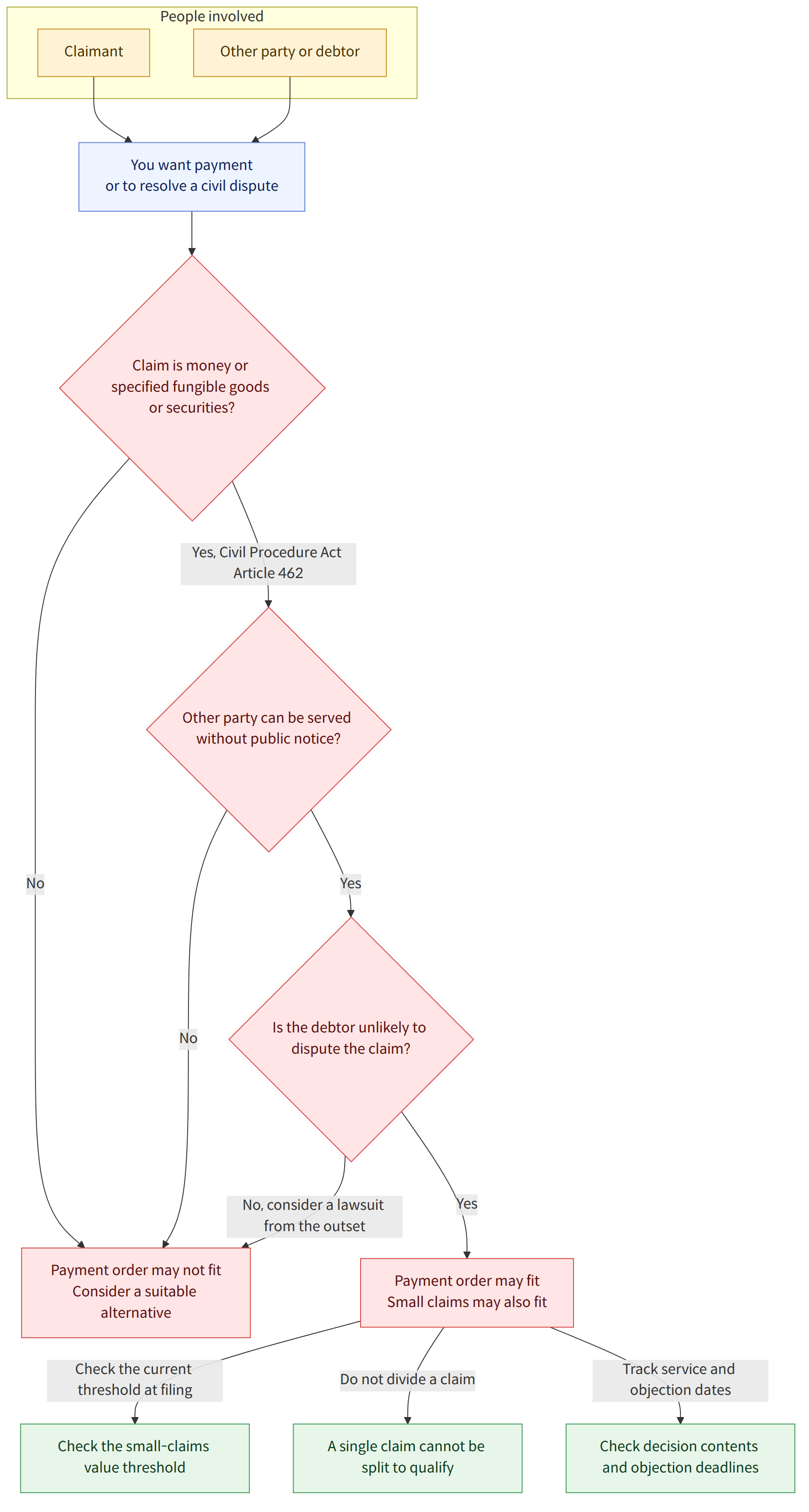
- A payment order may be used to claim payment of money or a specified quantity of fungible goods or securities. If the debtor objects, the matter generally proceeds as a lawsuit. It cannot be used for claims such as delivery of a building or registration of a transfer of ownership (Civil Procedure Act, Article 462 (민사소송법 제462조)).
- The other party must be capable of being served with a payment order by a method other than service by public notice. If the debtor is likely to dispute the claim, it may be preferable to file a lawsuit from the outset.
- Whether a case is a small-claims case is determined by the value of the subject matter of the litigation when the action is filed and the threshold applicable at the relevant time. Because the examples refer to both changes in the threshold and transitional measures, do not apply an amount from an earlier example to a current case without checking (Rules on the Trial of Small Claims, Article 1-2 (소액사건심판규칙 제1조의2), Example 23).
- A single claim may not be divided into multiple claims in order to have the small-claims procedure apply (Small Claims Act, Article 5-2 (소액사건심판법 제5조의2)).
- A decision recommending performance has the same effect as a final judgment if the defendant does not file a written objection within two weeks from the date they receive a copy of the decision. If an objection is filed, a hearing date will be set and the matter will proceed as a lawsuit (Small Claims Act, Articles 5-4 and 5-7 (소액사건심판법 제5조의4, 제5조의7)).
- As a general rule, compulsory execution may be carried out based on the original copy of a final decision recommending performance. In an action to oppose compulsory execution, grounds that existed before the decision became final may also be raised, as well as grounds arising after execution (Small Claims Act, Article 5-8 (소액사건심판법 제5조의8)).
- Once civil mediation is successful, it has the same effect as a judicial settlement. To challenge a decision in lieu of mediation, an objection must be filed within two weeks from the date a copy is served. If a valid objection is filed, the matter may proceed as a lawsuit (Civil Mediation Act, Articles 34 and 36 (민사조정법 제34조, 제36조)).
- A decision recommending settlement or a pre-litigation settlement may have strong legal effects once final. Because the decision may become final if no objection is filed within the prescribed period, check its contents and the date of service (Civil Procedure Act, Articles 220, 226, and 231 (민사소송법 제220조, 제226조, 제231조)).
Frequently asked questions
Q. Can I apply for a payment order if it is difficult for me to appear in court frequently?
A payment order may be considered if you are claiming payment of money or a specified quantity of fungible goods or securities, and the other party can be served by a method other than service by public notice. If the debtor objects, the matter will generally proceed as a lawsuit, so you should also consider the possibility that the other party may dispute the claim itself.
Q. Can I split a large claim into parts so that it qualifies as a small claim?
You may not split a claim and pursue it in separate parts for the purpose of having the Small Claims Act procedure apply. The examples explain that such an action may be dismissed (Small Claims Act, Article 5-2 (소액사건심판법 제5조의2)).
Q. If I do not agree with a decision recommending performance, by when must I object?
You may file a written objection within two weeks from the date you are served with a copy of the decision recommending performance. If you object within that period, the court will set a hearing date. A written submission disputing the plaintiff’s alleged facts may also be treated as an objection (Small Claims Act, Article 5-4 (소액사건심판법 제5조의4)).
Q. I missed the two-week deadline to object to a decision recommending performance. Is there any remedy?
If you were unable to meet the deadline due to unavoidable circumstances, you may file a supplemental objection within the prescribed period after those circumstances cease, and you must explain the circumstances in writing. If there were no unavoidable circumstances, the examples explain that one option is to file an action to oppose compulsory execution when enforcement begins.
Q. Can compulsory execution be carried out based on a final decision recommending performance?
As a general rule, compulsory execution may be carried out using the original copy of the decision recommending performance, without obtaining a separate execution clause. However, an execution clause may be required if execution is conditional or a clause for execution by succession is needed (Small Claims Act, Article 5-8 (소액사건심판법 제5조의8)).
Q. What happens to the case if I do not appear at a mediation date?
If the respondent fails to appear at a mediation date once, a decision in lieu of mediation may be issued unless there is a substantial reason for the failure to appear. If the respondent does not agree with the decision, they may object within two weeks from the date they are served with a copy. If a valid objection is filed, the matter may proceed as a lawsuit.
Q. Can I appeal a decision recommending settlement if I change my mind a month after receiving it?
An objection to a decision recommending settlement must be filed within two weeks from the date you are served with a copy. Once the decision becomes final because no objection was filed within that period, it is difficult to challenge it again through the ordinary objection or appeal procedures described in the examples. A final decision has the same effect as a judicial settlement.
Q. Can I appeal to the Supreme Court from an appellate judgment in a small-claims case on the ground that the rules of evidence were violated?
According to the examples, an appeal to the Supreme Court in a small-claims case is limited to grounds such as an improper determination that a statute or regulation violates the Constitution or laws, or a determination that conflicts with Supreme Court precedent. They explain that a mere violation of the rules of evidence, by itself, is not a ground for such an appeal (Small Claims Act, Article 3 (소액사건심판법 제3조)).
Relevant laws
- Civil Procedure Act, Article 3 (민사소송법 제3조)
- Civil Procedure Act, Article 7 (민사소송법 제7조)
- Civil Procedure Act, Article 8 (민사소송법 제8조)
- Civil Procedure Act, Article 9 (민사소송법 제9조)
- Civil Procedure Act, Article 12 (민사소송법 제12조)
- Civil Procedure Act, Article 18 (민사소송법 제18조)
- Civil Procedure Act, Article 187 (민사소송법 제187조)
- Civil Procedure Act, Articles 194–196 (민사소송법 제194조부터 제196조)
- Civil Procedure Act, Article 220 (민사소송법 제220조)
- Civil Procedure Act, Articles 225–232 (민사소송법 제225조부터 제232조)
- Civil Procedure Act, Article 385 (민사소송법 제385조)
- Civil Procedure Act, Article 388 (민사소송법 제388조)
- Civil Procedure Act, Article 462 (민사소송법 제462조)
- Civil Procedure Act, Article 463 (민사소송법 제463조)
- Civil Procedure Act, Article 470 (민사소송법 제470조)
Watch out for
- A decision recommending performance, a decision recommending settlement, or a decision in lieu of mediation may become final once the objection period after service expires. Check immediately the date you received the decision and the applicable deadline for that procedure.
- A supplemental objection to a decision recommending performance is not available merely because you missed the deadline. The examples require unavoidable circumstances and a written explanation of them.
- The monetary threshold for small-claims cases has changed over time, as reflected in the examples, which also describe transitional measures for cases pending before the court when the amendments took effect. Check the threshold applicable when the action was filed as well as any transitional measures applicable to the case.
- Matters finalized through pre-litigation settlement or mediation may have strong effects, including enforceability. Carefully review the document to see whether it contains terms that limit a tenant’s rights or address legal relationships beyond the subject matter of the lawsuit.
Source cases
This guide was compiled by AI from the following Korea Legal Aid Corporation consultation cases (in Korean).
- 지급명령제도
- 소액사건의 이행권고결정제도
- 소액사건심판법상 ‘대법원의 판례에 상반되는 판단’의 의미
- 화해권고결정이 확정된 이후 불복방법
- 공시최고법원을 속여 제권판결을 얻은 경우 증서소지인의 구제방법
- 소액사건심판제도
- 소액사건에 관하여 상고이유로 할 수 있는 ‘대법원의 판례에 상반되는 판단을 한 때’의 요건을 갖추지 않았지만 대법원이 실체법 ...
- 이행권고결정에 대한 이의 신청
- 병합심리로 소가의 합산액이 소액사건의 소가를 초과하는 경우 소액사건심판법의 적용대상인 소액사건에 해당하는지 여부
- 편면적 강행법규에 반하는 제소전화해조서의 효력
- 이행권고결정에 기한 강제집행
- 공시최고신청인이 소지인을 알면서 제권판결 받은 때 불복사유가 되는지
- 소액사건심판법 적용을 받기 위하여 분할청구가 가능한지
- 민사소송법상 조정의 효력
- 이행권고결정에 대한 이의신청을 2주일 내에 하지 못하였을 경우 구제절차
- 전자소송에서 전자문서 등재사실에 관한 통지의 방법
- 예비적·선택적 공동소송에서 조정에 갈음하는 결정에 대하여 일부 공동소송인이 이의하지 아니한 경우, 그 공동소송인에 대한 관계에...
- 민법 제170조 제1항에서 정한 '재판상의 청구'에 지급명령 신청도 포함되는지 여부
- 강박에 의한 증여 후 증여를 원인으로 한 소유권이전등기를 하기로 제소전화해를 하여 그 화해조서에 기하여 소유권이전등기가 경료된...
- 민사조정제도
- 제소전화해제도
- 지급명령 사건이 채무자의 이의신청으로 소송으로 이행되는 경우, 지급명령에 의한 시효중단 효과의 발생시기
- 소액사건의 범위가 3,000만원 이하로 개정되는지 여부 및 그 경과조치에 대하여
- 성질상 당사자가 임의로 처분할 수 없는 사항을 대상으로 한 조정이나 재판상 화해가 허용되는지 여부
- 민사조정결정에 대한 이의신청
This guide is general legal information about Korean law, not legal advice for your situation. For a specific case, consult a lawyer or the Korea Legal Aid Corporation (call 132 in Korea).