
A Practical Guide to Offenses Under the Act on the Aggravated Punishment, etc. of Specific Crimes
Based on 20 consultation cases · Updated · Translated from the Korean original.
The Act on the Aggravated Punishment, etc. of Specific Crimes provides for aggravated punishment for certain offenses, including bribery, fleeing after a traffic accident, assaulting a driver, and dangerous driving. Whether an offense is established, however, depends on the elements of the relevant provision, the specific circumstances after the accident, and how the offense relates to other offenses.
At a glance
Key points
- Officers and employees of a public corporation who are deemed to be public officials for purposes of the bribery offenses may be subject to aggravated punishment under the Act on the Aggravated Punishment, etc. of Specific Crimes if the amount of the bribe received reaches the threshold set by law (Article 2; Case 1).
- Aggravated punishment may also apply if an official receives a bribe after committing an improper act, or receives a bribe after committing an improper act in the course of their duties, if the amount of the bribe reaches the threshold (Criminal Act, Article 131 (형법 제131조); Act on the Aggravated Punishment, etc. of Specific Crimes, Article 2 (특정범죄 가중처벌 등에 관한 법률 제2조); Case 19).
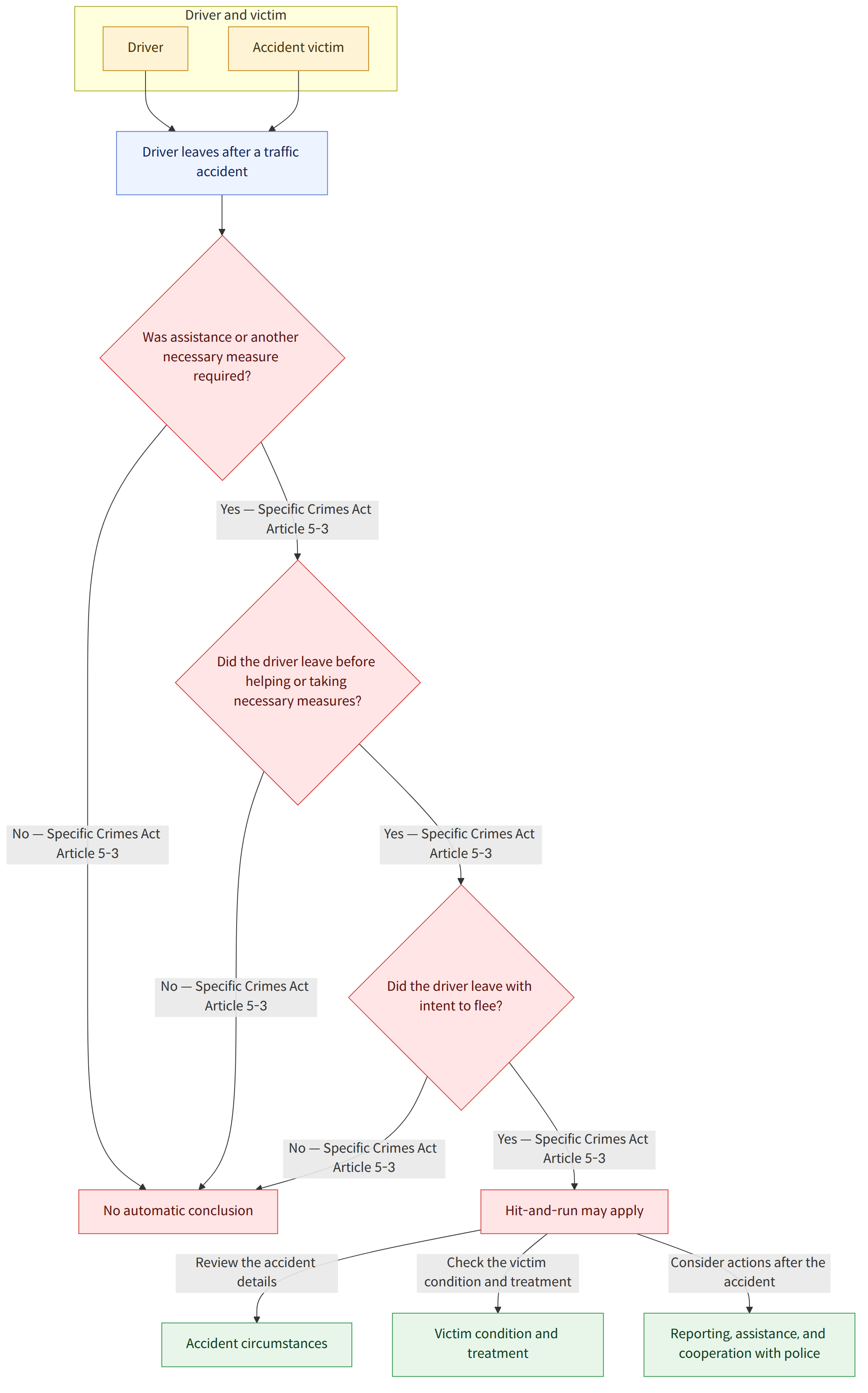
- The hit-and-run offense is assessed by considering whether the driver involved in the accident was actually required to assist the victim or take other necessary measures, and whether the driver left the scene with the intent to flee. The fact that the injuries were minor does not, by itself, establish that assistance was unnecessary (Act on the Aggravated Punishment, etc. of Specific Crimes, Article 5-3 (특정범죄 가중처벌 등에 관한 법률 제5조의3); Cases 2, 4, and 10).
- Even if the driver disclosed their identity after the accident, leaving the scene before assisting the victim or taking other necessary measures may be considered fleeing. Conversely, remaining at the scene and reporting the accident, assisting the victim, or cooperating with the police are circumstances considered when determining whether the driver fled (Act on the Aggravated Punishment, etc. of Specific Crimes, Article 5-3 (특정범죄 가중처벌 등에 관한 법률 제5조의3); Cases 11, 13, 16, and 18).
- The aggravated-punishment provision may apply if a person assaults or threatens the driver of a motor vehicle in operation and thereby causes injury or death to anyone, including the driver, a passenger, or a pedestrian. An intermediate cause such as a traffic accident is not necessarily required (Act on the Aggravated Punishment, etc. of Specific Crimes, Article 5-10 (특정범죄 가중처벌 등에 관한 법률 제5조의10); Cases 3, 5, and 7).
- The offense of causing injury or death by dangerous driving, which involves causing injury while in a condition that makes normal driving difficult due to alcohol or other influences, may absorb the offense of bodily injury by occupational negligence under the Act on Special Cases Concerning the Settlement of Traffic Accidents. However, it may be established separately from the drunk-driving offense under the Road Traffic Act, in a relationship of substantive concurrence (Cases 15 and 20).
- Although there was formerly an aggravated-punishment provision for habitual theft, the case explains that the provision was deleted following a ruling that it was unconstitutional, and that habitual theft is punishable under the Criminal Act (Criminal Act, Article 332 (형법 제332조); Case 9).
Frequently asked questions
Q. Can an employee of a public corporation who is deemed to be a public official receive aggravated punishment if the bribe is substantial?
According to the case, if the statute establishing a public corporation deems its officers and employees to be public officials for purposes of applying the Criminal Act’s bribery offenses, they may be subject to aggravated punishment if the amount of the bribe received reaches the threshold set by the Act on the Aggravated Punishment, etc. of Specific Crimes. The existence of a provision deeming them to be public officials does not, by itself, exclude them from aggravated punishment.
Q. If a traffic accident victim suffers only minor injuries, does leaving the scene still constitute the hit-and-run offense?
The fact that the injuries were minor does not, by itself, establish that assistance was unnecessary. The need to provide assistance and the circumstances of leaving the scene are assessed by considering the details of the accident, the victim’s condition, the course of treatment, and the circumstances after the accident as a whole.
Q. Does the hit-and-run offense not apply if the driver briefly leaves the scene of an accident and returns shortly afterward?
The fact that the driver briefly left and then returned does not, by itself, determine the outcome. The specific circumstances must be examined, including whether the driver assisted the victim or took other necessary measures, and whether the driver intended to flee when leaving.
Q. Can I avoid the hit-and-run offense by giving the victim my ID or contact information?
Even if the driver provided information to confirm their identity, leaving the scene before assisting the victim or taking other necessary measures may constitute fleeing. Providing identification information alone does not satisfy the duty to provide assistance.
Q. Can aggravated punishment apply if I injure a driver by hitting them, even though no traffic accident occurs?
The Supreme Court decision cited in the case holds that the aggravated-punishment provision may apply where a person causes injury by assaulting the driver of a moving motor vehicle, even if there is no intermediate cause such as a traffic accident. The provision may also apply if the person injured is a passenger or pedestrian rather than the driver.
Q. If the offense of causing injury or death by dangerous driving is established, is the drunk-driving offense also established separately?
According to the case, the offense of causing injury or death by dangerous driving and the offense of drunk driving under the Road Traffic Act are separate offenses that may both be established, in a relationship of substantive concurrence. By contrast, the case explains that when the offense of causing injury or death by dangerous driving is established, the offense of bodily injury by occupational negligence under the Act on Special Cases Concerning the Settlement of Traffic Accidents is not separately established.
Q. Is habitual theft subject to aggravated punishment under the Act on the Aggravated Punishment, etc. of Specific Crimes?
According to the case, the provision of the Act on the Aggravated Punishment, etc. of Specific Crimes that formerly applied to habitual theft and certain other offenses was deleted after being held unconstitutional. Under the standard set out in the case, the relevant offense is habitual theft under the Criminal Act, not an offense punishable under that provision of the Act on the Aggravated Punishment, etc. of Specific Crimes.
Q. Can the offense of mediation and acceptance of money or valuables be established even if the matter is not part of a public official’s duties under statutes or regulations?
The duties referred to in Article 3 of the Act on the Aggravated Punishment, etc. of Specific Crimes may include not only duties assigned by statute or regulation, but also conduct closely related to those duties and duties in which the official is involved by custom or in practice. Whether particular conduct falls within a public official’s duties is determined by considering both its form and substance.
Relevant laws
- Act on the Aggravated Punishment, etc. of Specific Crimes, Article 2 (특정범죄 가중처벌 등에 관한 법률 제2조)
- Act on the Aggravated Punishment, etc. of Specific Crimes, Article 3 (특정범죄 가중처벌 등에 관한 법률 제3조)
- Act on the Aggravated Punishment, etc. of Specific Crimes, Article 4-2(1) (특정범죄 가중처벌 등에 관한 법률 제4조의2 제1항)
- Act on the Aggravated Punishment, etc. of Specific Crimes, Article 5-3(1) (특정범죄 가중처벌 등에 관한 법률 제5조의3 제1항)
- Act on the Aggravated Punishment, etc. of Specific Crimes, Article 5-10(1) and (2) (특정범죄 가중처벌 등에 관한 법률 제5조의10 제1항·제2항)
- Act on the Aggravated Punishment, etc. of Specific Crimes, Article 5-4(1) (provision deleted, according to the case) (특정범죄 가중처벌 등에 관한 법률 제5조의4 제1항(사례에 따르면 삭제된 조항))
- Criminal Act, Article 124(1) (형법 제124조 제1항)
- Criminal Act, Article 129(1) (형법 제129조 제1항)
- Criminal Act, Article 131(1) and (2) (형법 제131조 제1항·제2항)
- Criminal Act, Article 268 (형법 제268조)
- Criminal Act, Article 332 (형법 제332조)
- Road Traffic Act, Article 54(1) (도로교통법 제54조 제1항)
- Road Traffic Act, Article 148 (도로교통법 제148조)
- Act on Special Cases Concerning the Settlement of Traffic Accidents (교통사고처리특례법)
Watch out for
- Whether a driver left the scene after an accident is not determined solely by the time elapsed or distance traveled. The specific circumstances are important, including whether the victim needed assistance, whether the driver knew of the accident, the circumstances of leaving, and the intent to flee.
- For the offense of assaulting a driver, whether the vehicle was “in operation” within the meaning of the provision may be at issue. A lower court decision discussed in the case presented the view that the provision applies only while the vehicle is actually in operation; a stopped vehicle must therefore be considered separately.
- The case includes wording from earlier versions of the law and past court decisions, and explains that the provision concerning habitual theft has been deleted. For an actual case, the law in force at the relevant time and the specific facts must be checked.
Source cases
This guide was compiled by AI from the following Korea Legal Aid Corporation consultation cases (in Korean).
- 공사직원이 특정범죄가중처벌 등에 관한 법률 상 가중처벌 대상인지
- 특정범죄 가중처벌 등에 관한 법률 위반(도주차량)죄에 해당되는지 (1)
- 특정범죄 가중처벌 등에 관한 법률상 운행 중인 자동차 운전자에 대한 폭행으로 사람에게 상해에 이르게 한 경우의 의미
- 특정범죄 가중처벌 등에 관한 법률 제5조의3 제1항 위반죄에서 ‘사고발생시의 조치’ 필요성 유무의 판단 기준
- 운전자 폭행의 범위
- 운전자 폭행의 범위
- 운전자 폭행의 범위
- 특정범죄 가중처벌 등에 관한 법률 위반(도주차량)죄에 해당되는지 (4)
- 상습적으로 절도죄를 범한 경우 특정범죄가중처벌법에 따라 가중처벌을 받게 되는지
- 특정범죄가중처벌 등에 관한 법률 제5조의3의 치상 후 도주죄에서 ‘구호조치 필요성’ 유무의 판단 방법
- 특정범죄 가중처벌 등에 관한 법률 위반(도주차량)죄에 해당되는지 (3)
- 즉결심판 피의자를 강제로 경찰서 보호실에 유치시키는 것이 불법감금죄에 해당하는지
- 특정범죄 가중처벌 등에 관한 법률 위반(도주차량)죄에 해당되는지 (2)
- 특정범죄가중처벌 등에 관한 법률상 ‘위험운전치사상죄’와 도로교통법상 ‘업무상과실 재물손괴죄’의 관계
- 위험운전치사상죄의 입법 취지 및 교통사고처리특례법 위반죄와의 관계
- 특정범죄 가중처벌 등에 관한 법률 위반(도주차량)죄에 해당되는지 (5)
- 특정범죄가중처벌 등에 관한 법률 제3조의 ‘공무원의 직무에 속한 사항’의 의미
- 특정범죄 가중처벌 등에 관한 법률 위반(도주차량)죄에 해당되는지 (6)
- 수뢰후부정처사, 부정처사후수뢰의 경우 특정범죄가중처벌법에 따라 가중처벌되는지
- 특정범죄가중처벌 등에 관한 법률상 ‘위험운전치사상죄’와 도로교통법상 ‘음주운전죄’의 관계
This guide is general legal information about Korean law, not legal advice for your situation. For a specific case, consult a lawyer or the Korea Legal Aid Corporation (call 132 in Korea).