
Guide to State Compensation Claims: Requirements and Responsible Parties
Based on 83 consultation cases · Updated · Translated from the Korean original.
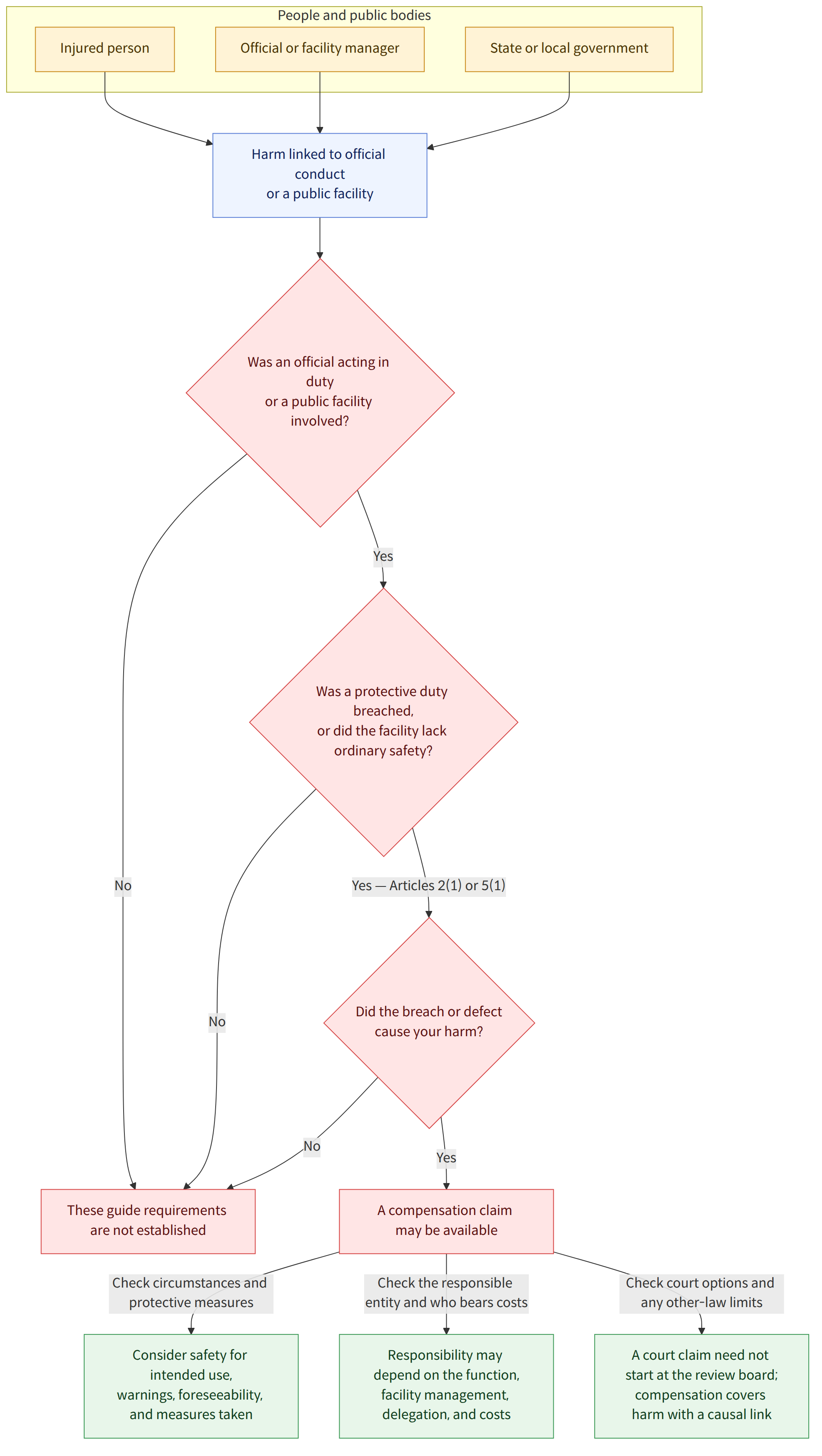
If you suffer harm because of an official’s unlawful conduct in the performance of official duties or a defect in the installation or management of a public facility, you may claim compensation from the state or a local government. However, a breach of official duty, a lack of safety in the public facility, and a causal connection to the harm must be established. Whether liability exists is determined by examining the circumstances at the time and whether the measures taken were appropriate.
At a glance
Key points
- The state or a local government may be liable for compensation if an official, while performing official duties, causes harm by violating laws or regulations intentionally or negligently (State Compensation Act, Article 2(1) (국가배상법 제2조 제1항)).
- Compensation may be awarded if the official’s duty was intended to protect individuals’ safety and interests and there was an adequate causal connection between the breach of duty and the harm (Cases 4 and 12).
- Whether a road, manhole, or other public facility is defective is assessed by considering whether it lacked the safety ordinarily required for its intended use and whether the manager took protective measures proportionate to the danger (State Compensation Act, Article 5(1) (국가배상법 제5조 제1항); Cases 7, 11, and 18).
- If temporary measures, such as warning signs, were taken after a danger was reported, or if the accident was difficult to foresee or avoid, the mere existence of a defect in the facility does not establish a maintenance defect (Case 18).
- Even where an official has discretion, failing to exercise that authority in the specific circumstances may constitute a breach of official duty if the failure was manifestly unreasonable (Case 4; Case 9).
- The entity responsible for compensation may depend on which entity the administrative function belongs to and the applicable allocation of legal responsibility, including the agency that delegated the function, the entity managing the facility, and the entity bearing the costs (State Compensation Act, Article 6(1) (국가배상법 제6조 제1항); Cases 5 and 7).
- Even if a service member or other covered person is injured in the line of duty, a claim for state compensation may not be restricted if compensation is unavailable under other laws. A social service agent is not a service member under the State Compensation Act solely by virtue of that status (proviso to Article 2(1) of the State Compensation Act (국가배상법 제2조 제1항 단서); Cases 8 and 23).
- You may file a state compensation lawsuit in court without applying to the Compensation Review Board, and compensation is limited to harm for which a causal connection is established (State Compensation Act, Article 9 (국가배상법 제9조); Cases 11 and 25).
Frequently asked questions
Q. Can I receive state compensation if I was injured because a manhole cover was missing from the road?
A manhole may qualify as a public facility. You may claim compensation if the evidence shows a defect in its maintenance and a causal relationship between that defect and your injury. Relevant factors include whether the cover was missing, whether lighting or warning signs were present, whether the manager knew or could have known of the danger, and whether you were injured because of the defect.
Q. Will the state pay compensation if a roadside slope collapses during heavy rain and causes an accident on the road?
The fact that there was heavy rain does not, by itself, establish that the road was defective in its maintenance. The circumstances must be assessed in detail, including whether the defect could have been remedied—for example, by installing drainage channels or protective structures—yet was left unaddressed, taking into account the road’s design and location, how it was used, and other relevant factors.
Q. Which agency should I claim against if an accident is caused by a malfunctioning traffic signal?
The entity responsible for compensation may depend on which entity is legally responsible for the installation and management of the traffic signal. One case sets out the principle that delegating management authority to another agency does not change which entity the underlying administrative function belongs to. You should therefore check the delegation of installation and management authority and who bears the costs.
Q. Can I receive compensation if inadequate fire inspections caused greater fire damage?
You should consider whether the fire officials’ duties were intended to protect the life, person, or property of individual members of the public; whether their breach of duty was so serious that it lacked objective justification; and whether there was an adequate causal connection between the breach and the harm. Even when an authority has discretion, failing to exercise it in the circumstances may be unlawful if the failure was manifestly unreasonable.
Q. Can I claim compensation from the state if a third party is injured by a police pursuit or the use of a firearm?
A police pursuit may be considered unlawful if there are special circumstances showing that it was unnecessary for the purpose of the officers’ duties, or that its commencement, continuation, or manner was unreasonable in light of the specific risks that could have been anticipated. The use of a firearm is assessed in light of factors such as the type of crime, the urgency of the threat, the degree of resistance, and how the firearm was used. Stricter standards apply to handguns, which pose a significant risk of injuring people.
Q. Can the state be held liable if the police failed to isolate a dangerous person or a correctional institution failed to prevent an inmate’s suicide?
You should consider whether the police breached a duty to protect someone, or whether a correctional institution breached its duty to supervise or provide treatment, and whether the failure to act was manifestly unreasonable in light of the specific risk. Liability is not established solely because a suicide or crime occurred; it is also important whether the risk could have been foreseen at the time and what measures were actually taken.
Q. Can someone injured during military service not claim state compensation?
A claim for state compensation may be restricted when a service member or other covered person is injured in the line of duty and is eligible for compensation under other laws, such as an accident-compensation payment or pension. By contrast, a claim may be available if the person does not qualify for a disability grade or other accident compensation. One case also held that a social service agent is not a service member for purposes of this restriction unless serving in the military.
Q. Must I apply to the Compensation Review Board before filing a lawsuit in court?
No. According to a case, you may file a state compensation lawsuit in court without first applying to the Compensation Review Board. If you do apply to the Board, you may seek a reconsideration or file a lawsuit if you disagree with its decision or the amount of compensation.
Q. If I had to close my business because of an unlawful government action, can I also receive compensation for losses resulting from the closure?
Only harm causally connected to the unlawful performance of official duties is eligible for compensation. In a case where incorrect provision of tax-delinquency information damaged a person’s credit or reputation, emotional harm was recognized. However, the causal connection between that information and the person’s business closure and lost income was considered difficult to establish.
Relevant laws
- State Compensation Act, Article 2(1) and (2) (국가배상법 제2조 제1항·제2항)
- State Compensation Act, Article 5(1) (국가배상법 제5조 제1항)
- State Compensation Act, Article 6(1) (국가배상법 제6조 제1항)
- State Compensation Act, Article 8 (국가배상법 제8조)
- State Compensation Act, Article 9 (국가배상법 제9조)
- State Compensation Act, Article 10 (국가배상법 제10조)
- Constitution of the Republic of Korea, Article 29(1) and (2) (대한민국헌법 제29조 제1항·제2항)
- Civil Act, Article 750 (민법 제750조)
- Civil Act, Article 765 (민법 제765조)
- Act on the Performance of Duties by Police Officers, Article 4(1) (경찰관직무집행법 제4조 제1항)
- Act on the Performance of Duties by Police Officers, Article 10-4(1) (경찰관직무집행법 제10조의4 제1항)
- Act on Liability for Fire Caused by Negligence, Articles 1, 2, and 3 (실화책임에 관한 법률 제1조·제2조·제3조)
- Road Traffic Act, Article 3(1) (도로교통법 제3조 제1항)
- Enforcement Decree of the Road Traffic Act, Article 86(1)(1) (도로교통법 시행령 제86조 제1항 제1호)
- Enforcement Decree of the Seal Certificate Act, Articles 7 and 13 (인감증명법 시행령 제7조·제13조)
Watch out for
- Compensation is not automatically available merely because an official made a mistake or a public facility had a defect. You must also establish a causal connection between the unlawfulness, negligence, or maintenance defect and the harm.
- A public facility is not required to be flawless; it must have the level of safety generally expected under social norms. When the danger became known and whether any temporary measures were appropriate may also affect the determination.
- State liability may depend on whether an official’s duty was intended solely to serve the public interest generally or also to protect the safety and interests of individuals.
- Whether compensation restrictions apply to service members and other covered persons may depend not only on whether the injury was related to official duties but also on whether compensation is available under other laws. The individual circumstances should be checked.
Related articles
Source cases
This guide was compiled by AI from the following Korea Legal Aid Corporation consultation cases (in Korean).
- 군인과 공동불법행위를 한 민간인의 국가에 대한 구상권 행사 여부
- 소방공무원의 실화에 실화책임에 관한 법률이 적용되는지
- 경찰관이 무기를 사용할 수 있는 법적 요건과 한계
- 소방공무원의 소방점검부실로 화재피해가 확대된 경우 국가배상청구
- 교통신호기의 고장으로 교통사고 발생 시 누가 책임지는지
- 사기꾼이 공무원의 부주의를 이용하여 타인의 인감증명서를 발급받아 이를 통해 금융기관에서 거액을 대출받은 경우 금융기관의 지방자...
- 도로의 설치·관리상의 하자로 인한 국가배상청구권
- 국가유공자 상이등급에 미달된 군인의 국가배상청구권
- 이웃집 정신질환자에 대한 격리조치 미흡한 경우 국가배상청구
- 국가가 예술작품인 벽화를 함부로 훼손한 경우 작가의 국가에 대한 손해배상청구 여부
- 하수도 맨홀뚜껑이 없는 곳에서 추락한 자의 국가배상청구권
- 수질기준 유지의무 위반하여 수돗물 공급한 경우 국가배상청구
- 지방자치단체에서 설치·운영하는 학교에서 학생이 다른 학생들로부터 장기간 집단괴롭힘을 당하다가 자살한 경우 지방자치단체에 대한 ...
- 국가가 압수한 고춧가루를 잘못 보관하여 전량 폐기처분한 경우 고춧가루 소유권자의 국가에 대한 손해배상청구 여부
- 검사가 법원의 결정에 반하여 수사서류의 열람·등사를 거부한 경우 국가에 대한 손해배상청구 여부
- 주한미군이 운전하는 차량에 사고 당한 경우 손해배상청구
- 수익적 행정처분인 허가 등을 신청한 사안에서 공무원이 신청인의 목적 달성에 필요한 안내나 배려 등을 하지 않았다는 사정만으로 ...
- 도로를 달리던 차가 노상의 맨홀 뚜껑으로 인하여 사고를 입은 경우 사고 운전자가 도로의 관리자인 지방자치단체에 대해 손해배상을...
- 피해자가 고소를 하였음에도 불구하고 사법경찰관이 가해자를 형사입건하지 않은 채 징벌만 부과하여 사건을 종결한 경우 국가에 대한...
- 경찰이 추적하는 도주차량에 치어 중상을 입은 경우 국가배상청구
- 교통할아버지의 수신호 잘못으로 교통사고 발생한 경우 국가배상청구
- 우울증을 앓고 있는 사람이 유치장에서 자살한 경우 그 가족들의 국가에 대한 손해배상청구 여부
- 공익근무요원이 국가배상법상의 ‘군인’에 해당하는지
- 국립 소△▽병원 등에 입원해 있다가 위 병원 등에 소속된 의사 등으로부터 정관절제수술 또는 임신중절수술을 받았음을 이유로 국가...
- 담당공무원이 법령에 위반하여 체납정보를 제공한 경우 국가에 대한 손해배상청구 여부
This guide is general legal information about Korean law, not legal advice for your situation. For a specific case, consult a lawyer or the Korea Legal Aid Corporation (call 132 in Korea).