
Guide to the Creation and Exercise of Superficies and Jeonse Rights
Based on 158 consultation cases · Updated · Translated from the Korean original.
A statutory superficies does not arise automatically whenever the owners of land and a building become different. A jeonse right is also a real right separate from a lease. In auctions, changes to rights, and assignments of claims, the scope and effect of rights depend on when they arose, whether they were registered, and their priority.
At a glance
Key points
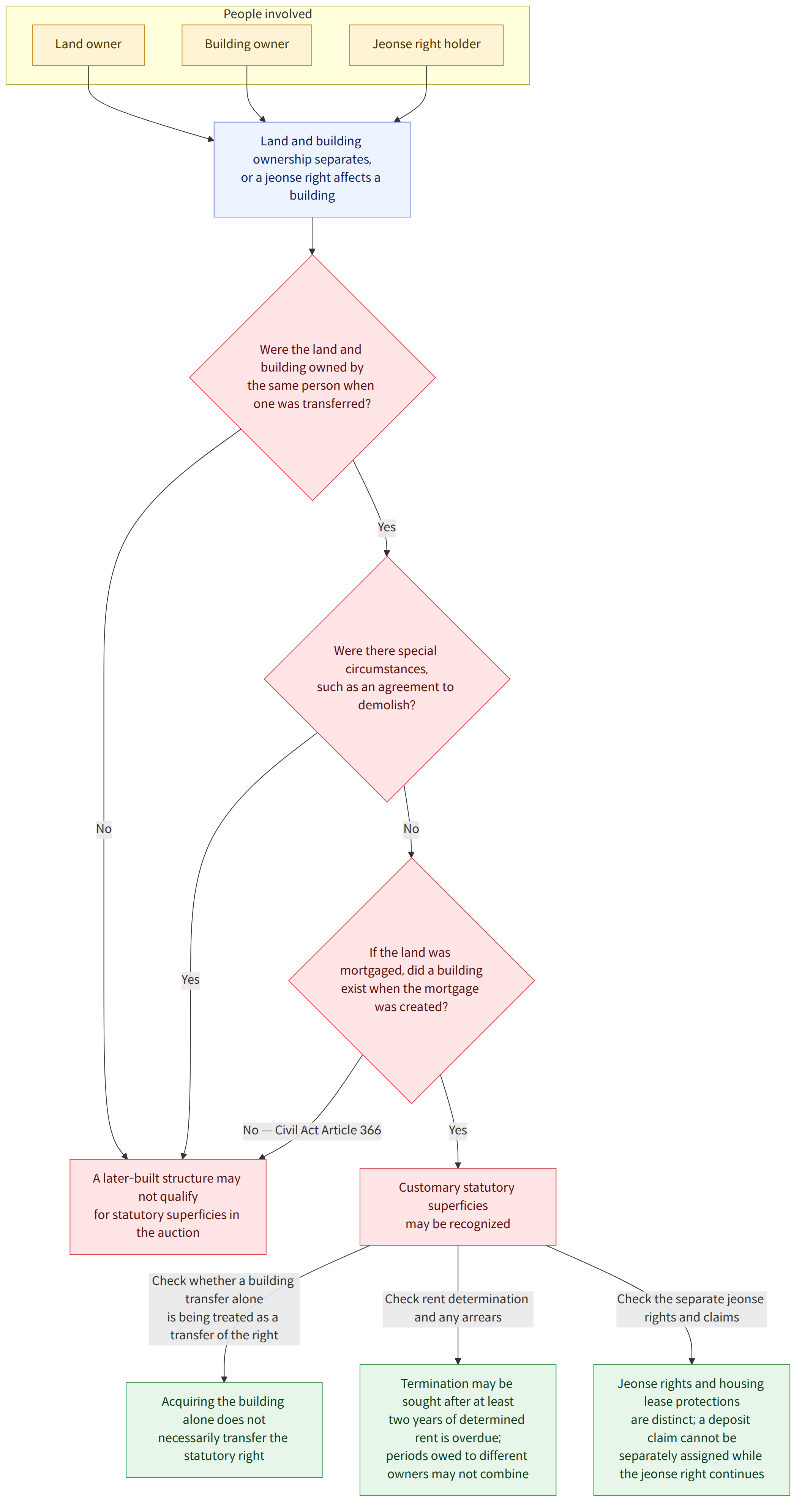
- A statutory superficies under customary law may be recognized when land and a building were owned by the same person, ownership of one of them later changed, and there were no special circumstances, such as an agreement to demolish the building. It is sufficient that they were owned by the same person at the time of transfer; they need not have been owned by the same person from the outset (Case 2).
- A statutory superficies under customary law may arise without registration. However, if the owner of the building who acquired that right transfers the building to someone else, the transferee cannot be said to have acquired the statutory superficies solely by acquiring ownership of the building (Civil Act, Article 187 (민법 제187조); Cases 2 and 3).
- If no building existed when a mortgage was created on the land, a statutory superficies may not be recognized even if a building is constructed later and the land and building come to have different owners through an auction (Civil Act, Article 366 (민법 제366조); Case 4).
- The land rent for a statutory superficies or superficies must be assessed in light of the specific circumstances, including any agreement or court determination. If at least two years’ worth of rent is overdue after the rent has been determined, termination may be sought. However, when the land changes owners, the period of nonpayment owed to the former owner may not be added to the period owed to the new owner (Civil Act, Article 287 (민법 제287조); Cases 11 and 24).
- The effect of a jeonse right over a building may extend to a superficies or lease necessary for the building to remain in existence. If a jeonse right is created over a building while the building and the land are owned by the same person and ownership of the land later changes, a statutory superficies may become an issue (Civil Act, Articles 304 and 305 (민법 제304조·제305조); Case 5).
- The right to oppose third parties and the right to preferential repayment under a housing lease are separate from the rights of a holder of a jeonse right. Even if the jeonse right has been registered, the tenant may in some cases no longer receive protection under the Housing Lease Protection Act if the requirements for opposing third parties under that Act are no longer met (Housing Lease Protection Act, Article 3 (주택임대차보호법 제3조); Case 8).
- In certain circumstances, the claim for return of the jeonse deposit may be assigned separately after the jeonse right ends, for example, upon expiration of its term. However, while the jeonse right remains in force, the claim for return of the jeonse deposit and the jeonse right may not be assigned separately (Cases 10 and 16).
- If a right held by an interested party is registered after a change to the registration of a jeonse right, that party’s consent may be required for an incidental registration, depending on the nature of the change. A reduction in the jeonse deposit and an extension of the term may be treated differently (Real Estate Registration Act, Article 52 (부동산등기법 제52조); Cases 12 and 14).
Frequently asked questions
Q. Does a statutory superficies under customary law arise when the land and building come to have different owners?
It may arise if the land and building were owned by the same person when either property was transferred, and there were no special circumstances, such as an agreement to demolish the building. However, it may not be recognized depending on the land readjustment disposition, co-ownership arrangements, or the rights in place at the time of transfer.
Q. Can an unregistered or unauthorized building be subject to a statutory superficies?
A statutory superficies under customary law may be recognized even for an unregistered or unauthorized building if the owner originally acquired ownership by constructing it. However, a person who acquires an unregistered building is generally not considered to have acquired ownership of the building, or an equivalent right, unless ownership is registered in that person’s name.
Q. Does a statutory superficies arise if a building is constructed after a mortgage is created on the land?
If the land was vacant when a mortgage was created and a building was constructed afterward, a statutory superficies may not be recognized even if the land and building come to have different owners through an auction. The specific timing and facts must be checked, including whether a building already existed when the mortgage was created.
Q. Can a person who buys a building subject to a statutory superficies also claim that right?
The fact that a person bought a building does not automatically mean that the statutory superficies has been transferred to that person. Whether the statutory superficies was registered as created or transferred, and any agreement between the parties at the time the building was transferred, must be examined.
Q. Does a statutory superficies immediately end if the land rent is not paid?
If the amount of the land rent has not been determined, there may be no delay in payment. Once the rent has been determined, termination may be sought if at least two years’ worth of rent is overdue for reasons attributable to the person liable to pay it. However, a new landowner may be unable to seek termination if the period of nonpayment after acquiring ownership has not reached two years.
Q. If a residential tenant has also registered a jeonse right, are they still protected under housing lease law after moving out?
A registered jeonse right and the rights to oppose third parties and to receive preferential repayment under the Housing Lease Protection Act have different legal bases and requirements. Even if a jeonse right is registered, a tenant may lose protection under the Housing Lease Protection Act if the requirements for opposing third parties under the housing lease are no longer met.
Q. Can the claim for return of the jeonse deposit be assigned separately after the jeonse term ends?
After a jeonse right ends, for example, upon expiration of its term, the claim for return of the jeonse deposit may be assigned separately if there are no special circumstances requiring the disposition of the jeonse right to accompany it. In that case, the assignee may acquire the claim, but not the jeonse right itself. The timing of the assignment and the status of the jeonse right should therefore be checked.
Q. Is the consent of a junior mortgagee required to extend the term of a jeonse right or reduce the jeonse deposit?
In some cases, an incidental registration changing only the amount of the jeonse deposit may be made without the consent of a junior mortgagee. By contrast, an incidental registration extending the term may require the consent of an interested third party. The requirements therefore depend on the nature of the change.
Q. What happens to a first-ranking jeonse right in an auction or public sale?
In a civil execution auction, a first-ranking jeonse right is generally taken over by the purchaser, but it may be extinguished by the sale if the holder of the jeonse right files a claim for distribution. In a public sale, a jeonse right enforceable against third parties may be taken over by the purchaser regardless of whether a claim for distribution was filed. The type of procedure and whether the jeonse right is enforceable against third parties must therefore be distinguished.
Relevant laws
- Civil Act, Article 186 (민법 제186조)
- Civil Act, Article 187 (민법 제187조)
- Civil Act, Article 245 (민법 제245조)
- Civil Act, Article 248 (민법 제248조)
- Civil Act, Article 279 (민법 제279조)
- Civil Act, Article 283 (민법 제283조)
- Civil Act, Article 287 (민법 제287조)
- Civil Act, Article 303 (민법 제303조)
- Civil Act, Article 304 (민법 제304조)
- Civil Act, Article 305 (민법 제305조)
- Civil Act, Article 318 (민법 제318조)
- Civil Act, Article 366 (민법 제366조)
- Civil Act, Article 492 (민법 제492조)
- Act on the Registration of Real Estate under Actual Titleholder’s Name, Articles 2 and 8 (부동산 실권리자명의 등기에 관한 법률 제2조·제8조)
- Housing Lease Protection Act, Articles 3, 3-3, and 3-4 (주택임대차보호법 제3조·제3조의3·제3조의4)
Watch out for
- Whether a statutory superficies is created may depend on why and when ownership of the land and building came to differ, pre-existing rights such as mortgages or provisional attachments, and agreements between the parties.
- Even if a statutory superficies is created, payment of land rent may be at issue. Whether termination may be sought because rent is overdue, and whether a claim may be made to purchase structures on the land, depends on the reason the right ends.
- The rights arising from a jeonse right are not the same as those arising from a lease. The requirements for a lease to be enforceable against third parties, such as moving in and taking possession, and the effect of registering a jeonse right should be examined separately.
- The outcome of a change to the registration of a jeonse right, its assignment, or distribution in an auction may vary depending on priority and procedure. The registration details and the timing of changes to the rights should be checked together.
Related articles
Source cases
This guide was compiled by AI from the following Korea Legal Aid Corporation consultation cases (in Korean).
- 명의신탁 해지로 소유권 환원 시 수탁자의 법정지상권 취득 여부
- 건물소유자의 토지소유자에 대한 건물의 관습법상 법정지상권
- 미등기 무허가건물도 관습법상의 법정지상권이 인정되는지
- 토지에 저당권이 설정된 후 신축된 건물의 법정지상권의 성립 여부
- 전세권설정건물양수인의 법정지상권 포기가 전세권자에게 미치는지
- 지상물이 지상권자 본인의 토지에 걸쳐서 존재할 경우 매수청구권 행사 가능한지
- 법정지상권 성립 후 토지임대차계약 체결 시 법정지상권의 포기인지
- 주택임대차보호법상 임차인의 지위와 전세권자의 지위를 함께 가졌으나 나중에 임차인의 지위를 상실한 경우, 경매절차에서 우선배당 ...
- 전세금 반환채권과 상계
- 전세금반환채권 양도 후 전세권가압류의 경우 전세권등기 말소방법
- 지상권 소멸청구 시 종전소유자에 대한 지료연체기간 합산 가능한지
- 전세권의 존속기간 변경등기 시 후순위 근저당권자의 승낙이 필요한지
- 공매절차에서의 전세권 소멸 여부
- 전세권의 전세금액 변경등기 시 후순위 근저당권자의 승낙이 필요한지
- 타인 소유의 토지에 방치한 무연고묘지의 처리방법
- 기간만료 후 전세금반환채권만을 전세권과 분리하여 양도할 수 있는지
- 최선순위 전세권자의 채권자가 전세기간 만료 후 채권자대위를 통해 자신의 채권을 보전 받을 수 있는지 여부
- 분묘기지권을 시효취득한 경우에도 그 사용료를 지급해야 하는지
- 지상권 점유취득시효의 인정요건 및 그 판단기준
- 집합건물의 전유부분과 대지 지분에 관하여 공동저당권이 설정된 후 집합건물이 철거되고 새로운 집합건물이 신축된 경우 법정지상권 ...
- 임대차계약에서 전세권설정의 특약이 이행되지 않은 경우, 손해배상책임의 범위와 내용
- 강제경매의 경우 관습상 법정지상권의 성립요건인 ‘토지와 지상 건물이 동일인에 속하였는지 여부’의 기준시점
- 환지처분으로 토지와 건물의 소유자가 달라진 경우 관습법상 법정지상권
- 법정지상권에 대한 지료미지급을 이유로 지상권소멸청구 가능한지
- 건물 일부에 관하여 전세권을 설정하였는데 그 건물이 집합건물로 변경된 경우 전세권의 효력이 미치는 범위
This guide is general legal information about Korean law, not legal advice for your situation. For a specific case, consult a lawyer or the Korea Legal Aid Corporation (call 132 in Korea).