
Essential Guide to Suspension of Pronouncement, Suspended Execution, and Parole
Based on 35 consultation cases · Updated · Translated from the Korean original.
A suspension of pronouncement defers the pronouncement of a sentence, while a suspension of execution defers execution of a sentence that has been pronounced for a specified period. Parole is the conditional release, before the sentence expires, of a person serving a sentence who meets certain requirements. Each has different requirements and effects.
At a glance
Key points
- A suspension of pronouncement is a system under which pronouncement of a sentence is deferred when there are compelling circumstances to take into account in a case where a sentence would otherwise be pronounced. If the deferral period passes without incident, the person is deemed to have been granted a dismissal of prosecution; the court may also order probation (Criminal Act, Articles 59, 59-2, and 60 (형법 제59조·제59조의2·제60조)).
- Whether there are “marked circumstances showing reform,” as required for a suspension of pronouncement, is determined not solely by whether the person is remorseful, but by considering the sentencing factors as a whole. A suspension of pronouncement may be possible even if the person denies the facts of the offense (Supreme Court en banc Decision 2001Do6138).
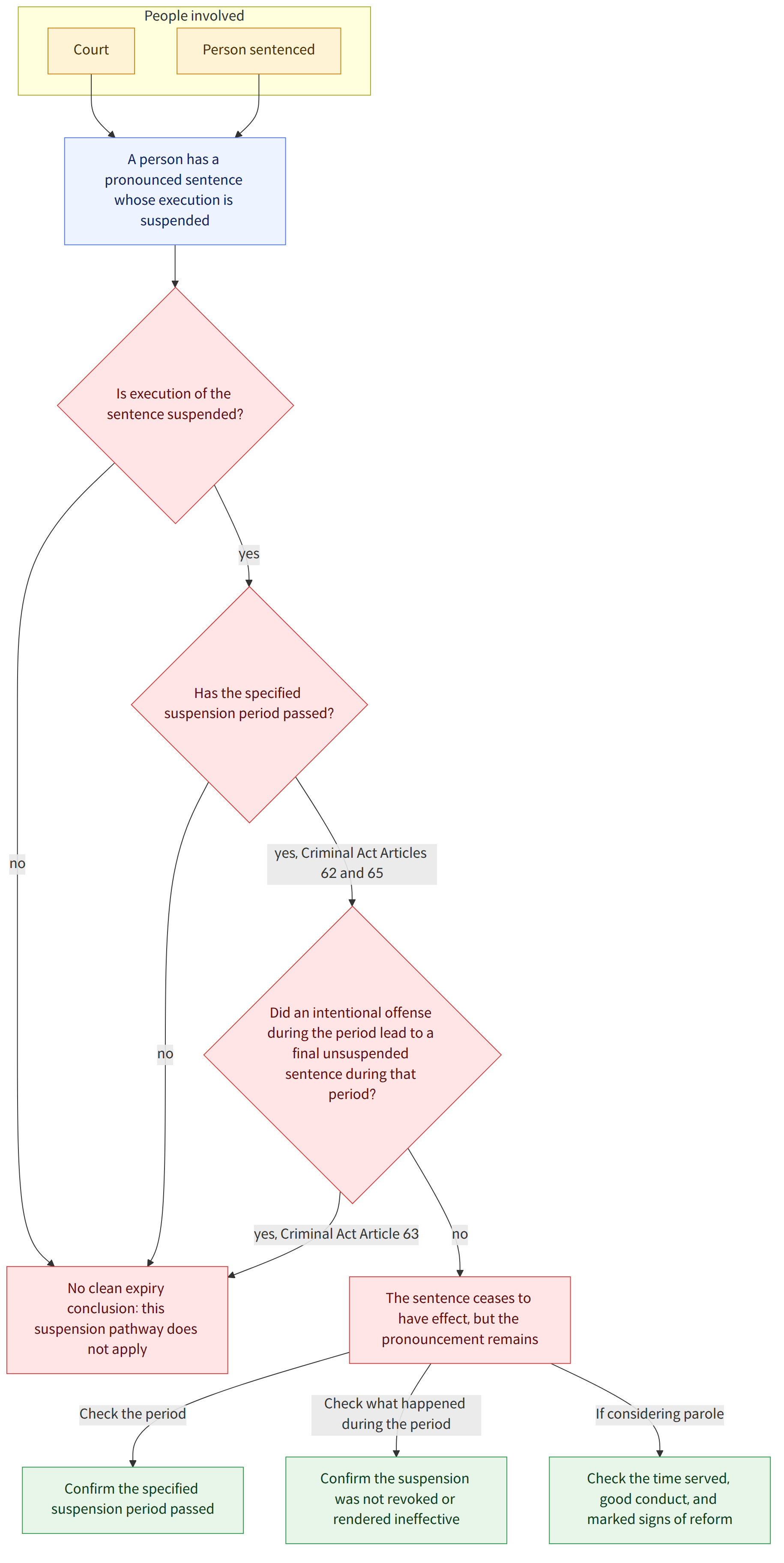
- A suspension of execution defers execution of a sentence prescribed by law for a specified period. If that period passes without the suspension becoming ineffective or being revoked, the sentence ceases to have effect, but the historical fact that a sentence was pronounced is not erased (Criminal Act, Articles 62 and 65 (형법 제62조·제65조)).
- If, during the suspension period, a person is sentenced to an unsuspended term of imprisonment or a more severe punishment for an intentional offense committed during that period, and the judgment becomes final during the period, the existing suspension may cease to be effective. The date of the offense and the date the judgment imposing the unsuspended sentence becomes final are both important (Criminal Act, Article 63 (형법 제63조)).
- As a general rule, a person cannot receive another suspension of execution during a suspension period. However, an exception may be recognized in special circumstances where several offenses would have received a suspension of execution together had they been tried in the same proceedings (Criminal Act, Article 62(1) (형법 제62조 제1항); Supreme Court en banc Decision 87Do2365).
- Probation, community service, and an order to attend a course may be imposed at the same time as a suspension of execution. If the person seriously violates the conditions or orders, the suspension may be revoked (Criminal Act, Articles 62-2 and 64(2) (형법 제62조의2·제64조 제2항)).
- The court held that, in the absence of a specific statutory basis, a single prison sentence may not be divided into a portion to be served and a portion whose execution is suspended. By contrast, separate custodial sentences for concurrent crimes may each be given a different form of execution (Supreme Court Decisions 2006Do8555 and 2001Do3579).
- Parole may become possible after 20 years of a life sentence or one-third of a determinate sentence has been served, provided that the person has demonstrated good conduct and marked signs of reform. Meeting the time requirement does not automatically result in approval (Criminal Act, Article 72 (형법 제72조)).
Frequently asked questions
Q. What happens if I receive a suspension of pronouncement of sentence?
This is a system that defers the pronouncement of the sentence itself. If the deferral period passes without incident, the person is deemed to have been granted a dismissal of prosecution. However, the deferred sentence may be pronounced if, during the deferral period, a judgment sentencing the person to suspension of qualifications or a more severe punishment becomes final, or if certain prior convictions are discovered (Criminal Act, Articles 59, 60, and 61 (형법 제59조·제60조·제61조)).
Q. Can I receive a suspension of pronouncement of sentence even if I deny the offense?
It may be possible. Courts have held that “marked circumstances showing reform” are not limited to cases of deep remorse; the court considers the sentencing factors as a whole, including the degree of remorse.
Q. Can I receive another suspension of execution of sentence if I am tried for another offense while serving a suspended sentence?
As a general rule, it is difficult to receive another suspension of execution of sentence. However, an exception may be recognized in special circumstances where several offenses are related as concurrent crimes and, had they been tried together in the same proceedings, the person would have received a suspension of execution for all of them.
Q. Is an existing suspension of execution automatically revoked if I commit an offense during the suspension period?
The suspension is not automatically revoked merely because another offense was committed. Under the standard in Article 63 of the Criminal Act described in the case, the existing suspension of execution may cease to be effective if, during the suspension period, the person is sentenced to an unsuspended term of imprisonment or a more severe punishment for an intentional offense committed during that period, and the judgment becomes final during the period. The timing of both the offense and the final judgment must therefore be considered.
Q. Can a suspension of execution be revoked if a disqualifying circumstance is discovered after the suspension period ends?
One case held that if the suspension period passes without the suspension becoming ineffective or being revoked, the suspension cannot be revoked even if a disqualifying circumstance is discovered afterward. Post-judgment revocation may also be restricted if the prosecutor knew, or objectively could have known, of the disqualifying circumstance before the judgment became final.
Q. Can probation or community service be imposed together with a suspension of execution?
Yes. Probation, community service, and an order to attend a course may be imposed at the same time. If the person seriously violates the conditions or orders, the suspension of execution may be revoked.
Q. Can I be released on parole as soon as I have served a specified portion of my sentence?
No. A person meets the time requirement for parole only after serving 20 years of a life sentence or one-third of a determinate sentence. The person must also have demonstrated good conduct and marked signs of reform, and parole requires a separate review and approval.
Q. Can execution of only part of a prison sentence be suspended?
Courts have held that it is not permitted to suspend execution for only part of a single prison sentence. However, if separate custodial sentences are imposed for concurrent crimes, one sentence may be ordered to be served and the other may be suspended.
Q. Can execution of a fine also be suspended?
Case 19 explains that, following the amendment that took effect on January 7, 2018, execution of a fine of 5 million won or less may also be suspended. However, the case includes explanations from both before and after the amendment, so the law applicable at the relevant time must be checked for a specific case.
Relevant laws
- Criminal Act, Article 37 (형법 제37조)
- Criminal Act, Article 41 (형법 제41조)
- Criminal Act, Article 49 (형법 제49조)
- Criminal Act, Article 50 (형법 제50조)
- Criminal Act, Article 57 (형법 제57조)
- Criminal Act, Article 59 (형법 제59조)
- Criminal Act, Article 59-2 (형법 제59조의2)
- Criminal Act, Article 60 (형법 제60조)
- Criminal Act, Article 61 (형법 제61조)
- Criminal Act, Article 62 (형법 제62조)
- Criminal Act, Article 62-2 (형법 제62조의2)
- Criminal Act, Article 63 (형법 제63조)
- Criminal Act, Article 64 (형법 제64조)
- Criminal Act, Article 65 (형법 제65조)
- Criminal Act, Article 72 (형법 제72조)
Watch out for
- Whether a suspension of execution becomes ineffective may depend not only on when the offense was committed, but also on when the new judgment becomes final and whether the existing suspension period has expired.
- One case held that the suspension period is calculated from the date the judgment becomes final, not the date it is pronounced.
- Even if the sentence ceases to have effect after the suspension period ends, the historical fact that the sentence was pronounced is not erased.
- Cases may include statutory provisions and explanations from both before and after legislative amendments. For a specific case, check the law applicable at the relevant time.
Related articles
Source cases
This guide was compiled by AI from the following Korea Legal Aid Corporation consultation cases (in Korean).
- 집행유예기간 중 범한 죄에 대해 다시 집행유예선고 가능한지
- 집행유예기간 중 다시 집행유예를 선고받으면 어떻게 되는지
- 집행유예기간 만료 직전에 다시 죄를 범했으면 어떻게 되는지
- 집행유예 판결확정 전 검사가 집행유예 결격사유 알 수 있었던 경우
- 두 개의 범죄에 대하여 두 개의 징역형 선고 시 집행유예 여부
- 벌금형과 선고유예부 징역형 중 어느 것이 더 중한 것인지
- 집행유예기간 경과 후 취소사유가 발각되면 어떻게 되는지
- 집행유예 선고 시 보호관찰과 사회봉사를 동시에 명할 수 있는지
- 집행유예부 징역형과 벌금형 중 어느 것이 더 중한 것인지
- 집행유예기간 경과 후의 전과기록 말소 여부
- 선고유예 판결을 받았는데 선고유예는 어떤 것인지
- 재판 도중 집행유예 기간이 경과한 경우 다시 집행유예를 선고할 수 있는지
- 선고유예 실효결정에 대한 상소심 진행 중에 유예기간인 2년이 경과한 경우, 선고유예 실효 결정을 할 수 있는지 여부
- 집행유예의 기간이 경과한 경우 선고유예가 가능한지
- 집행유예취소의 요건에 해당하는지 여부를 심리할 때의 평가 요소
- 피고인이 범죄사실을 부인하는 경우에는 선고유예가 불가능한지
- 하나의 자유형 중 일부에 대해서만 집행유예를 선고하는 것이 가능한지 여부
- 보호관찰시 특별준수사항의 정당성
- 벌금형에 대한 집행유예 가부
- 미결구금기간이 본형기간을 초과하는 경우에도 집행을 유예할 수 있는지 여부
- 집행유예 결격사유가 발각되었지만 취소 못하는 경우
- 가석방의 요건
- 사회봉사 명령의 의미
- 필요적 몰수의 경우, 선고유예가 가능한지 여부
- 형의 집행종료 후 7년 이내에 별도의 사건으로 집행유예의 판결을 받았더라도 형의 실효를 선고받을 수 있는지 여부
This guide is general legal information about Korean law, not legal advice for your situation. For a specific case, consult a lawyer or the Korea Legal Aid Corporation (call 132 in Korea).