
Administrative Guide to Tax Matters: Taxation, Appeals, and Refunds
Based on 123 consultation cases · Updated · Translated from the Korean original.
In tax disputes, it is necessary to examine who substantively owns the income or property and the grounds for taxation. When challenging a tax disposition, the prescribed procedures and time limits must be followed. Who may claim a refund and which type of lawsuit is appropriate depend on how the refund arose and the legal nature of the claim.
At a glance
Key points
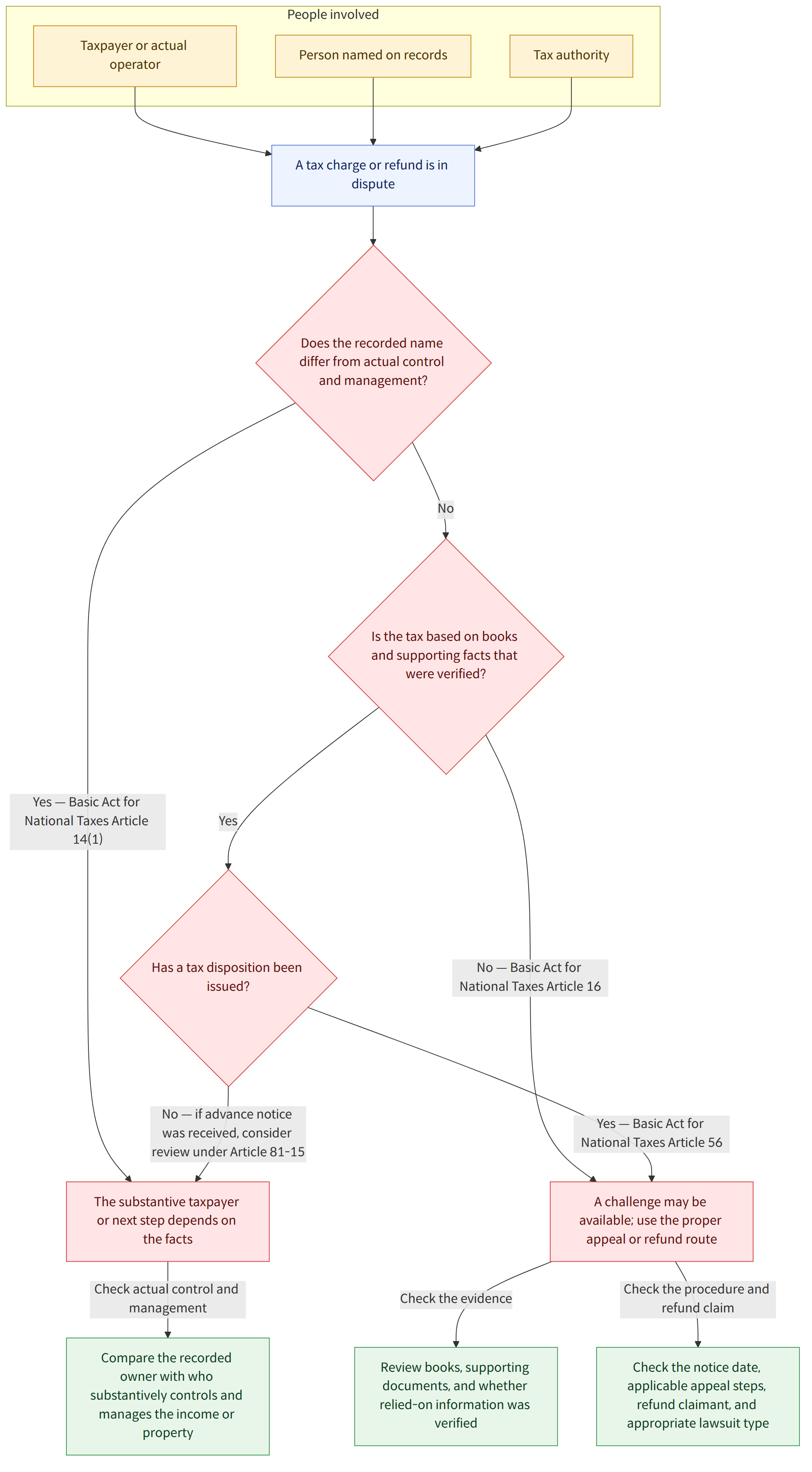
- If the name on record for income, property, or a transaction differs from its actual ownership, the person who substantively controls and manages it may be the taxpayer (Basic Act for National Taxes, Article 14(1) (국세기본법 제14조 제1항)).
- A tax disposition must be based on books and supporting documents and on facts established through an investigation. Taxation based solely on information whose authenticity or contents have not been verified may raise an issue of violation of the principle that taxation must be based on evidence (Basic Act for National Taxes, Article 16 (국세기본법 제16조)).
- If you receive advance notice of taxation or similar notice, you may request a pre-assessment review. After a disposition is issued, you should consider appeal procedures such as an objection, a request for review, or a request for adjudication (Basic Act for National Taxes, Article 81-15 (국세기본법 제81조의15), Article 66 (국세기본법 제66조), Article 62 (국세기본법 제62조), and Article 69 (국세기본법 제69조)).
- As a general rule, a prior administrative appeal procedure must be completed before filing an administrative lawsuit against a national tax disposition. However, exceptions may apply, including where one of several persons subject to the same obligation has completed that procedure (Basic Act for National Taxes, Article 56 (국세기본법 제56조)).
- The taxpayer liable for value-added tax is the business operator that supplies the goods or services. Unless there is a separate agreement that the recipient will bear the value-added tax, the supplier cannot claim the tax directly from the other party solely on the basis of tax law (Value-Added Tax Act, Article 31 (부가가치세법 제31조)).
- The person entitled to claim a national tax refund and the appropriate type of lawsuit vary by case. If tax assessed against and paid by a nominal business operator is refunded, that operator may be entitled to claim it; a claim for payment of a value-added tax refund may be brought as a party litigation.
- Tax reductions and deductions are available only when the requirements prescribed by law are met. It is difficult to interpret the requirements for tax reductions or income deductions more broadly than their wording permits (Restriction of Special Taxation Act, Article 77 (조세특례제한법 제77조); example concerning the former Enforcement Decree of the Income Tax Act, Article 112(4)(1)(a) (구 소득세법 시행령 제112조 제4항 제1호 가목)).
Frequently asked questions
Q. How can I challenge a tax assessment by the tax office that I believe is unjustified?
If you have received advance notice of taxation or notice of the results of a tax audit, you may consider requesting a pre-assessment review. As a general rule, after a tax disposition has been issued, you must go through an appeal procedure—such as an objection, a request for review, or a request for adjudication—before filing an administrative lawsuit. The examples explain the time limits for each procedure, so you should check the date you received notice of the disposition and the laws that apply.
Q. Can I seek cancellation of a tax disposition if I believe the evidence on which it was based is unreliable?
The tax authorities must review books and supporting documents and, if they rely on facts that differ from the records kept in the books as grounds for taxation, disclose the facts they investigated and the grounds for their decision. Even if information was obtained from an investigative agency, a tax disposition based solely on that information may violate the principle that taxation must be based on evidence if the information’s authenticity or contents have not been verified.
Q. If the person named on a business registration differs from the actual business operator, who should be charged the tax?
If an asset or income subject to taxation is nominally in one person’s name but is actually controlled and managed by another person, the person to whom it substantively belongs may be treated as the taxpayer. However, the tax and payment relationship between the actual business operator and the person in whose name the business is registered may be treated separately. The actual business operator therefore does not automatically acquire the right to claim a refund of tax assessed against the nominal business operator.
Q. Can I claim value-added tax from the other party to a transaction even if our contract does not specify who bears it?
The taxpayer liable for value-added tax is the business operator that supplies the goods or services. The Value-Added Tax Act, by itself, does not give the supplier the right to claim the tax directly from the recipient. However, the supplier may make such a claim if the parties agreed that the recipient would bear the value-added tax. The agreement need not be express; it may also be found to have been implied based on circumstances such as the course of the transaction.
Q. If I acquire a claim to a national tax refund, can I also request a correction on behalf of the original taxpayer?
The example explains that a person who has acquired a claim to a tax refund does not thereby succeed to the original taxpayer’s right to request a correction. The right to request a correction is provided for, among others, persons who have filed a return of the tax base. The transfer of a tax-refund claim must therefore be distinguished from the right to request a correction.
Q. Do I have to bring a civil lawsuit to claim a value-added tax refund from the state?
The example explains that a taxpayer’s claim for payment of a value-added tax refund is a public-law claim arising under value-added tax legislation and should therefore be brought as a party litigation under the Administrative Litigation Act, rather than as a civil lawsuit. Even if the right to receive the refund has been transferred, it is necessary to confirm who may bring the claim and what type of lawsuit is appropriate.
Q. Will capital gains tax or acquisition tax apply if I receive real estate through a division of property after divorce?
According to the examples, a transfer of assets made as part of a division of property that settles the spouses’ actual joint property is not, absent special circumstances, treated as a transfer for consideration subject to capital gains tax. By contrast, transferring assets in exchange for alimony or child support may be subject to capital gains tax. Local taxes, including acquisition tax, may also be relevant when real estate is acquired through a division of property.
Q. If real estate is sold at public auction to collect delinquent taxes, can a mortgagee receive a distribution?
The example explains that proceeds from a public sale are distributed first toward delinquent taxes and other amounts related to the seized property, and that any remaining balance is then distributed toward claims secured by a mortgage. A mortgagee holding a maximum-amount mortgage must apply for distribution with supporting documents. The distribution priority and amount of the claim must be checked in light of the specific date the security interest was created and the public sale proceedings.
Relevant laws
- Basic Act for National Taxes, Article 14(1) (국세기본법 제14조 제1항)
- Basic Act for National Taxes, Article 16 (국세기본법 제16조)
- Basic Act for National Taxes, Article 18(3) (국세기본법 제18조 제3항)
- Basic Act for National Taxes, Article 26-2(1) and (2) (국세기본법 제26조의2 제1항·제2항)
- Basic Act for National Taxes, Article 41(1) (국세기본법 제41조 제1항)
- Basic Act for National Taxes, Article 45-2(1) and (2) (국세기본법 제45조의2 제1항·제2항)
- Basic Act for National Taxes, Article 51(1) (국세기본법 제51조 제1항)
- Basic Act for National Taxes, Article 56(2) and (3) (국세기본법 제56조 제2항·제3항)
- Basic Act for National Taxes, Articles 61, 62, 66, and 69 (국세기본법 제61조·제62조·제66조·제69조)
- Basic Act for National Taxes, Article 81-15 (국세기본법 제81조의15)
- National Tax Collection Act, Article 35 (국세징수법 제35조)
- National Tax Collection Act, Article 77(1) (국세징수법 제77조 제1항)
- National Tax Collection Act, Article 80(1) (국세징수법 제80조 제1항)
- National Tax Collection Act, Article 81 (국세징수법 제81조)
- Value-Added Tax Act, Articles 2, 3, 29, 30, and 31 (부가가치세법 제2조·제3조·제29조·제30조·제31조)
Watch out for
- Some of the laws and court decisions discussed in the examples are based on former laws applicable at a particular point in time. For an actual case, check the laws in force at the relevant time.
- The time limit for an appeal or lawsuit may be calculated from the date notice of the disposition or decision was received. First check the date you received the notice and the deadline for each procedure.
- As a general rule, prior administrative appeal procedures must be completed before challenging a tax disposition, but an exception discussed in an example will not necessarily apply to every case.
- Where the name on record differs from the actual facts, or a tax-refund claim has been transferred, the taxpayer, the person entitled to claim the refund, and the person entitled to request a correction may be different people.
Source cases
This guide was compiled by AI from the following Korea Legal Aid Corporation consultation cases (in Korean).
- 1세대 1주택 소유자의 주택 양도 시 양도소득세 면제요건
- 수 개의 장소에서 하던 사업 중 일부 장소에서의 사업을 포괄양도한 경우에도 제2차 납세의무를 부담하는 사업의 양수에 해당하는지...
- 혼인으로 1세대 2주택이 된 비거주자의 주택 양도 시 양도소득세의 비과세 여부
- 증여세를 증여자가 대신 납부한 것을 새로운 증여를 한 것으로 보아 증여세 과세대상이 될 수 있는지의 문제
- 의약품 도매상인 甲주식회사와 乙은행이 ‘약국운영자인 丙이 의약품 구매대금을 의약품 구매전용카드로 결제하면 甲회사가 乙은행에 수...
- 공익사업용 토지 등에 대한 양도소득세 감면의 적용 범위
- 처분금지가처분등기 후 체납처분 압류등기 시 그 효력
- 증여자가 수증자에게 이전한 보험계약상 지위에 대하여 증여세를 과세하는 경우
- 국세공매절차에서 선순위 근저당권의 피담보채권의 확정시기
- 국세환급금반환채권을 전부받은 전부채권자가 국세기본법 제45조의2 제1항에서 정한 경정청구권을 행사할 수 있는지 여부
- 납세의무자들 중 1인이 적법한 전심절차를 거침으로써 다른 납세의무자가 전심절차를 거치지 않고 곧바로 과세처분의 취소소송을 제기...
- 실질과세의 원칙이 거주자나 내국법인이 우리나라의 조세를 회피하기 위하여 조세피난처에 외형뿐인 ‘기지회사(Base Company...
- 부당한 조세부과에 대한 구제절차
- 국세징수법상 조세채권압류 후 설정된 저당권과의 우선순위
- 사업자가 공급을 받는 자로부터 부가가치세를 직접 징수할 권리가 있는지
- 수사기관에서 통보해온 수사서류를 진실한 것이라 믿고 이를 기초로 행한 조세부과처분의 적부
- 공매대금이 수 개의 국세채권의 총액에 부족한 경우 그 충당방법
- 특별소득공제의 대상이 되는 주택임차자금 차입금의 범위
- 사업자가 부가가치세 상당액을 직접 징수할 권리가 있는지
- 연예인이 독립된 자격에서 용역을 제공하고 받는 소득이 사업 소득에 해당하는지 또는 일시 소득인 기타 소득에 해당하는지 여부의 ...
- 재산분할로 부동산소유권 이전 시 양도소득세 부과되는지
- 구 지방세법 제15조 제1항 제6호의 취지 및 위 조항이 사실혼 해소시 재산분할로 인한 취득에 대해서 적용되는지 여부
- 실제사업자가 따로 있는데도 사업명의자에게 과세처분이 이루어져 사업명의자 명의로 세액이 납부되었으나 과세처분이 무효이거나 취소되...
- 특정 과세기간에 관한 국세 부과처분에 대하여 행정소송 등의 판결이 확정된 후 그 판결의 취지에 따른다는 명목으로 위 과세처분과...
- 부가가치세 환급세액 지급청구가 당사자 소송 대상인지 여부
This guide is general legal information about Korean law, not legal advice for your situation. For a specific case, consult a lawyer or the Korea Legal Aid Corporation (call 132 in Korea).