
When Are Theft and Robbery Offenses Established, and How Are They Assessed?
Based on 48 consultation cases · Updated · Translated from the Korean original.
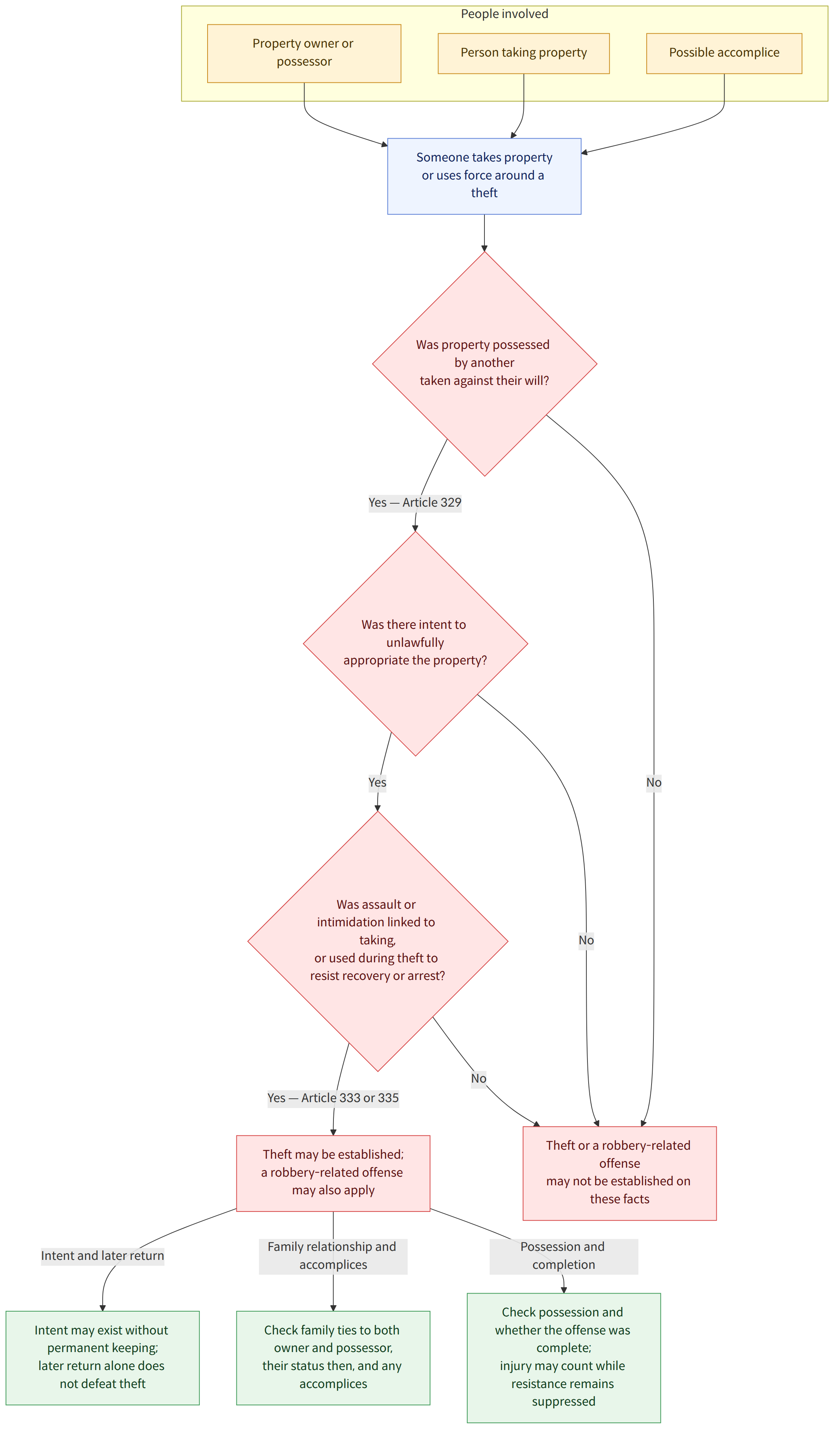
The key issues in theft are whether property possessed by another person was taken against the possessor’s will and whether there was an intent to unlawfully appropriate it. For robbery and quasi-robbery, the purpose of the assault or intimidation and its temporal and spatial connection to the theft must be considered. The outcome may also depend on family relationships and the state of possession.
At a glance
Key points
- The basic act constituting theft is transferring property possessed by another person into the possession of oneself or a third party, against the possessor’s will. The fact that property was taken does not by itself determine whether the offense is established; the intent to unlawfully appropriate it must also be considered (Criminal Act, Article 329 (형법 제329조)).
- Even without an intention to keep property permanently, an intent to infringe ownership or an equivalent proprietary right may establish an intent to unlawfully appropriate it. The fact that the property is later returned to the owner or that the owner benefits does not, by itself, negate theft (Cases 8, 10, and 15).
- For special theft, the requirements for a jointly committed offense, including the sharing of execution of the offense, must be considered in addition to the existence of a plan. A participant who was not at the scene may be a co-principal if they can be regarded as having used the acts of those who carried out the offense at the scene as a means of carrying out their own intent (Criminal Act, Article 331(2) (형법 제331조 제2항); Supreme Court en banc Decision 98Do321, May 21, 1998).
- Robbery requires a connection between the assault or intimidation and the acquisition of the property. If, after an assault unrelated to taking property, the offender takes property by chance without the victim’s knowledge, robbery may not be established (Criminal Act, Article 333 (형법 제333조); Case 3).
- Quasi-robbery is established when a thief uses assault or intimidation on the occasion of the theft for a purpose such as resisting the recovery of the property or evading arrest. If the offense was already over according to social norms, quasi-robbery may not be established even if the offender assaulted someone to avoid arrest (Criminal Act, Article 335 (형법 제335조); Cases 13 and 16).
- Even where injury occurs after a theft, robbery resulting in injury may be established if the victim remains psychologically incapable of resisting and the offense has not yet reached completion. The outcome is not determined solely by the time or distance between the events (Criminal Act, Article 337 (형법 제337조); Case 19).
- The family-relationship exception does not automatically apply whenever there is a family relationship. The relationship between the offender and both the owner and possessor of the property, their status when the offense occurred, and whether there were accomplices must be considered (Criminal Act, Articles 328 and 344 (형법 제328조·제344조); Cases 18 and 20).
- According to the examples, copying information stored on a computer, using ordinary telephone communication services, and taking lost property on a subway before it has been found by a person responsible for managing it may respectively be regarded as not constituting theft or may be assessed as embezzlement of lost property (Criminal Act, Articles 346 and 360 (형법 제346조·제360조); Cases 5, 21, and 22).
Frequently asked questions
Q. Can a person be guilty of special theft even if they were not at the scene, after planning the theft with others?
It may be possible. Even if a person participated in the plan, the court considers whether there are indicia of principal-offender status—such as whether the person used the acts of those who carried it out at the scene as a means of carrying out their own intent. The fact of having participated in the plan alone does not determine the outcome.
Q. Is it robbery if someone takes property without the victim’s knowledge after assaulting them?
The connection between the assault and the acquisition of the property is important. Robbery may not be established if the assault was not used as a means of taking the property and the offender did not take advantage of a state in which the victim’s resistance had been suppressed by the assault.
Q. Does assaulting someone much later to avoid arrest after committing theft amount to quasi-robbery?
The key issue is whether the assault occurred on the occasion of the theft. Relevant considerations include whether the circumstances were sufficiently close in time and place to the scene of the offense, and whether, according to social norms, the theft had already been completed. Accordingly, quasi-robbery may not be established if the offense was already over.
Q. Can taking a vehicle with the intention of returning it to its original owner still constitute theft?
It may. If someone takes a vehicle owned by another person and possessed by someone else, against the possessor’s will, the intent to unlawfully appropriate the vehicle may not be negated merely because the act ultimately benefited the owner or the vehicle was actually returned.
Q. Will I avoid punishment if I take property belonging to a family member or relative?
The relevant issues include whether the family-relationship exception applies to the relationship in question and what the relationship was when the offense occurred. The outcome may depend on whether the offender was related to both the owner and the possessor of the property, and whether the exception also applies to an accomplice.
Q. Is taking a bag left on the subway theft?
The example explains that if a crew member or manager has not yet actually found the lost property and taken possession of it, the issue is embezzlement of lost property rather than theft. The outcome may depend on whether the person responsible for managing the location had actual control of the property.
Q. Is copying computer files or using someone else’s telephone theft?
According to the example, computer data itself is not property for purposes of theft, and a telephone service provided for making calls is not property subject to physical control. Therefore, those acts alone do not constitute theft. However, taking the physical card itself, such as a telephone card, or conduct that satisfies the elements of another offense must be considered separately.
Q. Can taking someone else’s property to submit it as evidence constitute theft?
In a case where property was taken for the purpose of submitting it as evidence, the intent to unlawfully appropriate it was not found, and theft therefore may not be established. The actual purpose and specific circumstances must be considered; the example is based on a finding that this purpose was established.
Relevant laws
- Criminal Act, Article 236 (형법 제236조)
- Criminal Act, Article 328 (형법 제328조)
- Criminal Act, Article 329 (형법 제329조)
- Criminal Act, Article 330 (형법 제330조)
- Criminal Act, Article 331 (형법 제331조)
- Criminal Act, Article 333 (형법 제333조)
- Criminal Act, Article 335 (형법 제335조)
- Criminal Act, Article 337 (형법 제337조)
- Criminal Act, Article 343 (형법 제343조)
- Criminal Act, Article 344 (형법 제344조)
- Criminal Act, Article 346 (형법 제346조)
- Criminal Act, Article 347 (형법 제347조)
- Criminal Act, Article 347-2 (형법 제347조의2)
- Criminal Act, Article 348-2 (형법 제348조의2)
- Criminal Act, Article 350 (형법 제350조)
Watch out for
- Whether theft is established depends not only on ownership but also on who actually possessed or controlled the property when the offense occurred. Even if ownership was acquired through inheritance, the point at which actual control is established may need to be determined separately.
- Where the family-relationship exception applies and withdrawal of a complaint is at issue, the example addresses withdrawal before judgment is pronounced by the court of first instance. The timing of withdrawal and the family relationship must be confirmed in each case.
- The conclusions in the examples are based on the specific facts presented. The assessment may differ if details such as the connection between the assault and the theft, the state of possession, or the intent to unlawfully appropriate the property differ.
- Laws and legal systems may be amended. Before applying them to an actual case, the current law and the specific facts should be checked separately.
Source cases
This guide was compiled by AI from the following Korea Legal Aid Corporation consultation cases (in Korean).
- 공모만 하고 실행에 가담하지 않아도 특수절도죄로 처벌될 수 있나요
- 장인을 기망하여 5억원을 차용한 경우 친족상도례규정 적용 여부
- 폭행과 강도
- 흉기를 휴대하고 삼촌을 협박하여 돈을 갈취한 경우 친족상도례 적용 여부
- 컴퓨터내장 프로그램을 타인이 복제한 경우 절도죄인지
- 전화카드를 절취하여 전화통화에 이용한 경우 처벌 여부
- 강도를 할 목적에 이르지 않고 준강도할 목적이 있음에 그치는 경우
- 명의신탁자의 자동차절도
- 상습절도 기간 중 절도 목적의 주거침입을 별도로 처벌받을 수 있는지
- 점유자의 의사에 반하여 취거하는 행위가 결과적으로 소유자의 이익이 되는 경우
- 상속인이 아직 사실상 지배 점유를 개시하지 않은 재물을 상속인 허락없이 가져간 경우
- 인지의 소급효가 친족상도례 규정에도 미치는지 여부
- 절도범행이 종결된 후 체포를 면탈하기 위해 폭행한 경우에도 준강도죄에 해당하는지
- 손자가 할아버지의 통장을 절취하여 예금 잔고를 자신의 계좌로 계좌이체한 경우 형사책임
- 리스차량을 담보로 사채업자에게 돈을 빌리면서 사채업자에게 인도하고, 사채업자가 다른 사람에게 넘긴 그 차를 임의회수하여 리스회...
- 준강도죄의 행위상황인 절도의 기회
- 점유와 절도죄
- 아내 실소유 차량을 명의자인 남편이 타인에게 매도한 경우 절도죄 여부
- 강취행위 이후 발생한 상해행위에 대하여 강도상해죄로 처벌이 가능한지 여부
- 친구와 함께 친구 할아버지의 물건을 훔친 경우 처벌 여부
- 타인의 전화를 무단 사용한 경우 절도죄 성립 여부
- 유실물(분실물)을 가져간 경우 형사책임 2
- 매도인이 계약해제 후 임의로 물건 가져간 경우 처벌 여부
- 집행유예의 실효 내지 취소와 특정범죄가중처벌등에관한법률상 상습절도
- 증거물로 제출하기 위해 물건을 가져간 경우에도 절도죄가 성립하는지
This guide is general legal information about Korean law, not legal advice for your situation. For a specific case, consult a lawyer or the Korea Legal Aid Corporation (call 132 in Korea).