
Violations of the Act on Special Cases Concerning the Settlement of Traffic Accidents: Punishment and Exceptions
Based on 124 consultation cases · Updated · Translated from the Korean original.
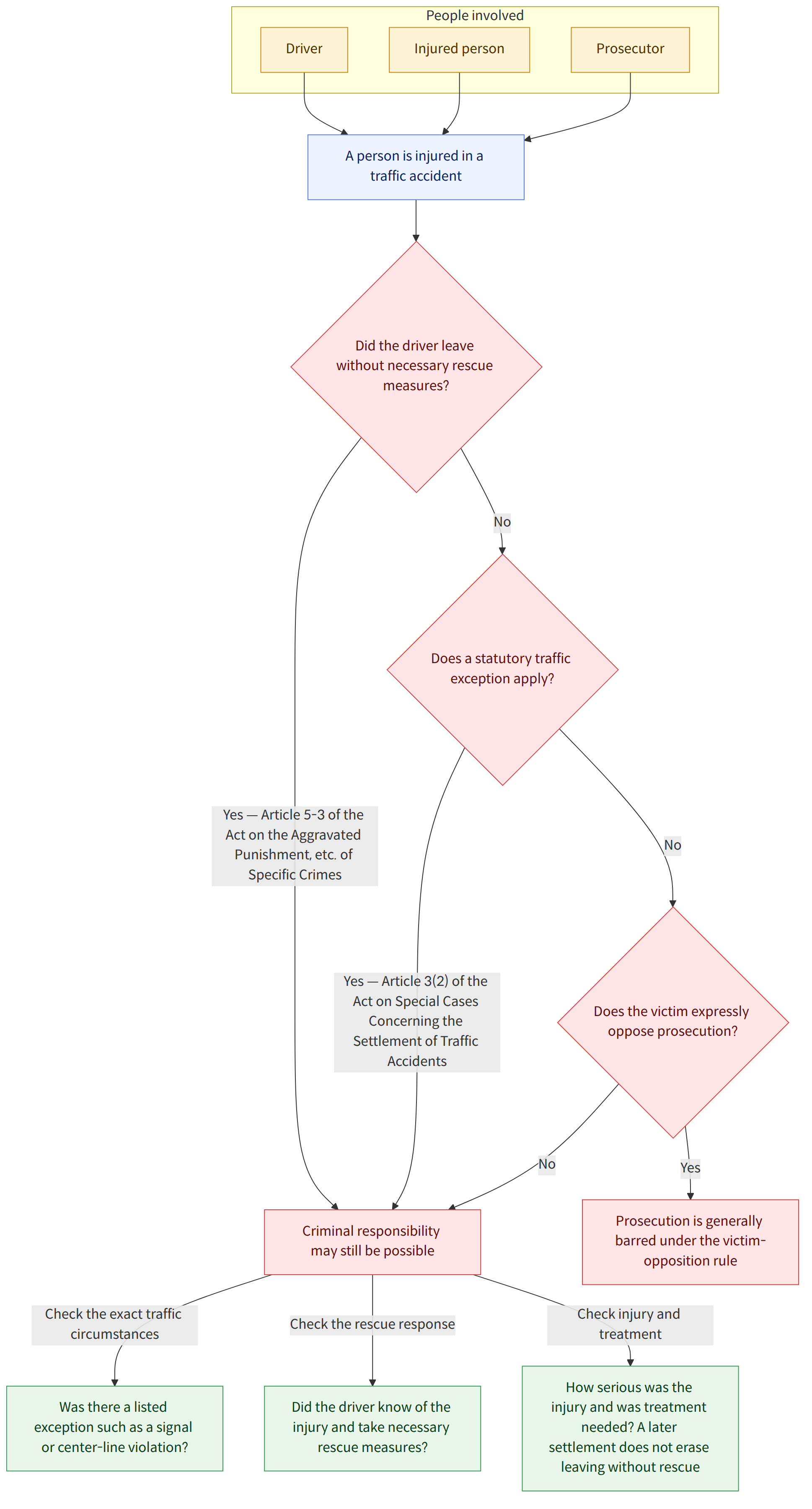
If a person is injured in a traffic accident, the offender cannot always avoid criminal punishment merely because the victim does not wish to press charges or the offender has insurance. Whether an exception applies—such as a signal violation or crossing the center line—and whether the driver breached the duty to take rescue measures after the accident are determined by examining the specific circumstances, including how the accident occurred and the extent of the victim’s injuries.
At a glance
Key points
- As a general rule, a person who commits bodily injury by occupational or gross negligence in a traffic accident may not be prosecuted against the victim’s express wishes. However, the person may be punished if a statutory exception applies (Act on Special Cases Concerning the Settlement of Traffic Accidents, Article 3(2) (교통사고처리특례법 제3조 제2항); Cases 13 and 21).
- The exceptions described in the cases include signal violations, crossing the center line, exceeding the speed limit by more than 20 km/h, violating rules on overtaking or crossing railroad tracks, breaching the duty to protect pedestrians at a crosswalk, driving without a license or while intoxicated, driving onto a sidewalk, breaching the duty to prevent passengers from falling, and accidents in child protection zones (Cases 13 and 21).
- Even if a driver crosses the center line, the exception for crossing the center line may not apply if the driver had no time to take appropriate measures to avoid an obstacle or the crossing was unavoidable because of external circumstances beyond the driver’s control. Conversely, an accident that occurs while returning to the original lane after crossing the center line may still be an accident involving a center-line crossing (Cases 2 and 24).
- A right turn on a red signal must be assessed according to the circumstances. If the pedestrian signal at a crosswalk adjoining the intersection is green, the driver must stop at the stop line and may not turn right. However, even if the driver turns right on red while obstructing other traffic, that act alone may not constitute the signal-violation exception (Cases 8 and 23).
- A white solid line immediately before an intersection does not, by itself, constitute a safety marking prohibiting a change of lane within the intersection. If there is no separate sign prohibiting lane changes within the intersection, an accident involving a lane change does not automatically amount to a violation of a signal or instruction under the Act on Special Cases Concerning the Settlement of Traffic Accidents (Case 16).
- Whether a driver fled after an accident is determined by considering whether the driver knew that the victim was injured, whether the driver took the necessary rescue measures, and whether the driver left the victim in a situation where the person who caused the accident could not be identified. Even if the driver later settles with the victim, that does not eliminate responsibility for leaving the scene immediately after the accident without taking rescue measures (Act on the Aggravated Punishment, etc. of Specific Crimes, Article 5-3 (특정범죄가중처벌 등에 관한 법률 제5조의3); Cases 4, 7, and 14).
- The crime of hit-and-run driving may not be established if the injury is extremely minor, treatment is unnecessary, and the victim’s health cannot be said to have been impaired. However, the need for rescue measures cannot be ruled out merely because no external injury was visible or the victim went about their daily activities immediately after the accident (Cases 11, 12, and 25).
- The application of the Act on Special Cases Concerning the Settlement of Traffic Accidents and the hit-and-run vehicle offense may not depend solely on whether the accident occurred on a road as defined by the Road Traffic Act. The cited case explains that the hit-and-run vehicle provisions may apply even to an accident in a church parking lot (Case 18).
Frequently asked questions
Q. Can I avoid punishment by settling with the victim or having comprehensive insurance?
As a general rule, if the victim has not died and does not wish the offender to be punished, a prosecution may not be brought. Having insurance or mutual-aid coverage is also relevant to the statutory exception. However, a settlement or insurance coverage alone cannot prevent punishment if a statutory exception applies or, for example, the driver fled without taking rescue measures after the accident.
Q. Is a driver always punished if an accident occurs after crossing the center line?
The mere fact that a vehicle crossed the center line does not automatically make the accident an exception for center-line crossing. If the driver had no opportunity to avoid an obstacle, or crossed the line unavoidably because of external circumstances, the exception may not apply. However, a driver may be subject to punishment if an accident occurs while returning to the original lane after crossing the center line.
Q. If an accident occurs while turning right on red at an intersection, is that a signal violation?
In some circumstances, a driver may turn right on a red light without obstructing other traffic; an accident does not necessarily mean that the driver violated the signal. However, if the pedestrian signal at a crosswalk adjoining the intersection is green, the driver must stop at the stop line and may not turn right. An accident caused by disregarding this rule may be found to involve a signal violation.
Q. If I hit someone crossing at a crosswalk while the pedestrian signal is red, is it still a crosswalk accident?
The cited case explains that when a pedestrian crosses against the pedestrian signal, the driver may have breached a separate duty to take care to prevent an accident, but that this does not necessarily constitute a breach of the duty to protect pedestrians on a crosswalk. Accordingly, the exception does not automatically apply merely because the accident occurred on a crosswalk.
Q. Does everyone who leaves the scene immediately after an accident commit hit-and-run driving?
Leaving the scene, by itself, does not constitute the crime of hit-and-run driving. The determination is made by considering all the circumstances, including whether the driver knew the victim was injured, whether rescue measures were necessary, and whether the driver left the victim in a situation where it was difficult to identify the person who caused the accident.
Q. Can hit-and-run driving be established even if the victim suffered only a minor injury?
The crime of hit-and-run driving may not be established if the injury is so minor that treatment is unnecessary and it is difficult to find that the victim’s health was impaired. Conversely, even if an injury appears minor, the crime may be established if the victim actually received treatment and the need for rescue measures at the time of the accident cannot readily be ruled out.
Q. If the victim said they were all right or had no visible injuries, was it unnecessary to take rescue measures?
That cannot be concluded categorically. In particular, a child or another victim who may have difficulty fully assessing their own injuries may need a medical examination and treatment. Whether rescue measures were necessary is determined by considering the circumstances of the accident, the location and severity of the injury, and what happened afterward.
Q. Do the Act on Special Cases Concerning the Settlement of Traffic Accidents or the hit-and-run vehicle offense apply to accidents in a church or apartment parking lot?
The cited case explains that an accident covered by the Act on Special Cases Concerning the Settlement of Traffic Accidents and the offense of hit-and-run driving are not necessarily limited to accidents occurring on a road as defined by the Road Traffic Act. Whether a road within an apartment complex qualifies as a road under the Road Traffic Act may depend on the specific circumstances, including whether it is open to use by an unspecified number of people.
Relevant laws
- Act on Special Cases Concerning the Settlement of Traffic Accidents, Article 3(1) (교통사고처리특례법 제3조 제1항)
- Act on Special Cases Concerning the Settlement of Traffic Accidents, Article 3(2) (교통사고처리특례법 제3조 제2항)
- Act on Special Cases Concerning the Settlement of Traffic Accidents, Article 4 (교통사고처리특례법 제4조)
- Road Traffic Act, Article 13(3) (도로교통법 제13조 제3항)
- Road Traffic Act, Article 27(1) (도로교통법 제27조 제1항)
- Road Traffic Act, Article 54(1) (도로교통법 제54조 제1항)
- Enforcement Rules of the Road Traffic Act, Article 6(2) [Appendix 2] (도로교통법 시행규칙 제6조 제2항 [별표 2])
- Act on the Aggravated Punishment, etc. of Specific Crimes, Article 5-3 (특정범죄가중처벌 등에 관한 법률 제5조의3)
- Criminal Act, Article 268 (형법 제268조)
Watch out for
- Whether an exception applies depends on factors such as the accident location, signal status, the circumstances of the driving, and the direct cause of the accident, so it is difficult to decide based on the outcome alone.
- Even if the offender has settled with the victim or has insurance, the offender may still be punished if the accident involved a death, a statutory exception, or fleeing without taking rescue measures.
- Do not assume that rescue measures are unnecessary merely because the victim says they are all right or has no visible injuries.
Source cases
This guide was compiled by AI from the following Korea Legal Aid Corporation consultation cases (in Korean).
- 주차장에서의 음주운전이 도로교통법상 음주운전인지
- 진행차선의 장애물을 피하기 위한 경우 중앙선침범 여부
- 호흡측정기 음주측정결과가 음주운전의 절대적 증거인지
- 피해자와 합의 중 사정상 운전면허증만 주고 간 경우
- 도로교통법상 음주측정불응죄 성립 여부
- 아파트 단지 내의 통행로에서 교통사고로 인해 3세의 어린이가 상해를 입었음을 보았음에도 보호조치 없이 현장을 이탈한 경우
- 교통사고 후 구호의무를 위반하고 도주한 경우의 가중처벌
- 교차로 차량신호등이 적색이고 횡단보도의 보행등이 녹색인 상태에서 우회전을 한 경우 신호위반인지 여부
- 음주측정수치가 나타나지 않을 정도로 숨을 불어넣은 경우
- 횡단보도상에 누워있는 사람을 충격한 경우의 형사책임
- 사고운전자에게 구호조치의무가 인정되지 않는 경우
- 교통사고 피해자의 상해가 경미하여 구호조치 않은 경우
- 10대 주의의무 위반의 경우
- 경찰에 의해 피해자와 함께 병원에 후송된 후 말 없이 나온 경우
- 범칙금과 벌금의 차이점
- 진로변경금지 안전표지가 미설치된 교차로 내에서 진로변경 중 사고가 발생한 경우
- 횡단보도상의 적색신호시에 횡단하는 자를 충격한 경우
- 교회 주차장에서 교통사고로 피해자에게 상해를 입히고도 구호조치 없이 도주한 경우
- 공무원이 형사처벌 받아 그 신분을 상실하게 되는 경우
- 범칙금이란 어떤 것인지
- 교통사고처리특례법상 예외사유
- 선행차량에 대한 주의의무
- 교차로 차량신호등이 적색인 상태에서 우회전을 하다가 사고가 발생한 경우 신호위반인지 여부
- 중앙선을 넘다가 다시 넘어오던 중 사고 낸 경우에도 중앙선침범 사고인지
- 교통사고 피해자가 2주간의 치료를 요하는 경미한 상해를 입은 경우 구호 필요성 여부
This guide is general legal information about Korean law, not legal advice for your situation. For a specific case, consult a lawyer or the Korea Legal Aid Corporation (call 132 in Korea).