
Guide to Traffic-Related Administrative Disposition Standards and Challenges
Based on 79 consultation cases · Updated · Translated from the Korean original.
Administrative dispositions concerning drunk-driving license revocation, private taxi business licenses, and traffic accidents are assessed based on specific circumstances, including where and how the conduct occurred, the procedures followed, and the type of license involved. The outcome is not determined by the disposition standards alone, so check the notice and hearing procedures and do not miss the statutory deadlines for challenging the disposition.
At a glance
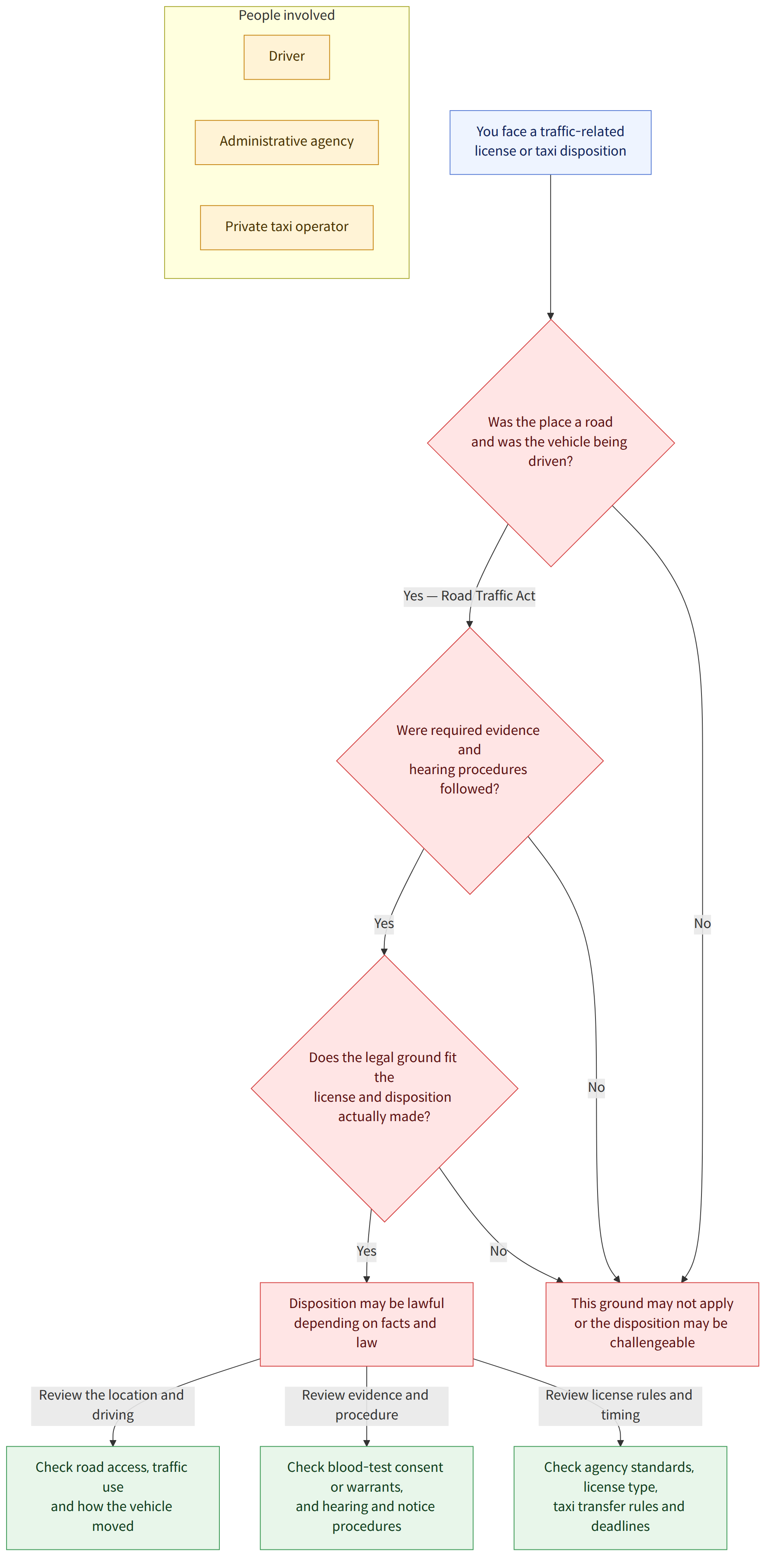
Key points
- Whether a place is a road under the Road Traffic Act is determined by examining, among other things, whether it is open to an unspecified number of people and used for traffic. A passageway within an apartment complex may qualify as a road depending on the circumstances, but courts have held that a parking area within marked parking spaces is not a road (Examples 2 and 8).
- Even briefly moving a vehicle to park may constitute driving if the place is a road and the vehicle was used in its ordinary manner (Example 16).
- A pedestrian crossing while the pedestrian signal is flashing green is also protected by the driver’s duty to protect pedestrians. However, in an example involving an accident after the pedestrian signal turned red, the court distinguished a breach of the duty to protect pedestrians at a crosswalk from a breach of the general duty to prevent accidents (Examples 14 and 17).
- The standards for revoking a driver’s license may be internal guidelines for the administrative agency. The lawfulness of a disposition must therefore be assessed by considering both the laws and the specific circumstances of the disposition (Examples 3 and 7).
- Blood sampling to determine whether a person drove under the influence may raise issues concerning the driver’s consent or compliance with legal procedures. A license disposition based solely on blood test results obtained without consent or a warrant may be unlawful (Examples 12 and 19).
- As a general rule, different types of driver’s licenses are treated separately. It must be examined whether the grounds for revocation apply only to a license related to the vehicle driven (Examples 18 and 20).
- When the law requires a hearing before a disposition, merely visiting the administrative agency and requesting a postponement does not mean that a hearing was held (Example 4).
- For dispositions concerning a private taxi business license, distinguish whether a driver’s license revocation disposition was actually made and how the rules on succession to, or transfer and acquisition of, the license apply (Examples 13 and 21).
Frequently asked questions
Q. Can my license be revoked for drunk driving inside an apartment complex?
The first question is whether the place where you drove qualifies as a “road” under the Road Traffic Act. A passageway within an apartment complex may qualify as a road depending on factors such as access by outside vehicles and how it is managed, but courts have held that a parking area within marked parking spaces is not a road.
Q. Is it drunk driving if I move my car just a little to park after drinking?
If you start the vehicle and move it in a place open to general traffic, such as a dead-end alley in a residential area, even a short move to park may constitute driving. Both the place where you drove and the way you moved the vehicle are considered.
Q. Must I protect a pedestrian who starts crossing while the pedestrian signal is flashing green?
Yes. The court decision discussed in the example held that a driver’s duty to protect pedestrians also applies to pedestrians crossing while the pedestrian signal is flashing green. Whether the pedestrian obeyed the signal and whether the driver fulfilled the duty to protect pedestrians must be considered separately.
Q. If I hit a pedestrian after the pedestrian signal turns red, is that a breach of the duty to protect pedestrians at a crosswalk?
The court decision discussed in the example held that, if the pedestrian signal had turned red at the moment of impact, the incident might not constitute a breach of the duty to protect pedestrians at a crosswalk. However, this does not eliminate liability for breaching general accident-prevention duties, such as keeping a proper lookout.
Q. Can my license be revoked based on a blood test taken without my consent or a warrant?
A legal procedure is required to take a blood sample without the driver’s consent, and even when a sample is taken without a warrant in an emergency, the need for a subsequent warrant may be at issue. A license disposition based on blood test results obtained without consent or a warrant may be unlawful.
Q. What happens if I challenge a breathalyzer result and the police lose my blood sample?
The breathalyzer result is not automatically excluded just because the blood sample was lost. However, whether the test result is particularly reliable is assessed by considering the circumstances as a whole, including the number and distribution of the readings. The court decision discussed in the example held that the disposition may be unlawful if it is difficult to conclude, based only on the test results, that the revocation threshold was exceeded.
Q. If I drive drunk a vehicle that I am not authorized to drive with one type of license, will all my other licenses also be revoked?
As a general rule, different types of driver’s licenses are treated separately. Whether a license may also be revoked if it is unrelated to the license authorizing the driver to operate the vehicle in question depends on the grounds for revocation applicable to each license.
Q. By when must I apply to challenge the revocation of my driver’s license?
According to the example, an administrative appeal must be filed within 90 days from the date you became aware of the disposition and within 180 days from the date it was made. If you file a lawsuit challenging the administrative appeal decision, you must also check the applicable deadlines: within 90 days from the date you received an authenticated copy of the written decision, and within one year from the date the decision was made.
Q. Can I challenge the revocation of a private taxi business license if no hearing was held beforehand?
If the applicable laws and regulations require a hearing, one must be held unless an exception applies. Filing a document requesting a postponement of the disposition does not, by itself, mean that a hearing was held.
Relevant laws
- Road Traffic Act, Article 1 (도로교통법 제1조)
- Road Traffic Act, Article 2 (도로교통법 제2조)
- Road Traffic Act, Article 5 (도로교통법 제5조)
- Road Traffic Act, Article 16 (도로교통법 제16조)
- Road Traffic Act, Article 25 (도로교통법 제25조)
- Road Traffic Act, Article 27 (도로교통법 제27조)
- Road Traffic Act, Article 44 (도로교통법 제44조)
- Road Traffic Act, Article 80 (도로교통법 제80조)
- Road Traffic Act, Article 93 (도로교통법 제93조)
- Road Traffic Act, Article 142 (도로교통법 제142조)
- Road Traffic Act, Article 148-2 (도로교통법 제148조의2)
- Enforcement Rules of the Road Traffic Act, Article 6 (도로교통법 시행규칙 제6조)
- Enforcement Rules of the Road Traffic Act, Article 53 (도로교통법 시행규칙 제53조)
- Enforcement Rules of the Road Traffic Act, Article 91 (도로교통법 시행규칙 제91조)
- Enforcement Rules of the Road Traffic Act, Article 92 (도로교통법 시행규칙 제92조)
Watch out for
- Whether a place is a road is not determined by its name alone; its accessibility to the public and the actual circumstances of its management and use must be examined.
- The driver’s license administrative disposition standards are described in the examples as internal guidelines that do not directly bind courts or the public. The lawfulness of a disposition must be assessed by considering both the applicable laws and the individual circumstances.
- When challenging a drunk-driving disposition, check the filing deadlines for administrative appeals and lawsuits separately, and take care not to miss the deadlines stated in the examples.
- A private taxi business license and a driver’s license are separate dispositions. Distinguish whether the grounds for revoking a driver’s license also permit revocation of the business license, and whether a revocation disposition was actually made.
Related articles
Source cases
This guide was compiled by AI from the following Korea Legal Aid Corporation consultation cases (in Korean).
- 견인 회사에 레커차를 지입하고 견인업무를 하다가 이동 중 교통사고로 사망한 경우 유족보상금 지급 가부
- 아파트 단지 내의 통행로가 도로교통법상 ‘도로’에 해당하는지
- 승객을 강제추행한 개인택시운전사의 운전면허취소가 적법한지
- 청문 실시 없는 개인택시운송사업면허 취소처분의 적법 여부
- 개인택시업자에 대한 운전면허취소 시 그 근거의 객관성 정도
- 사업주 명의의 자동차로 배송업무를 하다가 당한 교통사고로 지급받은 자기신체사고보험금이 산업재해보상보험급여에서 공제되는지 여부
- 음주운전으로 인한 운전면허취소처분의 기준 및 불복절차
- 아파트단지의 주차구역도 도로교통법상의 도로에 해당되는지
- 화물이 없는 승객을 승차시켜 차량을 운행한 화물자동차운수사업자에 대한 개선명령
- 경찰관 과실로 면허취소통지서 반송 시 면허취소의 효력
- 운전적성에 관한 정밀검사를 받지 않고 운전한 기간은 운전경력에서 제외하여 개인택시운송사업면허 신청을 거부하는 것이 타당한지. ...
- 동의나 영장 없이 한 혈액 채취 조사 결과에 따른 운전면허취소처분의 적법 여부
- 운전면허 취소사유가 있으나 그에 따른 운전면허 취소처분이 이루어지지 않은 경우, 개인택시운송사업면허를 취소할 수 있는지.
- 보행신호등의 녹색등화가 점멸하고 있는 동안에 횡단보도를 통행하는 자도 횡단보도에서의 보행자보호의무 대상인지
- 교통사고 불기소처분 시 무사고운전경력이 될 수 있는지
- 차량을 일렬주차하기 위하여 1m 정도 전, 후진을 한 것이 도로교통법상 운전에 해당하는지
- 보행신호등의 녹색등화가 점멸되고 있는 상태에서 횡단보도에 진입한 보행자가 보행신호등이 적색등화로 변경된 후 차량에 충격된 경우...
- 12인승 승합차를 음주운전한 경우 1종 특수면허도 취소되는지
- 위법한 혈액채취에 의한 운전면허취소처분에 대해서 다툴 수 있는지.
- 레이카크레인을 음주운전한 경우 1종 보통면허도 취소되는지
- 개인택시면허를 양수하기 전에 양도인에게 존재했던 면허취소 사유를 원인으로 양수인의 면허를 취소할 수 있는지
- 신호등이 설치되어 있고 비보호좌회전이 불가능한 교차로에서 유턴하여 사고가 같은 진행방향 후방차량에게 신호위반 책임을 부담하는지...
- 경찰관의 혈액채취샘플 분실로 불복한 음주측정기에 근거한 면허취소처분의
- 피해자과실로 인한 교통사고로 개인택시사업면허가 취소된 경우
- 교통섬이 설치되어 있고 그 오른쪽에 우회전차로가 설치되어 있는 교차로 직진차로에서 우회전하는 것이 교차로 통행방법을 위반한 것...
This guide is general legal information about Korean law, not legal advice for your situation. For a specific case, consult a lawyer or the Korea Legal Aid Corporation (call 132 in Korea).