
A Guide to Terminating Travel Contracts and Travel Agency Liability
Based on 12 consultation cases · Updated · Translated from the Korean original.
Travelers may cancel a contract before departure and may terminate it during the trip if there is an unavoidable reason or a serious defect that is not remedied. A travel agency may have a duty to investigate and disclose risks to protect travelers' safety. Travelers may request correction of a trip that differs from the contract, a price reduction, or damages.
At a glance
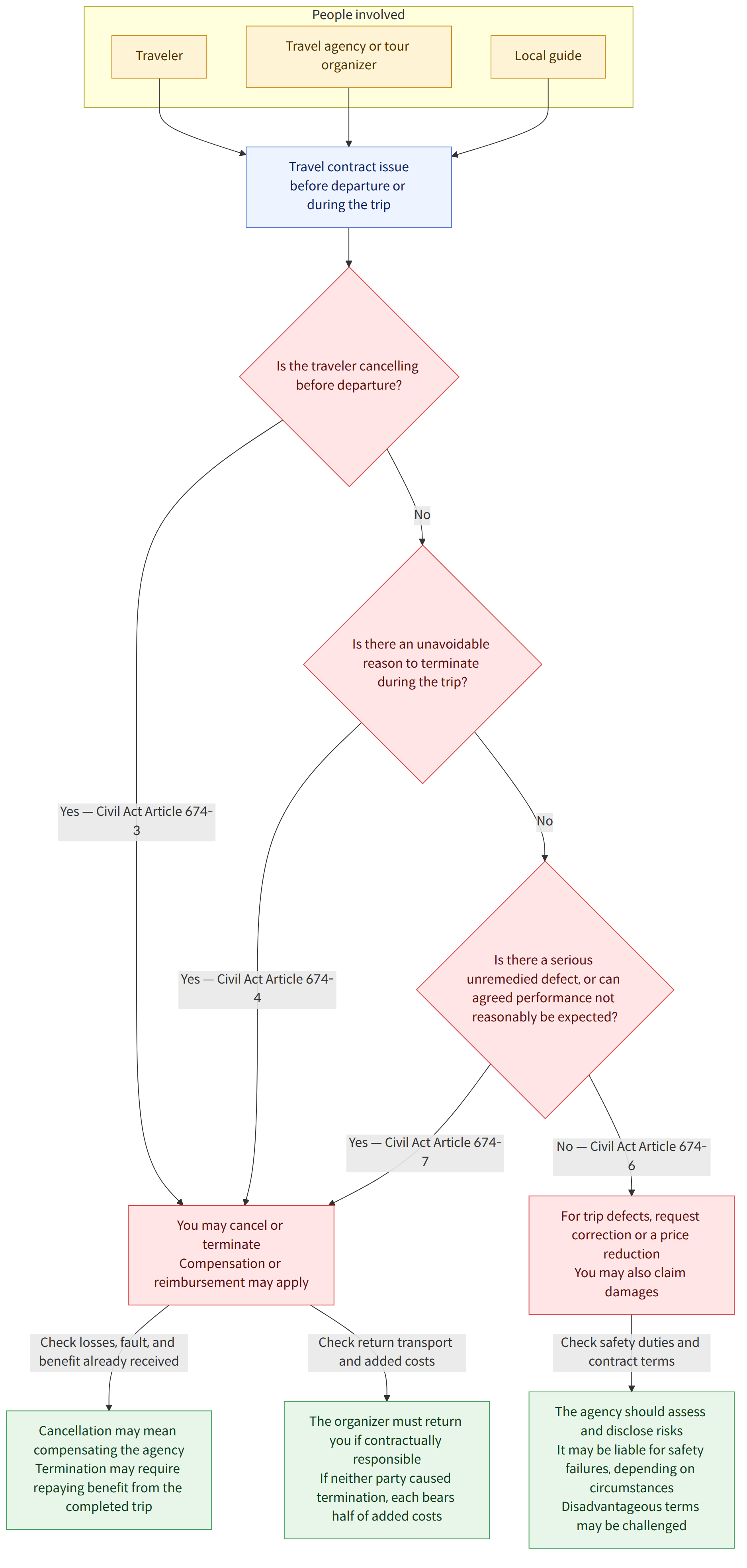
Key points
- A travel agency must investigate and assess in advance the risks associated with the destination and travel services, take necessary safety measures, or inform travelers of risks so they have an opportunity to make a choice (Supreme Court Decision 98Da25061, rendered Nov. 24, 1998; Supreme Court Decision 2011Da1330, rendered May 26, 2011).
- If a travel agency or local guide breaches its duty of care for travelers' safety, such as by failing to disclose a risk, it may be held liable for damages suffered by a traveler. However, liability may be limited depending on the specific circumstances.
- Before departure, a traveler may cancel the contract at any time, but may have to compensate the travel agency for any loss it incurs (Civil Act, Article 674-3 (민법 제674조의3)).
- A contract may be terminated during the trip for an unavoidable reason. If that reason arose through the fault of one party, that party must compensate the other for any loss (Civil Act, Article 674-4, Paragraph 1 (민법 제674조의4 제1항)).
- Even if the contract is terminated for an unavoidable reason, the traveler must be returned if the tour organizer is contractually responsible for return transportation. If the reason for termination is attributable to neither party, each party bears half of the additional costs arising from the termination (Civil Act, Article 674-4, Paragraphs 2 and 3 (민법 제674조의4 제2항·제3항)).
- If the trip is defective, the traveler may request correction of the defect or a reduction in the price, and may also claim damages. The traveler may not request correction if it would entail excessive cost or cannot reasonably be expected (Civil Act, Article 674-6, Paragraph 1 (민법 제674조의6 제1항)).
- If the trip has a serious defect that is not remedied, or performance as agreed cannot be expected, the traveler may terminate the contract. After termination, the traveler may have to reimburse the tour organizer for any benefit received from the portion of the trip already completed (Civil Act, Article 674-7 (민법 제674조의7)).
- The Civil Act provisions relating to travel contracts are described as mandatory provisions that cannot be excluded to the disadvantage of travelers. If a travel agency's terms contravene those provisions and disadvantage travelers, the validity of those terms may be challenged.
Frequently asked questions
Q. Can I cancel the contract before departure, or do I have to pay a cancellation fee?
A traveler may cancel the contract at any time before the trip begins. However, if the cancellation causes the travel agency to suffer a loss, the traveler may have to compensate the agency for that loss, and any cancellation fee set by the agency does not necessarily apply as stated.
Q. Can I terminate the contract during the trip if there is a death in the family or a natural disaster?
The examples explain that a travel contract may be terminated during the trip for unavoidable reasons, such as a death in the family or an earthquake. However, if the reason arose through the fault of one party, that party may have to compensate the other for any loss.
Q. Who pays for the return flight and additional costs after termination during the trip?
If the tour organizer is contractually responsible for arranging return transportation, it must return the traveler even if the contract is terminated during the trip. If the reason for termination is attributable to neither party, the traveler and the tour organizer each bear half of the additional costs arising from the termination, such as return transportation costs.
Q. What can I request if the number of travelers or the itinerary differs from what I was told?
If the trip is defective—for example, the number of travelers differs from what was initially stated or a scheduled activity is canceled—you may request that the defect be remedied or that the price be reduced, and you may also claim damages if you have suffered a loss. You may also terminate the contract if the defect is serious and is not remedied, or if it would be unreasonable to expect the trip to be performed as agreed.
Q. Can I terminate the travel contract if the accommodation or meals are substantially different from what was described?
The grade of the accommodation, the quality of meals, and the itinerary may be important terms of the contract. If there is a serious defect in any of these matters and it is not remedied, or if performance as agreed cannot reasonably be expected, you may terminate the contract. Remedies such as correction of the defect, a price reduction, and damages may also be available.
Q. If an accident occurs during a trip, can I hold the travel agency responsible for the safety incident?
A travel agency may have a duty to investigate risks at the destination, take necessary measures, or inform travelers of risks in order to protect their lives, physical safety, and property. If an accident occurs because the agency failed to disclose a risk or neglected to take safety measures, it may be held liable for damages. However, the scope of liability may be limited depending on the circumstances of the accident and other factors.
Q. Can I hold a travel agency responsible if someone dies in a terrorist attack during an overseas trip?
The examples conclude that a travel agency may be liable for damages if it failed to fulfill its duty to investigate and inform travelers about matters such as the security situation at the destination, the possibility of terrorism, and the contents of travel advisories. However, liability may be limited in light of circumstances such as the difficulty of foreseeing or preventing the terrorist attack.
Q. If I signed a risk acknowledgment, can I no longer hold the travel agency responsible?
The examples explain that signing a risk acknowledgment before riding a banana boat does not, by itself, mean that the traveler assumed the risk of every possible accident. In particular, it was not interpreted as meaning that the traveler agreed to accept the risk of an accident caused by the facility's failure to comply with safety laws and regulations.
Q. Do I have to follow the travel agency's terms if they disadvantage travelers?
The examples explain that the Civil Act provisions governing travel contracts, which protect travelers, are mandatory and that terms and conditions that disadvantage travelers in contravention of those provisions are ineffective. If a travel agency's terms refuse cancellation before departure or prevent correction of a defect in the trip or termination of the contract, their validity may be challenged.
Relevant laws
- Civil Act, Article 674-3 (민법 제674조의3)
- Civil Act, Article 674-4 (민법 제674조의4)
- Civil Act, Article 674-6 (민법 제674조의6)
- Civil Act, Article 674-7 (민법 제674조의7)
- Tourism Promotion Act, Article 16-3 (관광진흥법 제16조의3)
Watch out for
- Whether liability for damages is established, and its scope, may depend on the specific circumstances, including whether risks were disclosed, the traveler's conduct, and whether the accident could have been foreseen or prevented.
- A contract may be canceled before departure, but the traveler may have to compensate the travel agency for any loss caused by the cancellation.
- How additional costs after termination during the trip are allocated may depend on whether the reason for termination is attributable to either party.
- The fact that a traveler signed a risk acknowledgment does not, by itself, determine liability for every accident; both the acknowledgment's contents and the cause of the accident must be considered.
Source cases
This guide was compiled by AI from the following Korea Legal Aid Corporation consultation cases (in Korean).
- 여행 중 강도피해를 당한 여행자에게 여행사와 보험계약을 체결한 보험사가 손해배상책임을 지는지
- 해외여행 중 테러로 인하여 사망시 여행사의 배상책임 여부
- 여행업자의 손해배상 책임
- 해외여행 자유시간 중 바나나보트 뒤집혀 사망한 경우 여행사가 어느 정도 책임지는지
- 여행계약 법률을 위반한 여행계약의 효력
- 기획여행업자가 여행자에게 부담하는 안전배려의무
- 여행을 떠나기 전에 여행계약을 취소할 수 있는지
- 여행 도중에 중대한 하자가 있는 경우 계약해지가 가능한지
- 부득이한 사유가 있는 경우에 여행계약을 해지할 수 있는지
- 체결한 여행계약과 다르게 여행에 하자가 있는 경우 여행자는 여행사에 책임을 물을 수 있는지
- 여행계약 중도해지시 귀환운송비용 등 추가로 발생하는 비용은 누가 부담하는지
- 여행중 계약해지시 여행사는 여행자에게 귀국항공편을 마련해주어야 하는지
This guide is general legal information about Korean law, not legal advice for your situation. For a specific case, consult a lawyer or the Korea Legal Aid Corporation (call 132 in Korea).