
Essential Guide to Claims for Restitution of Unjust Enrichment
Based on 28 consultation cases · Updated · Translated from the Korean original.
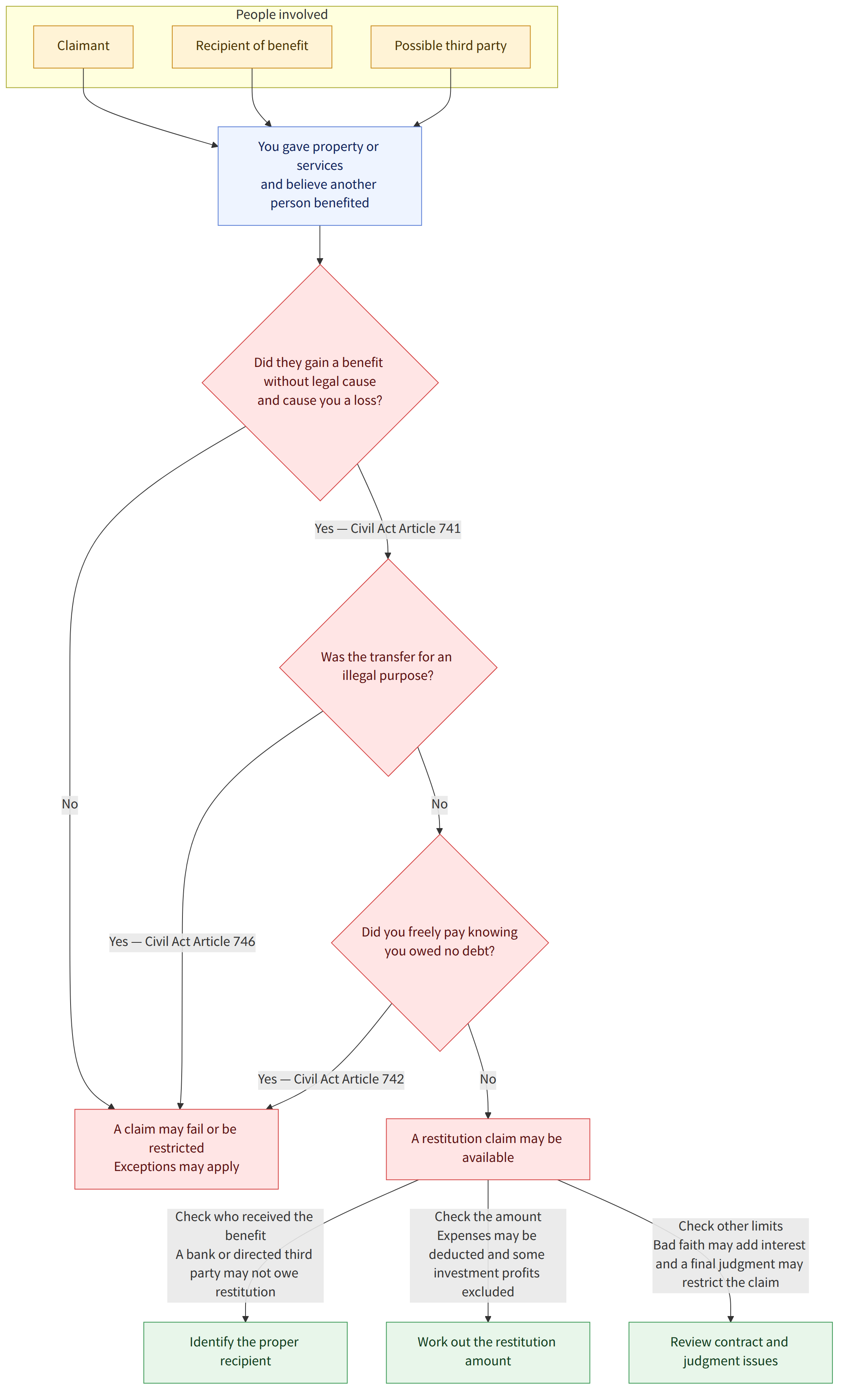
To establish a claim for restitution of unjust enrichment, it is important to determine whether the other party obtained a benefit without legal cause and whether that resulted in loss to the claimant. However, whether restitution is owed, and its extent, may vary depending on the specific circumstances, including deductions for expenses, the circumstances at the time of payment, performance for an illegal cause, and final judgments.
At a glance
Key points
- A person who obtains a benefit from another person’s property or services without legal cause, thereby causing loss to that person, must return the benefit (Civil Act, Article 741 (민법 제741조)).
- If restitution in kind is impossible and the value must be returned, expenses incurred to obtain the benefit may be deducted. In certain circumstances, investment profits generated through the recipient’s efforts may also be excluded from the scope of restitution (Case 1, Supreme Court Decision 94Da25551, May 12, 1995).
- Even if a person paid knowing that no debt was owed, the right to claim a refund may remain if the payment was not made of the person’s free will but was made out of necessity to avoid harm resulting from refusing to pay (Civil Act, Article 742 (민법 제742조); Case 10).
- If property is transferred for an illegal purpose, restitution generally cannot be claimed, and a claim for restitution based on ownership may also be restricted on the same grounds. However, exceptions may apply, including where the recipient’s wrongdoing was significantly greater than that of the person who made the transfer (Civil Act, Article 746 (민법 제746조); Cases 9, 11, 12, 16, and 22).
- If a recipient acquires a deposit claim through a mistaken bank transfer, restitution may generally be claimed from the recipient. The receiving bank, however, may have no duty to make restitution because it obtained no benefit (Case 15, Supreme Court Decision 2007Da51239, November 29, 2007).
- Even if money or another benefit is provided directly to a third party at the direction of a contracting party, a claim for restitution of unjust enrichment generally cannot be brought directly against that third party (Cases 14 and 19).
- A claim for restitution of unjust enrichment may be restricted where a third party occupies land provided as a public passageway and the owner has waived the exclusive right to use and profit from it. Conversely, if a structure is installed without legal authority and prevents the land from being used in its entirety, an amount equivalent to rent for the whole land may be included in the scope of restitution (Cases 4, 5, 18, and 24).
- If a contract is invalid, a recipient in bad faith may be required to return the benefit received together with statutory interest. If a judgment against the claimant in an action challenging a distribution becomes final, it may be difficult to make a contrary assertion about the right to receive the distribution in a subsequent unjust-enrichment action (Civil Act, Article 748(2) (민법 제748조 제2항); Cases 17 and 20).
Frequently asked questions
Q. Can I claim a refund from the bank if I accidentally sent money to someone else’s account?
If the recipient acquired a deposit claim through a bank transfer, you may, in principle, claim restitution of unjust enrichment from the recipient even if there was no underlying transaction that gave rise to the transfer. The receiving bank did not obtain the amount as a benefit, so a claim for restitution against the bank may not be upheld.
Q. Can’t I get my money back if I paid a debt knowing that I didn’t owe it?
If you voluntarily paid a debt knowing that you did not owe it, you may be unable to claim a refund. However, if you had no choice but to pay to avoid actual harm—such as the sale of property at auction—that could result from refusing to pay, the payment may not be regarded as having been made of your own free will, and you may retain the right to claim a refund.
Q. If I transferred real estate to repay a gambling debt, can I get the property back?
If property is transferred for an illegal purpose, a claim for restitution based on ownership, as well as a claim for restitution of unjust enrichment, may in principle be restricted. However, a restitution claim may be permitted if the recipient’s wrongdoing was significantly greater than that of the person who made the transfer. There is also a case in which the court held that cancellation could be sought where only a mortgage was established.
Q. Does registering real estate through a transaction that violates the law, such as a title-trust arrangement, constitute a performance for an illegal cause?
A transaction does not automatically constitute a performance for an illegal cause under the Civil Act merely because it violated a statutory prohibition. In one case, the court held that an agreement to hold title in another’s name in violation of the Act on the Registration of Real Estate under Actual Titleholder’s Name, and the resulting registration, did not by themselves amount to a performance for an illegal cause.
Q. If someone is unlawfully occupying part of my land, can I claim rent for the entire parcel?
If an unauthorized structure leaves the remaining land as a residual parcel that cannot, in practice, be used for its intended purpose, you may claim an amount equivalent to rent for the entire land. However, if the land is provided as a public passageway and the owner is found to have waived the exclusive right to use and profit from it, a restitution claim may be restricted on the basis that no loss resulted from the occupation.
Q. Do I have to repay interest as well on money received under an invalid sales contract?
An obligation to make restitution under an invalid contract is an obligation to restore unjust enrichment, and a recipient in bad faith must return the benefit received together with statutory interest. In one case, the court held that payment of this interest is distinct in nature from damages for delay in performing the restitution obligation and is therefore unrelated to whether the obligation to cancel the registration and the restitution obligation are concurrently performable.
Q. I was charged compensation for the unauthorized occupation of state-owned property. Can I also be required to pay unjust enrichment under civil law?
A right to impose and collect compensation for use is a public-law right, whereas a claim for restitution of unjust enrichment is a private-law claim; they differ in legal character. Accordingly, one case held that a civil claim for restitution of unjust enrichment may be brought separately from the imposition and collection of compensation for use.
Q. Can I recover as unjust enrichment taxes paid under an unlawful tax assessment?
If a defect in a tax assessment is merely one that makes the assessment voidable, it is difficult to obtain a refund of taxes paid while the assessment remains uncanceled by claiming that the payment was unjust enrichment. The case explains that a tax payment constitutes unjust enrichment only if it has no legal basis at all, or if the defect in the tax assessment is so serious and obvious that the assessment is void from the outset.
Q. Can I claim restitution of unjust enrichment again after losing an action challenging a distribution?
Once a judgment on the merits in an action challenging a distribution becomes final, res judicata may attach to the determination of the right to receive the disputed distribution amount. A claim for restitution of unjust enrichment based on an assertion inconsistent with that determination is restricted.
Relevant laws
- Civil Act, Article 103 (민법 제103조)
- Civil Act, Article 203 (민법 제203조)
- Civil Act, Article 214 (민법 제214조)
- Civil Act, Article 469 (민법 제469조)
- Civil Act, Article 472 (민법 제472조)
- Civil Act, Article 741 (민법 제741조)
- Civil Act, Article 742 (민법 제742조)
- Civil Act, Article 744 (민법 제744조)
- Civil Act, Article 746 (민법 제746조)
- Civil Act, Article 748 (민법 제748조)
- Civil Procedure Act, Article 216(1) (민사소송법 제216조 제1항)
- Former State Property Act, Article 32(3) (구 국유재산법 제32조 제3항)
- Former State Property Act, Article 51(1), (4), and (5) (구 국유재산법 제51조 제1항·제4항·제5항)
- Act on Security over Movable Property, Claims, etc., Article 35(2) (동산·채권 등의 담보에 관한 법률 제35조 제2항)
- Labor Standards Act, Articles 18 and 34 (the version before amendment referred to in the case) (근로기준법 제18조·제34조(사례에 언급된 개정 전 법률))
Watch out for
- The fact that the other party obtained a benefit does not, by itself, establish a right to restitution. The legal basis, the claimant’s loss, and the relationship between the parties must all be considered.
- Whether a transaction constitutes a performance for an illegal cause cannot be determined solely by whether it violated the law. The illegality of both the person who made the payment and the recipient, as well as the specific circumstances, must be examined.
- The scope of restitution may vary depending on expenses incurred, benefits obtained through the recipient’s efforts, and whether the recipient acted in good or bad faith. Do not assume that the entire amount received is necessarily subject to restitution.
- Where a separate administrative or judicial procedure is involved, such as a tax assessment or a distribution, whether the assessment has been canceled or a judgment has become final may affect a claim for restitution of unjust enrichment.
Related articles
Source cases
This guide was compiled by AI from the following Korea Legal Aid Corporation consultation cases (in Korean).
- 부당이득반환의 범위에서 지출비용 및 운용이익이 공제되어야 하는지
- 임용행위가 당연무효이거나 취소된 공무원의 임용 시부터 퇴직 시까지의 사실상의 근로에 대한 국가 또는 지방자치단체의 부당이득반환...
- 무효인 퇴직금 분할 약정에 의하여 이미 지급한 퇴직금 명목의 금원이 부당이득에 해당하는지 여부
- 사용권을 포기한 소유자의 불법점유자에 대한 부당이득반환청구권
- 도로부지로 제공된 토지의 특정승계자가 부당이득반환청구 가능한지
- 국유재산의 무단점유자에 대하여 구 국유재산법 에 의한 변상금 부과·징수권의 행사와 별도로 민사상 부당이득반환청구의 소를 제기할...
- 과세처분의 하자가 단지 취소할 수 있는 정도에 불과할 때 그로 인한 조세의 납부가 부당이득이 되는지 여부
- 동산·채권 등의 담보에 관한 법률에 의한 채권담보권자가 채권양수인에게 부당이득으로서 변제받은 것의 반환을 청구할 수 있는지 여...
- 노름빚 담보조로 부동산에 근저당권을 설정한 경우 그 효력
- 비채변제가 지급자의 자유로운 의사에 반하여 이루어진 경우에도 그 반환청구권을 상실하는지
- 불법원인급여와 물권적 청구권의 행사가부
- 불법원인급여에서 불법성이 더 큰 자에 대한 부당이득반환청구 가능한지
- 부동산실권리자명의등기에관한법률에 위반되어 무효인 명의신탁약정에 기하여 경료된 타인 명의의 등기가 불법원인급여에 해당하는지 여부...
- 계약상의 급부가 계약상대방뿐만 아니라 제3자의 이익으로 된 경우에 급부를 한자가 그 제3자에 대하여 직접 부당이득반환을 청구할...
- 송금의뢰인이 수취인의 예금구좌에 착오송금을 한 경우, 계좌이체의 원인이 되는 법률관계의 부존재를 이유로 송금의뢰인이 수취인이 ...
- 불법의 원인으로 재산을 급여한 사람이 불법의 원인에 가공한 상대방 수령자에 대하여 불법행위로 인한 손해배상을 요구할 수 있는지...
- 배당이의 소에서 패소 확정 후 부당이득반환청구 가능한지
- 권원 없이 타인 토지 위에 시설물을 설치·사용한 자의 부당이득반환범위
- 계약의 일방당사자가 상대방의 지시 등으로 상대방과 또 다른 계약관계에 있는 제3자에게 직접 급부한 경우, 제3자의 부당이득 성...
- 매도인의 매매대금 반환의무와 매수인의 소유권이전등기 말소등기절차 이행의무가 동시이행의 관계에 있는지와 관계없이 법정이자를 지급...
- 손해배상청구의 소를 먼저 제기하여 과실상계 등으로 승소액이 제한된 경우, 제한된 금액에 대한 부당이득반환청구권 행사의 허용 여...
- 도박채무의 양도담보로 넘긴 소유권이전등기의 말소청구 가능한지
- 공무원이 직무수행 중 불법행위로 타인에게 손해를 입힌 경우, 피해자에게 손해를 직접 배상한 경과실이 있는 공무원이 국가에 대하...
- 권원 없이 타인의 토지 일부분 위에 시설물을 설치·소유함으로써 나머지 토지까지 사용할 수 없게 된 경우, 그 시설물 보유자가 ...
- 채무자가 피해자로부터 횡령한 금전을 채권자에 대한 채무변제에 사용한 경우 채권자의 부당이득여부
This guide is general legal information about Korean law, not legal advice for your situation. For a specific case, consult a lawyer or the Korea Legal Aid Corporation (call 132 in Korea).