
Administrative Decisions Concerning Persons of Distinguished Service to the State: Registration and How to Challenge a Decision
Based on 13 consultation cases · Updated · Translated from the Korean original.
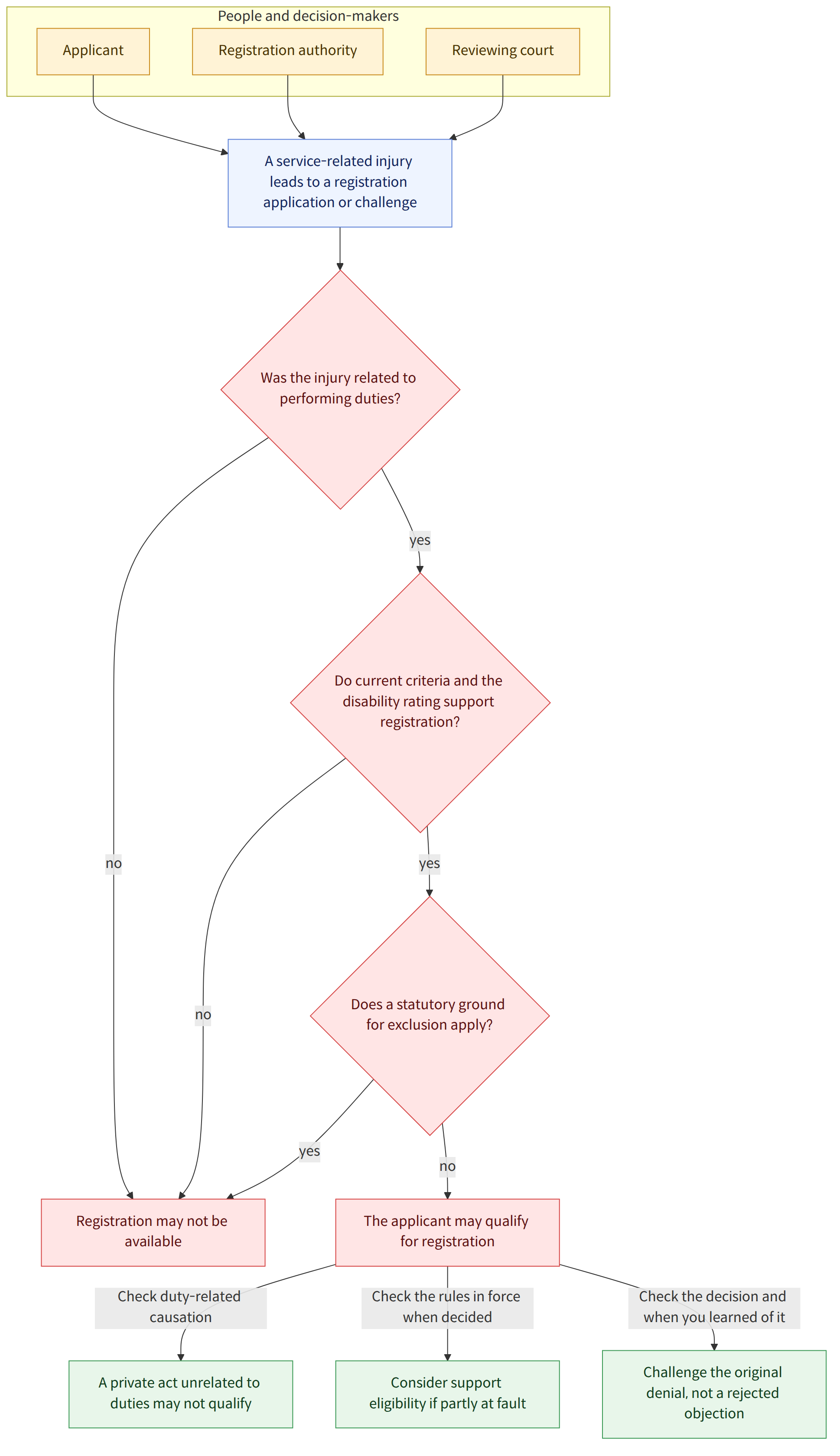
Whether a person is registered as a person of distinguished service to the State depends on several requirements, including the relationship between the injury and the performance of duties, the applicable laws and regulations, and the disability rating. If you challenge a denial of registration or a refusal of interment in a national cemetery, first determine which decision may be challenged in court and when you actually became aware of the decision.
At a glance
Key points
- Even if a person is injured during military service, an injury resulting from a private act unrelated to the person’s duties may not meet the requirements for recognition as a person of distinguished service to the State (Case 7, Supreme Court Decision 92Nu4444, November 27, 1992).
- An application for registration should not be denied in its entirety merely because the applicant was partly at fault. It should be considered whether the applicant may qualify as a person of distinguished service to the State or a person eligible for support, as applicable (Case 9, Supreme Court Decision 2013Du2402, July 11, 2013).
- There is a case holding that distinguishing between persons of distinguished service to the State and persons eligible for veterans' compensation based on whether an injury sustained in the performance of duties is directly related to the defense and security of the State, among other things, does not violate the principle of equality (Case 3, Constitutional Court Decision 2016Hun-Ba263, December 29, 2016).
- A person is not excluded from recognition as a person of distinguished service to the State merely because they were disciplinarily dismissed after suffering an injury in the line of duty. However, it must be separately determined whether a statutory ground for exclusion applies (Case 4, Supreme Court Decision 94Nu12005, December 27, 1994).
- As a rule, eligibility for registration is determined under the laws, regulations, and criteria in force when the application is reviewed and the decision is made (Case 5, Supreme Court Decision 2004Du8521, May 31, 2007).
- If an objection to a denial of registration as a person of distinguished service to the State is rejected, the challenge should be directed at the original denial of registration, not the decision rejecting the objection itself (Cases 6 and 12, Supreme Court Decision 2015Du45953, July 27, 2016).
- The period for filing an action to revoke a decision begins when the person actually becomes aware that the decision has been made. Unless otherwise provided, a decision addressed to another party takes effect when it is notified to that party (Case 11, Supreme Court Decision 2014Du8254, September 25, 2014).
- There is a case holding that rights granted personally, such as compensation for persons of distinguished service to the State, are personal rights that cannot be inherited, and that an heir cannot succeed to litigation brought by a deceased person (Case 8, Supreme Court Decision 2003Du5037, August 19, 2003, and others).
Frequently asked questions
Q. Is everyone who is injured during military service recognized as a person of distinguished service to the State?
Not necessarily. An injury sustained in an act ordinarily related to one’s duties may satisfy the requirements, but an injury caused by a private act unrelated to the performance of one’s duties may be excluded.
Q. Can registration be denied even if I was partly at fault for my injury or death?
There is a case holding that an entire application for registration should not be summarily rejected merely because the applicant’s own negligence contributed to the injury or death. The decision-maker must examine, among other things, whether there is a causal relationship between the training or performance of duties and the resulting injury or death, and determine whether the applicant qualifies as a person of distinguished service to the State or a person eligible for support.
Q. Can I be denied registration as a person of distinguished service to the State if I am disciplinarily dismissed after suffering an injury in the line of duty?
There is a case holding that disciplinary dismissal alone does not exclude someone from registration as a person of distinguished service to the State. However, it must be separately determined whether any statutory ground for exclusion applies.
Q. If my objection to the denial of registration as a person of distinguished service to the State is rejected, should I bring an action against that decision?
There is a case holding that a decision rejecting an objection merely leaves the original denial of registration in place and is not itself a separate decision subject to an action for revocation. You should consider an administrative appeal or an action for revocation challenging the original denial of registration.
Q. If the veterans affairs office revokes an earlier decision recognizing me as a person of distinguished service to the State, who has to prove the case?
There is a case holding that the administrative agency that revokes a decision granting an existing benefit or right must prove that the original decision was flawed or that there is a public need to revoke it. The public interest in revocation must also be weighed against the disadvantage to the person concerned.
Q. Does the period for filing an action begin on the day I first inspect materials relating to the decision?
There is a case holding that the relevant date is not when a person could infer the substance of a decision from related materials, but when the person actually became aware that the decision had been made. For a decision addressed to another party, the time when that party became aware of the decision, such as through notification, is important.
Q. If the applicant dies before being recognized as a person of distinguished service to the State, can the family continue the lawsuit?
There is a case holding that rights such as compensation for persons of distinguished service to the State are personal rights belonging exclusively to the individual, are not inheritable, and cannot be succeeded to by an heir who seeks to continue the deceased person’s pending litigation.
Q. Is a refusal of interment in a national cemetery always lawful if it complies with the operating rules?
Not necessarily. Operating rules are internal administrative guidelines for handling affairs, so a decision is not automatically lawful merely because it complies with those rules. However, there is a case holding that the outcome of the review should be respected unless the criteria themselves or the result of applying them are manifestly unreasonable.
Q. Can I bring a separate action for revocation solely against a determination in a reexamination that did not recognize my disability rating?
There is a case holding that a determination made in a reexamination is only part of the procedure for deciding whether to grant registration and does not, by itself, constitute a disposition that establishes separate rights or obligations. Accordingly, an action for revocation cannot be brought to challenge the determination itself.
Relevant laws
- Act on the Honorable Treatment of and Support for Persons of Distinguished Service to the State, Article 4(1)(5) (국가유공자 등 예우 및 지원에 관한 법률 제4조 제1항 제5호)
- Act on the Honorable Treatment of and Support for Persons of Distinguished Service to the State, Article 4(1)(6) (국가유공자 등 예우 및 지원에 관한 법률 제4조 제1항 제6호)
- Act on the Honorable Treatment of and Support for Persons of Distinguished Service to the State, Article 4(5)(4) (국가유공자 등 예우 및 지원에 관한 법률 제4조 제5항 제4호)
- Act on the Honorable Treatment of and Support for Persons of Distinguished Service to the State, Article 4(6)(3) (국가유공자 등 예우 및 지원에 관한 법률 제4조 제6항 제3호)
- Act on the Honorable Treatment of and Support for Persons of Distinguished Service to the State, Article 5 (국가유공자 등 예우 및 지원에 관한 법률 제5조)
- Act on the Honorable Treatment of and Support for Persons of Distinguished Service to the State, Article 6 (국가유공자 등 예우 및 지원에 관한 법률 제6조)
- Act on the Honorable Treatment of and Support for Persons of Distinguished Service to the State, Article 19 (국가유공자 등 예우 및 지원에 관한 법률 제19조)
- Act on the Honorable Treatment of and Support for Persons of Distinguished Service to the State, Article 74-18 (국가유공자 등 예우 및 지원에 관한 법률 제74조의18)
- Act on the Honorable Treatment of and Support for Persons of Distinguished Service to the State, Article 79(1)(4) (국가유공자 등 예우 및 지원에 관한 법률 제79조 제1항 제4호)
- Act on Support for Persons Eligible for Veterans' Compensation, Article 2(1)(2) (보훈보상대상자 지원에 관한 법률 제2조 제1항 제2호)
- Act on the Establishment and Management of National Cemeteries, Article 5(3)(5) (국립묘지의 설치 및 운영에 관한 법률 제5조 제3항 제5호)
- Former Operating Rules of the National Cemetery Interment Eligibility Deliberation Committee, Article 4(4)(2) (구 국립묘지안장대상심의위원회 운영규정 제4조 제4항 제2호)
- Administrative Litigation Act, Article 20(1) (행정소송법 제20조 제1항)
- Constitution of the Republic of Korea, Article 39(2) (헌법 제39조 제2항)
- Enforcement Decree of the Act on the Honorable Treatment of and Support for Persons of Distinguished Service to the State, Article 8(2) (국가유공자예우등에관한법률 시행령 제8조 제2항)
Watch out for
- A decision rejecting an objection and the original denial of registration may be different decisions for purposes of a lawsuit, so first identify the decision you intend to challenge.
- The period for filing an action depends on when you actually became aware of the decision and whether it was notified to you. Do not assume that the period necessarily starts on the day you received records disclosed under an information-access request; check when the decision was actually notified and delivered.
- In a case where an administrative agency revokes an existing decision that was favorable to the person concerned, the burden of proof may differ from that in an ordinary case involving denial of registration.
- Some cases concern laws and regulations as they stood before amendment. For a current application or challenge, check the laws and regulations in force at the relevant time.
Source cases
This guide was compiled by AI from the following Korea Legal Aid Corporation consultation cases (in Korean).
- 국가유공자 등 예우 및 지원에 관한 법률상 국가유공자 등록에서 제외되는 ‘자해행위로 인한 사망’의 의미 및 군인의 직무수행 중...
- 구 국립묘지안장대상심의위원회 운영규정의 법적 성격(=행정청 내부의 사무처리준칙) 및 그에 따른 처분의 적법 여부를 판단하는 방...
- 국가유공자와 보훈보상대상자의 구별에 따른 평등원칙 위반 여부
- 공상을 입은 후 징계해임된 경우 국가유공자로 될 수 없는지
- 구 국가유공자 등 예우 및 지원에 관한 법률 제4조 제1항 제6호에서 정한 공상군경에 해당하는지 판단하기 위해 적용할 법령과 ...
- 국가유공자등록거부처분에 대한 이의신청 기각결정에 대하여 항고가 가능한지
- 전역기념품을 만들던 중 부상 입은 군인이 국가유공자로 인정될 수 있는지
- 국가유공자 등 예우 및 지원에 관한 법률’에 의하여 국가유공자와 유족으로 등록되어 보상금을 받고, 교육 등 각종 보호를 받을 ...
- 국가보훈처장이 국가유공자 등록신청에 대하여 단지 본인의 과실이 경합되어 있다는 등의 사유만이 문제가 됨에도 등록신청을 전부 배...
- 국민에게 일정한 이득과 권리를 취득하게 한 종전 행정처분을 취소할 수 있는 경우 및 취소해야 할 필요성에 대한 증명책임의 소재...
- 행정소송법 제20조 제1항이 정한 제소기간의 기산점인 ‘처분 등이 있음을 안 날’의 의미 및 상대방이 있는 행정처분의 경우 위...
- 국가유공자 등 예우 및 지원에 관한 법률 제74조의18 제1항 이 정한 이의신청을 받아들이지 아니하는 결정이 항고소송의 대상이...
- 국가유공자예우등에관한법률시행령 제15조 소정의 재심신체검사시 행하는 등외판정이 행정처분인지 여부(소극)
This guide is general legal information about Korean law, not legal advice for your situation. For a specific case, consult a lawyer or the Korea Legal Aid Corporation (call 132 in Korea).