
Key Guide to Offenses Under the Act on the Punishment of Acts of Violence, etc.
Based on 16 consultation cases · Updated · Translated from the Korean original.
Punishment relating to the Act on the Punishment of Acts of Violence, etc. depends on specific circumstances, including whether a dangerous object was carried, whether the offense was committed jointly, whether the conduct was habitual, and whether the group qualifies as a criminal organization. Because some provisions of the former law were deleted after being held unconstitutional, it is important to distinguish the provisions in force at the time of the example from the Criminal Act provisions that apply today.
At a glance
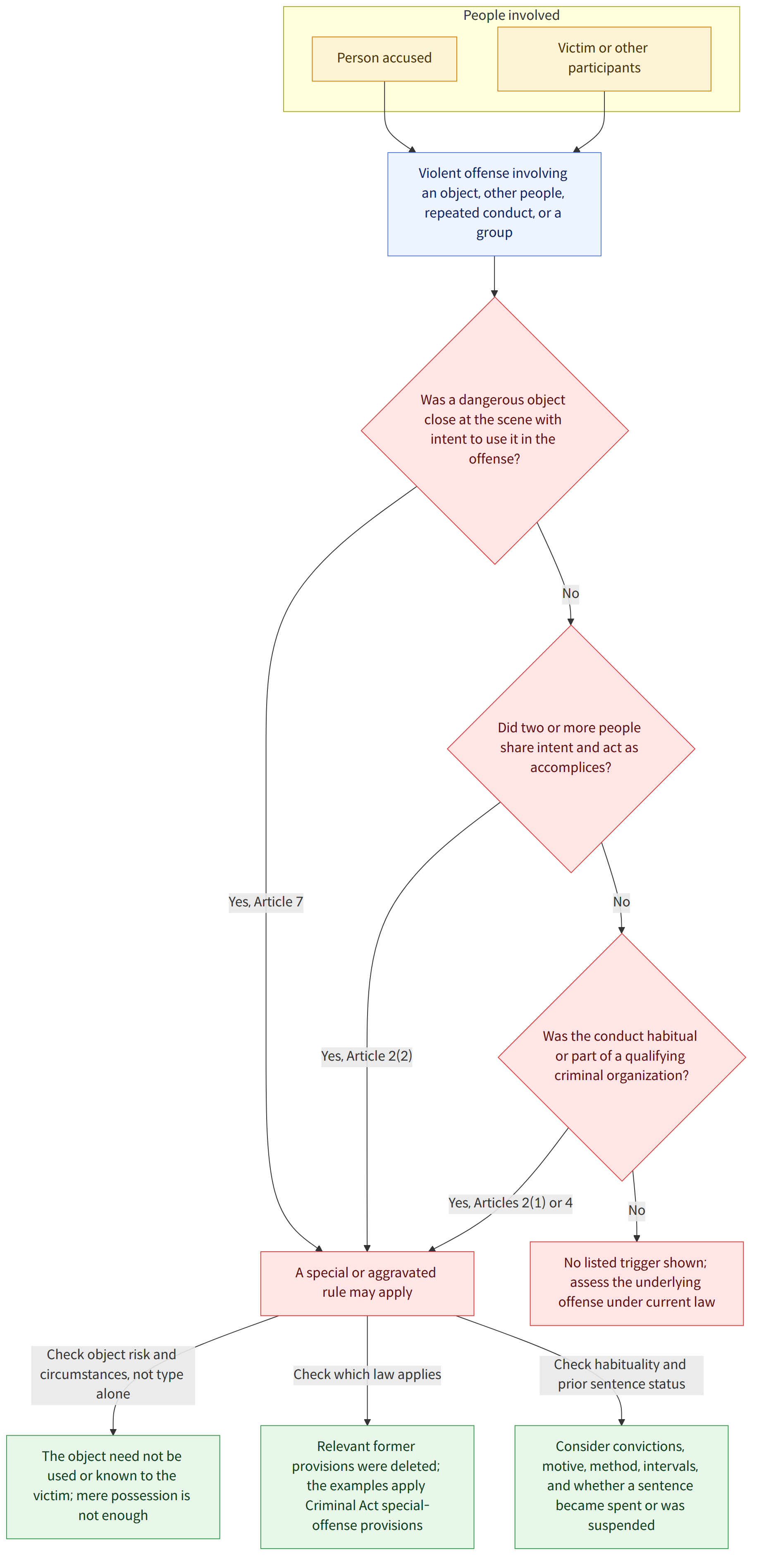
Key points
- Carrying a dangerous object means possessing it on one’s person or close at hand at the scene of an offense with the intent to use it in committing the offense. Merely storing it inside one’s home does not constitute carrying it (Act on the Punishment of Acts of Violence, etc., Article 7 (폭력행위 등 처벌에 관한 법률 제7조), Cases 2, 15, and 16).
- A dangerous object need not actually be used, nor must the victim be aware of it, for carrying it to be established. However, the mere fact that a person possessed an object does not give rise to a presumption that it could be used to commit a violent crime (Act on the Punishment of Acts of Violence, etc., Article 7 (폭력행위 등 처벌에 관한 법률 제7조), Cases 2 and 10).
- Whether an object is dangerous is not determined solely by its type. The question is whether, given the specific manner of use and circumstances, the other person or a third party could feel that their life or body was at risk (Cases 4 and 9).
- A joint offense by two or more people requires an accomplice relationship and a shared intent to carry out the offense. Even without an explicit prior agreement, a joint offense may be established if a sequential or tacit agreement of intent is supported by circumstantial evidence (Act on the Punishment of Acts of Violence, etc., Article 2(2) (폭력행위 등 처벌에 관한 법률 제2조 제2항), Case 6).
- A criminal organization is a group of people continuously associated for a criminal purpose. If it has at least a minimal command structure, it need not necessarily have a name, code, or membership ceremony. Simply taking over the leadership of an existing organization does not mean that a new criminal organization has been formed (Act on the Punishment of Acts of Violence, etc., Article 4 (폭력행위 등 처벌에 관한 법률 제4조), Cases 3 and 7).
- Habituality is not limited to repeated commission of the same type of crime; it may refer to a propensity spanning the violent crimes listed in the law. Habituality is determined by considering various circumstances, including prior convictions, motive, method, and intervals between offenses. Multiple types of habitual offenses may also constitute a single comprehensive offense (Act on the Punishment of Acts of Violence, etc., Article 2(1) (폭력행위 등 처벌에 관한 법률 제2조 제1항), Cases 5 and 12).
- When a sentence becomes spent, the legal effects of the sentence are extinguished prospectively. As a result, the prior conviction may not fall within the “case of having received a sentence of imprisonment” requirement for aggravated punishment discussed in the example. However, specific circumstances, including whether a suspended sentence was revoked or annulled, should also be checked (Act on the Punishment of Acts of Violence, etc., Article 2(3) (폭력행위 등 처벌에 관한 법률 제2조 제3항), Case 1).
- Even in cases involving assault, intimidation, or destruction of property while carrying a dangerous object that were previously governed by provisions of the Act on the Punishment of Acts of Violence, etc., the special-offense provisions of the Criminal Act described in the examples apply after the relevant provisions were held unconstitutional and deleted (Cases 4, 8, 9, 10, and 14).
Frequently asked questions
Q. Can I be punished even if I did not actually use the weapon in the offense or the victim did not know about it?
If a person carries or keeps a dangerous object, such as a weapon, at the scene of an offense with the intent to use it in committing the offense, this may constitute carrying the object even if the victim did not know about it or the object was not actually used. However, this does not include cases where the person happened to possess the object for reasons unrelated to the offense.
Q. Can I be punished for keeping a knife in my car to protect myself or my family?
The examples explain that carrying, without a justifiable reason, a weapon that could be used to commit a violent crime may constitute the offense of carrying a weapon, even if the person claims they intended to protect themselves or their family. The mere fact that someone possessed a dangerous object does not automatically establish that it could be used to commit a crime; the purpose for carrying it and the surrounding circumstances must be examined.
Q. Does merely storing a dangerous object at home count as “carrying” it?
The mere fact that a person stored a dangerous object in a place where they live does not constitute “carrying” as described in the examples. Carrying refers to possessing an object on one’s person or close at hand at the scene of an offense with the intent to use it there.
Q. Can a car or a fire extinguisher be considered a dangerous object?
Whether an object is dangerous is determined in light of generally accepted social standards, based on whether its actual manner of use and the circumstances could cause a person to feel that their life or body was at risk. A car may be a dangerous object if used to harm a person or damage property. However, in a case involving someone throwing a fire extinguisher, the court considered various circumstances, including that it was not aimed at a particular person and no one was injured, and found that special assault was unlikely to be established.
Q. If several people commit an assault at the same place, are they all punished for a joint offense?
Being at the same place is not, by itself, enough to establish a joint offense. There must be an accomplice relationship in which the people are aware of and take advantage of one another’s offenses, as well as a shared intent to carry out the crime. A claim that there was no prior agreement can also be assessed based on circumstantial evidence and other facts.
Q. Does a criminal organization need to have a name or hold a membership ceremony?
It is not essential for a criminal organization to have a clearly established name or code, or to hold a founding or membership ceremony. What matters is whether people have formed an ongoing association for the purpose of committing crimes and whether it has at least a minimal command structure to maintain order.
Q. Does a change in the leader of an existing organization mean that a new criminal organization has been formed?
A change in the leader or a more active operation of the organization does not, by itself, establish that a new organization has been formed. The existing organization must have been dissolved and then rebuilt, or have changed so completely through separation, absorption, merger, or similar developments that the resulting organization is a separate entity no longer identical to the original one.
Q. If a past sentence of imprisonment becomes spent, will it still count toward aggravated punishment under the Act on the Punishment of Acts of Violence, etc.?
The example explains that once a sentence has become spent, the prior conviction can no longer be considered a case of having “received a sentence of imprisonment” under the relevant aggravated-punishment provision. However, the outcome may depend on specific circumstances, such as whether the suspended sentence was revoked or annulled.
Q. Is assault involving the carrying of a dangerous object still subject to aggravated punishment under the Act on the Punishment of Acts of Violence, etc.?
According to the examples, Article 3(1) of the Act on the Punishment of Acts of Violence, etc., which previously applied to assaults involving the carrying of dangerous objects, was deleted following a decision that it was unconstitutional. The examples explain that the relevant provisions of the Criminal Act, such as those on special assault, special intimidation, and special destruction of property, apply instead. The date of the incident and the specific type of offense must therefore be checked.
Relevant laws
- Act on the Punishment of Acts of Violence, etc., Article 2(1) (폭력행위 등 처벌에 관한 법률 제2조 제1항)
- Act on the Punishment of Acts of Violence, etc., Article 2(2) (폭력행위 등 처벌에 관한 법률 제2조 제2항)
- Act on the Punishment of Acts of Violence, etc., Article 2(3) (폭력행위 등 처벌에 관한 법률 제2조 제3항)
- Act on the Punishment of Acts of Violence, etc., Article 3(1) (폭력행위 등 처벌에 관한 법률 제3조 제1항)
- Act on the Punishment of Acts of Violence, etc., Article 3(4) (폭력행위 등 처벌에 관한 법률 제3조 제4항)
- Act on the Punishment of Acts of Violence, etc., Article 4 (폭력행위 등 처벌에 관한 법률 제4조)
- Act on the Punishment of Acts of Violence, etc., Article 7 (폭력행위 등 처벌에 관한 법률 제7조)
- Criminal Act, Article 35 (형법 제35조)
- Criminal Act, Article 260(1) (형법 제260조 제1항)
- Criminal Act, Article 261 (형법 제261조)
- Criminal Act, Article 283(1) (형법 제283조 제1항)
- Criminal Act, Article 320 (형법 제320조)
- Criminal Act, Article 366 (형법 제366조)
- Criminal Act, Article 369(1) (형법 제369조 제1항)
- Act on the Lapse of Criminal Sentences, Article 7(1)(2) (형의 실효 등에 관한 법률 제7조 제1항 제2호)
Watch out for
- Whether an object is dangerous and whether it was carried should not be determined solely by the type of object. The specific circumstances, including the purpose for possessing it, its location, and how it was used, must also be considered.
- The examples explain that some aggravated-punishment provisions of the Act on the Punishment of Acts of Violence, etc. were deleted after being held unconstitutional. Check when the incident occurred to avoid confusing former provisions with the Criminal Act provisions that apply today.
- Whether a prior conviction counts toward aggravated punishment may depend not only on whether the sentence has become spent but also on individual circumstances, such as whether a suspended sentence was revoked or annulled.
- The conclusions in the examples are based on the facts presented. In an actual case, the outcome may differ depending on specific details, such as the circumstances of the offense and the evidence.
Source cases
This guide was compiled by AI from the following Korea Legal Aid Corporation consultation cases (in Korean).
- 형이 실효된 경우, 그 전과를 폭력행위 등 처벌에 관한 법률 제2조 제3항의 ‘징역형을 받은 경우’라고 할 수 있는지
- 자신 및 가족을 지키기 위하여 사시미칼 등을 휴대하는 경우에도 폭력행위 등 처벌에 관한 법률 제7조에 해당되는지 여부
- 폭력행위 등 처벌에 관한 법률 제4조의 ‘범죄단체’의 의미
- 경륜장 사무실에서 술에 취해 소란을 피우면서 ‘소화기’를 집어던진 경우 특수폭행죄가 성립하는지
- 폭력행위 등 처벌에 관한 법률 제2조 제1항에서 정한 ‘상습’의 의미 및 상습성 유무를 판단하는 기준
- 폭력행위 등 처벌에 관한 법률 제2조 제2항에서 정한 ‘2인 이상이 공동하여 상해 또는 폭행의 죄를 범한 때’의 의미
- 기존의 범죄단체를 이용하여 새로운 범죄단체를 구성하였다고 하기 위한 요건
- 수인이 흉기를 휴대하여 타인의 건조물에 침입하기로 공모한 후 일부만이 건조물에 들어간 경우, 특수주거침입죄에 해당하는지
- 자동차가 '위험한 물건'에 해당하는지
- 범행 현장에서 범행에 사용하려는 의도로 흉기 등 위험한 물건을 소지하거나 몸에 지닌 경우에도 위험한 물건의 “휴대”에 해당하는...
- ‘다중의 위력’의 의미
- ‘상습성’을 구성하는 범죄행위의 범위 및 상습폭력범죄의 죄수 관계
- 폭력행위 등 처벌에 관한 법률 제3조 제4항에 의한 가중처벌 규정 및 형법상 누범 규정의 중복 적용 여부
- 흉기 기타 위험한 물건을 휴대하여 형법상 폭행죄, 협박죄, 재물손괴죄를 범한 경우 폭력행위 등 처벌에 관한 법률이 적용되는지
- 우범자의 기준
- 위험한 물건을 자기가 기거하는 장소에 보관한 것만으로 폭력행위등처벌에관한법률 제7조 소정의 위험한 물건의 “휴대”에 해당하는지...
This guide is general legal information about Korean law, not legal advice for your situation. For a specific case, consult a lawyer or the Korea Legal Aid Corporation (call 132 in Korea).