
Guide to Compensation for Illegal Private Lending and Voice Phishing
Based on 27 consultation cases · Updated · Translated from the Korean original.
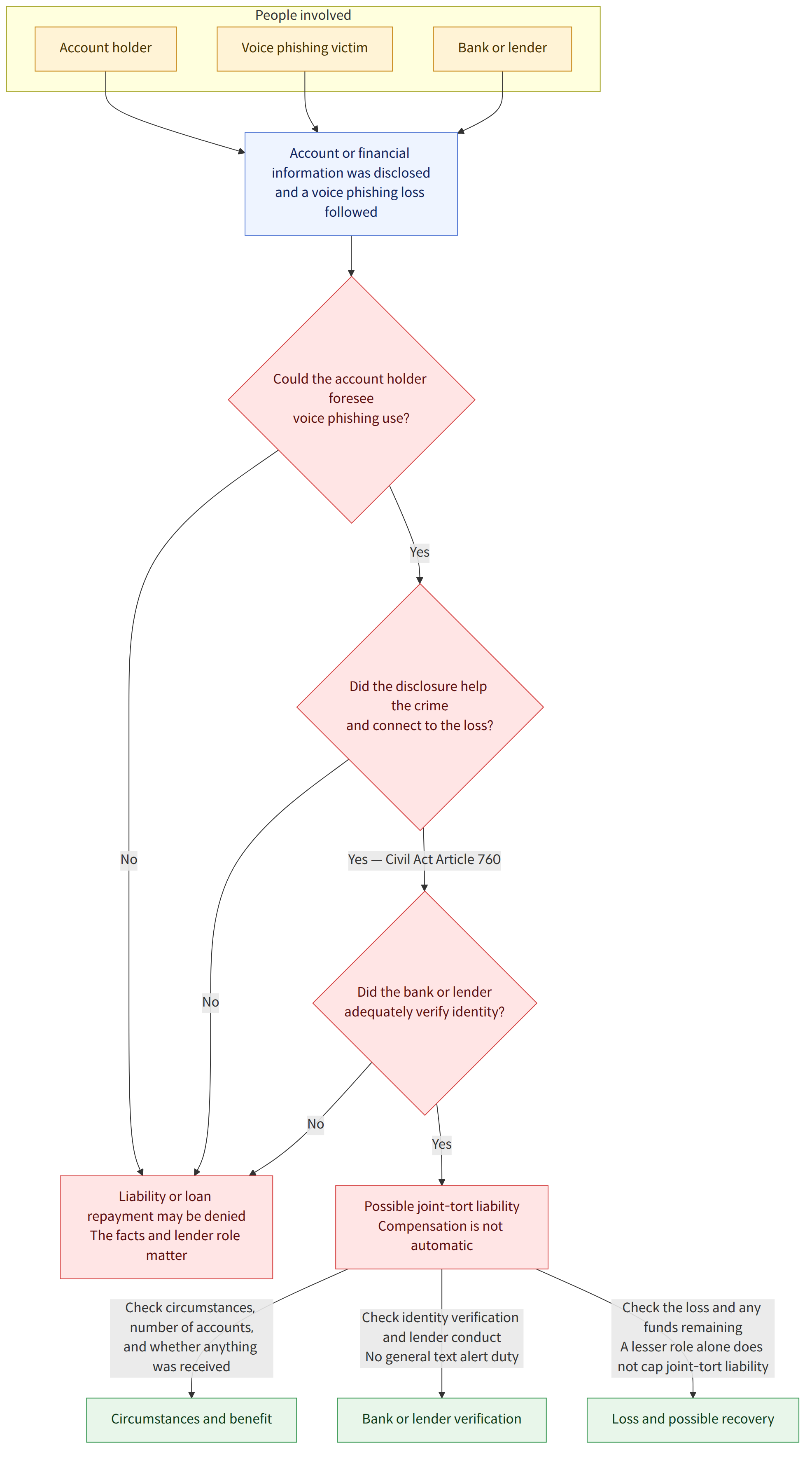
Providing a bankbook or personal information used in voice phishing does not always mean that you must compensate victims for the entire amount of their losses. Liability is assessed by considering the circumstances at the time of disclosure, whether the crime could have been foreseen, whether there is a causal connection between the conduct and the loss, and whether the financial institution failed to verify identity.
At a glance
Key points
- When someone is tricked into handing over a bankbook, card, or password, civil liability for damages is assessed by examining whether they could have foreseen the voice-phishing crime, the circumstances in which they provided it, and whether they received anything in return (Cases 3 and 14).
- Even if the person who provided the bankbook did not actively participate in the crime, they may be held liable for a joint tort if they could have foreseen that it might be used for voice phishing and made the crime easier (Civil Act, Article 760 (민법 제760조); Case 22).
- Conversely, liability may be denied if it cannot be concluded that the person foresaw the crime—for example, because they provided only one bankbook and received nothing in return—or if an adequate causal connection between their conduct and the loss is not established (Case 14).
- If a loan is issued after someone is tricked into entering financial information for voice phishing, that fact alone does not make the account holder a party to the loan agreement. Whether the financial institution adequately verified identity is among the factors considered when determining the agreement’s effect (Case 5).
- A person who exposed financial information may be found to have been grossly negligent, but any failure by the lender or financial institution to verify identity that also contributed to the loss is considered in assessing liability (Cases 2 and 11).
- There is also a court ruling that financial institutions do not have a general duty of care to notify customers by text message when a digital certificate is reissued. A financial institution’s liability depends on the specific circumstances, including the type of incident and the verification procedures used (Case 15).
- A claim against the bankbook holder for the entire amount lost as unjust enrichment may not be recognized. However, there is a case in which a claim for the return of the remaining amount was recognized because the lost funds remained in the account and the account holder had a claim against the bank for repayment of the deposit (Cases 10 and 25).
- There is a court ruling that, once a joint tort is established, liability to the victim cannot be limited to part of the loss solely because the person’s role was less significant. However, whether liability is established and how damages are assessed must be examined separately in each case (Civil Act, Article 760 (민법 제760조); Case 18).
Frequently asked questions
Q. I handed over my bankbook and card after being promised a job or a loan. Do I have to compensate victims for their voice-phishing losses?
Compensation is not automatic. Liability is assessed by considering whether, when handing over the account, you could have foreseen that it would be used for voice phishing, whether you received anything in return, how many accounts you provided, and the circumstances in which you provided them. If you provided the account despite being able to sufficiently foresee that it might be used in a crime, you may be held liable for a joint tort.
Q. I was tricked into entering personal and financial information for a voice-phishing scheme. Do I have to repay a loan taken out in my name?
If the account holder did not apply for the loan personally or authorize someone else to act on their behalf, a loan agreement made using stolen information may be found to have no effect on the account holder. Factors considered include whether the lender adequately verified the applicant’s identity and whether there were suspicious aspects to the application information.
Q. Does my own fault in disclosing financial information absolve the bank or lender of liability?
That cannot be stated categorically. A financial information provider’s failure to exercise due care and a financial institution’s failure to verify identity may both be at issue. In one case, a financial institution was found to have contributed to the loss by failing to check for irregularities in the loan application information.
Q. Can I claim compensation if the bank did not notify me by text when my digital certificate was reissued?
There is a court ruling that financial institutions do not have a general duty of care to notify customers by text message or other means when a digital certificate is reissued. The ruling also took into account, among other things, that the user had not signed up for a separate security text-message service.
Q. Can I claim the entire amount lost to voice phishing from the bankbook holder as unjust enrichment?
The fact that a victim sent money through a transaction with a fraudster does not, by itself, mean that the victim can directly claim the entire loss from the bankbook holder. It must be examined whether the bankbook holder obtained a benefit directly from the victim without legal cause.
Q. If some of the lost money remains in the account, can I demand that the bankbook holder return it?
There is a case in which a claim for the return of unjust enrichment was recognized for the amount remaining in an account, where the victim’s funds remained in the account and the bankbook holder had a claim against the bank for repayment of that deposit. This is distinct from a claim for the entire amount lost.
Q. Can someone who exchanged money obtained through voice phishing also be liable for damages?
Even if someone did not actively participate in the crime, they may be held liable for negligently assisting it if they accepted a currency exchange request from someone whose identity they did not know well and could have foreseen that the money might be used in a crime. In the case, however, liability was limited after taking into account, among other things, that the victim had transferred a large sum without making meaningful checks on the other person’s identity.
Q. Can I face criminal punishment even if I did not know the bankbook would be used for voice phishing?
A case explains that transferring an access medium used for electronic financial transactions is prohibited, and that the act of transferring it may itself be punishable even if the person did not know the specific purpose for which it would be used. Criminal liability and civil liability to victims for damages are assessed separately.
Q. Will my compensation amount be reduced if my role in the voice-phishing organization was minor?
There is a court ruling that, once a joint tort is established, liability to the victim cannot be limited to part of the loss solely because the person’s role was less significant than that of the other accomplices. Whether liability for a joint tort is established in the first place must still be determined based on the specific circumstances.
Relevant laws
- Civil Act, Article 760 (민법 제760조)
- Electronic Financial Transactions Act, Article 6(3), subparagraph 1 (전자금융거래법 제6조제3항제1호)
- Electronic Financial Transactions Act, Article 9(2) and (3) (전자금융거래법 제9조제2항·제3항)
- Electronic Financial Transactions Act, Article 49(4), subparagraph 1 (전자금융거래법 제49조제4항제1호)
- Electronic Signature Act, Article 15 (전자서명법 제15조)
- Electronic Signature Act, Article 18-2 (전자서명법 제18조의2)
- Electronic Signature Act, Article 23 (전자서명법 제23조)
Watch out for
- Civil liability is neither automatically established nor automatically ruled out merely because you provided a bankbook or exposed financial information. The circumstances of disclosure, whether anything was received in return, foreseeability, and the causal connection to the loss are important.
- A claim for damages against a bankbook holder and a claim for the return of unjust enrichment may have different requirements and cover different amounts. It is also necessary to distinguish whether any of the lost money remains in the account and what benefit the account holder actually obtained.
- A financial institution’s responsibility to verify identity or duty to provide text-message notifications is not assessed uniformly in every incident. The outcome in each case described depends on that case’s specific facts.
Source cases
This guide was compiled by AI from the following Korea Legal Aid Corporation consultation cases (in Korean).
- 면책된 채무에 대하여 변제를 요구하는 행위가 불법행위로 인정되는지 여부
- 보이스피싱으로 인해 제공된 개인정보로 인해 대출이 된 경우 명의자가 대출업자에 대해 손해배상책임을 지는지 여부
- 보이스피싱에 사용된 통장명의자의 법적 책임
- 유흥업소 여종업원의 대출약정의 유효성
- 보이스피싱으로 인해 제공된 개인정보로 인해 대출이 된 경우 명의자에 대해 대출계약의 효력이 발생하는지 여부
- 보이스피싱에서 은행의 책임이 부정된 사례
- 보이스피싱 공동불법행위자로 손해배상책임을 진 사례
- 이자의 최고한도
- 착오송금의 송금인이 수취은행대하여 부당이득반환을 청구할 수 있는지 여부
- 보이스피싱에 속아 통장에 입금한 자가 통장 명의자를 상대로 하여 피해금액 전체 부당이득반환 인정 여부
- 전자금융거래법 제9조 제2항에서 정한 ‘이용자의 고의나 중대한 과실’이 인정된 사례
- 과도한 이자약정에 따라 지급한 이자를 반환받을 수 있는지
- 채무자가 채권추심비용을 지급해야 하는지 여부
- 보이스피싱에 사용된 통장의 명의자가 불법행위 손해배상책임을 지지 아니하는 경우
- 은행이 공인인증서 재발급에 있어 이용자에게 이를 문자메세지 등을 이용하여 통지할 주의의무가 있는지 여부
- 허위 금융거래확인서 발급이 불법행위에 해당하는지 여부
- 채권추심행위로 피해를 입은 경우에 손해배상청구가 가능한지 여부
- 보이스피싱 가담자의 불법행위 책임의 범위
- 복리 이자약정에 대하여도 이자제한법이 적용되는지 여부
- 이자제한법 시행 전의 금전소비대차계약에도 이자제한법이 적용되는지 여부
- 여러 명의 채권자가 채무이행을 독촉하는 경우 채무자가 채무를 변제하는 방법
- 보이스피싱에 사용된 통장을 제공한 사람들에 대하여 공동불법행위가 인정되는지
- 금전을 대여하면서 선이자를 공제한 경우, 이자제한법 적용여부
- 모든 금전소비대차계약에 이자제한법이 적용되는지 여부
- 보이스피싱에 속아 통장에 입금한 자가 통장 명의자를 상대로 하여 피해금액 중 통장에 남아있는 금액에 대한 부당이득반환 인정 여...
This guide is general legal information about Korean law, not legal advice for your situation. For a specific case, consult a lawyer or the Korea Legal Aid Corporation (call 132 in Korea).