
Guide to Claims for Wages and Severance Pay and Their Calculation
Based on 138 consultation cases · Updated · Translated from the Korean original.
As a general rule, the right to severance pay arises when employment ends, and an agreement stating that severance pay is included in wages does not, by itself, eliminate the obligation to pay it. Severance pay and overtime, night-work, and holiday-work pay are calculated according to the substance of the employment relationship and wages and the applicable rules, so you should review your contract and pay records together.
At a glance
Key points
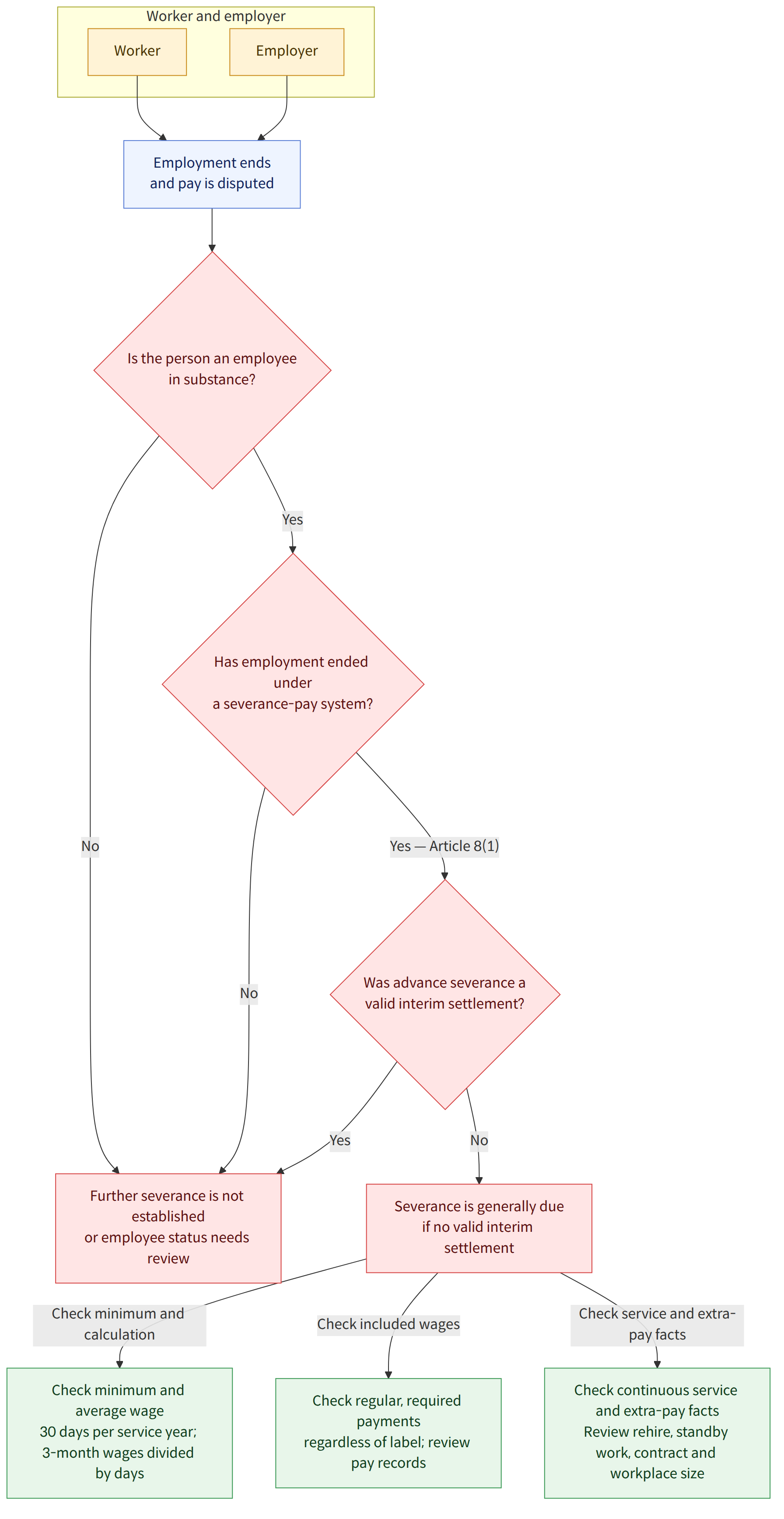
- Where a severance-pay system has been established, the statutory minimum is at least 30 days' average wages for each year of continuous service (Employee Retirement Benefit Security Act, Article 8(1) (근로자퇴직급여 보장법 제8조 제1항)).
- An agreement to pay in advance, as part of monthly wages, money described as severance pay is not effective as payment of severance pay unless it qualifies as a valid interim settlement (Supreme Court en banc Decision, May 20, 2010, Case No. 2007Da90760).
- Average wage is calculated by dividing the total wages paid during the three months before the event giving rise to the calculation, such as separation from employment, by the total number of days in that period. Payments made continuously and regularly that the employer is obligated to pay may be included regardless of their label (Labor Standards Act, Article 2(1)(6) (근로기준법 제2조 제1항 제6호)).
- Even during standby duty, pay may be due for work performed if regular duties continued or the work was similar to ordinary work. The actual nature and intensity of the work must be considered (Supreme Court Decision, January 12, 1995, Case No. 93Da46254).
- Overtime, night-work, and holiday-work pay may depend on the size of the workplace, the form of work, and the terms of the contract. Whether an inclusive wage agreement applies is determined by examining the wage components and calculation method in the contract, the nature of the work, and other relevant factors.
- Even if there was a formal resignation and rehire, the period of continuous service may not be interrupted if this was done under company policy and the employment relationship continued in substance (Supreme Court Decision, May 10, 1988, Case No. 87Daka2578).
- As a general rule, an employer may not unilaterally deduct a loan or other debt from wages. An exception may be at issue where the employee's consent was given of their own free will, among other circumstances (Labor Standards Act, Article 43 (근로기준법 제43조)).
- Whether someone is an employee is not determined solely by the label “freelance contract.” The actual relationship must be assessed as a whole, including the employer's direction and supervision of the work, the nature of the compensation, and the continuity of the relationship (Supreme Court Decision, February 9, 1999, Case No. 97Da56235).
Frequently asked questions
Q. Can I claim severance pay even if my annual salary is said to include it?
An agreement stating that an amount for severance pay is included in the monthly or annual salary is generally not, by itself, recognized as payment of severance pay. However, a separate issue may arise as to the return or setoff of amounts actually paid as severance pay, so the circumstances of payment and the terms of the agreement should be reviewed together.
Q. What wages are used to calculate severance pay?
Basically, severance pay is calculated using the average wage, determined by dividing the total wages paid during the three months before the event giving rise to separation by the total number of days in that period. Meal allowances and family allowances may also be included if they are paid continuously and regularly and the employer is obligated to pay them, while discretionary and uncertain special bonuses may be excluded.
Q. Can I receive additional pay for overnight standby duty or work on a holiday?
Not all hours worked while on standby duty count as overtime merely because the duty is called standby duty. If you perform your regular duties while on standby, or if the nature and intensity of the work are similar to those of ordinary work, you may claim overtime, night-work, or holiday-work pay for that work.
Q. How long do I have to claim overtime pay?
According to the case described, you may claim overtime pay that is not time-barred; the period given is three years. To determine whether this applies and calculate the amount, it is advisable to review your working hours, pay statements, employment contract, and other relevant records.
Q. What happens to my separation date and severance pay calculation if my employer delays accepting my resignation?
The separation date may depend on whether the resignation was accepted and on any special provisions in the employment contract or work rules. The case explains that, in certain circumstances, the resignation takes effect after the notice period under the Civil Act has elapsed. However, in exceptional cases where unpaid time immediately before separation or similar circumstances have caused the average wage to fall substantially below the ordinary wage for living expenses, the average wage may be calculated using another reasonable method.
Q. Does my period of service continue if I was rehired immediately after resigning or transferred to an affiliate?
If you formally resigned and were rehired in accordance with company policy, and the employment relationship did not actually break, your period of service may continue without interruption. By contrast, if you freely consented to a transfer and there is no agreement or rule providing that your service period will be aggregated, your period of service with the former company may not be counted toward the total.
Q. If I have a freelance contract and have not been paid, can I make a claim under labor law?
Even if a contract describes you as a freelancer, you may be recognized as an employee under the Labor Standards Act if, in reality, you worked in a subordinate relationship for the purpose of earning wages. The overall circumstances must be considered, including direction and supervision, the way the work was performed, the nature of the compensation, and the continuity of the working relationship. If you are not recognized as an employee, a civil claim under the contract may be at issue.
Q. Can my employer deduct money it lent me from my wages or severance pay?
As a general rule, an employer may not unilaterally deduct wages to recover a debt owed to the employer, such as a loan. An exception may apply if the employee consented to the setoff of their own free will, but whether the consent was voluntary must be examined strictly.
Relevant laws
- Labor Standards Act, Article 2(1)(6) (근로기준법 제2조 제1항 제6호)
- Labor Standards Act, Article 11 (근로기준법 제11조)
- Labor Standards Act, Article 21 (근로기준법 제21조)
- Labor Standards Act, Article 34 (근로기준법 제34조)
- Labor Standards Act, Article 36 (근로기준법 제36조)
- Labor Standards Act, Article 38 (근로기준법 제38조)
- Labor Standards Act, Article 43 (근로기준법 제43조)
- Labor Standards Act, Article 49 (근로기준법 제49조)
- Labor Standards Act, Article 50 (근로기준법 제50조)
- Labor Standards Act, Article 53 (근로기준법 제53조)
- Labor Standards Act, Article 56 (근로기준법 제56조)
- Labor Standards Act, Article 94 (근로기준법 제94조)
- Employee Retirement Benefit Security Act, Article 4 (근로자퇴직급여 보장법 제4조)
- Employee Retirement Benefit Security Act, Article 8 (근로자퇴직급여 보장법 제8조)
- Employee Retirement Benefit Security Act, Article 10 (근로자퇴직급여 보장법 제10조)
Watch out for
- The cases give a three-year period for claims for severance pay and overtime pay, running from the separation date or in connection with the wage claim, respectively. It is advisable not to delay making a claim.
- Whether severance pay applies and the period used in calculating it may depend on factors such as the period of continuous service, the prescribed weekly working hours, the number of employees at the workplace, and the applicable dates.
- Amounts already received as severance pay may raise issues of repayment or setoff depending on the substance of the agreement; you should also consider the extent to which setoff against a severance-pay claim is restricted.
- A company's severance-pay rules may be more favorable than the statutory standard, so compare the statutory minimum with the amount payable under the work rules or collective agreement.
Related articles
- Financial Lifelines: Can You Access Your Pension Before Retirement for a Family Emergency?
- The Union's Promise vs. Your Paycheck: Can a Company Delay Your Severance?
- The 'Hidden' Math of Severance: When Your Company Excludes Allowances from Your Final Pay
- When the Agency Changes: Does Your Job Travel with the Mission?
- The Untouchable Nest Egg: Can Your Creditors Seize Your Retirement Pension?
- From Employee to Executive: When Does the Clock Start Ticking on Your Severance Pay?
Source cases
This guide was compiled by AI from the following Korea Legal Aid Corporation consultation cases (in Korean).
- 연봉제 근로계약에 있어서 퇴직금을 별도로 청구할 수 있는지
- 퇴직금의 산정기준과 방법
- 당직근무가 시간외 근로에 해당되는지
- 근로자의 동의를 얻어 임금채권에 대하여 상계하기로 한 약정의 효력
- 형식적인 근로관계의 단절 있을 때의 퇴직금산정기간
- 불합격 후 추가 채용되면서 그 사이 변경된 퇴직금규정 적용 시 정당한지
- 회사합병으로 퇴직금이 누진제에서 단수제로 변경된 경우
- 퇴직금지급규정이 적용되는 사업장의 범위
- 퇴직연금
- 사직서 수리를 고의로 지연한 경우 퇴직시기 및 퇴직금산정기준
- 동일회사내 계열사로 전적되면서 퇴직금 수령 시 퇴직금산정기간
- 특근수당의 산정
- 초과근무를 했을 경우 초과근무수당의 청구가 가능한지
- 퇴직금 산정에 있어서 일부수당이 제외된 경우 위법인지
- 퇴직금 배제 약정의 효력
- 연장근로수당 등
- 퇴직 후 소급 적용 된 임금인상의 효력이 퇴직자에게도 미치는지
- 근로자의 요구로 퇴직금을 중간정산한 경우 퇴직금 정산방법
- 평균임금에 특별상여금의 포함될 수 있는지의 여부
- 프리랜서의 임금체불
- 회생절차가 개시된 회사에 대한 임금 등 청구 가능 여부
- 퇴직금 분할약정 유효 여부
- 퇴직금 분할약정이 무효인 경우 근로자가 반환할 부당이득채권과 지급받을 퇴직금을 상계할 수 있는지 여부
- 최저임금제도
- 회사채권으로 자기회사 직원의 임금채권에 압류를 할 수 있는지
This guide is general legal information about Korean law, not legal advice for your situation. For a specific case, consult a lawyer or the Korea Legal Aid Corporation (call 132 in Korea).