
Guide to Recognition Criteria and Compensation for Work-Related Accidents
Based on 30 consultation cases · Updated · Translated from the Korean original.
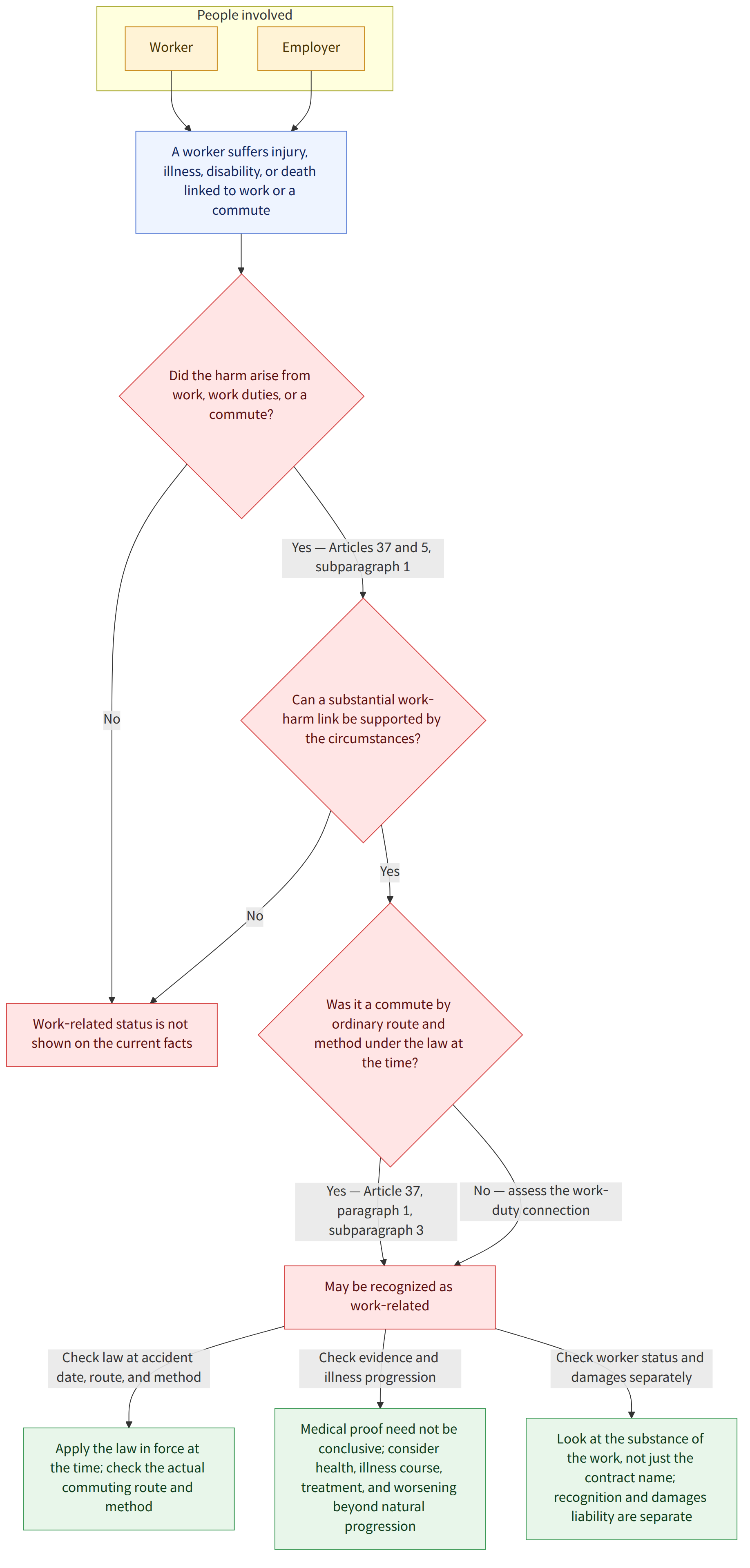
For an accident to be recognized as work-related, there must be a substantial causal relationship between the work and the injury, illness, disability, or death. The causal relationship does not have to be conclusively established on medical grounds. Commuting accidents and the worsening of pre-existing illnesses must be considered in light of the law in force at the time of the accident and the specific circumstances.
At a glance
Key points
- A work-related accident means an injury, illness, disability, or death arising from work while performing work duties, and requires a substantial causal relationship between the work and the accident (Industrial Accident Compensation Insurance Act, Article 37 and Article 5, subparagraph 1 (산업재해보상보험법 제37조, 제5조 제1호)).
- The causal relationship does not have to be conclusively established on medical or natural-scientific grounds; it may be inferred from various circumstances, including the person’s health, how the illness developed, and the course of treatment (cases 9, 10, and 25).
- For commuting accidents, whether the employer exercised control and management was important under the former law discussed in the cases. Since January 1, 2018, however, accidents occurring while commuting by the ordinary route and method have also been classified as work-related accidents (Industrial Accident Compensation Insurance Act, Article 37, paragraph 1, subparagraph 3 (산업재해보상보험법 제37조 제1항 제3호)).
- A pre-existing illness may still qualify as work-related if a work-related accident or excessive work demands cause it to worsen beyond the rate of natural progression or cause symptoms to manifest (cases 10 and 25).
- If a mental illness is worsened by work-related stress and the person dies by suicide while their capacity for normal judgment is significantly impaired, a substantial causal relationship between the work and death may be recognized (cases 11 and 18).
- Whether someone qualifies as a worker is not determined solely by the name of the contract. The substance of the work may be examined, including direction and supervision, restrictions on working hours and location, the nature of the remuneration, and exclusivity (cases 7 and 17).
- A prosthesis damaged for work-related reasons may qualify as an injury eligible for medical care benefits. Where a work-related injury worsens an existing disability, the assessment is not determined solely by whether that pre-existing disability arose from a work-related accident (cases 14 and 21).
- Recognition of a work-related accident and an employer’s or other party’s liability for damages are separate issues. In an accident involving a dispatched worker, a lower-court case held that the dispatching employer may also be liable for damages if the user employer or another relevant party was negligent (case 23).
Frequently asked questions
Q. Can an accident be recognized as work-related even if it happens while I am commuting to work in my own car by my usual route?
The amended law that took effect on January 1, 2018, as discussed in the case, classified accidents occurring while commuting by the ordinary route and method as commuting-related accidents. However, the law in force at the time of the accident, the actual route and method of travel, and the connection between the work and the accident must be examined.
Q. Must I conclusively prove medically that my work caused my illness to have it recognized as work-related?
It does not have to be conclusively proven on medical or natural-scientific grounds. The claim may also be considered proven where a substantial causal relationship can be inferred from various circumstances, including the person’s health when they began working, how the illness developed, the nature of the illness, and the course of treatment.
Q. Can my illness qualify as work-related if I already had it and it got worse because of my work?
Even if you had a pre-existing illness, it may qualify as a work-related accident if an accident connected with your work or the demands of your job worsened it beyond the rate of natural progression or caused symptoms to manifest. The condition of the pre-existing illness, the nature of the work, and how the condition worsened should all be considered.
Q. Can a suicide following depression caused by work-related stress be recognized as work-related?
A substantial causal relationship between the work and the death may be recognized if work-related stress worsened depression and the person died by suicide while their capacity for normal perception and choice of action, or their mental self-control, was significantly impaired. One case held that this conclusion would not change merely because personal vulnerability contributed to the outcome or because there were no psychotic symptoms immediately before the suicide.
Q. Can quick-service delivery drivers or insurance solicitors qualify as workers under workers’ compensation insurance?
A person may be recognized as a worker depending on the substance of their work. The specific circumstances must be considered, including direction and supervision of the work, restrictions on working hours and location, the nature of the remuneration, and whether the work was exclusive. The cases found that quick-service delivery drivers and insurance solicitors selling insurance by phone could qualify as workers.
Q. Can I receive medical care benefits if my prosthetic leg was damaged in a fall at work?
One case held that a prosthesis damaged for work-related reasons falls within the injuries to a worker eligible for medical care benefits, taking into account that a prosthesis functionally, physically, and practically replaces a leg. Whether benefits are actually available depends on the specific circumstances, including whether the accident occurred for work-related reasons.
Q. What happens if a work-related injury worsens a pre-existing disability in the same part of my body?
The precedent discussed in the case interpreted the relevant provision as covering situations where a work-related injury worsened the degree of a disability in the same part of the body, regardless of whether the pre-existing disability resulted from a work-related accident. The scope and availability of disability benefits depend on the specific disability and the relevant provisions.
Q. Can I continue receiving medical care benefits if I am being treated only to prevent my symptoms from getting worse?
The precedent discussed in the case held that grounds for concluding treatment may exist where treatment is needed only to prevent fixed symptoms from worsening, rather than to improve the underlying condition. Whether treatment is intended to improve the symptoms and whether the symptoms have stabilized may be at issue.
Q. If a dispatched worker is injured and the user employer was negligent, must the dispatching employer also pay damages?
A lower-court decision discussed in the case held that a dispatching employer may be liable for damages even without direct negligence of its own if the user employer or another relevant party was negligent. This was the ruling in that particular case; actual liability depends on the circumstances of the accident and the status and fault of each party.
Relevant laws
- Industrial Accident Compensation Insurance Act, Article 5, subparagraph 1 (산업재해보상보험법 제5조 제1호)
- Industrial Accident Compensation Insurance Act, Article 5, subparagraph 4 (산업재해보상보험법 제5조 제4호)
- Industrial Accident Compensation Insurance Act, Article 5, subparagraph 8 (산업재해보상보험법 제5조 제8호)
- Industrial Accident Compensation Insurance Act, Article 6 (산업재해보상보험법 제6조)
- Industrial Accident Compensation Insurance Act, Article 37 (산업재해보상보험법 제37조)
- Industrial Accident Compensation Insurance Act, Article 40 (산업재해보상보험법 제40조)
- Industrial Accident Compensation Insurance Act, Article 51 (산업재해보상보험법 제51조)
- Industrial Accident Compensation Insurance Act, Article 57 (산업재해보상보험법 제57조)
- Industrial Accident Compensation Insurance Act, Article 77 (산업재해보상보험법 제77조)
- Enforcement Decree of the Industrial Accident Compensation Insurance Act, Article 29 (산업재해보상보험법 시행령 제29조)
- Enforcement Decree of the Industrial Accident Compensation Insurance Act, Article 36, subparagraph 2 (산업재해보상보험법 시행령 제36조 제2호)
- Enforcement Decree of the Industrial Accident Compensation Insurance Act, Article 53, paragraph 4 (산업재해보상보험법 시행령 제53조 제4항)
- Occupational Safety and Health Act on the Prevention of Industrial Accidents, Article 5 (산업재해예방에 관한 산업안전보건법 제5조)
- Act on the Protection, etc. of Dispatched Workers, Article 34 (파견근로자보호 등에 관한 법률 제34조)
- Act on the Protection, etc. of Dispatched Workers, Article 35, paragraph 2 (파견근로자보호 등에 관한 법률 제35조 제2항)
Watch out for
- The assessment of a commuting accident may vary depending on the law in force when the accident occurred. Do not apply a decision under former law in a past case directly to a current accident.
- Whether an accident is work-related is determined by considering the causal relationship between the work and the accident or illness, together with the specific facts. The outcome in a case does not necessarily apply in the same way to every similar accident.
- Eligibility for workers’ compensation benefits and liability for damages on the part of an employer or a third party are separate issues and should be considered separately.
Source cases
This guide was compiled by AI from the following Korea Legal Aid Corporation consultation cases (in Korean).
- 산업재해보상보험법 제37조 제1항 제1호 다목이 헌법상 평등원칙에 위배되지 여부
- 통상적인 일요일 당직근무를 위해 자기 소유의 승용차로 출근 중 사고로 사망한 경우 업무상 재해에 해당하는지 여부
- 구 산업재해보상보험법 제4조 제1호 에 정한 ‘업무상 재해’의 의미 및 근로자의 출·퇴근 중에 발생한 재해를 업무상 재해로 인...
- 퇴근하기 위하여 자전거를 타고 재직 중인 회사 내 도로를 지나던 중 급정거로 자전거와 함께 넘어지는 사고 발생하였는데, 이것이...
- 근로자가 사업주로부터 전근명령을 받고 자신의 승용차를 운전하고 신임지로 부임하던 도중 발생한 교통사고로 입은 재해가 업무상 재...
- 산업재해보상보험법 시행령 제29조 가 규정한 출퇴근 중의 사고가 산업재해보상보험법 제37조 제1항 제1호 (다)목 이 규정한 ...
- 오토바이 퀵서비스업체 배송기사가 노동관계법에 의한 보호를 받을 필요성이 있는 경우에는 근로자에 해당한다고 볼 수 있는지 여부
- 회사원이 자기 소유의 승용차를 운전하고 출근하던 도중 교통사고가 발생하여 재해를 당한 경우 업무상 재해에 해당하는지 여부
- 업무상 재해에 있어서 업무와 질병 또는 사망간의 인과관계에 관한 입증책임의 소재 및 입증의 정도
- 기존 질환이 자연적인 경과를 넘어서 급격히 악화되었다고 보아, 업무상 재해에 해당한다고 볼 수 있는지 여부
- 업무상 부담으로 중압감을 느낀 나머지 출근하였다가 자살한 사안에서, 업무와 사망 사이에 상당인과관계를 인정할 수 있는지 여부
- 노동조합 간부가 노동조합업무를 수행하던 중 재해를 입은 경우 업무상 재해에 해당하는지 여부
- 근로자가 사업주의 카풀권장책에 호응하여 자신의 승용차에 다른 근로자를 동승시켜 출근하다가 교통사고로 부상을 입은 경우
- 산업재해보상보험법 시행령 제53조 제4항 중‘이미 장해가 있던 사람’에서 말하는 ‘장해’가 업무상 재해로 인한 장해로 한정되는...
- 회사 소속 택시운전사가 근무 교대 시 교대근무자의 택시를 타고 퇴근하다가 교통사고를 당한 경우 업무상 재해에 해당하는지 여부
- 반도체 사업부에서 약 6년 2개월 동안 근무하다가 건강 이상으로 퇴사한 뒤 사망한 경우 업무상 재해에 해당하는지 여부
- 생명보험회사의 통신판매 보험모집인이 산업재해보장보험법상 근로자로서 보험급여대상자에 포함되는지 여부
- 비관 자살이 산업재해보상보험법 제37조 제2항 및 같은 법 시행령 제36조 제2호 에서 정한 업무상 재해에 해당하는지 여부
- 티켓다방의 종업원인 미성년자가 무면허로 오토바이를 운전하여 차배달을 가던 중 부상을 당한 것이 '업무상 재해'에 해당하는지 여...
- 산업재해보상보험법 제6조 에서 정한 ‘사업 또는 사업장’의 의미와 산업재해보상보험관계 적용단위로서 독립한 ‘사업 또는 사업장’...
- ‘의족 파손’이 산업재해보상보험법상 요양급여의 대산인 근로자의 부상에 포함되는지 여부
- 근로자가 야근을 마치고 승용차를 운전하여 귀가하던 중 졸음운전으로 사고가 발생하여 부상을 입은 것이 업무상 재해에 해당하는지 ...
- 파견근로자의 산재사고에 관하여 사용사업주 등에게 과실이 있는 경우에 파견사업주도 산재사고로 인한 손해배상책임을 부담하는지 여부...
- 요양 중인 근로자의 상병을 호전시키기 위한 치료가 아니라 단지 고정된 증상의 악화를 방지하기 위한 치료만 필요한 경우, 치료종...
- 기존질병이 직무의 과중 등이 원인이 되어 자연적인 진행속도 이상으로 급격하게 악화된 경우
This guide is general legal information about Korean law, not legal advice for your situation. For a specific case, consult a lawyer or the Korea Legal Aid Corporation (call 132 in Korea).