
Scope of the Housing Lease Protection Act: In what cases are you protected?
Berdasarkan 31 kasus konsultasi · Diperbarui · Diterjemahkan dari naskah asli bahasa Korea.
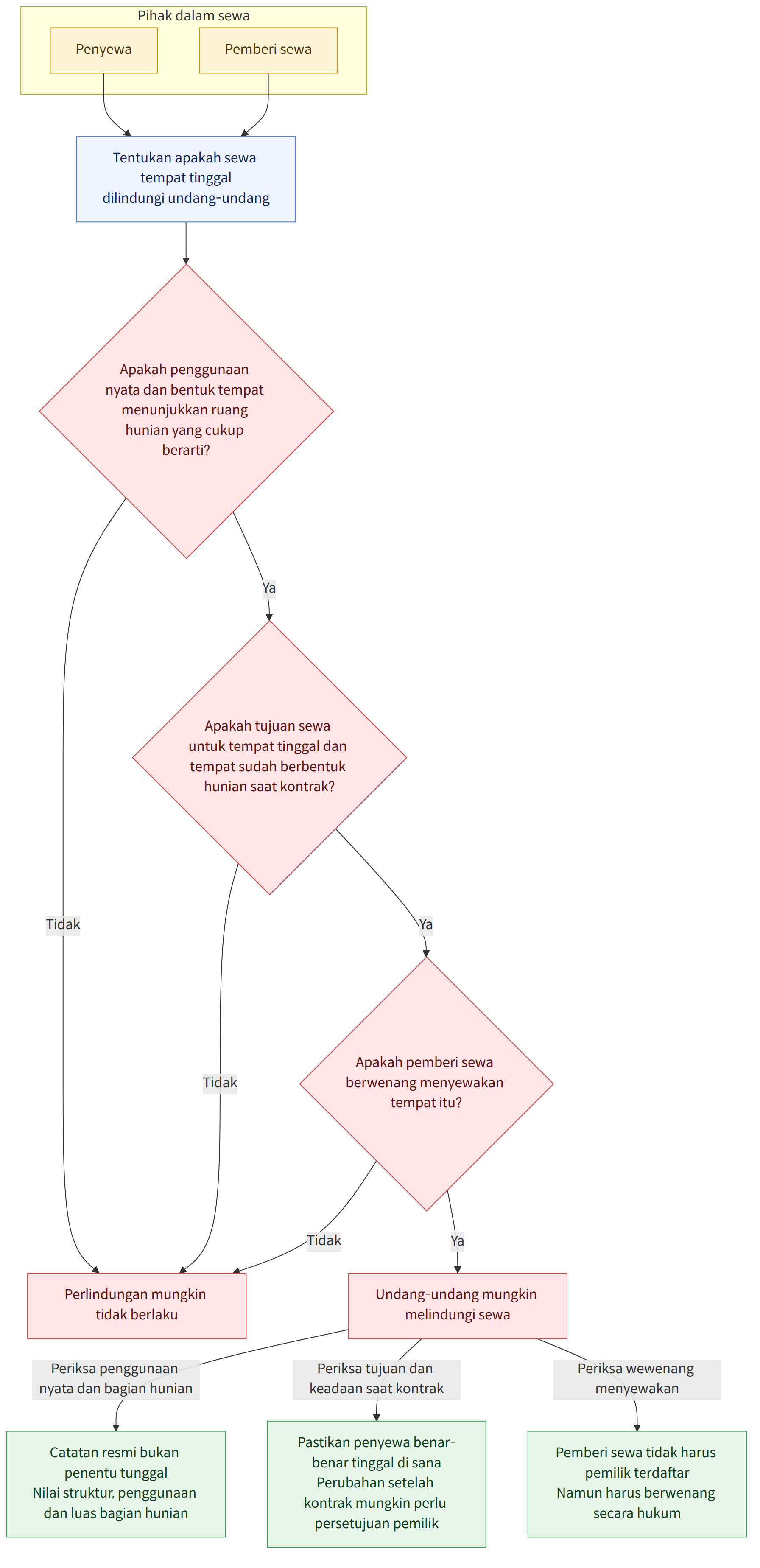
Whether the Housing Lease Protection Act applies is determined not solely by the description in the building register or title register, but by considering factors such as the building’s structure and actual use at the time of the lease. However, the fact that premises were used for residential purposes is not sufficient by itself; the purpose of the lease, whether the tenant actually lived there, and whether the person who entered into the contract had authority to lease the premises must also be considered.
Sekilas pandang
Poin penting
- Whether a building is residential is determined by its actual use rather than its designated use in official records. Where it is used for both residential and business purposes, the purpose of the lease, the structure and form of the building and the leased portion, the actual use of the premises, and whether daily life is conducted there are considered together (Cases 1, 13, 19, 20).
- Even where premises are used for both residential and business purposes, the Act may apply if the actual living space is substantial and serves as the tenant’s home. It may not apply, however, if residential use is merely incidental to the business or the residential portion is very small (Cases 13, 19, 20).
- The Act may apply to an unregistered or unauthorized building, or a building identified in official records as a factory, warehouse, or similar property, if it is actually residential. However, the premises must have been in residential form from the time of the contract. If the tenant converted them after entering into the contract, the Act may not apply unless there are special circumstances, such as the landlord’s consent (Cases 2, 4, 10, 21).
- A space such as a rooftop room, which does not appear in the building register or title register, may also be protected if it was in residential form at the time of the contract and was actually leased and used for residential purposes (Case 4).
- Foreign nationals may receive protection, in lieu of resident registration and a move-in report, by completing foreign resident registration and reporting a change of place of stay. The cases explain that an overseas Korean’s report of domestic residence may also serve as a procedure equivalent to resident registration (Cases 3, 6; Housing Lease Protection Act, Article 3, paragraph 1 (주택임대차보호법 제3조 제1항); Immigration Control Act, Article 88-2 (출입국관리법 제88조의2)).
- Where a small or medium-sized enterprise corporation leases a home for an employee’s residence, opposability against third parties may be recognized if an employee selected by the corporation takes delivery of the home and completes resident registration (Cases 8, 23; Housing Lease Protection Act, Article 3, paragraph 3 (주택임대차보호법 제3조 제3항)).
- The Act may apply even if the landlord is not the registered owner, provided the landlord has lawful authority to lease the premises. By contrast, a tenant cannot acquire a preferential right to repayment if they contract with someone who lacks lawful authority to lease the premises, such as the highest bidder at an auction (Cases 14, 17).
- A lease found to have been made mainly to recover a debt or abuse the system for the highest-priority repayment, rather than for residential purposes, may not qualify for protection as a small-amount tenant (Cases 15, 16; Housing Lease Protection Act, Article 8 (주택임대차보호법 제8조)).
Pertanyaan umum
Q. Does it apply if I use part of a shop or office as a home?
It may apply. The determination is made by considering the purpose of the lease, the building’s structure and area, how it is used, and whether people lead their daily lives there, based on its actual use rather than its designated use in official records. However, it may not apply if the room for sleeping or the kitchen is merely incidental to the business, or if the residential portion is very small.
Q. Can an unregistered or unauthorized home, or a rooftop room, also be protected?
The fact that a building is unregistered or lacks a building permit does not, by itself, exclude it from coverage. If it is actually used for residential purposes, an unregistered or unauthorized building, or even a rooftop room not shown in official records, may be covered. However, the building’s residential form at the time of the contract and its actual use must be examined.
Q. If I rent a factory or warehouse and convert it into a home, does the Act apply?
At the time of the contract, the premises must already have been substantially equipped for residential use or for combined residential and other use. If the tenant converts the premises for residential use without authorization after entering into the contract, the Act may not apply unless there are special circumstances, such as the landlord’s consent to the conversion.
Q. Can foreign nationals or overseas Koreans receive protection under the Housing Lease Protection Act?
According to the cases, a foreign national may receive protection by completing foreign resident registration and reporting a change of place of stay, in lieu of resident registration and a move-in report. The cases also explain the procedure for overseas Koreans to report their domestic residence at the location of the rented home. Other requirements, such as delivery of the home, must also be checked in each case.
Q. Can a home rented by a company for employee accommodation also be protected?
A corporation that qualifies as a small or medium-sized enterprise under the Framework Act on Small and Medium Enterprises may be recognized as having opposability against third parties if it leases a home for an employee’s residence and an employee selected by the corporation takes delivery of the home and completes resident registration. The cases also explain that a fixed date on the contract between the corporation and the landlord is required for a preferential right to repayment.
Q. Does the Housing Lease Protection Act apply if I stay in an inn or lodging facility for a long time?
The Act does not apply when it is clear that the lease is for temporary use, as with an accommodation contract between a lodging business operator and a guest. However, if the building’s actual structure and use are residential and the contract is not for temporary use, the fact that official records identify it as an inn or similar premises does not, by itself, determine whether the Act applies.
Q. Is the contract valid even if the landlord is not the registered owner?
The Housing Lease Protection Act may apply even if the landlord is not the registered owner, provided that the landlord has lawful authority to enter into the lease. However, a tenant cannot acquire a preferential right to repayment if they contract with someone who lacks authority to lease the property, such as the highest bidder at an auction who has not yet paid the sale price.
Q. Can I receive protection as a small-amount tenant if I move into a debtor’s home as a tenant to recover a debt?
Protection may not be available if the main purpose of the contract is not to actually use and enjoy the home, but to recover a debt or receive payment before secured creditors with priority. The cases explain that a tenant is also not eligible for protection as a small-amount tenant if the landlord and tenant enter into the contract to abuse the system for the highest-priority repayment.
Q. Can I receive preferential repayment of my deposit if the home remains in place but the land is auctioned separately?
The cases cite a court decision explaining that a tenant who has satisfied the requirements for opposability against third parties and has a fixed date, as well as a small-amount tenant, may exercise a preferential right to repayment from the proceeds of the land even when only the land is auctioned separately from the rented home. The cases also explain that a preferential right to repayment from the land may be recognized in the case of an unregistered home.
Hukum terkait
- Housing Lease Protection Act, Article 1 (주택임대차보호법 제1조)
- Housing Lease Protection Act, Article 2 (주택임대차보호법 제2조)
- Housing Lease Protection Act, Article 3, paragraph 1 (주택임대차보호법 제3조 제1항)
- Housing Lease Protection Act, Article 3, paragraph 3 (주택임대차보호법 제3조 제3항)
- Housing Lease Protection Act, Article 3-2, paragraph 1 (주택임대차보호법 제3조의2 제1항)
- Housing Lease Protection Act, Article 3-2, paragraph 2 (주택임대차보호법 제3조의2 제2항)
- Housing Lease Protection Act, Article 8 (주택임대차보호법 제8조)
- Housing Lease Protection Act, Article 11 (주택임대차보호법 제11조)
- Housing Lease Protection Act, Article 12 (주택임대차보호법 제12조)
- Act on the Immigration and Legal Status of Overseas Koreans, Article 2 (재외동포의 출입국과 법적 지위에 관한 법률 제2조)
- Act on the Immigration and Legal Status of Overseas Koreans, Article 3 (재외동포의 출입국과 법적 지위에 관한 법률 제3조)
- Act on the Immigration and Legal Status of Overseas Koreans, Article 6 (재외동포의 출입국과 법적 지위에 관한 법률 제6조)
- Act on the Immigration and Legal Status of Overseas Koreans, Article 7 (재외동포의 출입국과 법적 지위에 관한 법률 제7조)
- Act on the Immigration and Legal Status of Overseas Koreans, Article 10 (재외동포의 출입국과 법적 지위에 관한 법률 제10조)
- Immigration Control Act, Article 31 (출입국관리법 제31조)
Perhatikan
- Do not determine whether the Act applies solely from the designated use in the building register or title register; also consider the structure and actual use of the premises at the time of the contract.
- If the tenant converted the premises for residential use after entering into the contract, it may be important whether the premises were already in residential form at the time of the contract and whether the landlord consented to the conversion.
- Even if the tenant actually used the home and lived there, protection may not be available if the contract is found to have been made mainly to recover a debt or abuse the system for the highest-priority repayment.
- Whether premises qualify as a home covered by the Act is a separate question from whether the tenant has acquired opposability against third parties or a preferential right to repayment. Depending on the case, requirements such as delivery of the home, resident registration or an equivalent report, and a fixed date must be checked.
Kasus sumber
Panduan ini disusun oleh AI dari kasus konsultasi Korea Legal Aid Corporation berikut (bahasa Korea).
- 임치주택의 일부를 점포로 운영한 경우 주택임대차보호법 적용되는지
- 미등기주택을 임차한 경우 주택임대차보호법이 적용되는지
- 재외동포도 주택임대차보호법의 보호를 받는지
- 옥탑을 주거용으로 임차한 경우 주택임대차보호법이 적용되는지
- 주택임대차보호법상 임차인의 지위를 강화하기 위하여 별도의 전세권설정계약을 체결한 경우
- 외국인의 경우도 주택임대차보호법이 적용되는지
- 개정법과 소액임차인의 최우선변제권
- 직원 숙소로 회사가 임차한 주택도 주택임대차보호법 적용되는지
- 주택임대차보호법 제3조의2 제1항의 해석(1)
- 임차 후 비로소 주거용 건물로 개조한 경우도 주택임대차보호법이 적용되는지
- 주택임대차보호법 제3조의2 제1항의 해석(2)
- 미등기 전세계약에도 주택임대차보호법이 적용되는지
- 비주거용 건물에 주거의 목적으로 일부를 사용하는 경우에 주택임대차보호법의 적용여부
- 임대인이 주택의 명의신탁자인 경우, 임차인이 주택임대차보호법의 보호를 받을 수 있는지
- 채권회수를 위한 임대차계약의 경우, 임차인에게 주택임대차보호법이 적용되는지
- 부당한 이득을 취하기 위하여 임대차계약을 체결한 경우에 주택임대차보호법에서 보호하는 소액임차인에 해당하는지 여부
- 적법한 임대권한이 없는 사람과 임대차계약을 체결한 경우 주택임대차보호법이 적용되는지
- 일시사용임대차에도 주택임대차보호법이 적용되는지
- 공부상 단층 작업소 및 근린생활시설인 경우에 주택임대차보호법 적용여부
- 주택임대차보호법의 적용대상인 주거용 건물인지 여부의 판단기준
- 무허가 건물의 경우에 주택임대차보호법이 적용되는지 여부
- 임대차계약 종료 후 재계약을 하거나 임대차계약 종료 전 당사자의 합의로 차임 등이 증액된 경우 주택임대차보호법 제7조 의 적용...
- 법인의 경우에도 주택임대차보호법의 보호 대상인지 여부
- 주택임대차보호법의 적용대상인 ‘주거용 건물’에 대지도 포함되는지
- 1989.12.30.자로 개정된 주택임대차보호법 제4조 의 적용과 같은 날짜로 묵시적으로 갱신된 임대차계약의 존속기간
Panduan ini adalah informasi umum tentang hukum Korea, bukan nasihat hukum untuk kasus Anda. Konsultasikan dengan pengacara atau Korea Legal Aid Corporation (hubungi 132 di Korea).