
Guide to Offenses Under the Act on the Control of Dishonored Checks
Basato su 31 casi di consulenza · Aggiornato · Tradotto dall’originale coreano.
The fact that a check has been dishonored does not, by itself, immediately establish criminal liability. It is necessary to consider whether the issuer foresaw that payment would be refused when the check was issued, whether the reason for nonpayment is one specified by law, and whether the check was recovered.
In sintesi
Punti chiave
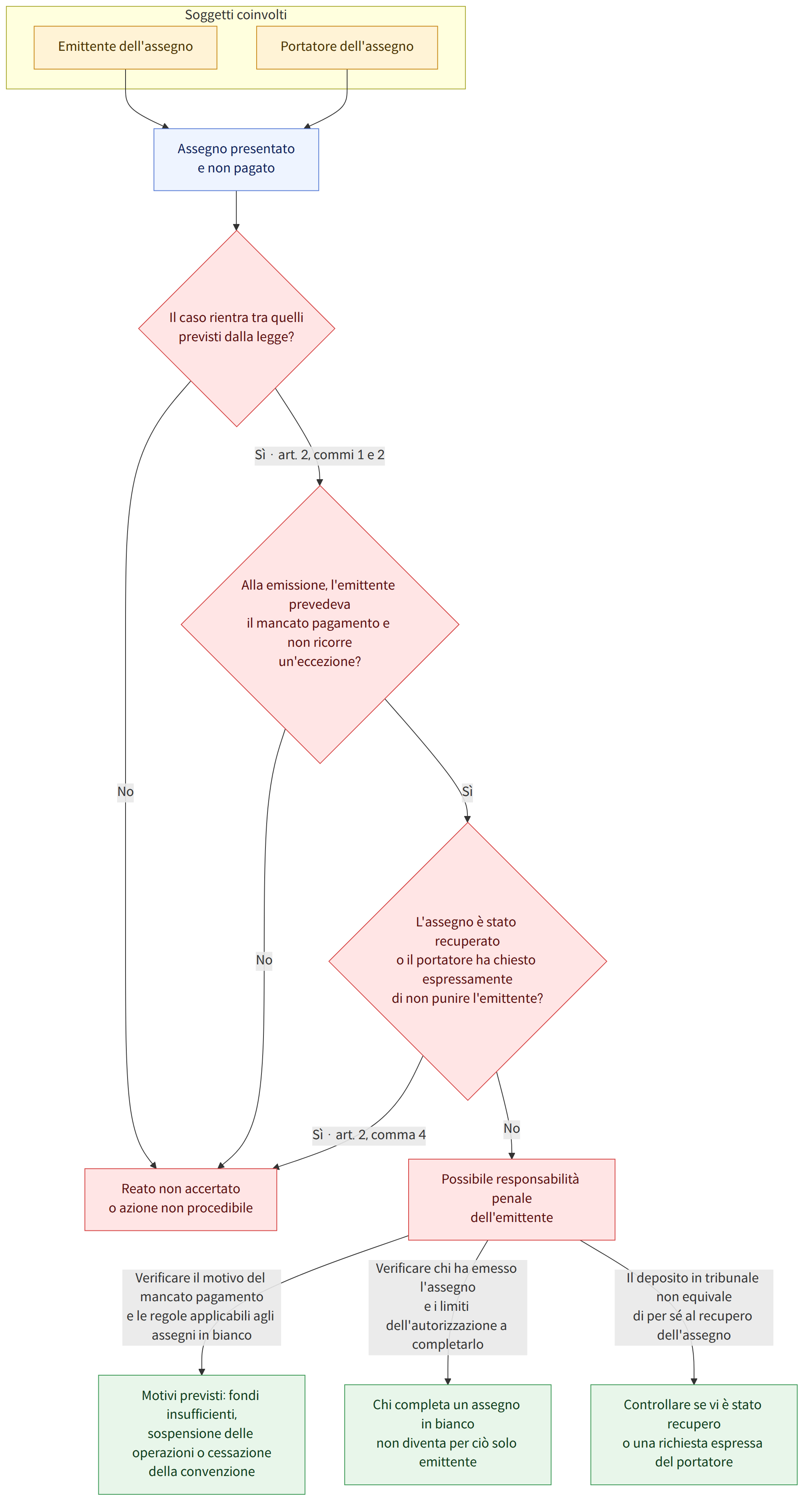
- A person may be punished for issuing a dishonored check specified by law, such as by issuing a check without a check agreement or issuing one after a suspension of transactions has been imposed. A person may also be punished for causing a check not to be paid on the date of presentment because of insufficient funds or similar reasons (Act on the Control of Dishonored Checks, Article 2(1) and (2) (부정수표단속법 제2조 제1항·제2항)).
- If, at the time of issuance, the issuer foresaw that the check would go unpaid because of insufficient funds or similar reasons, liability may arise even on the basis of conditional foresight. However, the issuer may not be liable in exceptional cases where they did not foresee that outcome or had a reasonable basis for believing that the check would not be presented for payment (Supreme Court, September 30, 2010, Decision 2010Do6490).
- The reasons for dishonor are limited to insufficient funds, a suspension of transactions, or the rescission or termination of the check agreement. If payment is refused for another reason, an offense under Article 2(2) may not be established (Supreme Court, October 26, 2006, Decision 2006Do5147).
- A prosecution for an offense under Article 2(2) or (3) may not be brought if the issuer recovers the check or, even if it is not recovered, against the express wish of the check holder that the issuer not be punished. If an accomplice recovers the check, the effect may also extend to the other accomplices (Act on the Control of Dishonored Checks, Article 2(4) (부정수표단속법 제2조 제4항)).
- Depositing an amount equivalent to the check amount in court in satisfaction of the debt and the holder’s receipt of that amount may not constitute recovery of the check or an expression of the wish that the issuer not be punished (Supreme Court, October 21, 1994, Decision 94Do789).
- A blank check may, in principle, also be subject to the Act. However, an exception may be recognized in special circumstances where, in light of the purpose of issuance and the terms of the agreement, the check could not circulate and it was clearly foreseeable at the time of issuance that transactions would be suspended when the check was presented for payment in the future (Supreme Court, December 26, 2013, Decision 2011Do7185).
- A person who completes a blank check does not, merely by completing it, become the issuer or maker of the check. The issuer is not liable for an amount exceeding the scope of the authority to complete it, and completion after the limitation period for that authority has expired may not be regarded as lawful completion (Supreme Court, September 8, 1981, Decision 81Do1495; Supreme Court, November 27, 2001, Decision 2001Do3184).
Domande frequenti
Q. Is the issuer automatically punished if a check is dishonored?
No. For a violation of Article 2(2), the check must have gone unpaid for a reason specified by law, and it must also be considered whether, at the time of issuance, the issuer foresaw that it would go unpaid. The fact that the check was dishonored does not, by itself, establish liability.
Q. If I lent a check to someone else and it is dishonored, who is liable?
The example explains that the person who issued or completed the check is the person liable, and that the person who borrowed the check and made a promise does not assume criminal liability in their place. The specific requirements for the issuer’s liability, such as intent or negligence, must nevertheless be considered separately.
Q. Can I be punished if the holder promised not to present the check but it was nevertheless dishonored?
It is generally difficult to avoid liability solely on the basis of that promise or the circumstances in which the check was issued. The matter may be decided differently in exceptional cases—for example, if the issuer did not foresee at the time of issuance that the check would go unpaid, or had a reasonable basis for believing that it would not be presented for payment.
Q. Can I avoid criminal liability by depositing the amount of a dishonored check in court in satisfaction of the debt?
According to the example, even if an amount equivalent to the face value is deposited in court in satisfaction of the debt and the holder receives it, this may not constitute either recovery of the check or the holder’s express wish that the issuer not be punished. It therefore cannot be concluded that the deposit alone prevents prosecution.
Q. If an accomplice recovers the check, can the other accomplices also no longer be prosecuted?
The precedent cited in the example holds that if an accomplice recovers the dishonored check, the effect also extends to the other accomplices. It explains that this remains the case even if the accomplice who recovered the check wants the other accomplices to be punished.
Q. If a blank check is completed for more than the agreed amount and is dishonored, is the issuer liable for the full amount?
According to the example, the issuer may be liable within the scope of the authority to complete the blank check, but is not liable for violating the Act on the Control of Dishonored Checks in respect of an amount completed in excess of that authority. The legal liability, if any, arising separately from the conduct of the person who completed the check cannot be determined from this example alone.
Q. Can someone be punished if a check with a blank or subsequently corrected issue date is refused for payment?
One example holds that if a check is presented without its date of issue having been completed, this cannot be regarded as a lawful presentment for payment, making it difficult to establish an offense under Article 2(2). By contrast, the issuer may be liable if, with the holder’s consent, the issuer lawfully corrects the date of issue and the check is presented within the presentment period calculated from the corrected date. A correction made by another person without the issuer’s consent or authorization may be assessed differently.
Q. Does making a false report about the loss of a check or similar matter violate the Act on the Control of Dishonored Checks?
Making a false report to a financial institution for the purpose of avoiding payment of a check or a suspension of transactions may constitute a violation of Article 4. It must be affirmatively proven that the report is objectively contrary to the truth. The example explains that a person who is not the named issuer, such as a person who borrowed another’s name, cannot be the perpetrator of an offense under Article 4.
Norme applicabili
- Act on the Control of Dishonored Checks, Article 2(1), (2), (3) and (4) (부정수표단속법 제2조 제1항·제2항·제3항·제4항)
- Act on the Control of Dishonored Checks, Article 3 (부정수표단속법 제3조)
- Act on the Control of Dishonored Checks, Article 4 (부정수표단속법 제4조)
- Act on the Control of Dishonored Checks, Article 5 (부정수표단속법 제5조)
- Check Act, Article 3 (수표법 제3조)
- Check Act, Article 51 (수표법 제51조)
- Banking Act, Article 1 (은행법 제1조)
- Enforcement Decree of the Act on the Control of Dishonored Checks, Article 2(1) (부정수표단속법 시행령 제2조 제1항)
- Criminal Procedure Act, Article 310-2 (형사소송법 제310조의2)
Attenzione
- The examples explain that, for recovery of a check or an expression of the wish that the issuer not be punished to have the effect of restricting prosecution, it may need to occur before the first-instance judgment is pronounced.
- A deposit in court in satisfaction of the debt or payment of the amount due under the check does not, by itself, establish recovery of the check or the holder’s express wish that the issuer not be punished.
- The outcome for a blank check may vary depending on the scope of the authority to complete it, the limitation period, the purpose of issuance, and the possibility of circulation.
- The reason payment of the check was refused and the circumstances at the time of issuance must be verified; the fact of dishonor alone should not be treated as conclusive proof that an offense was committed.
Casi di origine
Questa guida è stata redatta dall’IA a partire dai seguenti casi di consulenza della Korea Legal Aid Corporation (in coreano).
- 수표부도 후 변제공탁 한 경우 부정수표단속법 위반 여부
- 수표가 지급거절된 경우에도 처벌되지 않는 경우
- 백지수표가 부도가 났더라도 예외적으로 부정수표단속법위반죄가 성립하지 않는 경우
- 부도수표를 회수할 경우 형사책임을 면할 수 있는지
- 빌려준 당좌수표 부도처리 시 부정수표단속법위반의 책임자
- 백지수표가 부도난 경우 부정수표단속법 위반 여부
- 백지보충권 소멸시효 완성 후 보충된 수표 부도된 때 처벌 여부
- 부정수표가 부정수표가공범에 의하여 회수된 경우, 그 공범이 다른 공범자의 처벌을 원하는 경우에도 공소를 제기할 수 없는지 여부...
- 부정수표단속법 2조 1항 2호 소정의 "금융기관"의 범위
- 수표발행자가 피사취신고를 한 경우 부정수표단속법 위반 여부
- 백지수표를 보충한 자도 부정수표단속법 위반으로 처벌되는지
- 백지 보충없이 지급제시가 있을 경우 그 수표의 발행행위가 부정수표단속법 제2조 제2항 위반죄를 구성하는지 여부
- 발행한도액 초과한 가계수표가 부도된 경우 형사처벌
- 백지보충권의 범위를 넘은 금액에 대해 책임을 지는지 여부
- 타인의 기망에 의하여 발행된 수표가 부도된 경우 부정수표단속법 제2조제2항에 해당여부
- 공범이 부정수표를 회수한 경우 처벌되는지 여부
- 발행일의 정정과 부도수표 여부 (2)
- 수표금액의 지급 또는 거래정지처분 면탈 목적의 허위신고의 요건
- 발행일의 정정과 부도수표 여부 (1)
- 수표부도의 고의
- 부도수표 사본의 증거능력
- 백지수표의 위조와 벌금액
- 수표부도의 사유는 제한적인지
- 부정수표단속법위반죄와 무고죄의 죄수관계
- 명의차용인도 부정수표 단속법 제4조 위반죄의 주체가 될 수 있는지
Questa guida è un’informazione generale sul diritto coreano, non una consulenza legale sul tuo caso. Rivolgiti a un avvocato o alla Korea Legal Aid Corporation (132 in Corea).