

1. A Human Story
Hannah Lee and Daniel Kim had been divorced for about 200 days when Hannah gave birth to a baby boy, Noah. The marriage had ended on paper, but the timing of Noah’s arrival placed him in a legally complicated position. Hannah’s new partner, Alex Morgan, was Noah’s biological father, and the couple hoped to register that fact without delay.
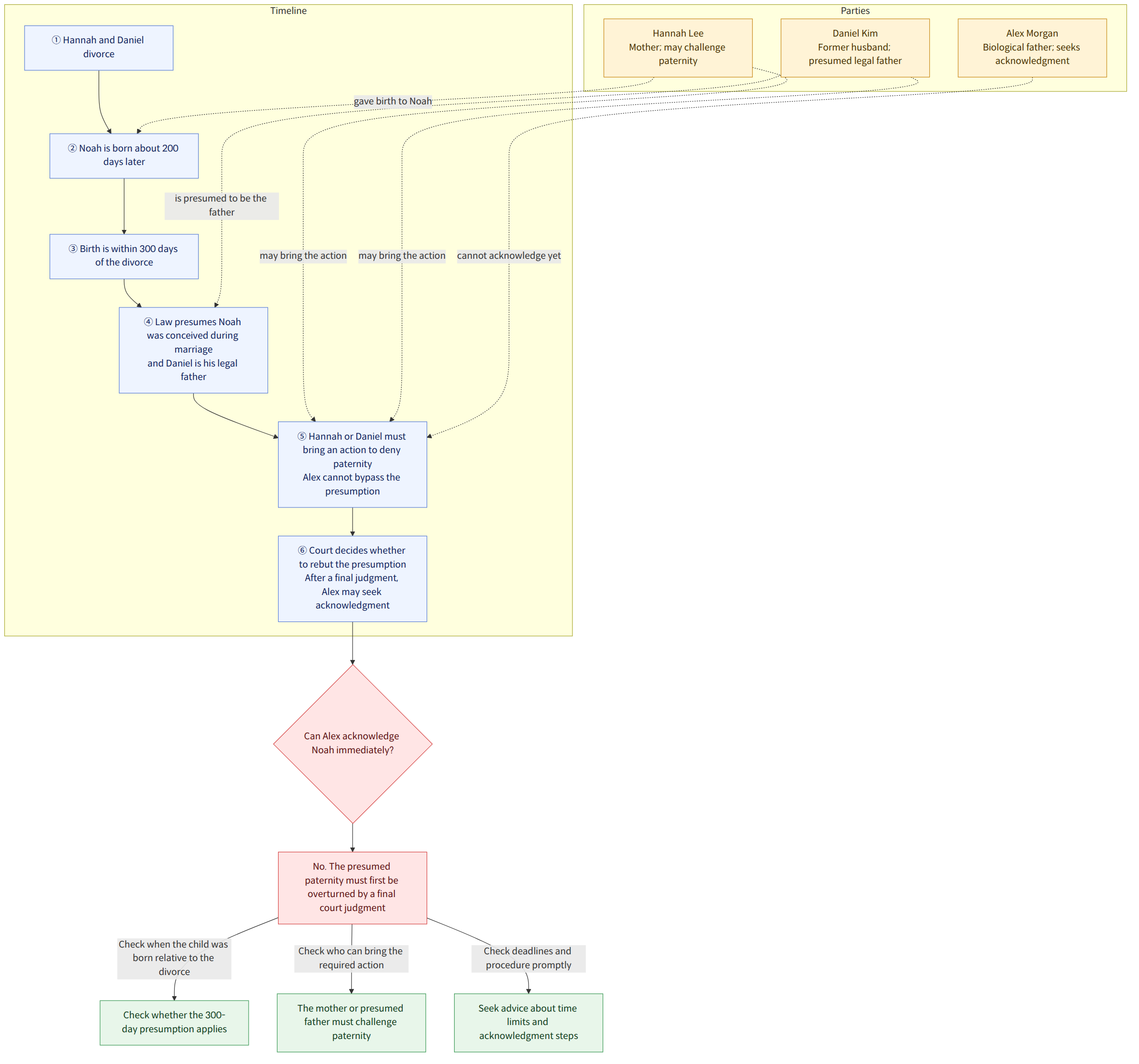
At the family registration office, however, Alex learned that biology alone was not enough. Because Noah was born within 300 days of Hannah and Daniel’s divorce, Korean law treated Daniel as Noah’s presumed legal father. Alex could not simply sign a form acknowledging Noah as his son. Before Alex could take that step, the presumption had to be removed through court proceedings.
2. The Legal Question
When a child is born about 200 days after a divorce, can the biological father acknowledge the child immediately—or must the former husband’s legal paternity first be overturned?
3. What Korean Law Says
Korean Civil Act Article 844 sets out rules for determining a child’s legal parentage when the child is born during or shortly after a marriage. The law uses a timing-based presumption: a child born within 300 days after the marriage ends is presumed to have been conceived during the marriage. A child presumed to have been conceived during marriage is, in turn, presumed to be the husband’s child.
Under Article 844(2) of the Korean Civil Act, a child born within 300 days after the end of a marriage is presumed to have been conceived during the marriage. Under Article 844(1), a child conceived during marriage is presumed to be the husband’s child.
That presumption can apply even when the couple has already divorced and the child’s biological father is someone else. In this situation, the biological father cannot bypass the presumption by making a direct acknowledgment of paternity.
The usual sequence is:
- The mother or the man presumed by law to be the father brings an action to deny paternity.
- The court decides whether the legal presumption should be rebutted. Evidence of biological parentage may be relevant to that decision.
- After a final judgment denying the presumed father’s paternity, the biological father may seek to acknowledge the child under the applicable procedure.
If neither the mother nor the presumed father brings the required action, the biological father cannot simply acknowledge the child while the presumption remains in force. Because family-law proceedings can be subject to statutory time limits, anyone facing this situation should seek advice promptly.
4. How Korean Courts Approach This
Korean courts treat the paternity presumption as a rule about legal status, not merely as a guess about biology. The fact that a couple has divorced, or that another man says he is the biological father, does not by itself erase the presumed father’s legal position.
The key point is procedural as well as factual: the presumption must be challenged through the proper family-court action. A private agreement, a DNA test on its own, or the biological father’s acknowledgment cannot substitute for the required court judgment. Once the court has issued a final judgment denying the presumed father’s paternity, the legal obstacle to acknowledgment can be removed.
The practical rule is straightforward: while the statutory presumption stands, biological truth alone does not allow a different man to establish legal paternity by acknowledgment.
5. Applying the Law to the Case
The dates are decisive at the outset. Noah was born about 200 days after Hannah and Daniel’s divorce. That is well within the 300-day period in Article 844(2), so the law presumes that Noah was conceived during the marriage. Article 844(1) then presumes that Daniel is Noah’s legal father.
Alex’s biological relationship to Noah does not automatically displace that result. Even if Alex and Hannah can show that Alex is Noah’s biological father, Alex cannot skip the legal step required to resolve the conflicting presumption. He cannot make an effective direct acknowledgment while Daniel remains the presumed father.
Hannah or Daniel must therefore bring an action to deny paternity. The court can consider the evidence and decide whether Daniel’s presumed paternity should be rejected. If the court issues a final judgment in Hannah’s favor, the legal presumption is no longer an obstacle, and Alex can then pursue acknowledgment through the appropriate procedure.
If neither Hannah nor Daniel takes that step, Alex remains unable to acknowledge Noah under the facts described—even if all three adults agree about Noah’s biological parentage. Their agreement cannot replace the court process that the law requires.
If you are dealing with a similar issue, attorney Ji-sun Ahn of Ijun Law Firm can review the family registration, the marriage, separation and birth dates relevant to the parentage dispute, and any prior court records with you. These details can help clarify which options apply to your situation.
6. Conclusion: What Happened, and What Should You Do?
Hannah consulted a family-law attorney and brought an action to deny Daniel’s presumed paternity. The court issued a final judgment establishing that Daniel was not Noah’s father. Only after that judgment became final could Alex proceed to acknowledge Noah as his child. The law did not deny their biological reality; it required them to resolve Noah’s legal parentage in the proper order.
For anyone in a similar situation:
- Check the dates carefully. A birth within 300 days after a marriage ends may trigger the statutory presumption, even if the divorce is complete.
- Do not rely on a DNA test or private agreement alone. Ask a Korean family-law professional which court action is required and who is eligible to bring it.
- Act promptly. Paternity proceedings can involve statutory deadlines and consequences for the child’s legal status, so get advice before attempting an acknowledgment.

















