
1. A Human Story
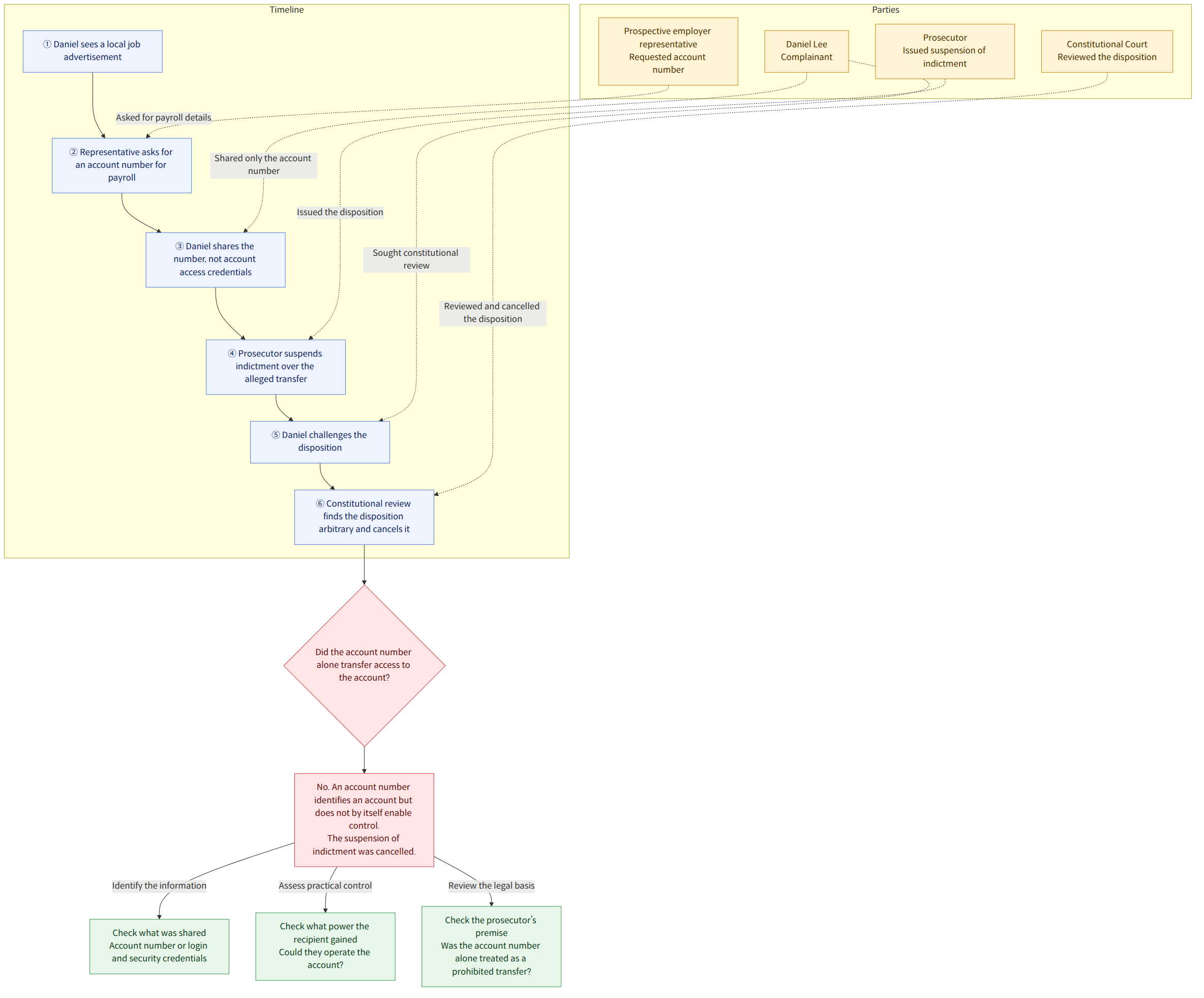
Daniel Lee was looking for steady work when he spotted a hiring notice in a neighborhood classifieds paper. The company representative who answered his call sounded routine and professional. Before discussing his first shift, the representative asked for the number of Daniel’s bank account, saying it was needed for payroll. Daniel gave the number. He did not hand over his bankbook, card, password, or online banking login.
Months later, Daniel learned that prosecutors had issued a suspension of indictment against him for allegedly transferring a user identifier registered with a financial institution, contrary to Korea’s Electronic Financial Transactions Act. The disposition did not amount to a conviction, but it treated his act of sharing an account number as criminally suspect. Daniel challenged it, arguing that the authorities had mistaken an address for access to the account.
2. The Legal Question
Does giving a prospective employer a bank account number amount to transferring a registered user identifier or giving that person the right to use the account under the Electronic Financial Transactions Act? And if it does not, can a prosecutor’s decision to suspend indictment on that basis be set aside as an arbitrary exercise of prosecutorial power?
3. What Korean Law Says
The issue turns on two linked ideas: what counts as a registered user identifier, and what it means to transfer an electronic financial means of access.
The Act’s definition includes a user number registered with a financial company or electronic financial business operator. In this context, the Constitutional Court has understood that phrase to refer to an identifier registered to distinguish a user—such as an ID or password used to log in to a financial institution’s online service. An ordinary bank account number does not, by itself, serve that function.
A bank account number identifies an account; it is not necessarily the credential a customer uses to log in or authorize transactions.
The Act also prohibits transferring certain means of access. But simply telling someone an account number does not ordinarily hand that person control over the account. The number alone does not enable its holder to withdraw or move money.
Sharing an account number alone does not give the recipient authority to use the account at will and, for that reason, is not by itself a transfer of the account’s means of access.
For a case like Daniel’s, the key points are:
- What was shared? An account number is different from a login ID, password, security credential, card, or other tool that enables account access.
- What power did the recipient obtain? The question is whether the recipient gained the ability or authority to operate the account, not merely whether they learned which account existed.
- What did the prosecutor rely on? A decision based on treating the account number alone as a prohibited transfer may rest on a mistaken interpretation of the Act.
A suspension of indictment is a prosecutorial decision not to bring a case to trial in light of the circumstances. It is not a court’s finding of guilt. But it can still have serious consequences, and a person may seek constitutional review when the decision is alleged to violate constitutional rights through an arbitrary exercise of prosecutorial authority.
4. How Korean Courts Approach This
Korean constitutional review distinguishes between information that identifies an account and credentials that allow someone to access or control it. Where a criminal rule uses a defined term such as “registered user number,” authorities must apply that term according to its legal meaning rather than stretch it to cover every piece of information associated with a bank account.
Criminal prohibitions should not be expanded beyond their proper meaning simply because the conduct appears suspicious in the surrounding circumstances.
The Constitutional Court has also treated the practical effect of the alleged transfer as important. If the person receiving the information cannot use the account merely by knowing the account number, it is difficult to say that control or authority over the account has been transferred.
Where a prosecutor’s decision depends on the opposite premise, constitutional review may find the decision arbitrary. In this kind of situation, the Court has concluded that such a disposition can infringe the complainant’s constitutional rights, including the right to equality and the right to pursue happiness, and should be cancelled.
5. Applying the Law to Daniel’s Case
The analysis begins with exactly what Daniel disclosed. He gave the supposed employer his bank account number after seeing a job advertisement. On the facts described, he did not provide his online banking ID or password, nor did he hand over a card or another instrument that would enable the representative to access the account.
Next comes the legal meaning of the information. Daniel’s account number pointed to the account, but it was not the registered login identifier covered by the relevant part of the Act. Treating the number as though it were a password or online banking ID would collapse two different kinds of information into one.
The next question is whether the representative gained the power to use Daniel’s account. Knowing the account number would not, on its own, let the representative log in, withdraw money, or make transfers. The disclosure therefore did not itself pass control of the account to the recipient.
Finally, the prosecutor’s reasoning must be assessed against those facts. If the suspension of indictment rested on the claim that giving the account number alone amounted to transferring a registered user identifier or means of access, it was based on an incorrect legal premise. The fact that the request came through a job advertisement may warrant caution, but it does not transform an account number into an access credential.
If you are dealing with a similar issue, attorney Ji-sun Ahn of Ijun Law Firm can review the sequence of events, records showing what each person knew or did, and the grounds stated in any formal notice with you. These details can help clarify which options apply to your situation.
6. Conclusion: What Happened, and What Should You Do?
Daniel’s constitutional challenge succeeds. Because he disclosed only his account number, that act did not constitute transferring a registered user identifier or giving the recipient authority to operate his account. The suspension of indictment, founded on the contrary interpretation, is an arbitrary exercise of prosecutorial power and should be cancelled for infringing his constitutional rights.
That conclusion is narrow: it does not mean that every request for bank details is harmless, or that sharing passwords, cards, or other access tools is legally safe. For readers facing a similar request:
- Share only what is genuinely needed. A legitimate payroll process may require account details, but do not disclose online banking passwords, one-time codes, card PINs, or login credentials.
- Verify the requester. Contact the employer through independently confirmed contact details, especially when the request follows an informal job advertisement.
- Keep a record and act quickly if access details were shared. Save messages and advertisements, contact your bank if you disclosed credentials or a card, and seek Korean legal advice if you receive a police or prosecution notice.