
1. A Human Story
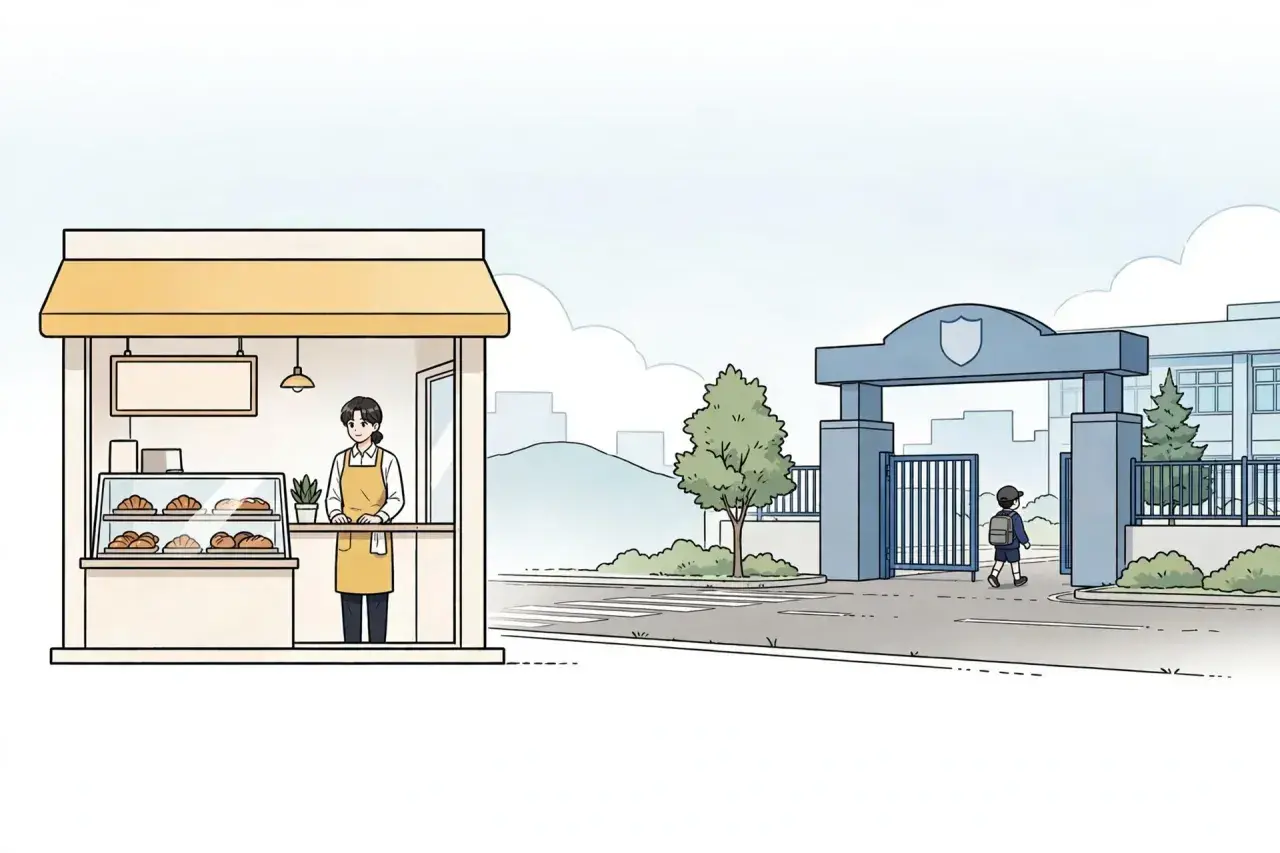
When Daniel Reed found a small storefront 150 metres from a middle school, he saw the beginning of a new business. He planned to open an adult PC room: private booths, computer access, and customers restricted to adults. The rent was manageable, the location was easy to reach, and the lease seemed ready to sign.
Then an official told him that the planned business could not operate there. The property was inside the school’s 200-metre school-environment protection area. Daniel had heard that certain lodging businesses in a similar area might be considered for permission after committee review. Why, he wondered, should his business face a complete ban? Was the rule an excessive interference with his freedom to earn a living?
2. The Legal Question
May South Korea prohibit, without an individual exception, a designated adult PC-room business throughout the school-environment protection area—even in the outer, or “relative,” zone 150 metres from a school—or does that prohibition unconstitutionally restrict the freedom to pursue an occupation?
3. What Korean Law Says
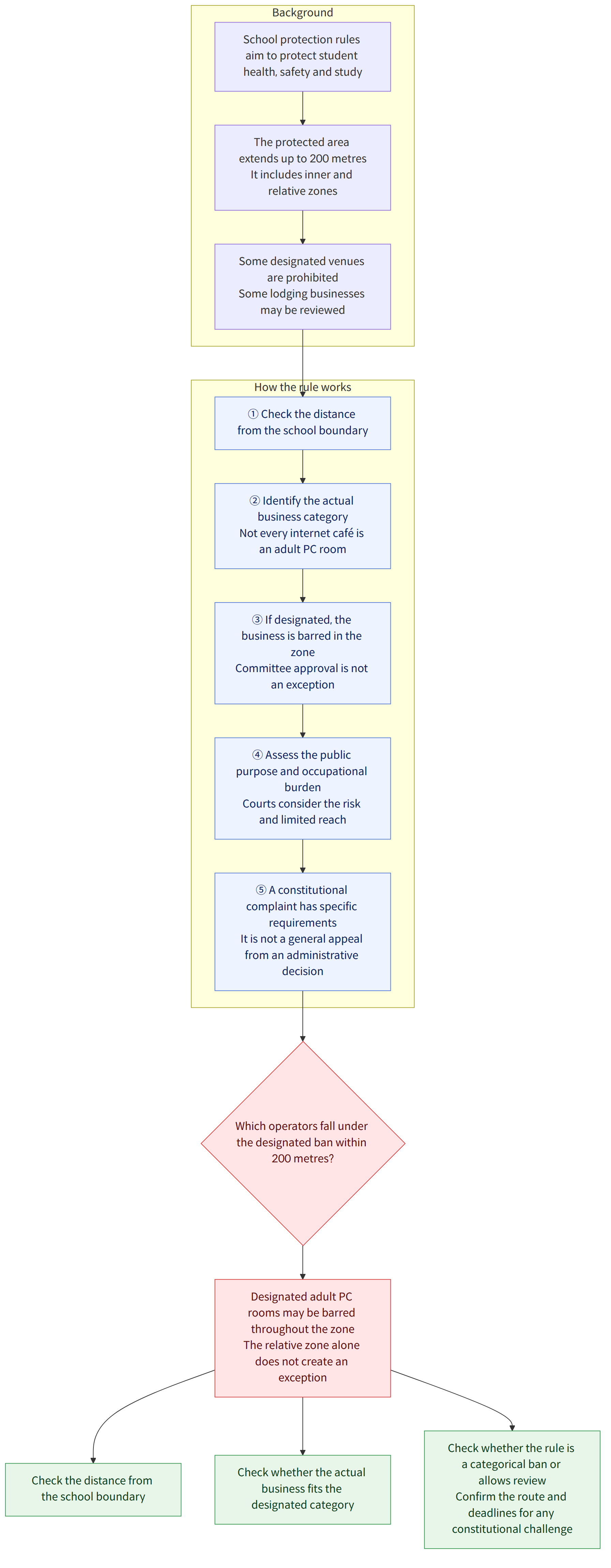
South Korea’s School Health Act creates a protected area around schools to reduce environmental factors considered harmful to students’ health, safety, and ability to study. The zone extends up to 200 metres from a school boundary. The law distinguishes a more restricted inner area from the surrounding relative-protection area, but being in the relative area does not mean every business is permitted.
The relevant rules, including the Act and the government designation of businesses prohibited from admitting or employing young people, cover certain businesses that provide services where sexual acts, or similar conduct, may take place. Adult PC rooms and similar venues can fall within this designated category. Where a business is covered, the prohibition applies in the school-environment zone; it is not simply a matter of obtaining the school sanitation committee’s approval.
The central legal distinction is between a business that falls within a specially designated prohibited category and one for which the law allows case-by-case review. A location in the relative-protection area is not, by itself, an exception to a categorical prohibition.
The framework therefore requires attention to several points:
- The distance: Is the site within 200 metres of the school boundary?
- The business category: Does the proposed operation fall within a legally designated category involving sexual or similar services? Not every ordinary internet café is an adult PC room for this purpose.
- The type of restriction: Is the relevant business absolutely prohibited in the zone, or is it one of the types that may be considered through a review process?
- The constitutional balance: Does the restriction pursue a legitimate public purpose and limit occupational freedom no more than reasonably necessary?
The Constitutional Court has reasoned that businesses with a risk of developing into prostitution-related or similar activities can have a serious adverse effect on the educational environment. It has also considered the ban’s limited reach—an area within 200 metres of a school—when assessing the burden on occupational freedom.
Some lodging businesses may be treated differently under the statutory scheme and may be considered for permission following a review. That difference matters to the legal analysis, but it does not automatically give every other business a right to the same exception.
A constitutional complaint under Article 68(2) of the Constitutional Court Act is also a particular legal procedure, not a general appeal from an administrative decision. Typically, it becomes available when a court rejects a request to refer a law’s constitutionality to the Constitutional Court in a pending case, subject to statutory requirements and deadlines. The precise route depends on the decision being challenged.
4. How Korean Courts Approach This
In reviewing restrictions on occupational freedom, Korean constitutional law generally asks whether the government is pursuing a legitimate purpose, whether the measure is rationally connected to that purpose, and whether the burden is excessive in light of the benefits sought. The question is not simply whether a less restrictive rule can be imagined. Courts also consider the legislature’s judgment about the nature and seriousness of the risk.
For school-protection rules, the Constitutional Court has accepted that the state may seek to shield students from businesses considered likely to encourage sexual exploitation or similar conduct. It has also regarded a uniform distance rule as a workable way to protect the school environment, even where an individual shop does not directly face a student’s usual route or is not visible from the school.
In the Court’s approach, the combination of a serious potential harm to the educational environment and a geographically limited restriction can justify a categorical ban. The fact that another kind of business receives a discretionary review does not, by itself, establish that the stricter rule is unconstitutional.
That does not mean every restriction near a school is automatically valid. The business must actually fall within the regulated category, the distance must be measured under the applicable rules, and the law must be applied to the facts of the particular operation. But where those conditions are met, courts have been reluctant to invalidate the categorical prohibition as an excessive restraint on the freedom to work.
5. Applying the Law to the Case
Daniel’s situation turns on the interaction of distance, business classification, and the constitutional balance.
- The address is within the protected area. At 150 metres from the school, the storefront lies inside the 200-metre school-environment zone. It is in the relative-protection area, not necessarily the most strictly protected inner area. But that label alone does not authorize the proposed business.
- The planned activity must be classified accurately. If Daniel’s proposed adult PC room is legally treated as a designated business providing services in which sexual acts or similar conduct may occur, the relevant prohibition applies. If, instead, the operation is an ordinary internet café that does not fall within that category, the mere use of computers or the word “adult” in its marketing would not settle the legal question. The actual business model and the applicable designation matter.
- A possible exception for lodging businesses does not control. Daniel’s comparison is understandable: if some lodging businesses may receive individual review, a flat ban on his business can seem arbitrary. But the law may classify different businesses according to their perceived risks and their place in the statutory scheme. The existence of a review route for one category does not require the state to create one for every other category.
- The restriction has a substantial public purpose and a defined geographic reach. The state’s purpose is to protect students and preserve an environment conducive to learning. The rule applies within the 200-metre zone rather than banning the business everywhere. The Constitutional Court has considered that limited reach important when deciding whether occupational freedom has been excessively restricted.
- The constitutional challenge is therefore unlikely to succeed on these facts. If Daniel’s business is within the designated category and the distance is correctly established, the categorical prohibition is consistent with the approach the Constitutional Court has taken. The fact that his premises are 150 metres away, rather than closer to the school, does not by itself remove the legal bar.
If you are dealing with a similar issue, attorney Ji-sun Ahn of Ijun Law Firm can review the applicable permit, business records or advertisements, and the legal grounds given by the authority with you. These details can help clarify which options apply to your situation.
6. Conclusion: What Happened, and What Should You Do?
Daniel did not sign the lease. After checking the proposed business against the applicable designation, he learned that the plan was likely to be treated as a prohibited adult PC-room operation within the school’s 200-metre protection zone. A constitutional challenge based only on the fact that some lodging businesses may receive committee review was unlikely to overturn the ban. He looked for a site outside the protected area instead.
For anyone considering a similar business:
- Confirm the precise legal category before paying a deposit. Ask the relevant local authority how it classifies the actual services and operating model; do not rely on the business’s name alone.
- Verify the measured distance and zone in writing. Check the school boundary and the applicable protection-zone map with the authority responsible for school-environment matters.
- Get advice before choosing a legal challenge. A constitutional complaint has specific procedural prerequisites and deadlines, and it is different from an ordinary appeal of an administrative decision.

















