

1. A Human Story
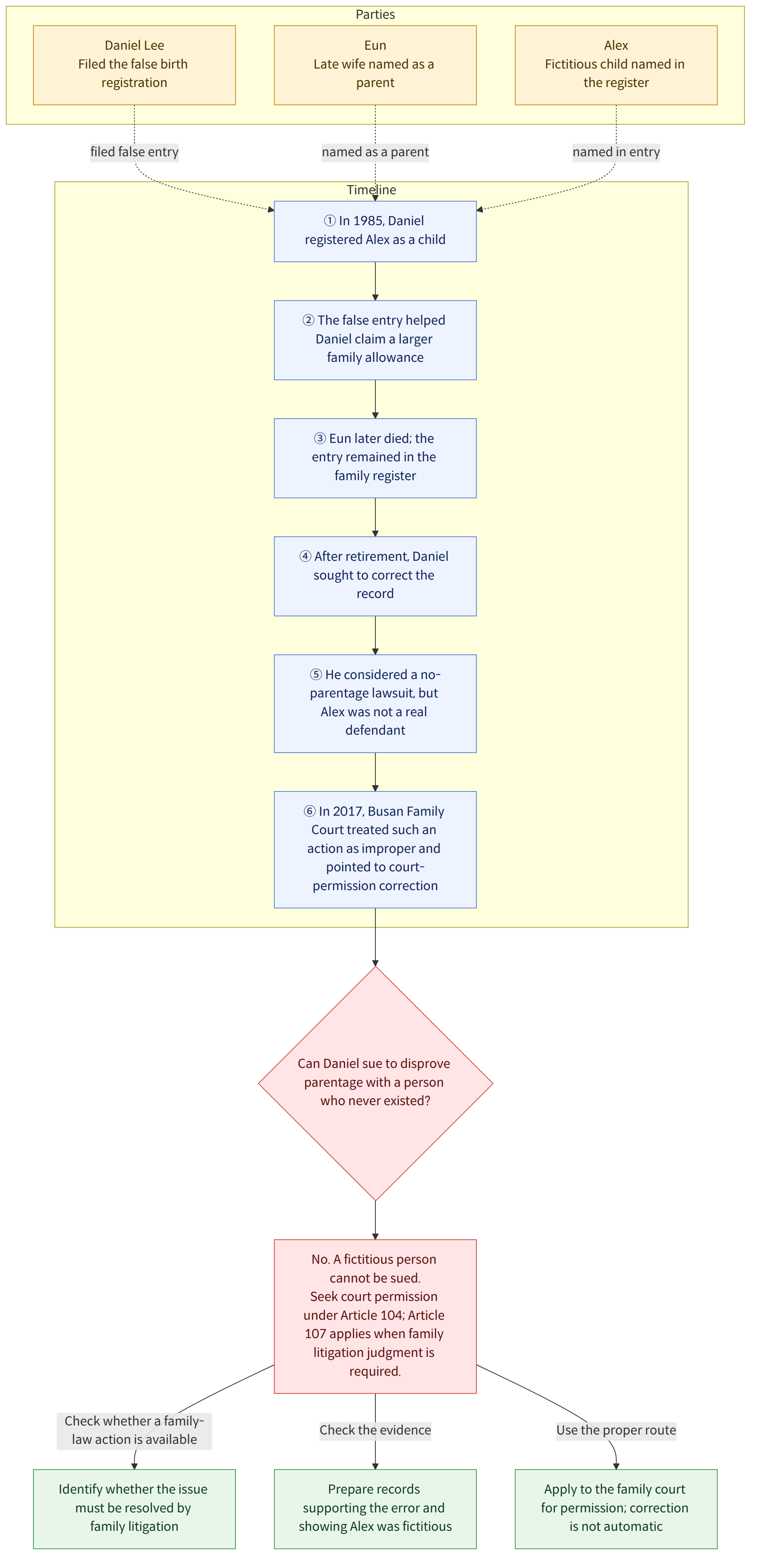
When Daniel Lee retired, he expected paperwork about his pension and final benefits—not a return to a secret he had kept for decades. In 1985, while employed at a large company, he had filed a birth registration for a supposed child, Alex, born on March 3 of that year. Alex was not a child whose whereabouts had been lost. Alex had never existed. Daniel had made the registration to receive a larger family allowance.
Daniel’s wife, Eun, had since died. The false entry, however, remained in their family register, recording Alex as their child. Daniel now wanted the record put right. He considered asking a family court to declare that neither he nor Eun had a parent-child relationship with Alex. But that plan ran into a basic obstacle: a lawsuit requires a real opposing party. There was no Alex to serve with legal papers or to appear in court.
2. The Legal Question
Can Daniel bring an action to confirm that no parent-child relationship exists between himself and a person who was falsely registered but never existed—and, separately, between his late wife and that supposed child? Or must he use a different procedure to correct the family register?
3. What Korean Law Says
Korean law distinguishes between correcting a family register after a court judgment and correcting it with the court’s permission when no suitable lawsuit can be brought.
Article 107 of the Family Relations Registration Act provides for correction based on a final judgment when the matter is one that must be decided through family litigation.
Parentage disputes can have serious consequences for family status and inheritance. Where the law provides a family-law action to determine that status, a final judgment may be required before the register can be changed.
But a different problem arises when the registered person is not a real person at all. A lawsuit seeking a declaration about a relationship with that person has no genuine defendant. Korean courts have recognized that a non-existent person cannot be made a party to a case. Nor is there a specific family lawsuit, or another designated litigation route, for obtaining a judgment against such a fictitious person.
Article 104 of the Family Relations Registration Act allows an interested person to seek the family court’s permission to correct a register where the matter is not one that must be resolved through the family-litigation judgment procedure.
The practical distinction is:
- Article 107: A correction based on a final judgment in a matter that must be decided through family litigation.
- Article 104: A court-permission application for a correction where the law provides no applicable lawsuit, including an entry naming a person who never existed.
An applicant should be prepared to explain the error and provide supporting records. Depending on the circumstances, useful material may include the original registration documents, official records, and evidence showing that the named individual was fictitious. The court decides whether the correction is justified.
4. How Korean Courts Approach This
Korean courts treat family-register entries as important because they can affect legal identity, family status, and inheritance. For that reason, when a family-law action is available to resolve a dispute, a person generally cannot bypass that process by seeking an administrative-style correction alone; a final judgment may be necessary.
Courts distinguish between a dispute about the legal status of a real person and an entry that names someone who never existed. A fictitious person cannot be sued, so the absence of a proper defendant is not a problem that can be solved by simply framing the case as a parentage action.
For the second kind of problem, the courts have treated Article 104 as the available route. In a 2017 decision, the Busan Family Court concluded that an action seeking confirmation of no parent-child relationship with a non-existent person was procedurally improper. It directed the applicant toward a court-permission application to correct the family register instead.
That approach does not mean the correction is automatic. The applicant must use the proper procedure and persuade the court that the entry should be corrected.
5. Applying the Law to the Case
First, Alex is not a real person. The issue is not whether a real child was biologically related to Daniel or Eun. The registration was allegedly made for a person who never existed.
Second, a parentage lawsuit would lack a defendant. Daniel cannot serve Alex with court papers, and Alex cannot answer the claim. A court cannot decide an ordinary contested parentage case against a person who has no existence outside the register.
Third, the fact that Eun has died does not make Alex a proper party. Daniel’s proposed claims concerning both himself and his late wife still concern the same fictitious registered person. The absence of a real defendant remains the central procedural problem.
Fourth, the appropriate route is an application under Article 104. Daniel should ask the competent family court for permission to correct the family-register entry, explaining that Alex was not a real person and describing how the false birth registration was made. He should provide evidence that helps establish those facts and identify the entries that need correction.
Finally, Daniel should not assume that correcting the record erases the past. The application concerns the accuracy of the family register. Any separate consequences arising from the original false registration—for example, questions connected with benefits received—are distinct issues and are not decided merely by correcting the entry.
If you are dealing with a similar issue, attorney Ji-sun Ahn of Ijun Law Firm can review family registration records, dates of marriage and birth, and any earlier acknowledgment of paternity, test result, or ruling with you. These details can help clarify which options apply to your situation.
6. Conclusion: What Happened, and What Should You Do?
Daniel cannot obtain the declaration he wants by suing Alex. Since Alex never existed, the proposed parentage action is procedurally improper. Daniel’s proper course is to apply to the family court for permission to correct the family register under Article 104 of the Family Relations Registration Act, supporting the application with evidence about the fictitious registration. The court, not a lawsuit against an imaginary defendant, is the route to resolving the record.
If you face a similar problem:
- Identify whether the person in the register is real. If the person exists and parentage is disputed, a family-law action may be required; if the person never existed, a different correction procedure may apply.
- Gather records before applying. Keep copies of the registration documents and collect credible evidence explaining why the entry is false.
- Get case-specific legal advice. A register correction does not necessarily resolve separate financial or legal consequences of the original filing.

















