
1. A Human Story
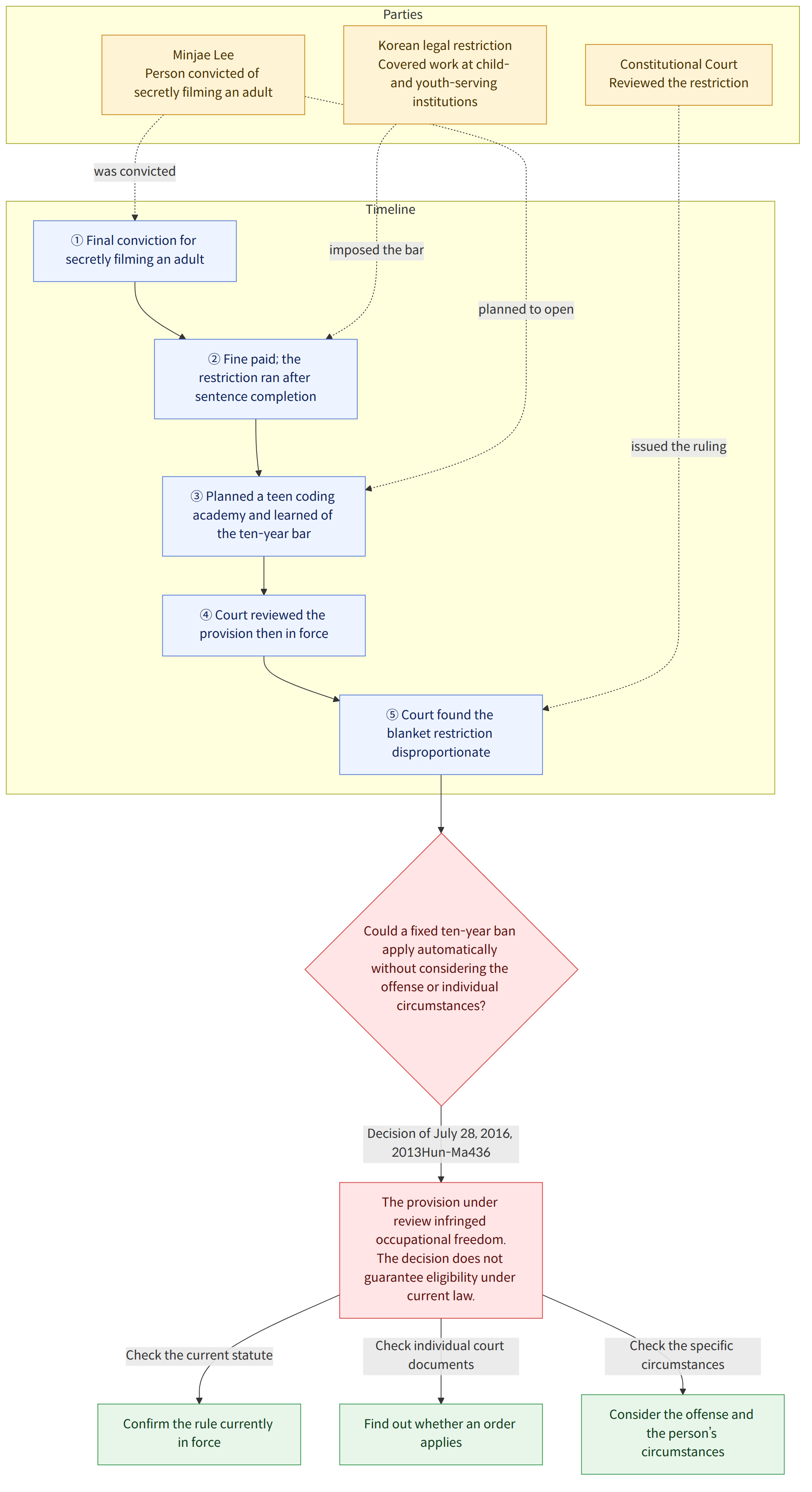
Minjae Lee had spent years teaching adults to code at evening classes. When he decided to open a small coding academy for teenagers, he pictured a modest classroom, a few computers, and students building their first apps. Then a conviction from his past stopped the plan in its tracks.
Several years earlier, Minjae had been convicted of secretly filming an adult without consent. The conviction was final, and he had paid a fine. Now he learned that a rule covering people with certain sexual-offense convictions could bar him from operating or working at an institution serving children and teenagers for ten years after his sentence was completed. The restriction did not turn on whether his past offense involved a child, or on an individual assessment of his risk.
Minjae understood why institutions working with young people must take safeguarding seriously. But he wondered whether one conviction, automatically and without an individual review, could fairly close off an entire line of work for a decade.
2. The Legal Question
Can South Korea impose a fixed ten-year ban on operating or working at child- and youth-related institutions solely because a person has a final conviction for a sexual offense against an adult, without considering the nature of the offense or the person’s individual circumstances?
3. What Korean Law Says
Korean law seeks to protect children and teenagers from sexual abuse, including by restricting some people convicted of sexual offenses from working at or operating institutions that serve them. In the version of the restriction considered by the Constitutional Court, the ban applied for a set period after the sentence had been completed.
The constitutional question was not whether child protection matters. It plainly does. The question was whether the particular restriction went further than necessary and imposed an excessive burden on the person’s freedom to choose an occupation.
The Constitutional Court accepted that protecting young people and preserving trust in institutions serving them are legitimate aims. But a rule that imposed the same employment restriction automatically, without taking account of the offense’s specific features or the individual’s circumstances, was disproportionate and infringed occupational freedom.
The Court reached that conclusion in its decision of July 28, 2016, in 2013Hun-Ma436. Its reasoning centered on two principles:
- A legitimate goal must be pursued by proportionate means. Keeping children safe is an important public interest, but the restriction must still be appropriately tailored.
- A blanket rule may be too broad. Treating every person within a wide category of sex-offense convictions identically can fail to account for differences in conduct and circumstances.
- The public benefit must be balanced against the individual burden. A long bar from an entire field of work can be a serious interference with the freedom to choose a profession.
The decision concerned the statutory provision then before the Court. It should not be read as a guarantee that every person with a sexual-offense conviction can work in a child- or youth-related institution today. The legal framework has since been amended, and restrictions may depend on the current statute and any order made in an individual case. The exact rule applicable to a particular person should therefore be checked against the current law and the relevant court documents.
4. How Korean Courts Approach This
Korean constitutional review weighs the purpose of a restriction against how broadly it operates and how seriously it burdens individual rights. In this setting, courts recognize the special responsibility of institutions that educate or care for young people. At the same time, they examine whether a restriction is imposed automatically or whether it allows decision-makers to consider the actual offense and the individual’s circumstances.
A protective purpose does not, by itself, justify every method of protection. When a rule assumes that every person with a qualifying conviction presents the same future risk and imposes an identical career ban, the rule may fail the requirements of necessity and balance.
The 2016 decision is significant because it rejected the idea that a broad category of convictions could, on its own, justify the same ten-year restriction for everyone. But the Court’s ruling was about the provision under review; it did not erase the government’s authority to impose appropriately tailored restrictions under a different or amended legal framework.
5. Applying the Law to Minjae's Case
Minjae’s case raises the concern identified by the Court, but it still requires careful attention to the law governing his own circumstances.
- Identify the basis of the restriction. Minjae should first establish whether the ten-year bar comes from the blanket statutory rule considered in the 2016 decision, a later law, or an individual court order. The legal consequences can differ depending on that source.
- Look at what the restriction fails to distinguish. His conviction involved secretly filming an adult. Under the earlier rule described in the Court’s decision, the restriction did not turn on whether the victim was a child or whether the person’s individual circumstances called for the same period of exclusion as everyone else.
- Apply the constitutional reasoning. If Minjae were subject to that earlier automatic rule, the Court’s reasoning would support his argument that an unvarying ten-year ban imposed without individualized consideration placed an excessive burden on his occupational freedom.
- Do not assume the old ruling decides the present-day outcome. If a current restriction or court order applies, its validity must be assessed under the law in force and the terms of that order. The 2016 decision is an important constitutional principle, not an automatic cancellation of every later restriction.
For Minjae, the decisive documents would include the final judgment, any notice or order imposing the restriction, and information about the intended academy and role. Those materials would show what legal rule was applied and whether the restriction was automatic or individually imposed.
6. Conclusion: What Happened, and What Should You Do?
Minjae’s concern was not simply that child protection should yield to his career plans. The deeper issue was whether the law could treat every person with a qualifying conviction as presenting the same risk and automatically bar each of them for the same length of time. The Constitutional Court held that the blanket ten-year restriction before it crossed that line: despite its legitimate protective aim, it disproportionately interfered with occupational freedom.
That ruling gives Minjae a substantial constitutional argument if the old blanket provision is the basis of his restriction. It does not, by itself, establish that he is eligible to run or work at a youth academy under today’s law. He should confirm the current legal basis and the exact terms of any order before making plans. Readers facing a similar restriction should:
- Keep the final judgment and any employment-restriction notice or court order, and check which law and period each document refers to.
- Ask whether the restriction was automatic under an older rule or individually imposed under the current framework.
- Before accepting a role or opening an institution, verify whether that specific position and institution are covered by the applicable restriction.
A review of the final judgment and any restriction notice or court order can help clarify whether the ban stems from the earlier blanket rule or a current individual order, and what work it covers. You could ask attorney Ji-sun Ahn of Ijun Law Firm to review those documents and explain what legal questions they raise in your circumstances.

















