
1. A Human Story
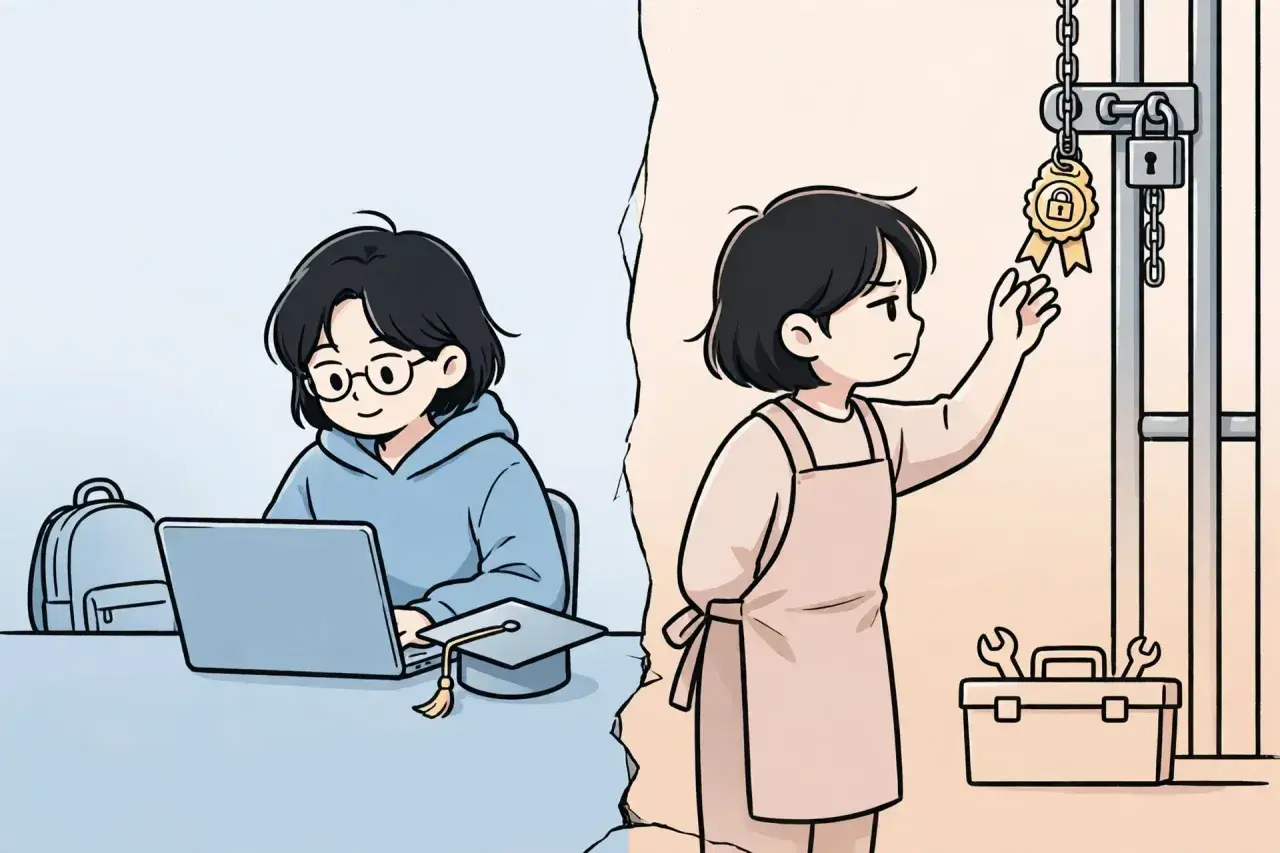
Daniel Lee had spent years working at a neighborhood hospital, helping organize patient information and administrative records. When he enrolled in an online health-administration program, he believed a degree in the relevant field would open the same professional door as a degree earned on campus. He studied after work, watched recorded lectures, and pictured himself qualifying for Korea’s national medical records technician examination.
But as graduation approached, Daniel discovered that the rules did not treat every degree alike. Graduates of qualifying universities, industrial universities, and junior colleges could sit the examination if they had studied a related subject. Graduates of cyber universities—Korea’s online higher-education institutions—were not included. Daniel thought his hospital job gave him more practical experience than many campus students. Why, he wondered, should the format of his education bar him from the same examination?
2. The Legal Question
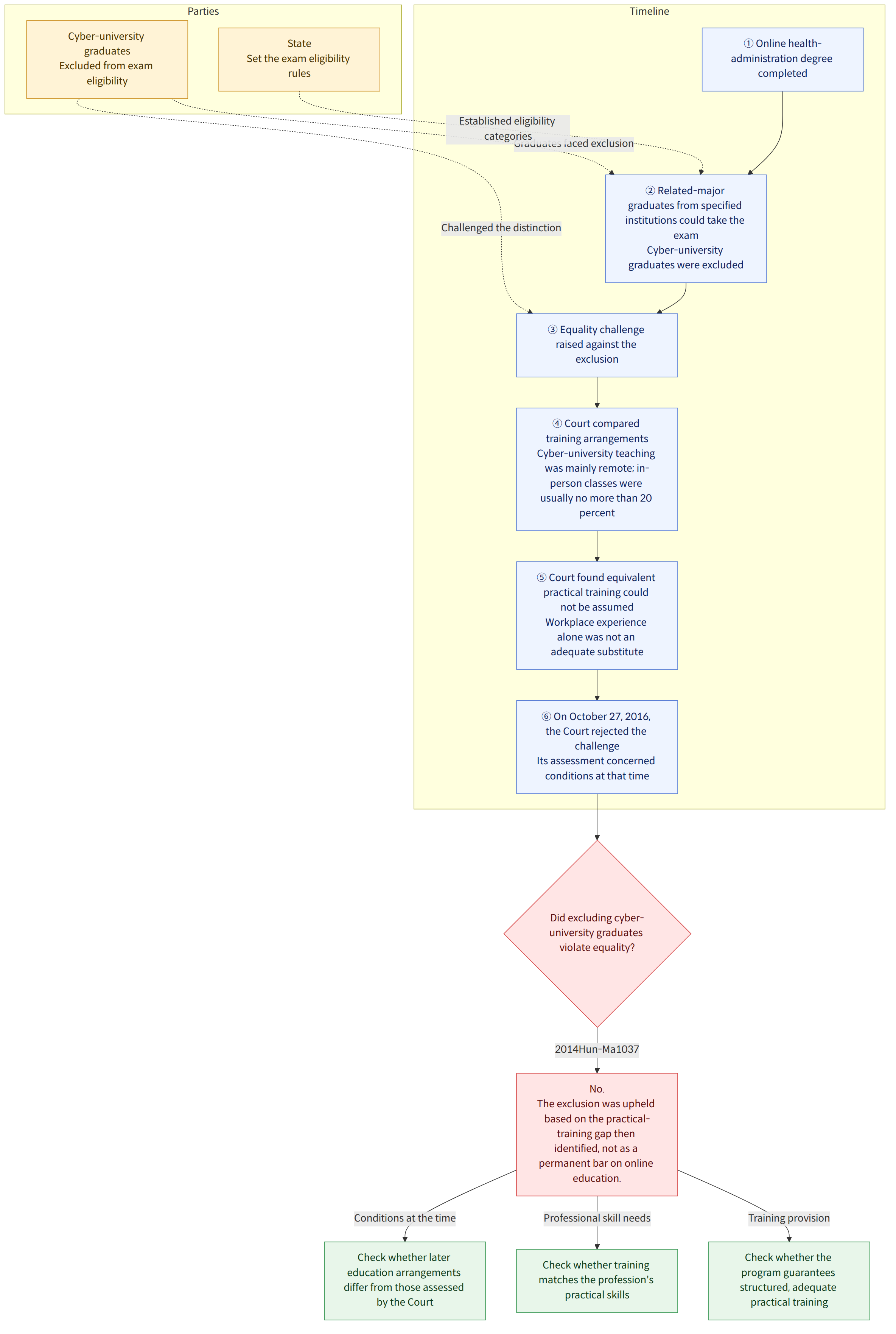
The central question was whether excluding graduates of online universities from the national examination, while allowing graduates of specified traditional institutions with a related major to take it, violated the constitutional right to equality.
3. What Korean Law Says
The relevant provision was Article 4(1)(1) of the Medical Technicians, Etc. Act, as amended in 2011. For the medical records technician qualification, it made examination eligibility depend on completing a related course of study at specified types of higher-education institution. The challenged rule did not extend that eligibility to graduates of cyber universities.
The dispute was not simply about whether an online degree was academically valuable. It concerned whether the state could require a particular educational route before a person could take a licensing examination for work involving specialized medical records and information.
Equality does not always require identical treatment. The constitutional question is whether people in relevantly comparable circumstances are treated differently without a sufficient reason. A distinction may be permissible when it is reasonably connected to a legitimate public purpose.
The Constitutional Court focused on whether the different treatment had a rational basis in the training needed for the profession. In particular, it considered the practical and skills-based instruction that students would need to manage medical records competently.
The Court’s assessment drew on the educational arrangements then in place:
- Cyber-university teaching generally relied on remotely accessed lectures prepared in advance.
- In-person classes were, as a rule, limited to no more than 20 percent of total instruction.
- Related departments at traditional universities and junior colleges offered practical subjects such as medical-records practice, medical-record transcription, health-information management practice, hospital statistics, and cancer-registration practice.
- The Court concluded that equivalent practical training could not then be assumed to be available in cyber-university programs.
The Court considered it insufficient to leave each student to find practical experience independently at a workplace. Practical training needed to be deliberately included in the educational program and adequate for the qualification—not merely left to students’ individual initiative.
4. How Korean Courts Approach This
When a legal rule distinguishes between groups, Korean constitutional review asks whether the distinction is unjustified in light of the purpose of the rule and the circumstances of the groups being compared. The label attached to a school is not, by itself, the entire answer. The substance of the difference matters: what training is offered, what the occupation requires, and whether the eligibility rule is reasonably related to those requirements.
In its decision of October 27, 2016, in case 2014Hun-Ma1037, the Constitutional Court rejected the equality challenge to the exclusion of cyber-university graduates from this examination route. The Court emphasized the practical character of the profession and the gap it saw between the training arrangements then available at cyber universities and those at traditional institutions offering related programs.
That conclusion was based on the educational conditions before the Court at that time. It was not a declaration that online education can never provide adequate professional training. The reasoning turned on whether the programs in question actually guaranteed sufficient, structured practical instruction.
5. Applying the Law to the Case
Daniel’s position initially seemed compelling. He had studied a related subject, and he had worked in a hospital. But the legal analysis required more than comparing his experience with that of a campus graduate.
- The groups were treated differently. Graduates from specified universities, industrial universities, and junior colleges could qualify for the examination through a related major. Graduates of cyber universities could not use that route.
- The purpose of the distinction mattered. The Court understood the eligibility requirement as connected to preparation for professional duties involving medical records and information—not simply as a preference for one kind of school.
- The Court examined the actual curriculum. Traditional institutions were offering practical and skills-based courses tailored to the work. By contrast, the Court found that the remote-learning model and limited in-person teaching then available did not establish that cyber-university students received the same level of supervised practice.
- Daniel’s workplace experience did not cure the program gap. His hospital might give him useful exposure, but the Court did not regard the possibility of students practicing at their individual workplaces as a substitute for a sufficient practical curriculum. A workplace may not offer every student the same tasks, instruction, supervision, or breadth of experience.
- The distinction therefore had a defensible basis. Because the Court saw a connection between structured hands-on education and professional readiness, it found the exclusion did not amount to an unconstitutional violation of equality.
If you are dealing with a similar issue, attorney Ji-sun Ahn of Ijun Law Firm can review the applicable permit, business records or advertisements, and the legal grounds given by the authority with you. These details can help clarify which options apply to your situation.
6. Conclusion: What Happened, and What Should You Do?
Daniel’s challenge would not succeed under the reasoning of the Constitutional Court’s 2016 decision. His degree and hospital experience were meaningful, but they did not overcome the statutory eligibility rule or the Court’s conclusion that the excluded programs had not demonstrated equivalent practical instruction. The Court therefore did not find that the distinction violated the right to equality.
For anyone planning a career that requires a Korean national qualification, the lesson is practical as well as legal:
- Check examination eligibility before enrolling. Confirm that the institution and major satisfy the statutory requirements for the specific license, rather than assuming that a related degree will be enough.
- Ask for details about practical training. Find out which supervised, skills-based courses are compulsory, how they are assessed, and whether the program guarantees access to them.
- Keep written confirmation. Save the relevant regulations and the school’s written explanation of how its curriculum meets licensing requirements; rules and program structures may change.

















