

1. A Human Story
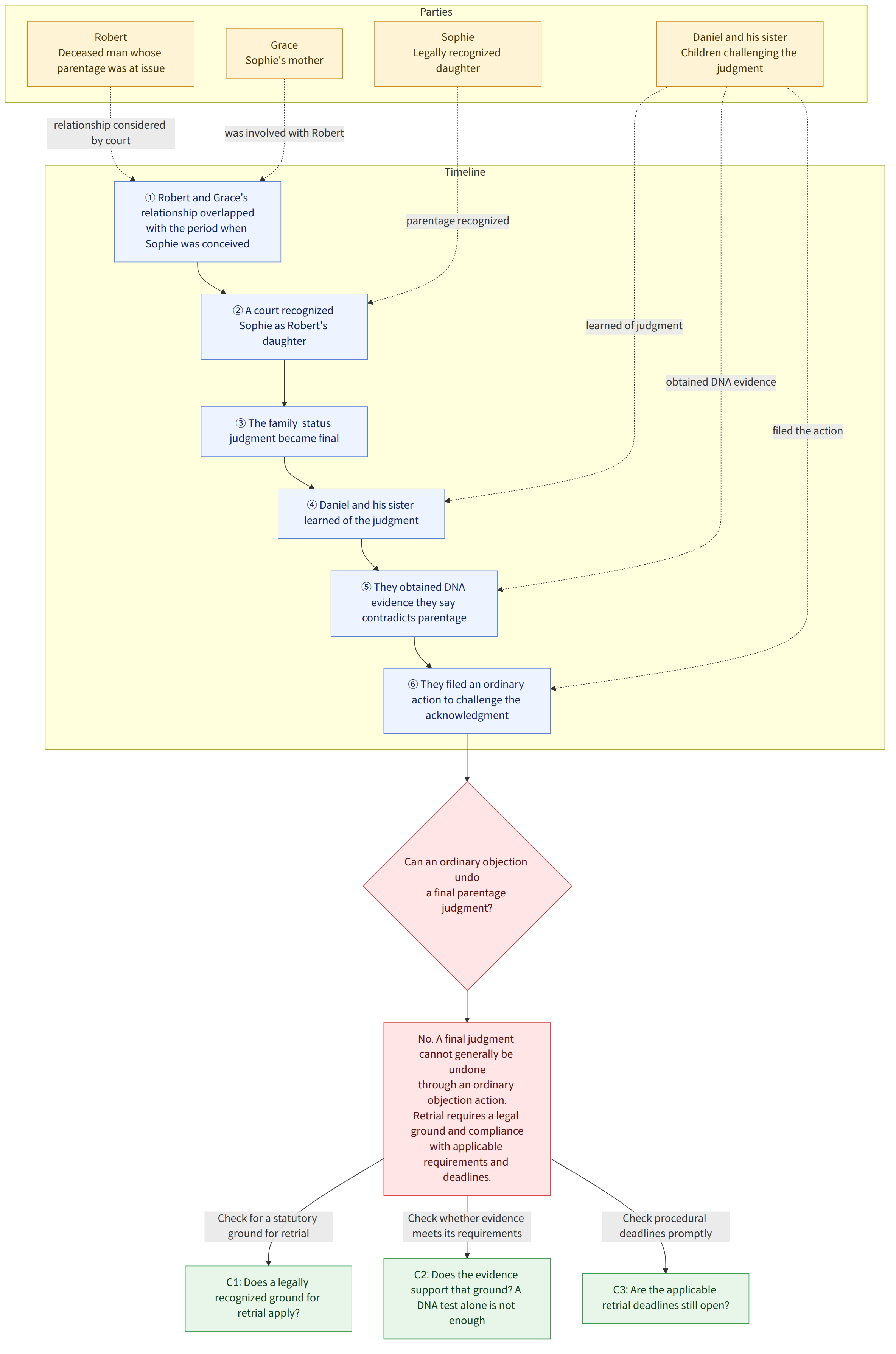
For years, Daniel Carter believed his late father’s family history was settled. Then a court judgment arrived with a startling consequence: Sophie, a woman in her thirties, had been legally recognized as his father’s daughter. Sophie’s mother, Grace, had once been involved with Daniel’s father, Robert, and the court had found that their relationship overlapped with the period when Sophie was conceived.
Daniel and his sister were shaken. They had never known Sophie existed, and they suspected that the court had reached the wrong conclusion. They obtained a genetic test that, they believed, showed no biological relationship between Robert and Sophie. Armed with the results, they filed an action seeking to challenge the acknowledgment and undo the judgment that had established Sophie’s legal relationship to their father.
2. The Legal Question
Can the children of a deceased man overturn a final judgment recognizing someone else as his child by bringing an ordinary action to object to that acknowledgment—especially when they have DNA evidence they say contradicts biological parentage?
3. What Korean Law Says
Korean law distinguishes between challenging an acknowledgment in the ordinary way and attacking a final court judgment that has already established parentage. The distinction matters because a final judgment about family status is not simply a decision binding only the people who appeared in court.
Under the Family Litigation Act, a final judgment in this type of family-status case has legal effect against third parties as well as the litigants. The judgment therefore cannot generally be set aside through a separate, ordinary objection action.
The Civil Act provides for an action to object to an acknowledgment. But that procedure is not a substitute for reopening a final judicial decision. When parentage has already been established by a final court judgment, a person seeking to undo that judgment must generally use the retrial procedure under the Civil Procedure Act.
A retrial is an exceptional remedy, not a second chance to argue the case from the beginning. In broad terms:
- The applicant must identify a ground for retrial recognized by law, rather than merely disagree with the result.
- The asserted ground must meet the relevant statutory requirements and be supported by evidence.
- Strict procedural deadlines may apply, so a person considering retrial should act promptly.
A DNA test may be important evidence, but its existence alone does not automatically invalidate a final judgment or establish that retrial is available. Its significance depends on whether the circumstances satisfy a statutory retrial ground and the applicable procedural rules.
4. How Korean Courts Approach This
Korean courts treat final judgments about legal family relationships as having consequences beyond the people who directly participated in the case. That approach helps prevent a person’s legal status from changing from one proceeding—or one relative—to another. It also gives final judgments a degree of certainty needed for inheritance and other family-law matters.
The general principle is that a final judicial determination of parentage cannot be attacked through an ordinary action designed to contest an acknowledgment. The proper route is retrial, but only where the legal grounds for reopening the judgment are established.
Courts therefore distinguish between evidence that may cast doubt on the original result and a legally sufficient reason to reopen a final case. A new test or a different view of the evidence may be relevant, but it does not by itself bypass the rules governing finality and retrial.
5. Applying the Law to the Case
Daniel and his sister face two separate questions.
First, the court’s recognition judgment was final. It established Sophie’s legal parentage in a proceeding based on evidence that Robert and Grace had been in a relationship and that Sophie was conceived around that time. Under the family-litigation rules, the judgment’s effect is not confined to Sophie and the people who took part in the original case. Daniel and his sister cannot treat it as legally nonexistent simply because they were not involved in that proceeding.
Second, the action they filed is the wrong procedural vehicle for attacking that final judgment. An ordinary action objecting to an acknowledgment cannot be used to cancel the effect of a final judicial determination of parentage. The fact that the siblings have a DNA report does not change that procedural barrier.
Their possible route is a retrial action. But they would have to show that the circumstances fit a ground for retrial under the Civil Procedure Act and satisfy the relevant requirements and deadlines. They cannot assume that the test result alone is enough. They should also establish when the evidence became available, what the original court knew, and why the asserted facts meet a statutory ground for reopening the case.
If no retrial ground applies—or if the procedural requirements are not met—the final judgment remains effective. The siblings’ disagreement with its factual conclusion, even if sincere and supported by a test, does not permit them to replace the required retrial process with an ordinary objection action.
If you are dealing with a similar issue, attorney Ji-sun Ahn of Ijun Law Firm can review the parentage registration, the test reports and records showing how samples were obtained, and any prior ruling with you. These details can help clarify which options apply to your situation.
6. Conclusion: What Happened, and What Should You Do?
Daniel and his sister cannot overturn Sophie’s legal recognition by pursuing the ordinary action they filed. Their DNA evidence may be relevant to a retrial application, but only if they can bring it within a statutory ground and comply with the applicable procedure. Unless they succeed in that process, the final judgment recognizing Sophie as Robert’s child remains legally effective.
If you are facing a similar situation:
- Get the final judgment and case record so you can determine exactly what was decided and on what evidence.
- Seek advice quickly from a Korean family-law attorney about whether a statutory retrial ground exists and whether any deadline is approaching.
- Preserve the DNA report and related records, but do not assume that scientific evidence alone cancels a final judgment.

















