
1. A Human Story
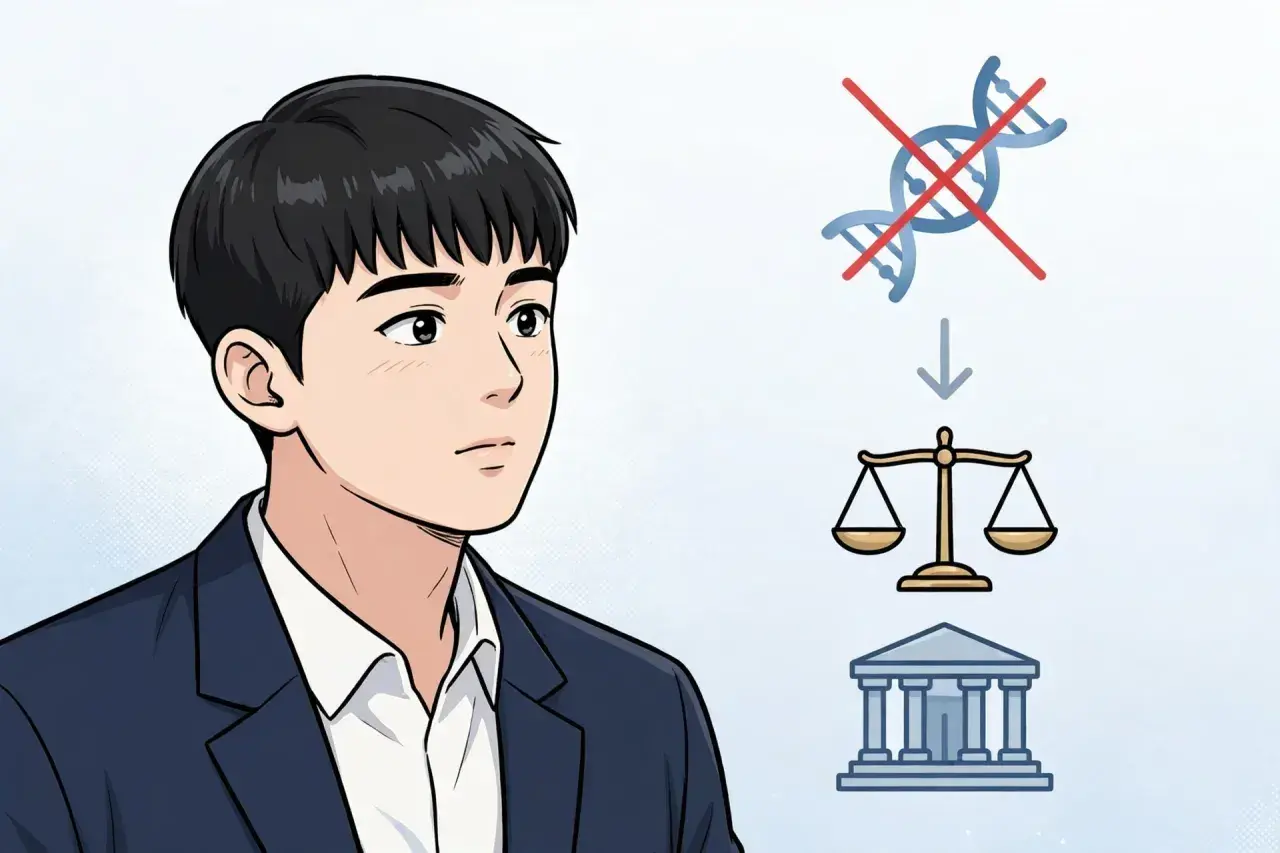
Alex Kim had always thought of himself as a practical man. So when a private DNA test suggested that the baby born to him and his wife, Soo-jin, was not biologically his, he looked for the most direct way to make the legal record match what he believed the science showed.
The couple had been legally married throughout the pregnancy. They had lived together, and nothing about their circumstances made it visibly impossible for Alex to be the child’s father. But the test results seemed decisive to him. He asked whether he could simply file a case asking a court to confirm that no parent-child relationship existed, rather than bring the specific lawsuit for denying paternity.
The distinction sounded technical, even evasive. To Alex, both routes seemed to ask the same question: was he the child’s biological father? Under Korean law, though, the answer may depend not only on the evidence, but also on which legal procedure is used.
2. The Legal Question
When a child is born within a legally recognized marriage and is presumed by law to be the husband’s child, can the husband set that presumption aside by filing an action to confirm that the parent-child relationship does not exist, instead of bringing the statutory action to deny paternity?
3. What Korean Law Says
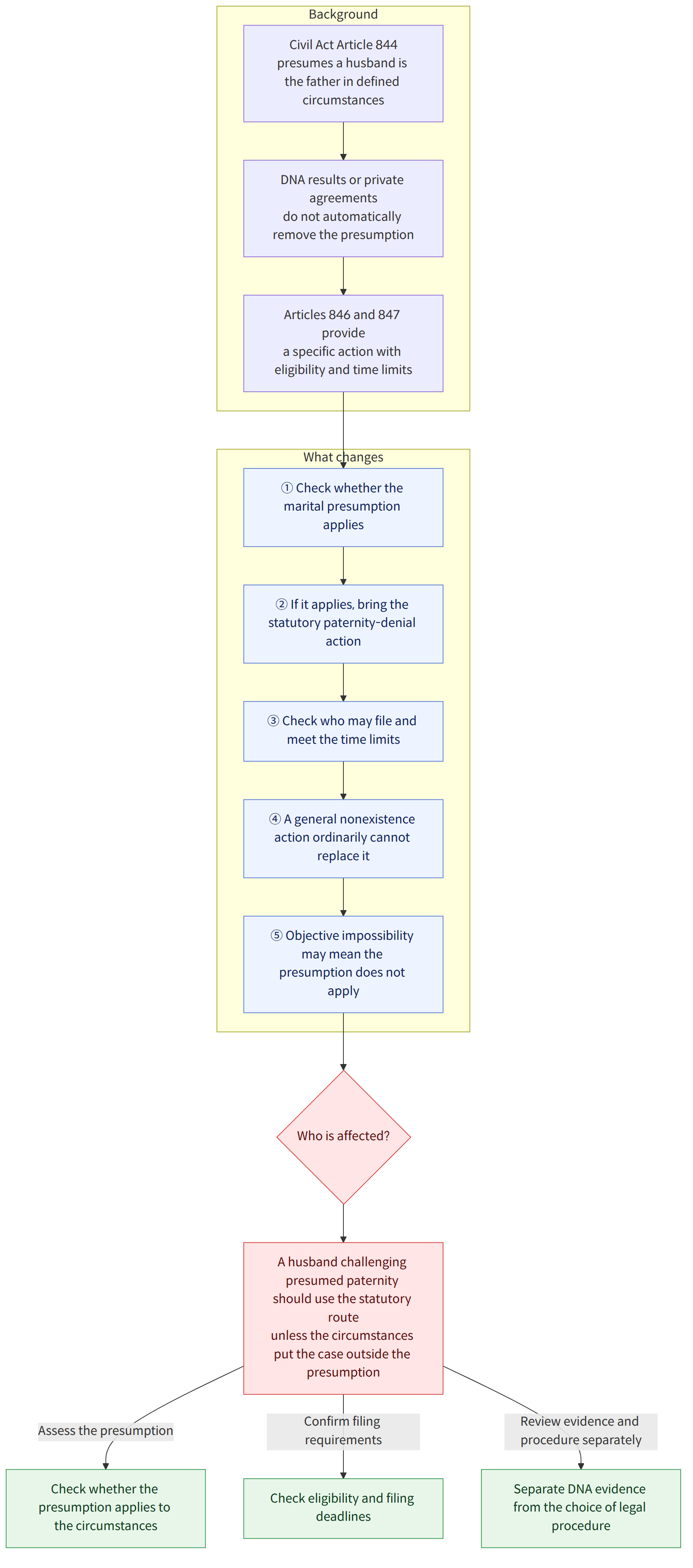
Korean Civil Act Article 844 establishes a legal presumption of paternity in defined circumstances. In broad terms, a child conceived during marriage is presumed to be the husband’s child. The presumption does not automatically disappear because a DNA test, private agreement, or family understanding points in another direction.
The presumption of paternity is a strong legal presumption. Where it applies, it generally cannot be rebutted through an ordinary challenge to the evidence; the prescribed paternity-denial action is required.
The Civil Act provides a specific procedure for contesting that presumed relationship: an action to deny paternity under Articles 846 and 847. The statute also limits who may bring such an action and imposes filing requirements, including time limits. Those requirements make prompt, case-specific legal advice important.
The general approach is therefore:
- If the presumption applies, the challenge ordinarily must be brought through the statutory paternity-denial action.
- If the presumption does not apply, a different type of parentage action may be available, depending on the facts and the claim being made.
- A general action to confirm that a parent-child relationship does not exist cannot normally be used as a substitute for the statutory action where the legal presumption is in force.
There is a narrow exception. The presumption may not apply when the circumstances make it objectively clear that the husband could not have fathered the child—for example, where the spouses had been separated in fact and had no opportunity to live together, or one spouse had been abroad for a prolonged period during the relevant time. The issue is not simply whether the husband says he was absent; the circumstances must make conception by him plainly impossible.
A related procedural point can matter in an unusual case. The Supreme Court has indicated that if a court nevertheless issues a final judgment confirming that the parent-child relationship does not exist, and that judgment becomes final, the presumed relationship is treated as displaced. That does not make the wrong procedure a sound or safe choice: a claim brought by the wrong route may be rejected before the court ever decides the underlying biological question.
4. How Korean Courts Approach This
Korean courts generally treat the marital presumption as a rule designed to protect stability in family relationships and a child’s legal status. They do not ordinarily allow a person to bypass the statutory procedure simply by giving a different label to the requested court order.
If the child falls within the legal presumption, the court generally requires the party challenging paternity to use the specific action provided by law. A general action confirming that parentage does not exist is not a substitute.
Courts also distinguish between two very different situations. In the first, the husband could have been the father, but later evidence casts doubt on biological paternity. In the second, the spouses’ actual circumstances made it plainly impossible for the husband to have conceived the child. The first situation ordinarily calls for the statutory paternity-denial action; the second may fall outside the presumption altogether.
That is why biological evidence and procedural rules must be considered separately. DNA evidence may be highly relevant to the merits of a properly brought case. But it does not, by itself, answer whether the claimant has chosen the legally correct type of case.
5. Applying the Law to the Case
Alex’s situation falls into the first category.
- The child was born during the marriage. The couple were legally married during the relevant period, and there was no apparent circumstance making it impossible for Alex to be the biological father. The marital presumption therefore applies on the facts described.
- The DNA result does not remove the presumption by itself. The result may be important evidence, but it does not allow Alex to disregard the legal procedure created for challenging presumed paternity.
- A general nonexistence action is the wrong route. If Alex files an action asking only for confirmation that no parent-child relationship exists, the court may find that claim procedurally improper because the presumption is still in force. The court may never reach the DNA evidence.
- He must use the statutory paternity-denial action. Alex should promptly consult a Korean family-law attorney about whether he has standing, whether the applicable filing period remains open, and how to present the evidence. If the case proceeds properly, the court can assess the relevant evidence, which may include genetic testing conducted or evaluated in a legally appropriate way.
- The exception does not fit these facts. Alex and Soo-jin lived together, and nothing suggests a prolonged separation, extended absence abroad, or another circumstance that made conception by Alex objectively impossible. He cannot rely on the narrow exception merely because he doubts the DNA result or wishes to use a simpler procedure.
In Alex’s fictional case, he seeks advice before filing. He brings the statutory action within the applicable period, and the court considers reliable genetic evidence that excludes him as the biological father. On those facts, the court grants the properly brought challenge. Had he instead relied on the general nonexistence action, he would have risked losing on procedure before the evidence was considered.
If you are dealing with a similar issue, attorney Ji-sun Ahn of Ijun Law Firm can review the family registration, the marriage, separation and birth dates relevant to the parentage dispute, and any prior court records with you. These details can help clarify which options apply to your situation.
6. Conclusion: What Happened, and What Should You Do?
Alex learned that the court does not treat the two actions as interchangeable. Because the child was born within his marriage and no exceptional circumstances made his paternity objectively impossible, he could not use a general parentage-confirmation action as a shortcut. He had to bring the statutory paternity-denial action—and, in the story, he did so in time and succeeded on the evidence.
For anyone facing a similar situation:
- Get advice before filing. The correct action may depend on whether the marital presumption applies, and the statute imposes limits on who may sue and when.
- Preserve reliable evidence. Keep relevant records and speak with counsel about how genetic testing and other evidence should be obtained and presented.
- Do not assume a final result is guaranteed by a DNA test. Evidence matters, but so does procedure; using the wrong legal route can prevent a court from reaching the underlying issue.

















