
1. A Human Story
Grace Lee’s daughter was only a few days old when Michael Han arrived at the hospital. Michael had been part of Grace’s life during her marriage to Daniel Park, and he believed the baby was his. He wanted to sign the papers that would make their relationship official in the eyes of the law.
But Grace was still legally married to Daniel when the child was born. Daniel was not the baby’s biological father, and all three adults knew it. Yet the birth certificate and the law did not simply follow what they knew about biology. Michael’s attempt to acknowledge the child as his ran into a legal barrier: the child was already presumed to be Daniel’s.
2. The Legal Question
Can a biological father immediately acknowledge a child born to a woman during her marriage to another man, or must the legal presumption that the husband is the father be overturned first?
3. What Korean Law Says
Korean law begins with a formal presumption of paternity. A child born while a woman is married is presumed to be her husband’s child. This presumption applies even if the husband is not the biological father.
Under Article 844 of the Korean Civil Act, a child conceived during marriage is presumed to be the husband’s child.
That presumption has practical consequences. Until it is legally displaced, the husband is treated as the child’s father for legal purposes. A DNA result or the biological father’s willingness to take responsibility does not, by itself, change that status.
The usual route to challenge the presumption is an action to deny paternity:
- The husband may bring an action to deny paternity against his wife or the child.
- The action must be filed within two years from the time he learns that the child is not his biological child.
- The legal presumption is not displaced merely by filing the action; it must be overturned by a final judgment.
- Only after that judgment has taken effect can the biological father seek to acknowledge the child.
The Supreme Court has held that, while the presumption of paternity applies, a biological father cannot acknowledge the child as his own before that presumption is overturned by a final judgment in a paternity-denial action.
4. How Korean Courts Approach This
Korean courts treat the presumption as a rule about legal status, not merely a shortcut for deciding who is biologically related to a child. Its purpose is to provide stability around a child’s legal parentage and family relationships. That is why the law does not let a biological father bypass the prescribed process simply by making an acknowledgment.
The distinction is important: biological truth and legal parentage may not match at first. Courts generally require the legally recognized father-child relationship to be challenged through the proper action before another man can establish paternity by acknowledgment. A DNA test may be relevant evidence in the denial proceedings, but it does not itself undo the presumption.
5. Applying the Law to the Case
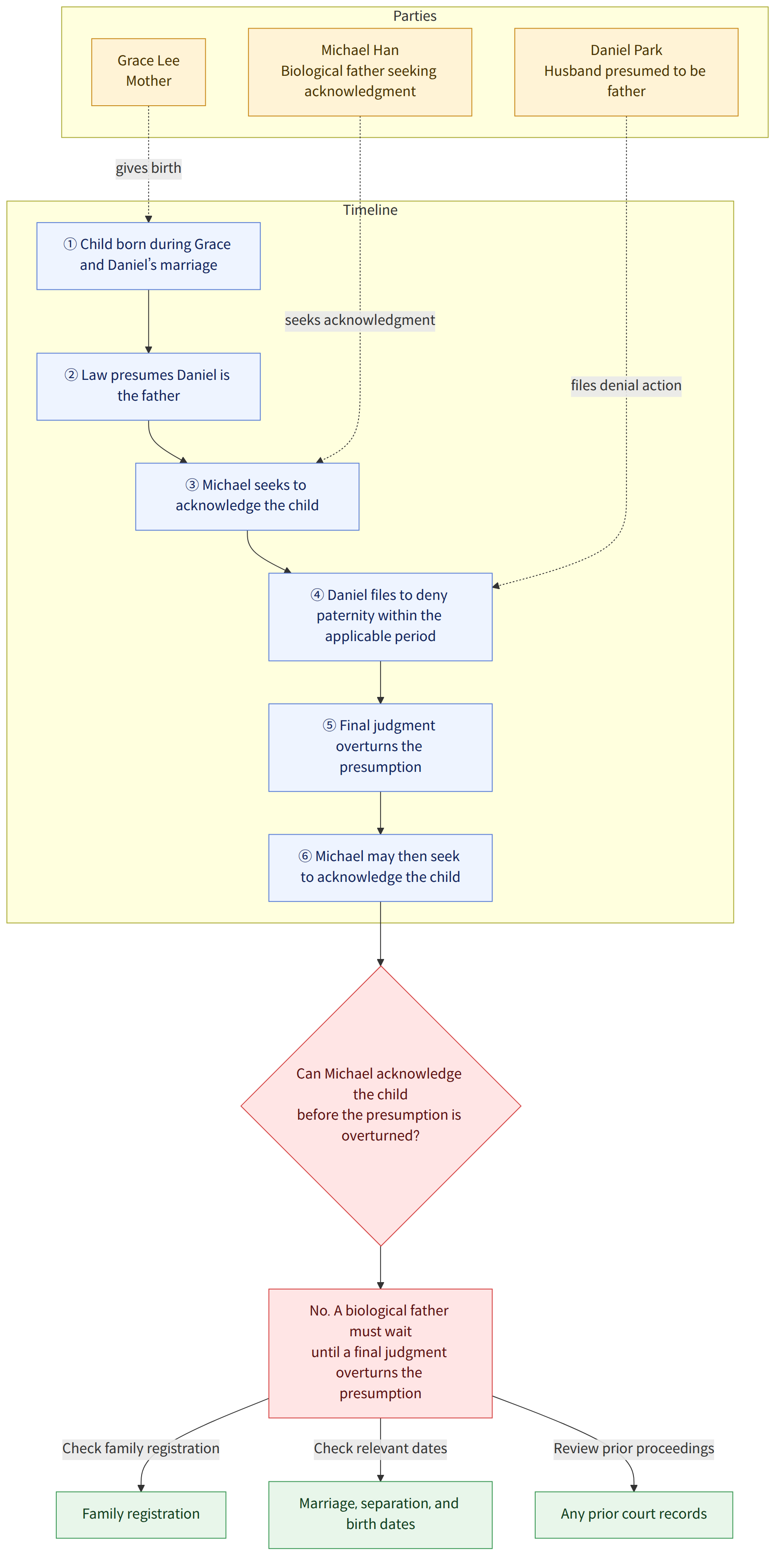
The law applies to Grace, Daniel, and Michael in a clear sequence.
- The child was born during Grace’s marriage to Daniel. Because the marriage was legally in force at the time of birth, the child was presumed to be Daniel’s under Article 844—even though everyone understood that Michael was the biological father.
- Michael could not immediately acknowledge the baby. His biological connection and desire to take responsibility did not remove Daniel’s legal status. An acknowledgment made while the presumption remained in force could not substitute for the required legal challenge.
- Daniel had to use the denial process. After learning that he was not the biological father, Daniel needed to bring an action to deny paternity within the statutory two-year period. Evidence, potentially including genetic testing, could be considered in that case.
- A final judgment had to come first. The presumption would remain in effect until the court’s judgment denying paternity became final. Only then could Michael take the next legal step to acknowledge the child.
So even if Michael’s DNA test established the biological relationship, it would not let him skip the court process. The legal sequence—not the adults’ agreement or the test result alone—determines when he can be recognized as the father.
If you are dealing with a similar issue, attorney Ji-sun Ahn of Ijun Law Firm can review the family registration, the marriage, separation and birth dates relevant to the parentage dispute, and any prior court records with you. These details can help clarify which options apply to your situation.
6. Conclusion: What Happened, and What Should You Do?
Daniel filed an action to deny paternity within the applicable period, and the court issued a final judgment overturning the presumption. After that judgment became final, Michael was able to acknowledge the child. The baby’s biological and legal parentage could then be brought into alignment through the required steps.
For anyone facing a similar situation:
- Check the marital status and dates carefully. A child born during a legal marriage may be presumed to be the husband’s child, regardless of biology.
- Do not rely on a DNA test or private agreement alone. Seek advice promptly about the proper paternity-denial action and the deadline, which runs from learning of the non-paternity.
- Complete the steps in order. The presumption must be overturned by a final judgment before the biological father can acknowledge the child.

















