
1. A Human Story
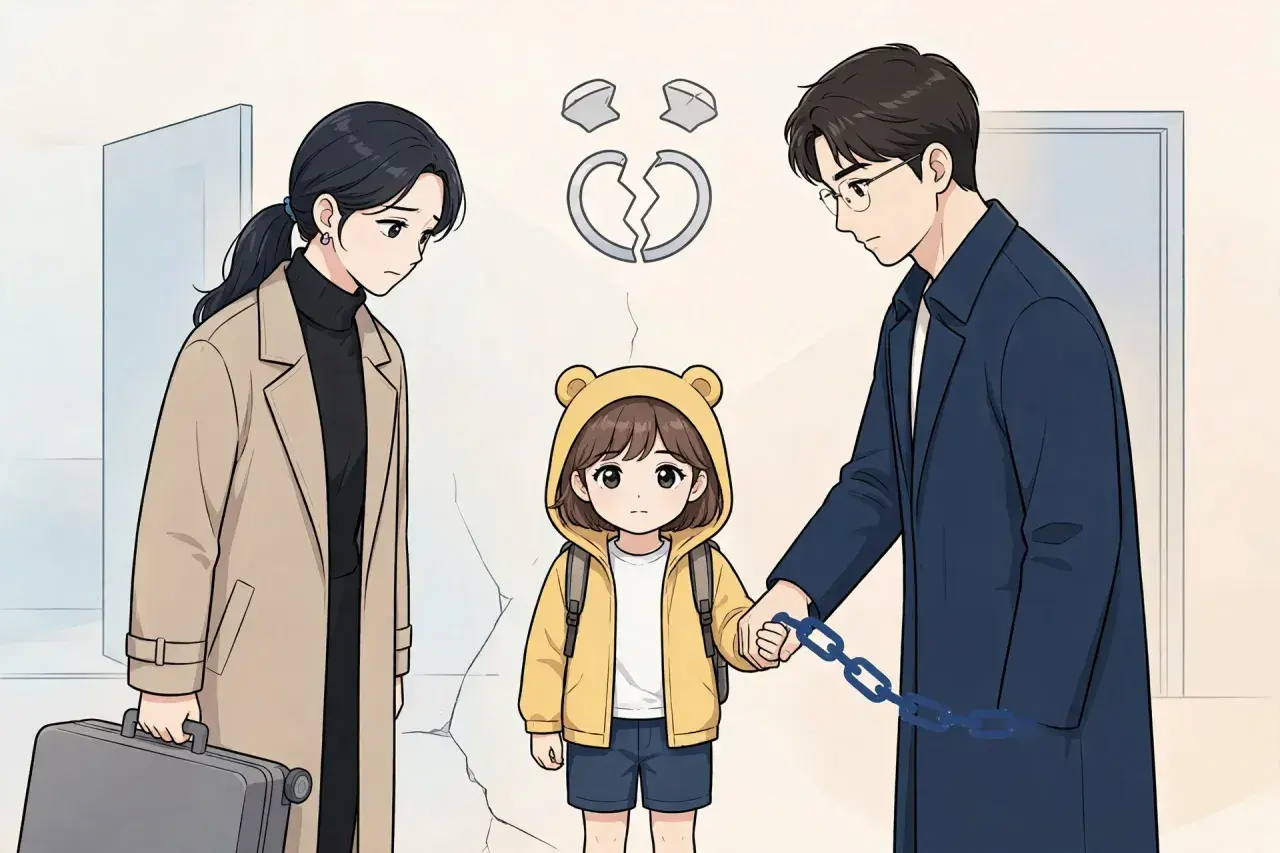
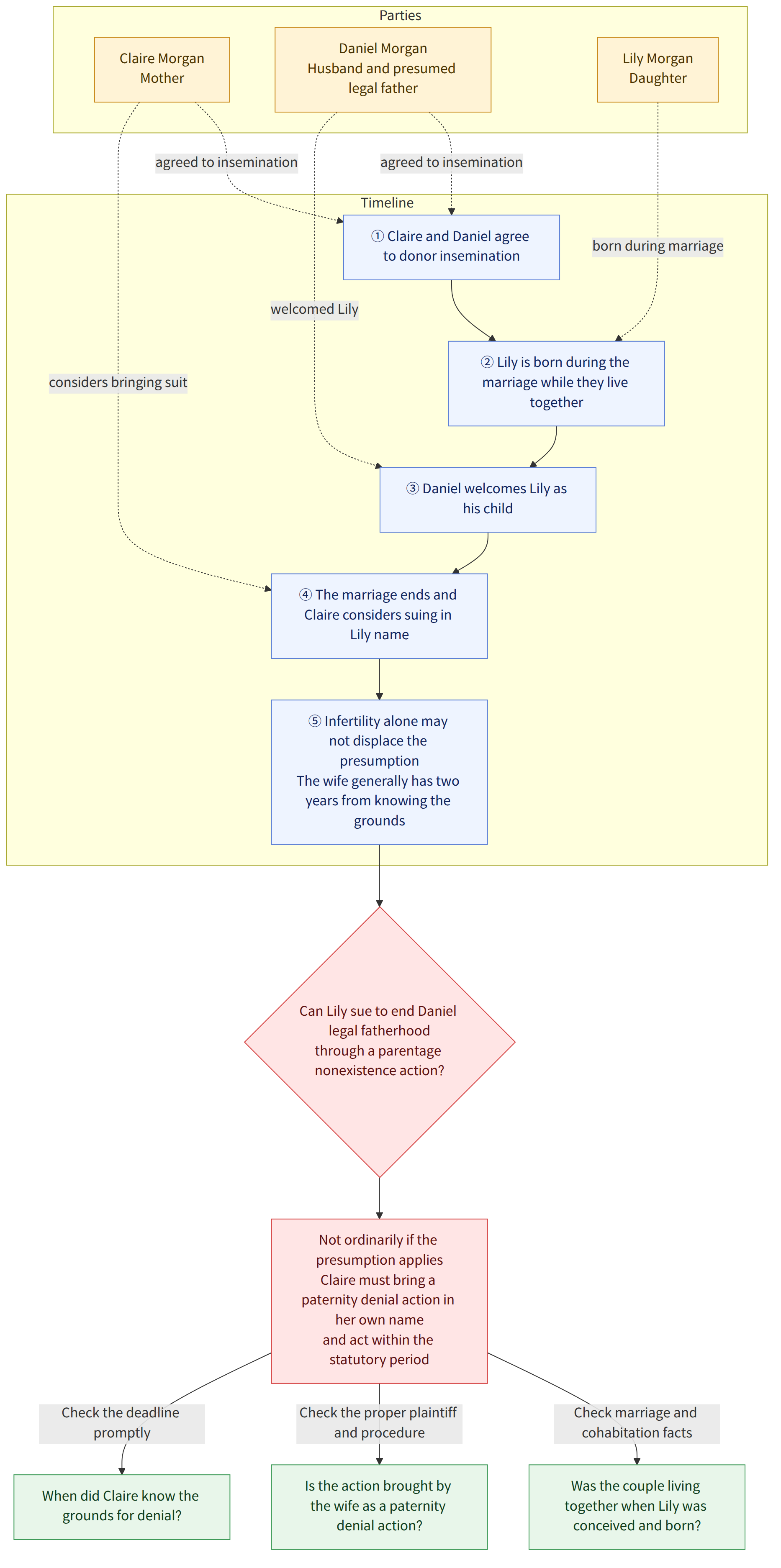
When Claire Morgan and Daniel Morgan decided to have a child, they knew Daniel could not produce sperm. After long discussions, they agreed to use sperm from a donor. Their daughter, Lily, was born while they were still married and living together. Daniel welcomed her as his child; Claire remembered the agreement as an act of shared commitment, not a question about who would be her father.
Years later, the marriage ended. As the divorce became final, Claire worried about what Lily’s legal relationship with Daniel would mean for the future. She considered bringing a lawsuit in Lily’s name, asking the court to declare that no parent-child relationship existed between Lily and Daniel. The biological fact seemed straightforward to her. The legal route, however, was not.
2. The Legal Question
Can Claire sue on Lily’s behalf to have the court declare that Daniel is not Lily’s legal father because he did not provide the sperm? Or, because Lily was born during the marriage, must Claire herself bring a different kind of case—and do so within a limited time?
3. What Korean Law Says
Korean family law distinguishes between a child whose legal parentage is presumed and one whose parentage is not covered by that presumption. That distinction determines what kind of lawsuit may be used.
When a child is presumed to be the husband’s child, that presumption is generally challenged through a paternity-denial action under Civil Act Articles 846 and following. A parentage-nonexistence action under Article 865 is generally available when the presumption does not apply.
In practical terms:
- Marriage and cohabitation matter. If a child is born to a married couple while they are living together, the husband may be presumed to be the child’s legal father.
- Biological impossibility is not always enough to avoid the presumption. A husband’s infertility, by itself, does not necessarily make the presumption disappear.
- The type of case matters. Where the presumption applies, a parentage-nonexistence action is not a substitute for the specific paternity-denial procedure.
- The deadline matters. The wife must bring the paternity-denial action within the statutory period—generally two years from when she knows the grounds for denial. In a donor-conception situation, that knowledge may exist from the child’s birth, so prompt legal advice is important.
The presumption may not apply in situations where the spouses’ circumstances make conception by the husband plainly impossible—for example, prolonged separation in which the couple had no marital relations. But infertility alone, where the couple continued living together, is a different matter.
4. How Korean Courts Approach This
Korean courts generally treat the presumption of parentage as a rule about legal family status, not simply as a guess about biological facts. The point is to give a child’s legal identity and family relationships stability, and to prevent those relationships from being challenged through the wrong procedure.
A lower court has applied that approach to a married couple who were living together even though the husband was infertile. It reasoned that the presumption remained in place because there was no outwardly clear circumstance—such as long-term separation—making marital conception impossible. The court concluded that the relationship could be challenged only through a paternity-denial action, not a parentage-nonexistence action.
The central question is not only whether the husband is the biological father. It is also whether the legal presumption applies—and, if it does, whether the challenge is brought through the procedure and within the time allowed by law.
5. Applying the Law to the Case
Claire’s situation can be assessed in several steps:
- Lily was born during the marriage. Daniel and Claire were legally married, and they were living together when Lily was conceived and born. Those facts point toward the presumption that Daniel is Lily’s legal father.
- Daniel’s infertility does not automatically remove that presumption. The couple’s use of donor sperm establishes that Daniel is not Lily’s genetic father. But under the approach described above, infertility alone does not necessarily mean the presumption never applied—particularly where the spouses lived together and agreed to the insemination.
- The proposed lawsuit uses the wrong route. Claire’s plan to sue in Lily’s name for a declaration that no parent-child relationship exists would not ordinarily be available to overturn a presumption that does apply. The fact that the biological relationship is absent does not, by itself, turn the case into one for parentage nonexistence.
- Claire must act in her own name. The appropriate procedure is a paternity-denial action brought by Claire herself against Daniel. She should not assume that filing a different action on Lily’s behalf will preserve the issue or extend the deadline.
- She must check the time limit immediately. Because Claire knew about the donor conception from the outset, the period for bringing the action may have started when she knew the relevant facts, potentially at or around Lily’s birth. The exact deadline should be assessed with a Korean family-law practitioner, but delay risks losing the opportunity to use the proper action.
If you are dealing with a similar issue, attorney Ji-sun Ahn of Ijun Law Firm can review family registration records, dates of marriage and birth, and any earlier acknowledgment of paternity, test result, or ruling with you. These details can help clarify which options apply to your situation.
6. Conclusion: What Happened, and What Should You Do?
Claire’s proposed parentage-nonexistence case in Lily’s name is not the proper way to challenge Daniel’s legal fatherhood if the marital presumption applies. Instead, Claire must bring a paternity-denial action in her own name and do so within the applicable two-year period. The fact that Daniel is not Lily’s biological father—and that both spouses agreed to donor insemination—does not, on its own, allow the presumption to be bypassed through a different lawsuit.
For anyone facing a similar situation:
- Get advice as soon as possible. Do not wait for a divorce to be completed before checking the deadline or the correct procedure.
- Bring the right case in the right person’s name. A paternity-denial action and a parentage-nonexistence action are not interchangeable.
- Preserve the relevant records. Keep documents and communications about the marriage, living arrangements, donor conception, and the spouses’ agreement; these facts may matter to the legal analysis.

















